Large Knitted Shopper Tote: Capacity, Handle Geometry and Load Testing
A large knitted shopper tote is a cost exercise before it is a design exercise, because capacity, handle rating and freight cube all move the unit figure. The working build is 28 litres at 420 x 360 x 180 mm, knitted at E7 in 600D recycled polyester at 320 g/m2, with two 22 mm handles at 240 mm drop and a junction rated at about 520 N. Minimum 100 pcs, sampling 7 working days, bulk 30 days, FOB Xiamen.

Where the Cost Sits in a 28 L Shopper Tote
Five lines decide the unit price on a large knitted shopper tote, and three of them scale with capacity. Yarn mass grows with surface area, machine time grows with loop count, and freight cube grows with the finished volume. Closure hardware and the base board are the two that stay roughly flat regardless of size, which is why a larger tote does not simply cost proportionally more.
| Cost line | What drives it | 28 L figure | Scales with size? |
|---|---|---|---|
| Body yarn | Surface area times fabric weight | About 310 g of 600D at 320 g/m2 | Yes, near linear |
| Machine time | Loop count and gauge changes | 13.2 min per body | Yes, near linear |
| Handle tubes | Two tubes at 22 mm, plus reinforcement | 16 tighter courses per junction | Partly |
| Base board | One 2.0 mm recycled board per unit | Flat cost per unit | No |
| Freight cube | Carton volume, not weight | About 640 x 440 x 300 mm per 20 | Yes, at cube rate |
The practical consequence is that going from 28 L to 34 L adds roughly 18 percent to yarn and machine time but a smaller share to hardware and board, so the unit price rises less than the capacity does. Buyers who need a large tote for merchandising reasons usually get better value at 34 L than by adding features to a 28 L body.
Capacity and Dimensions: 28 L Against 34 L
28 litres at 420 x 360 x 180 mm is the size that covers a full grocery run or a day of retail shopping, and it is the most ordered band for a large knitted shopper tote. 34 litres at 460 x 390 x 200 mm is the choice when the bag has to take a laptop sleeve or a folded jacket as well. Both fit a standard supermarket trolley bay, which is a sizing constraint that matters for any tote sold as a grocery or market bag.
Depth is the dimension that gets overlooked. A wide, shallow tote dumps its contents when it is set down; a deeper gusset at 180 mm keeps them contained. Knitting the gusset in rather than sewing it in is the structural advantage here, because a knitted gusset has no seam to split when the bag is overfilled, which is the single most common warranty claim on large totes.
Handle Geometry: Drop, Width and Junction Rating
Two handles at 22 mm wide with a 240 mm drop is the configuration that works at this size. A 240 mm drop clears the shoulder with a coat on and still allows the bag to be carried in the hand, which is how a shopper tote is actually used at a supermarket or a market. A longer drop turns it into a shoulder bag and stops hand carry entirely.
- Capacity
- 28 L at 420 x 360 x 180 mm; 34 L at 460 x 390 x 200 mm
- Gauge and yarn
- E7, 600D recycled polyester, 320 g/m2
- Handles
- Two knitted tubes, 22 mm wide, 240 mm drop
- Junction reinforcement
- 16 courses at a tighter setting at each handle end
- Junction rating
- About 520 N under ISO 13934-1
- Load case
- 12 kg carried, checked with an ASTM D5034 grab test
- Base
- 900D panel with a removable 2.0 mm recycled board
- Gusset
- Knitted in at 180 mm depth, no side seam
- Cycle time
- 13.2 minutes per 28 L body
- Wash shrinkage
- 2.6 percent, graded into the pattern before knitting
- Dimensional tolerance
- +/- 5 mm measured flat, 24 hours after knitting, before washing
- Decoration limit
- Jacquard marks hold cleanly to about 120 mm wide at E7
Handle width is a load decision rather than a style one. Two 22 mm tubes carry 12 kg comfortably because the load is split across four junctions rather than two, which is why a large tote can use narrower handles than a single-strap gym bag carrying less weight. Widening to 32 mm makes the handles read as webbing and adds about 90 seconds of cycle time.
Why the Junction Needs 16 Courses at 12 kg
Every kilogram in a shopper tote funnels through four small areas where the handles meet the body, and at 12 kg those areas are the whole structural problem. Sixteen courses knitted at a tighter setting at each junction raises the tested strength to about 520 N under ISO 13934-1. Without that reinforcement the same body and handles test closer to 330 N.
Tighter stitch courses
Sixteen courses at a reduced stitch length at each of the four handle ends. Keeps the tote fully seamless.
Wider footprint
Fan each handle over more needles where it enters the body. Spreads load but adds visible bulk at the top edge.
Second yarn feed
Introduce 900D at the junction only. Strongest seamless option at about 520 N, with a slight density change.
Tape core in the tube
A woven tape knitted inside each handle and anchored into the body. Used above 15 kg; adds an operation.
Load testing should be written into the tech pack rather than assumed. An ASTM D5034 grab test on the junction area and an ISO 13934-1 tensile figure give two comparable numbers, and quoting both means a buyer can compare two quotes that would otherwise describe the same bag differently.
Gusset and Base: Holding a Wide Flat Shape
A large tote has to stand open while it is being filled, and that is a base and gusset problem. The base panel knits at 900D rather than the 600D body yarn and takes a removable 2.0 mm recycled board, which keeps the footprint flat and stops the bag folding inward when it is part full. Floor contact is rated at about 20,000 rubs under ASTM D4966.
The gusset carries the second half of the job. A knitted-in gusset at 180 mm depth has no seam to split under an overfilled load, which is the failure that sewn totes suffer most. Where a brief wants the bag to collapse flat for storage, the gusset is knitted with a softer stitch so it folds along its own centre line rather than creasing randomly.
Closure and Top Edge Options on a Large Tote
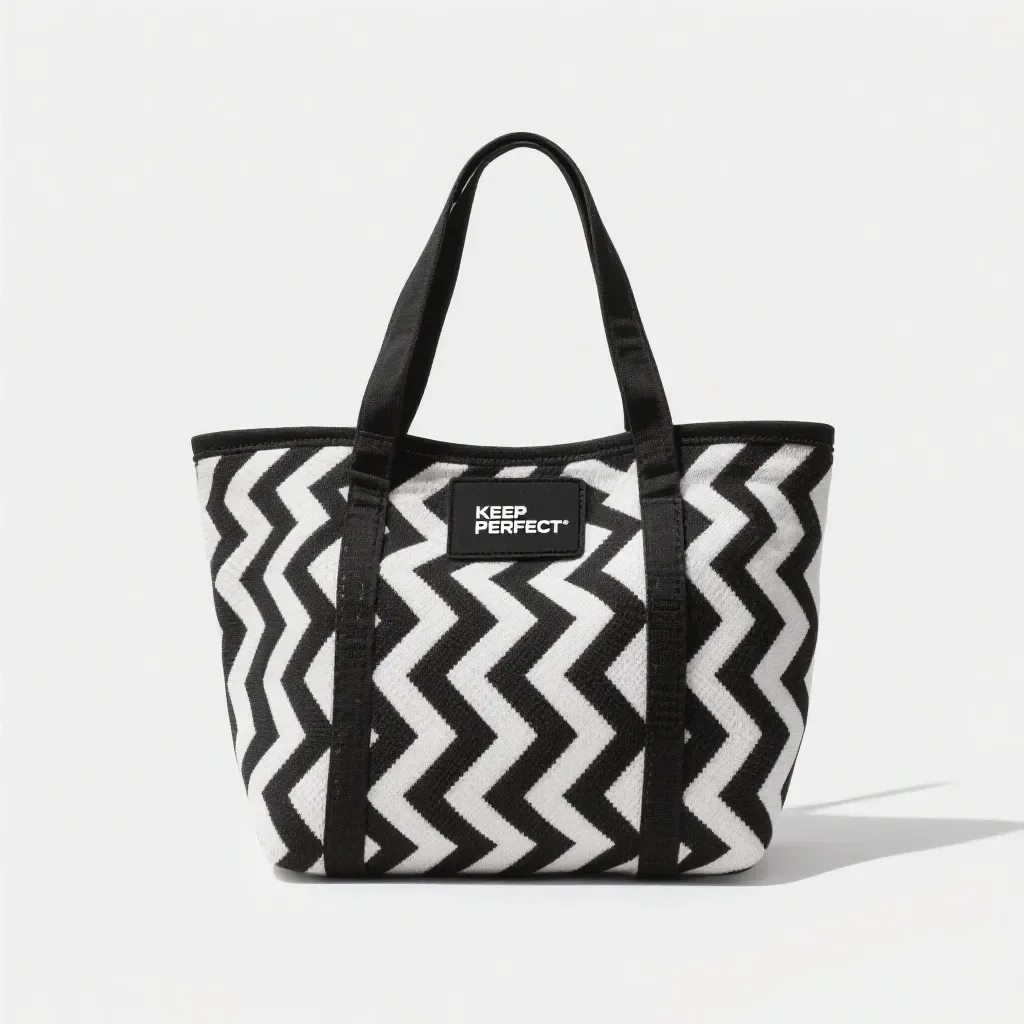
Most large shopper totes are left open, and the top edge then becomes the finishing decision. A bound edge with 12 courses at a tighter setting keeps the mouth from curling and gives the bag a defined line; an unbound knitted edge is softer but loses definition after a few weeks of use. Where a closure is required, a magnetic snap at about 20 N pull or a #5 coil zipper are the two options.
An interior pocket is worth specifying on any tote above 20 litres, because keys and a phone otherwise end up at the bottom of a 28 L cavity. A knitted slip pocket at 150D costs almost nothing in cycle time and is the single feature buyers notice most after the fact.
A lined interior is a separate decision from a pocket. A full 150D lining adds about 75 grams and makes the bag easier to clean, which matters for a grocery tote, but it also slows drying and adds an operation. Most retail programmes take the pocket without the lining, while grocery and farmers-market programmes take both.
Shrinkage and Tolerance at 28 L
Wash shrinkage on a 600D body at E7 is 2.6 percent, and on a 420 mm width that is about 11 mm of movement. The pattern is graded up so the washed bag hits its target dimension rather than the tolerance being widened, because a tote that arrives 11 mm short of spec does not sit correctly in a retail fixture cut to 420 mm.
Tolerance on a body this size is +/- 5 mm, which is looser in absolute terms than the +/- 2 mm used on a mini bag but tighter as a proportion of the bag. Both figures should be on the tech pack together with the measurement condition, meaning measured flat, 24 hours after knitting, before any washing.
Decoration on a Large Flat Panel
A 28 L tote front is the largest uninterrupted knitted surface in a range, and it invites artwork that does not survive knitting. A jacquard mark holds cleanly up to about 120 mm wide at E7; beyond that the loop structure starts to soften the edges and the mark loses definition. Intarsia handles larger artwork with cleaner boundaries but generates more yarn waste per unit.
Placement matters more on a tote than on any other silhouette, because the panel creases where the bag folds. Artwork placed across the gusset fold line will break up visually every time the bag is stored flat, so the mark is positioned above the fold and sized to clear it with margin. That constraint should be given to the designer before the artwork is finalised.
Sampling Protocol for a Large Tote
Large totes are sampled with three bodies from one programme, the same protocol used on bucket and gym styles. One is washed to confirm the 2.6 percent shrinkage figure, one is load-tested to 12 kg to confirm the 520 N junction rating, and one is kept sealed as the reference for final inspection under AQL 2.5.
The load body is the one buyers find most useful, because a 28 L tote fails in a way that is hard to see in a photograph. Filling it to 12 kg and leaving it overnight shows whether the handles stretch, whether the junction distorts and whether the base bows, which is three failure modes that a visual approval will not catch.
Freight, Carton Cube and Landed Cost
A large tote books as volumetric weight, so carton cube usually matters more than unit weight. Twenty units of a 28 L bag pack to about 640 x 440 x 300 mm with the boards shipped loose, against roughly 640 x 440 x 420 mm with the boards fitted. That difference is worth real money on an air-freighted first order and is one reason the removable board is specified.
Shipment is FOB Xiamen as standard, with CIF and DDP quoted where a buyer wants a landed figure. Because the programme runs on 7 production lines at about 200,000 pcs per month, a 100-piece tote order slots into a line without displacing a larger programme, and knit bag programmes have been coordinated since 2014.
Building the Tote Into a Knit Capsule
The shopper tote is the volume anchor of a knit capsule and its 600D yarn and colour reference carry across the range. The same yarn runs on a knitted beach bag, a knitted weekender bag and a knitted bucket bag, so one colour approval covers four silhouettes.
That shared reference is what makes a four-style order at 100 pcs per style and colourway a realistic first commitment rather than a large inventory position, and it is why the tote is usually developed first and the smaller styles added around it. See the knitted bag collection for the silhouette grouping and the knit vs traditional bags pillar for how a knitted tote compares with a cut-and-sew equivalent on cost and durability.
Quote a large shopper tote
Send capacity, handle drop and closure preference. The team returns a costed spec, a 7-working-day sampling plan and an FOB Xiamen quote. Start a tote programme.
Frequently Asked Questions
What capacity is a large knitted shopper tote?
28 litres at 420 x 360 x 180 mm is the most ordered band, covering a full grocery run. 34 litres at 460 x 390 x 200 mm suits buyers who need the bag to take a laptop sleeve or a folded jacket as well.
Why does depth matter on a shopper tote?
A wide shallow tote dumps its contents when set down. A knitted-in gusset at 180 mm keeps them contained and has no seam to split when the bag is overfilled, which is the most common warranty claim on large totes. A knitted gusset has no seam to split, which is the failure a sewn tote suffers most.
What handle drop suits a large tote?
240 mm, which clears the shoulder with a coat on and still allows hand carry. A longer drop turns the bag into a shoulder bag and removes hand carry entirely, which is not how a shopper tote is usually used. A longer drop removes hand carry entirely, which is not how a shopper tote is used.
How strong is a knitted tote handle junction?
With 16 tighter courses at each of the four handle ends the join tests at about 520 N under ISO 13934-1. Without that reinforcement the same body and handles test closer to 330 N, so the detail belongs on the spec. The detail belongs on the tech pack, because it is not visible in a finished photograph.
Why can a tote use narrower handles than a gym bag?
Because the load splits across four junctions rather than two. Two 22 mm tubes carry 12 kg comfortably, while a single-strap gym bag needs 45 mm for a lighter load because everything funnels through two points. Widening to 32 mm makes the handles read as webbing and adds about 90 seconds of cycle time.
How is the base of a large tote protected?
The base panel knits at 900D rather than the 600D body yarn and is rated at about 20,000 rubs under ASTM D4966. A removable 2.0 mm recycled board keeps the footprint flat when the bag is part full. Floor contact is the abrasion hot spot on any bag that is set down while loaded.
Should a large tote have a closure?
Most are left open, with a bound top edge of 12 tighter courses to stop the mouth curling. Where a closure is required, a magnetic snap at about 20 N pull or a #5 coil zipper are the two options. A bound top edge of twelve tighter courses stops the mouth curling when no closure is fitted.
What is the wash shrinkage on a 28 L tote?
2.6 percent on a 600D body at E7, which is about 11 mm of movement across a 420 mm width. The pattern is graded up so the washed bag hits its target dimension rather than the tolerance being widened. The pattern is graded up so the washed bag hits its target rather than the tolerance widening.
How much does freight affect the landed cost?
Substantially, because a large tote books as volumetric weight. Shipping the base boards loose cuts a 20-unit carton from about 640 x 440 x 420 mm to roughly 640 x 440 x 300 mm, which is worth real money on air freight. Shipping boards loose cuts a twenty-unit carton height by about 120 mm.
Is an interior pocket worth specifying?
Yes on any tote above 20 litres. Keys and a phone otherwise end up at the bottom of a 28 L cavity. A knitted 150D slip pocket costs almost nothing in cycle time and is the feature buyers notice most afterwards. A knitted 150D slip pocket costs almost nothing in cycle time and is noticed immediately.
Can a 34 L tote cost less per litre than a 28 L one?
Often yes. Hardware and the base board are flat costs, so moving from 28 L to 34 L adds roughly 18 percent to yarn and machine time but a smaller share to the fixed lines, lifting unit price less than capacity. Hardware and the base board are flat costs that do not grow with capacity.
What is the standard ordering and timing?
Minimum is 100 pcs per style and colourway, sampling takes 7 working days from an approved tech pack, and bulk runs 30 days from sample approval. Shipment is FOB Xiamen with CIF and DDP available. Inspection follows AQL 2.5 under ISO 2859-1 and shipment is FOB Xiamen.
People Also Ask
Is a knitted tote stronger than a sewn one?
At the gusset, yes. A knitted-in gusset has no seam to split under an overfilled load, and seam splitting is the most common failure on large cut-and-sew totes.
Why ship the base board separately?
Because freight is charged on cube, not weight. Boards shipped loose cut a 20-unit carton height by about 120 mm, and the board is a flat cost that is easy to fit at the destination.
Should a tote collapse flat for storage?
It helps for retail and e-commerce. Specifying a softer stitch in the gusset lets the bag fold along its own centre line rather than creasing randomly, which protects the surface appearance.
What gauge suits a large shopper tote?
E7 in 600D. A coarser loop gives the body enough stiffness to hold a wide flat shape without interlining, and it keeps the cycle time near 13.2 minutes for a 28 L body.
Can a tote share a yarn lot with other styles?
Yes. The 600D recycled polyester used at E7 carries across beach, weekender and bucket styles, so one colour approval covers four silhouettes at 100 pcs per style.
Sources and further reading
Every figure on this page is either our own programme data or attributed below. Open the originals before you write them into a specification.
- ASTM D5034 Breaking Strength and Elongation of Textile Fabrics (Grab Test)ASTM International Used to check the four handle junctions on a large knitted shopper tote at 12 kg.
- ASTM D4966 Abrasion Resistance of Textile Fabrics (Martindale)ASTM International Method behind the roughly 20,000-rub rating for the 900D tote base panel.
- ISO 2859-1 Sampling procedures for inspection by attributesISO The AQL 2.5 scheme applied at final inspection of shopper tote orders.
- Global Recycled Standard (GRS)Textile Exchange Documents the recycled content in the 600D tote body yarn for fibre labelling.