Knitted Beach Bag Material: Choosing Yarn and Structure for Sand, Salt and Sun
Sand, salt and sun are three different failure modes, and a knitted beach bag has to answer all three. The specification that holds up is 600D solution-dyed recycled polyester at 260 g/m2, a 32 L body knitted at E7 with E14 mesh panels at 2.5 mm aperture so sand falls straight through, and colour fastness rated to ISO 105-B02 for light and ISO 105-E02 for seawater. Minimum 100 pcs, sampling 7 working days, FOB Xiamen.
Does Sand Actually Fall Through a Knitted Beach Bag?
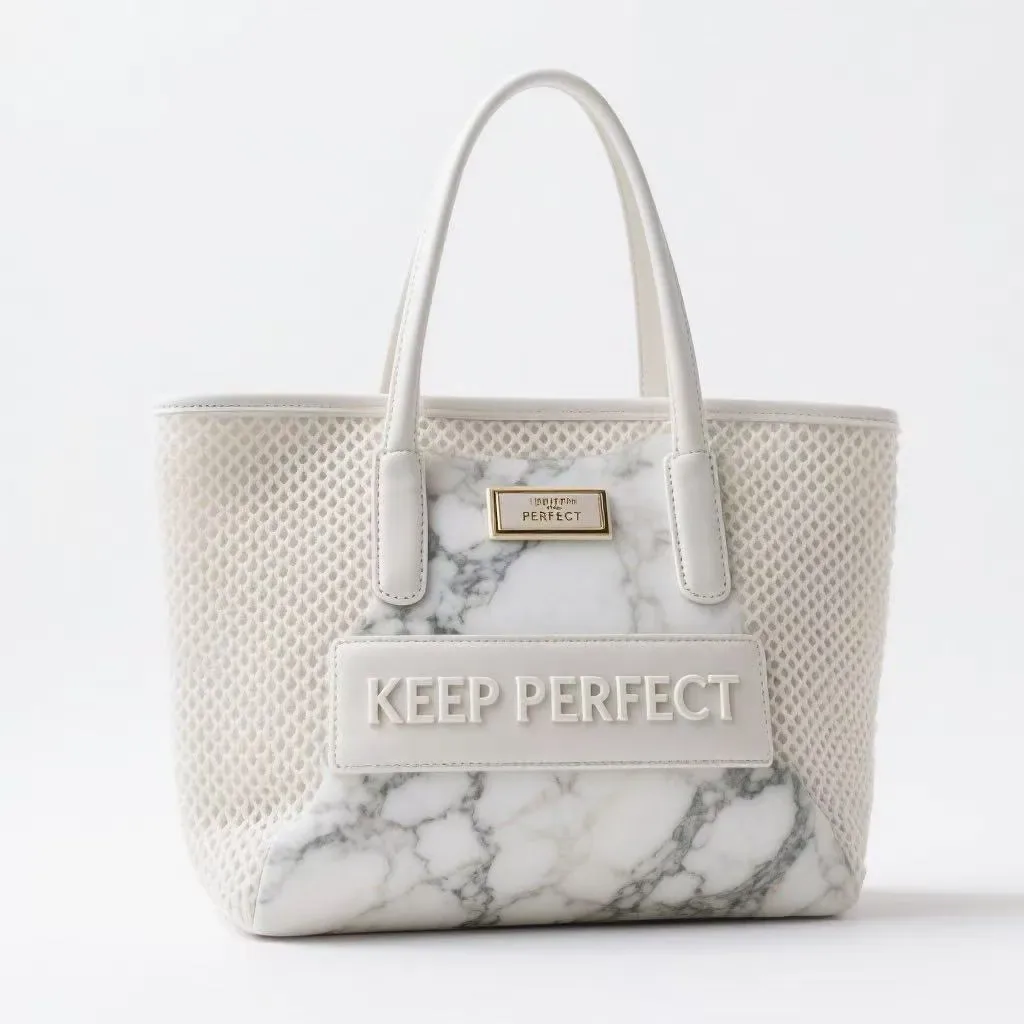
Yes, if the aperture is specified. Sand grains range from about 0.06 mm to 2 mm, so a mesh knitted at 2.5 mm aperture lets the great majority of dry sand pass straight through instead of collecting in the bottom seam. A woven beach bag cannot do this without adding a mesh panel, and the seam around that panel is exactly where sand builds up.
The aperture figure is the whole specification, and it has to be written down. Below about 1.5 mm the mesh holds fine damp sand and starts to behave like a solid panel; above about 4 mm the structure loses strength and small items slip out. Knitting the panel at E14 gives a stable 2.5 mm aperture that does not distort when the bag is loaded, because the loop geometry is locked by the machine rather than by a cut edge.
Placement is the second half of the answer. A mesh base panel handles sand that settles at the bottom, while mesh side panels handle the sand that is shaken off towels and toys. Most programmes specify both, with the mesh covering roughly 55 percent of the total surface area and the solid knit running where the handles and the mouth need strength.
Which Yarn Survives Salt Water and Chlorine?
Solution-dyed recycled polyester is the yarn that survives both. Pigment is added to the polymer before the filament is extruded, so the colour sits inside the fibre rather than on its surface, and there is no dye layer for salt or chlorine to attack. A conventionally dyed yarn of the same count fades and dulls noticeably faster in repeated seawater exposure.
Polyester also matters for a second reason: it does not absorb water. A wet cotton or cotton-blend beach bag stays heavy for hours and takes a long time to dry, which is the root of the mildew smell that returns on this category. Polyester at 260 g/m2 sheds water and dries in about 90 minutes at 25 degrees with air movement, so the bag is dry before it goes back into a car boot.
How Is Colour Fastness to Sun and Sea Tested?
Two separate standards cover the two exposures, and a beach bag spec should name both. ISO 105-B02 covers colour fastness to artificial light using a xenon-arc lamp, and the working target for a solution-dyed yarn is a grade of 6 to 7 after about 300 hours of exposure. ISO 105-E02 covers colour fastness to seawater, and ISO 105-E03 covers chlorinated pool water.
- Capacity
- 32 L at 480 x 300 x 260 mm
- Body gauge and yarn
- E7, 600D solution-dyed recycled polyester, 260 g/m2
- Mesh panels
- E14 open-work, 2.5 mm aperture, about 55 percent of surface
- Light fastness
- Grade 6 to 7 to ISO 105-B02 after about 300 hours xenon arc
- Seawater fastness
- Grade 4 to 5 to ISO 105-E02; pool water to ISO 105-E03
- Rubbing fastness
- Grade 4 to AATCC 8 for dark shades against light clothing
- Drying time
- About 90 minutes at 25 degrees with air movement
- Wet load
- 8 kg wet kit, strap junction rated about 440 N
- Shrinkage
- 1.6 percent, graded into the pattern before knitting
- Cycle time
- 12.4 minutes per 32 L body
- Handle
- 45 mm tube at 33 needles on E7, 300 mm drop, removable closed-cell pad
Buyers often ask for a single fastness grade to cover everything, and that request should be declined. Light, seawater, chlorinated water and rubbing are governed by different methods with different scales, and a grade quoted without its method cannot be compared between two quotes. Writing ISO 105-B02, ISO 105-E02 and AATCC 8 into the spec removes that ambiguity.
The test report should also state whether it was run on the finished body or on the yarn. A yarn may hold grade 6 to 7 while the finished open-work structure reads a grade lower, because the mesh exposes more surface area to light and water. Approving on yarn data and producing on fabric performance is the gap that produces most fastness complaints.
How Big Should a Beach Bag Be, and How Much Does Wet Kit Weigh?
32 litres is the size that covers a family beach load: two towels, sunscreen, a water bottle and a change of clothes. The useful discipline is to size against wet weight rather than dry volume, because a towel holding water weighs roughly three times its dry weight, and that is the number the strap and the junction have to carry.
| Bag size | Flat dimensions (mm) | Dry load | Wet load | Strap specification |
|---|---|---|---|---|
| 18 L | 380 x 240 x 200 | 2.0 kg | 4.5 kg | 32 mm tube, 280 mm drop |
| 32 L | 480 x 300 x 260 | 3.5 kg | 8.0 kg | 45 mm tube, 300 mm drop |
| 45 L | 560 x 340 x 300 | 5.0 kg | 11.5 kg | 45 mm tube plus tape core |
| 60 L | 640 x 380 x 340 | 6.5 kg | 15.0 kg | Two handles, reinforced base |
The wet column is the one that matters. A 32 L bag rated for 3.5 kg dry will be carried at 8 kg wet, so the junction is reinforced with 14 tighter courses and rated at about 440 N under ISO 13934-1, and the strap is knitted at 45 mm rather than the 32 mm default used on day bags.
What Structure Dries Fastest?
Open structure dries fastest, and the reason is airflow through the fabric rather than the fibre itself. A 600D yarn knitted at E7 with E14 mesh panels dries in about 90 minutes at 25 degrees, while the same yarn knitted solid at E12 without panels takes closer to three hours. The mesh is doing the work: it lets air reach both faces of the fabric at once.
E14 mesh panels
About 55 percent of the surface at 2.5 mm aperture. Fastest drying and lets sand fall through, at a modest strength cost.
E7 solid knit
Full-strength body with a soft hand. Dries more slowly but carries the handle and mouth loads best.
Split construction
Mesh below the mid-line and solid above it. Keeps strength where the handles are and airflow where damp kit sits.
Removable liner
A light 150D liner that comes out for washing. Adds an operation but protects the body from sunscreen and oil.
The split construction in that list is the one most beach programmes choose, because it resolves the conflict between drying speed and handle strength without compromise. Mesh below the mid-line deals with damp towels and sand; solid knit above it gives the mouth and the handle junction something to pull against.
How Does a Knitted Mesh Body Hold Its Shape?
Open-work knit has less inherent stiffness than solid knit, so shape retention comes from three places rather than one: a denser border around each mesh panel, a bound mouth with 10 courses at a tighter setting, and a removable 1.5 mm recycled board in the base. Together those hold a 32 L mesh bag upright when it is half full.
Where a brief wants a fully structured beach bag, the open-work area is reduced to about 30 percent and concentrated in the base, and the walls run solid. That trades drying speed for a crisper silhouette, and it is a legitimate choice for a resort retail programme where the bag is displayed standing rather than used hard.
How Is a Beach Handle Built for Wet Loads?
A beach handle is asked to carry a wet, shifting load over a shoulder that is often bare, which is a harder brief than it looks. The working answer is a 45 mm tube knitted at 33 needles on E7 in the same 600D yarn, with a 300 mm drop so the bag clears the hip, and 14 tighter courses at each junction rated at about 440 N under ISO 13934-1.
Padding is the detail most briefs get wrong. A padded section over the crown of the handle helps under a wet load, but padding a knitted tube traps water inside it, so the pad is specified as a closed-cell insert that can be pulled out rather than a foam sewn into the tube. That keeps the drying advantage the rest of the bag is built for.
A second handle pair is often requested at 45 L and above. Two handles at 38 mm each spread a 15 kg wet load across both shoulders and stop the bag swinging against the leg, and they are knitted as tubes in the same operation as the body so there is no secondary assembly to fail.
Which Compliance Rules Apply to a Beach Bag?
A beach bag is a textile article in contact with skin, sold in outdoor sunlight, and often bought for children, so three regimes apply. OEKO-TEX STANDARD 100 covers restricted substances in the knitted body. REACH Annex XVII governs the EU market. Where the bag is marketed for children, CPSIA and CPSC rules on lead content and phthalates in hardware and coatings come into scope.
Recycled content claims need the same discipline as any other environmental claim. The Global Recycled Standard provides the chain-of-custody documentation behind a percentage on a label, and Textile Exchange publishes the standard and its transaction certificate process. A beach bag claiming recycled content without that documentation is a claim a retailer will ask to see supported.
What Does the Programme Look Like End to End?
Sampling runs 7 working days from an approved tech pack and bulk production runs 30 days from sample approval, on a minimum of 100 pcs per style and colourway. Final inspection follows AQL 2.5 under ISO 2859-1, with a beach-specific defect list covering mesh aperture consistency, border definition around the panels, mouth distortion and shade match between the mesh and the solid zones.
The shade-match point deserves emphasis because it is the defect that catches most first beach orders. Mesh and solid zones in the same yarn read differently because the open structure reflects light differently, so the approval sample has to be knitted with both and signed off together. Where the difference is deliberate, it is specified as a two-tone design rather than left as a surprise.
Shipping is FOB Xiamen as standard with CIF and DDP available. Because the body is soft and the board is removable, a 32 L beach bag packs flat and a carton of 20 units measures roughly 620 x 420 x 260 mm, which keeps the volumetric weight figure reasonable for a bag of this size.
Where a Beach Bag Sits in a Knit Capsule
The beach bag is the seasonal peak of a knit capsule and its material specification carries into adjacent styles. The solution-dyed yarn approved on a beach bag is the right choice for a knitted weekender bag that sees outdoor use, and the mesh logic transfers to a knitted gym bag. A large knitted shopper tote takes the same yarn in a solid structure.
Sharing one yarn lot across those styles is what keeps shade consistent and makes a four-style order at 100 pcs per style realistic. See the knitted bag collection for the silhouette grouping and the knit bag materials pillar for how yarn counts and finishes are specified across a range.
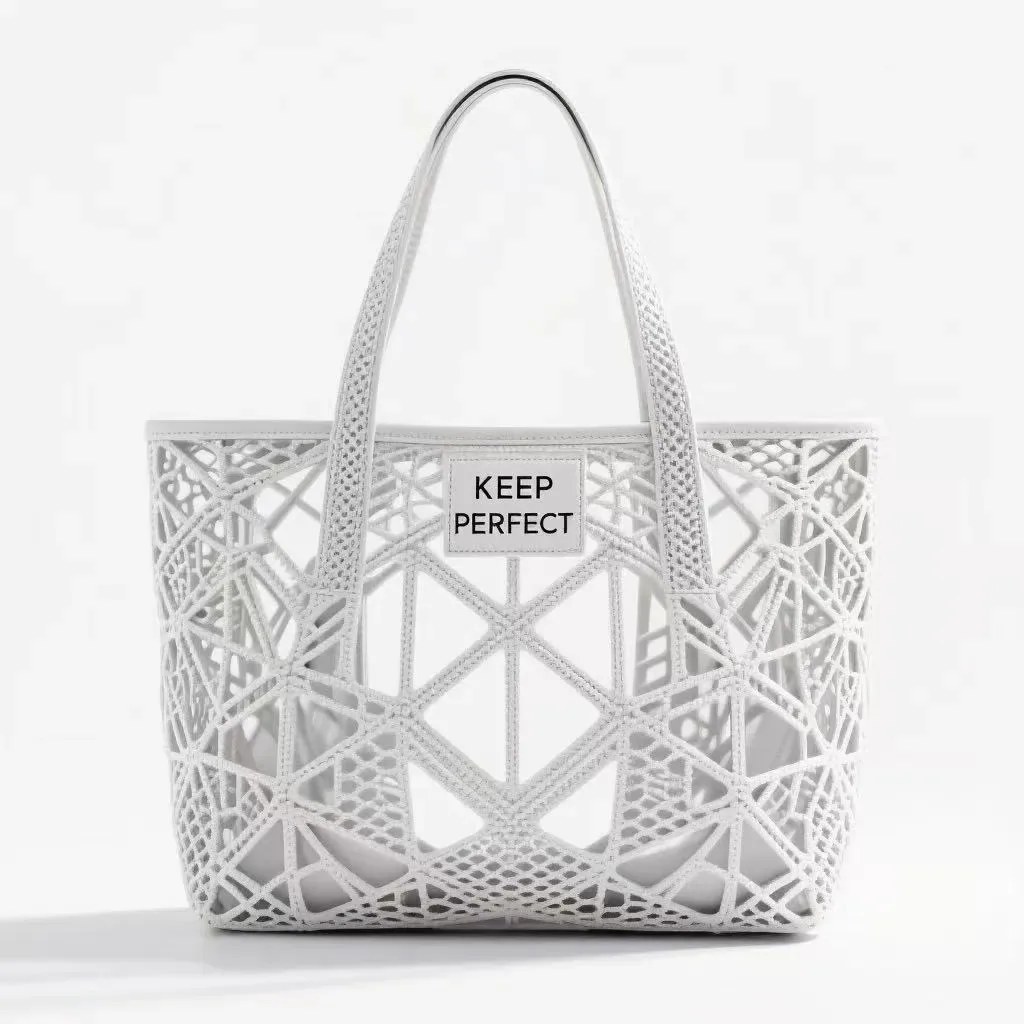
Spec a beach bag that handles sand and salt
Send capacity, mesh coverage and colour targets. The team returns a yarn and structure spec, a 7-working-day sampling plan and an FOB Xiamen quote. Start a beach bag programme.
Frequently Asked Questions
What yarn is best for a knitted beach bag?
600D solution-dyed recycled polyester at 260 g/m2. Pigment goes into the polymer before extrusion, so colour sits inside the fibre and salt or chlorine has no dye layer to attack. Polyester also sheds water rather than absorbing it. Polyester also sheds water rather than absorbing it, so the bag is dry before it goes back in a car.
What mesh aperture lets sand fall through?
About 2.5 mm, knitted at E14. Sand grains run from roughly 0.06 mm to 2 mm, so most dry sand passes through. Below 1.5 mm the mesh holds damp sand, and above 4 mm the structure loses strength and small items slip out.
How is colour fastness to sunlight specified?
Against ISO 105-B02, which uses a xenon-arc lamp. The working target for solution-dyed polyester is grade 6 to 7 after about 300 hours. A grade quoted without its method cannot be compared between two quotes. A grade quoted without its test method cannot be compared between two quotes.
Which standard covers seawater exposure?
ISO 105-E02 covers colour fastness to seawater and ISO 105-E03 covers chlorinated pool water. A beach bag spec should name both alongside ISO 105-B02 for light, because the three exposures attack colour differently. Naming all three removes the ambiguity that a single unnamed grade always creates.
How big should a beach bag be?
32 litres covers a family load of two towels, sunscreen, a bottle and a change of clothes. Size against wet weight rather than dry volume: a wet towel weighs roughly three times its dry weight, taking a 3.5 kg dry load to about 8 kg.
How fast does a knitted beach bag dry?
About 90 minutes at 25 degrees with air movement for an E7 body with E14 mesh panels. The same yarn knitted solid at E12 without panels takes closer to three hours, because the mesh lets air reach both faces at once. The mesh is doing the work, letting air reach both faces of the fabric at once.
Does a mesh beach bag hold its shape?
Yes, with three supports: a denser knitted border around each panel, a bound mouth with 10 tighter courses, and a removable 1.5 mm recycled board in the base. Together they hold a 32 L bag upright when half full. Most programmes take the bound mouth because the bag is displayed open on a shelf.
Why do mesh and solid zones look like different colours?
Because open structure reflects light differently from solid knit even in the same yarn lot. The approval sample must be knitted with both zones and signed off together, or the difference specified deliberately as a two-tone design. Approving on yarn data and producing on fabric performance is where complaints originate.
What compliance applies to a beach bag?
OEKO-TEX STANDARD 100 for restricted substances, REACH Annex XVII for the EU market, and CPSIA where the bag is marketed for children and hardware and coatings fall into scope. Recycled claims are documented under the Global Recycled Standard. A recycled claim without that documentation is one a retailer will ask to see supported.
How much does a beach bag cost to ship?
Less than its size suggests, because the body packs flat and the base board ships loose. Twenty units of a 32 L bag fit a carton of roughly 620 x 420 x 260 mm, which keeps volumetric weight reasonable for the capacity. Twenty units fit a carton of roughly 620 x 420 x 260 mm with the boards loose.
Can a beach bag share a yarn lot with other styles?
Yes. The solution-dyed 600D yarn approved on a beach bag suits weekender and gym styles, so one colour approval covers several silhouettes in a capsule ordered at 100 pcs per style and colourway. One colour approval then covers several silhouettes ordered at 100 pcs per style.
What is the sampling and production timing?
Sampling takes 7 working days from an approved tech pack and bulk runs 30 days from sample approval. Final inspection follows AQL 2.5 under ISO 2859-1, and shipment is FOB Xiamen with CIF and DDP available. Bulk starts after sample approval, and inspection follows AQL 2.5 under ISO 2859-1.
People Also Ask
Is mesh better than a solid knit for a beach bag?
For drainage and drying, yes. A 2.5 mm E14 mesh lets sand fall through and cuts drying time from about three hours to 90 minutes. Solid knit is stronger, so most programmes split the two.
Why use solution-dyed yarn instead of piece-dyed?
Pigment sits inside the filament rather than on its surface, so seawater and chlorine have no dye layer to attack. Light fastness also holds longer, typically grade 6 to 7 to ISO 105-B02.
Does polyester feel right for a beach bag?
Yes, and it dries far faster than cotton. A cotton beach bag stays heavy for hours after use, which is the root of the mildew smell that drives returns in this category.
Should a beach bag have a removable liner?
Only where sunscreen and oil are a concern. A light 150D liner pulls out for washing and protects the body, but it adds an operation and slows drying while it is fitted.
What strap does an 8 kg wet load need?
A 45 mm knitted tube with 14 tighter courses at the junction, rated about 440 N under ISO 13934-1. The 32 mm default used on day bags is not enough once towels are wet.
Sources and further reading
Every figure on this page is either our own programme data or attributed below. Open the originals before you write them into a specification.
- Global Recycled Standard (GRS)Textile Exchange Documents the recycled content declared for the 600D solution-dyed beach bag yarn.
- OEKO-TEX STANDARD 100OEKO-TEX Limit-value testing applied to knitted beach bag bodies that sit against skin in sun and salt water.
- ASTM D5034 Breaking Strength and Elongation of Textile Fabrics (Grab Test)ASTM International Used to check the mesh panel border and the handle junction on open-work beach structures.
- Proposition 65California OEHHA Relevant to hardware and coated trims on beach bags sold into California.