Knit Bag Packaging: Polybags, Cartons, Barcodes and the Documents Behind a Clean Delivery
Knit bag packaging adds about USD 0.32 per piece to a 100-piece order and up to 10 working days to the critical path, and almost all of that cost and delay sits in five lines: polybag, carton, label set, barcode and documents. This page breaks each line into the specification that moves the number, the component minimums that catch small orders out, and the documents a shipment cannot clear without, then closes with a packaging line you can copy straight onto a tech pack.
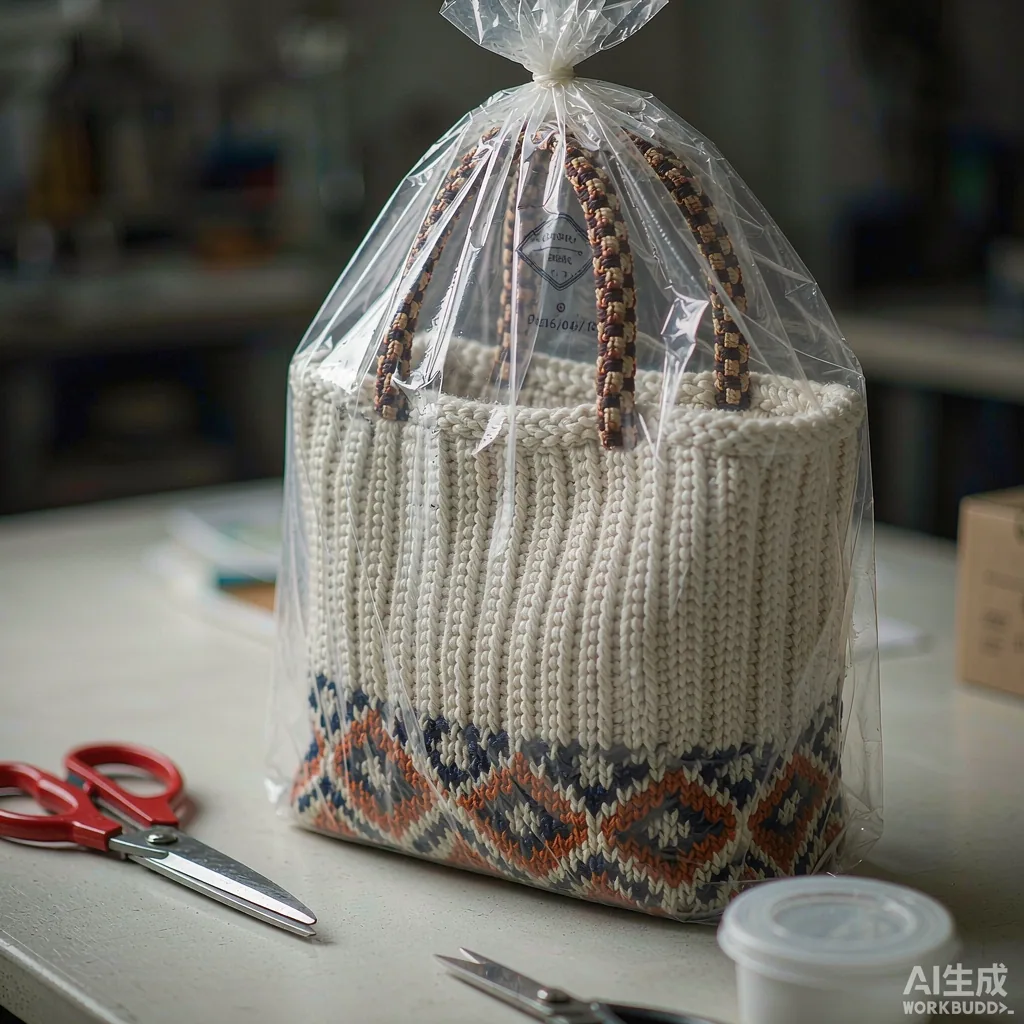
The Packaging Bill on a 100-Piece Knit Bag Order
Packaging adds about USD 0.32 per piece to a knit bag, which is roughly 7% of a USD 4.80 FOB unit price, and the largest line on that bill is the carton at USD 0.09 rather than the polybag at USD 0.055.
Packaging is quoted as a separate block, and it is the block most often left blank on a tech pack. When it is blank, the quote carries an assumption, and the assumption is usually the lightest and least expensive version of every component. That is not a problem until the goods arrive and the carton is too weak to stack, the barcode will not scan at the distribution centre, or the hangtag has been printed with the wrong fibre content. Five lines decide all of that: the polybag, the carton, the label set, the barcode and the document set.
The second thing to understand is that the per-piece figure is not fixed. Every packaging component carries its own production minimum, and those minimums are usually larger than the bag MOQ of 100 pcs per style and colourway. A woven label is booked on a loom set-up at 1,000 pcs per design, a printed carton at about 300 pcs per print run, an offset hangtag at 500 pcs and a stock-size polybag at 1,000 pcs. On a 100-piece colourway, the set-up cost for a custom component is spread across 100 pieces instead of 1,000, which is exactly why the same packaging set that costs USD 0.32 per piece at 100 pcs falls to about USD 0.19 per piece at 1,000 pcs.
| Line item | Typical specification | Cost per piece | What moves the number |
|---|---|---|---|
| LDPE polybag | 40 micron, 60 x 80 cm, two 6 mm vents, self-adhesive flap | USD 0.055 | Film thickness, print area, recycled content |
| Hangtag | 300 gsm art paper, 55 x 90 mm, two-sided four-colour | USD 0.115 | Colour count, finish, string and seal type |
| Woven label | 20 x 55 mm, satin edge, up to three yarn colours | USD 0.048 | Loom set-up spread, colour count, soft-hand yarn |
| Care label | 45 x 70 mm printed polyester satin, four languages | USD 0.032 | Number of languages blocked onto one label |
| Carton | 5-ply B-flute, 60 x 40 x 40 cm, 50 pcs per carton | USD 0.090 | Board grade and the pieces-per-carton ratio |
| Barcode and marking | EAN-13 label plus printed shipping mark | USD 0.012 | One label or two, black or colour print |
| Total packaging | Plain carton, printed hangtag, full label set | USD 0.35 | Order size, because set-up spreads over volume |
Polybag: Thickness, Ventilation and a Closure That Survives Transit
A 40 micron LDPE polybag with two 6 mm vent holes and a self-adhesive flap is the default for a knit bag; below 30 micron the film creases permanently in transit, and without vents a sealed bag holds condensed moisture inside a container that cycles between about 5 °C overnight and 60 °C during the day.
Size the bag to the folded piece, not to the flat piece. A 34 x 38 cm tote folded once fits a 60 x 80 cm bag with a 50 mm flap, and that fit is deliberate: a bag that is too large wrinkles at the corners, and a bag that is too tight pulls the knit surface into creases that no amount of steam removes at destination. Polypropylene film looks crisper on a shelf, but it crackles when handled and creases at low temperature, so LDPE remains the safe default for a knitted body that has to be folded rather than hung.
Three regulatory points sit on the polybag as well, and all three are inexpensive to get right at specification stage and expensive to fix after packing. Thin film bags sold into the US and EU carry a printed suffocation warning, and the text has to appear in the language of the destination market. Recycled-content polybags are available at about 30% post-consumer content, but the claim needs a chain-of-custody document requested at the same time as the yarn certificate, not at packing. And the film itself is an article placed on the European market, so the ink and adhesive on a printed bag are checked against REACH Annex XVII in the same way the hardware on the bag is.
- Film thickness: 40 micron LDPE as the default, 30 micron only for light pieces under 200 g
- Ventilation: two 6 mm holes per bag, positioned away from the printed warning text
- Closure: self-adhesive flap for retail packs, drawstring or no closure for bulk-packed pieces
- Recycled content: 30% post-consumer LDPE, with the transaction certificate booked before packing
- Warning text: printed in the language of the destination market, not the language of the packing floor
- Print area: one colour on one side keeps the bag near USD 0.055; each extra colour adds about USD 0.01
Carton: Board Grade, Packing Ratio and the 12 kg Ceiling
A 5-ply B-flute carton measuring 60 x 40 x 40 cm holds 50 knit totes at about 11.4 kg gross and stays under the 12 kg ceiling that most European and North American distribution centres apply to manual handling.
Board spec is where carton cost is won or lost. Five-ply B-flute at about 3.5 mm caliper with kraft liners handles a stacked pallet of knit bags without bowing, and it is specified by edge crush rather than by feel: a carton bought on board weight alone tends to arrive lighter than the sample that was approved. Corrugated board loses stacking strength as its moisture content rises, which is the practical reason cartons are stored off the floor, pallets are stretch-wrapped rather than left open, and a container is booked with desiccant when the route crosses a humid port in transit.
The pieces-per-carton ratio changes three numbers at once. Packing 25 pieces instead of 50 halves the gross weight to about 5.7 kg and makes the carton easier to handle, but it doubles the number of cartons, adds about USD 0.04 per piece in board and tape, and increases the floor area the shipment occupies. For a knit bag, which is light for its volume, the usual answer is to pack to the weight ceiling rather than to the volume ceiling: fill to roughly 12 kg, close the carton, and let the carton count follow.
- Carton board
- 5-ply B-flute, kraft liner, about 3.5 mm caliper
- Carton size
- 60 x 40 x 40 cm for a 34 x 38 cm tote folded flat
- Packing ratio
- 50 pcs per carton, about 11.4 kg gross
- Weight ceiling
- 12 kg gross for manual handling in EU and US distribution centres
- Closure
- 48 mm BOPP tape in an H-pattern, no staples
- Strapping
- 12 mm PP strap, two bands crossed on palletised cartons
- Void fill
- None required when the ratio is right; kraft paper only for mixed cartons
Hangtag, Woven Label and Care Label: Small Lines, Long Lead Times
The label set — hangtag, woven label and care label — adds about USD 0.20 per piece and up to 10 working days to the critical path, because these components are produced by third-party printers and booked only after the sample is approved.
Hangtag
300 gsm art paper at 55 x 90 mm, printed two-sided in four colours, hung on a 90 mm recycled polyester string. Offset printing carries a 500 pc minimum per design.
Woven label
20 x 55 mm satin-edge label with up to three yarn colours, sewn to the inside back panel. A seamless knit body has no side seam, so position is chosen on the tech pack, not assumed.
Care label
45 x 70 mm printed polyester satin, soft-hand finish, with content and care in up to four languages on one label to avoid a second set-up charge.
Barcode sticker
EAN-13 on a 50 x 30 mm thermal-transfer label, applied to the polybag or the hangtag. The lowest-cost fix when a printed carton minimum cannot be met.
The mismatch between a 100-piece colourway and a 500- or 1,000-piece component minimum has three standard answers, and picking one early saves more money than negotiating any single line. Book one packaging set across several colourways and put the colourway on a sticker. Use stock-size components — a plain polybag, a generic carton, a shared hangtag with a printed colour dot. Or accept the set-up cost on the first drop and reuse the same components on the reorder, where the cost per piece falls to about USD 0.19.
Attachment is specified too, because a label on a knitted body behaves differently from a label on a woven one. Knit fabric stretches, so a woven label is sewn with a 2 mm allowance and a soft-hand yarn to avoid puckering, and a hangtag is anchored to a reinforced point or to a loop knitted into the body rather than to a single stitch in the surface. Where the care content is short, a heat-transfer print replaces the sewn label entirely and removes both the minimum and the labour.
Barcode: Number, Symbology and Print Quality
An EAN-13 barcode printed at 100% magnification with a 0.330 mm X-dimension and clear quiet zones scans first time at retail; most knit bag barcode failures come from a wrong or reused GTIN, not from print quality.
The number is allocated, not invented. A GS1 company prefix gives the range from which each GTIN is assigned, and one GTIN is needed for every style, colourway and size variant, so a tote in four colourways is four numbers, not one. EAN-13 covers Europe and most of Asia; the US retail channel reads the same data as UPC-A in 12 digits; and the carton carries an ITF-14 built from the same GTIN, with an SSCC on the pallet label when the buyer's warehouse scans at pallet level.
- Allocate one GTIN per style, colourway and size before artwork is drawn
- Print EAN-13 at 100% magnification, X-dimension 0.330 mm, with quiet zones on both sides
- Verify the printed symbol to ISO/IEC 15416 and accept a minimum grade of C
- Put an ITF-14 on the carton and an SSCC on the pallet label for warehouse scanning
- Place the retail symbol on a flat area of the polybag or hangtag, never across a folded edge
- Keep the human-readable number under the symbol so staff can key it in when a scan fails
Carton Marking and Shipping Marks: What the Warehouse Reads First
A shipping mark is read before a carton is opened, so it should carry consignee, destination, PO number, style and colourway, carton number as x of y, gross and net weight in kg, dimensions in cm and country of origin in eight short lines.
Carton numbering is the field that prevents the most disputes. A shipment of 24 cartons numbered 1 of 24 to 24 of 24 lets a warehouse see instantly whether a delivery is complete, and it lets a claim be filed against a specific carton rather than against an order. The main mark goes on one long side and one short side of the carton, printed or on a 100 x 150 mm label, and the mark has to match the packing list line for line, because a mismatch between carton count and packing list is the single most common reason a container is held rather than released.
Eight fields on a knit bag shipping mark
- Consignee and delivery address as it appears on the booking
- Destination port or inland point, written as on the bill of lading
- Purchase order number and style number
- Colourway and size breakdown inside the carton
- Carton number, written as x of y, plus total carton count
- Gross and net weight in kg, and dimensions in cm
- Country of origin, and any made-in marking the retail market requires
- Handling icons: keep dry, this way up, and the recycle symbol where required
Pallet Pattern and Container Loading
A 1200 x 1000 mm pallet takes ten 60 x 40 cm cartons per layer and five layers in a 1.55 m stack, so a 200-carton order ships as four pallets, occupies about 19 m³ and uses a little over a quarter of a 40 ft high-cube container's 68 m³.
That ratio is the reason freight, not board, decides landed cost on small knit bag orders. Air freight bills on volumetric weight at the 6,000 divisor, so a 60 x 40 x 40 cm carton of 96,000 cm³ bills as 16 kg while it actually weighs 11.4 kg — the shipper pays for 4.6 kg of air per carton. Folding the bag flat and taking 5 cm off the carton height cuts the billed volume by about 12%, which on a 200-carton air shipment is worth more than any packaging line item on the page.
Pallet specification is short but not optional. Export pallets are heat-treated to the ISPM 15 standard — a core temperature of 56 °C held for 30 minutes — and carry the stamp, because a pallet without it can be refused at the destination port regardless of what is stacked on it. Cartons are stacked column-wise with no overhang beyond 50 mm, wrapped in three layers of 23 micron stretch film, and topped with a sheet; a 40 ft high-cube takes about 20 European pallets in two rows.
| Order size | Cartons and pallets | Volume | Best mode |
|---|---|---|---|
| 100 pcs, one colourway | 2 cartons, loose-loaded or one pallet | about 0.2 m³ | Courier or air, packed to 12 kg |
| 200 pcs, two colourways | 4 cartons, one pallet | about 0.4 m³ | Air consolidation, volumetric weight governs |
| 1,000 pcs, four colourways | 20 cartons, one pallet | about 2.0 m³ | Sea LCL on FOB Xiamen terms |
| 10,000 pcs, six colourways | 200 cartons, ten pallets | about 19 m³ | Sea FCL, 20 ft container is enough |
Sustainable Packaging and the Document Behind Each Claim
Recycled polybags and FSC-certified cartons add about USD 0.04 to USD 0.09 per piece, and every claim on that list needs a document: a transaction certificate for recycled content, an FSC chain-of-custody code printed on the carton, and a declaration that ink and adhesive meet REACH Annex XVII for the European market.
European packaging rules are moving towards recyclable mono-material packaging, and knit bag programmes are well placed for that because the bag itself is already a single-polymer article. The practical rules are simple: keep the polybag to one polymer, avoid PVC film and metallised layers, specify water-based ink, and say on the carton which stream it belongs in. A carton printed with an FSC claim is only as good as the supplier's chain-of-custody code, and that code is checked at the same time the certificate set for the bag is checked.
Four packaging claims and the document each one needs
- Recycled content in the film — a transaction certificate against the film lot, requested at booking
- Responsible fibre in the carton — an FSC chain-of-custody code printed on the carton itself
- Substance compliance — a REACH Annex XVII declaration covering ink, adhesive and film
- Harmful substances in the finished pack — OEKO-TEX STANDARD 100 where the buyer's retail channel asks for it
Export Documents: The Set That Holds a Shipment at the Port
A knit bag shipment clears on six documents — commercial invoice, packing list, bill of lading, certificate of origin, the certificate and test set the destination market requires, and the inspection report issued against AQL 2.5 (ISO 2859-1) — and the last two are the ones most often requested a week too late.
| Document | Who issues it | When it is needed |
|---|---|---|
| Commercial invoice | The seller, matching the pro forma values | Before booking; customs values match this document |
| Packing list | The packing line at loading | Must match carton count and marks line for line |
| Bill of lading | The carrier or the buyer's nominated forwarder | Released after loading, on FOB Xiamen terms |
| Certificate of origin | The competent authority in the country of export | Booked before loading; needed for preferential duty |
| Certificate set | GRS, OEKO-TEX and the test house | Booked with the yarn, not after packing |
| Inspection report | The buyer's inspector or a third-party agency | Before release, sampled to AQL 2.5 (ISO 2859-1) |
Classification deserves one line of thought before the invoice is typed. Bags with an outer surface of textile materials are normally classified in heading 4202, but the subheading depends on the construction and on how the article is presented, and the code is confirmed by the buyer's broker rather than assumed by the shipper. A wrong code does not delay the container; it delays the duty refund, which is worse.
- Week one: approve the sample, freeze the label artwork, and allocate the GTIN
- Week one to two: book cartons, polybags and hangtags against the approved artwork
- Week three onwards: bulk runs on the 30-day window, packaging components land in parallel
- Before packing: request the certificate set and the inspection booking
- At packing: issue the packing list and the carton numbering
- At loading: hand over invoice, packing list and certificate of origin; collect the bill of lading
The Packaging Line to Copy onto a Tech Pack
One packaging line on the tech pack — polybag spec, carton spec, packing ratio, label set, barcode and shipping mark — removes more follow-up questions than any other single field, because it turns a set of assumptions into a specification that can be quoted.
- Polybag
- 40 micron LDPE, 60 x 80 cm, two 6 mm vents, self-adhesive flap, warning text in [market language]
- Carton
- 5-ply B-flute, 60 x 40 x 40 cm, printed [yes/no], 48 mm BOPP tape, H-pattern
- Packing ratio
- 50 pcs per carton, single colourway per carton, maximum 12 kg gross
- Hangtag
- 300 gsm art paper, 55 x 90 mm, two-sided, 90 mm string, plastic seal
- Woven label
- 20 x 55 mm, satin edge, sewn to inside back panel, 2 mm allowance
- Care label
- 45 x 70 mm printed satin, content and care in four languages
- Barcode
- EAN-13 at 100%, GTIN per colourway, ITF-14 on carton, SSCC on pallet
- Shipping mark
- Consignee, destination, PO, style and colourway, x of y, kg, cm, origin
- Pallet
- 1200 x 1000 mm, ISPM 15 heat-treated, 10 cartons per layer, 5 layers, 3-layer wrap
- Documents
- Invoice, packing list, bill of lading, certificate of origin, certificate set, AQL 2.5 report
How Packaging Moves the Quote and the Calendar
Packaging does not change the 30-day bulk window, but a custom hangtag or woven label adds up to 10 working days before bulk can start, which is why label artwork should be approved in the same week as the sample rather than after it.
The sequence that works is short. The sample is developed in 7 working days, the artwork and the GTIN are frozen while the sample is being reviewed, the components are booked against that artwork, and bulk runs inside the 30-day window with packaging landing in parallel. Pre-shipment inspection is sampled to AQL 2.5 (ISO 2859-1), and the certificate set is requested at yarn booking so it is in hand at packing rather than at loading. On FOB Xiamen terms the buyer's nominated forwarder takes over at the port, and the document set goes with the handover.
Specify the packaging for your knit bag programme
Send the silhouette, the pieces per colourway and the destination market. The knit programme team will return a full packaging specification — polybag, carton, packing ratio, label set, barcode and shipping mark — with the cost per piece and the component minimums marked. Send the packaging specification on the contact page.
Frequently Asked Questions
What does knit bag packaging cost per piece?
Packaging adds about USD 0.32 per piece on a 100-piece order, roughly 7% of a USD 4.80 FOB unit price. The carton is the largest line at USD 0.09, the hangtag follows at USD 0.115, and the polybag is USD 0.055. At 1,000 pcs the same set falls to about USD 0.19 per piece because the print and loom set-up spreads across more units.
What thickness polybag should a knit bag use?
Forty micron LDPE is the default for a knit bag and works for pieces from 200 g to about 400 g. Below 30 micron the film creases permanently against the folded knit surface, and above 50 micron the bag adds cost and volume without adding protection. Two 6 mm vent holes are punched in every bag to stop moisture condensing inside a sealed pack during a container crossing.
How many knit bags go in one carton?
Fifty pieces per carton is the usual answer for a 34 x 38 cm tote in a 60 x 40 x 40 cm carton, giving about 11.4 kg gross. The governing rule is the 12 kg ceiling most European and North American distribution centres apply to manual handling, so heavier styles pack at 25 pcs and lighter styles pack higher. Mixed colourways in one carton are avoided because it breaks the carton numbering.
Why do packaging components have minimums larger than the bag MOQ?
Component printers run on set-ups, not on pieces. A woven label needs a loom set-up at 1,000 pcs per design, an offset hangtag is booked at 500 pcs, and a printed carton at about 300 pcs per run. Those minimums are independent of the 100 pcs per colourway the knitted body itself is booked at, which is why small colourways are usually packed in stock components with a printed sticker.
Which barcode does a knit bag need?
An EAN-13 for Europe and most of Asia, and the same data as UPC-A in 12 digits for the US retail channel. One GTIN is allocated per style, colourway and size variant, so four colourways need four numbers. The carton carries an ITF-14 built from the same GTIN, and a pallet label carries an SSCC where the buyer's warehouse scans at pallet level.
How is a barcode printed on a knitted bag?
The symbol is printed at 100% magnification with a 0.330 mm X-dimension and clear quiet zones, then verified to ISO/IEC 15416 with a minimum grade of C. On a knit bag it is applied as a thermal-transfer sticker on the polybag or the hangtag, never across a folded edge where the surface distortion breaks the scan. The human-readable number sits underneath so staff can key it in.
What should a shipping mark on a knit bag carton show?
Eight fields: consignee, destination, purchase order number, style and colourway, carton number as x of y, gross and net weight in kg, dimensions in cm, and country of origin. The mark goes on one long side and one short side and has to match the packing list line for line, because a mismatch between carton count and packing list is the most common reason a shipment is held.
Do knit bag shipments need heat-treated pallets?
Yes, for any wood packaging moving in international trade. Pallets are heat-treated to the ISPM 15 standard, which means a core temperature of 56 °C held for 30 minutes, and carry the stamp. A pallet without the stamp can be refused at the destination port regardless of the goods stacked on it, so the treatment certificate is requested from the pallet supplier before loading.
How much does sustainable packaging add to the cost?
Recycled-content polybags and FSC-certified cartons add about USD 0.04 to USD 0.09 per piece. The film usually carries 30% post-consumer recycled content, and the claim needs a transaction certificate booked at the same time as the yarn certificate. The FSC claim needs a chain-of-custody code printed on the carton itself, and the ink and adhesive are declared against REACH Annex XVII.
Which export documents does a knit bag shipment need?
Six: commercial invoice, packing list, bill of lading, certificate of origin, the certificate and test set for the destination market, and the pre-shipment inspection report sampled to AQL 2.5 (ISO 2859-1). On FOB Xiamen terms the buyer's nominated forwarder handles the booking, and the document set is handed over at loading. The certificate set is the one most often requested late.
Does packaging delay bulk production?
Packaging does not change the 30-day bulk window, but a custom hangtag or woven label adds up to 10 working days before bulk can start, because those components are produced by third-party printers after the sample is approved. Approving label artwork in the same week as the sample keeps the components landing in parallel with bulk instead of after it.
How many cartons fit in a 40 ft high-cube container?
A 1200 x 1000 mm pallet takes ten 60 x 40 cm cartons per layer and five layers, so one pallet carries 50 cartons and a 40 ft high-cube takes about 20 European pallets in two rows. That is roughly 1,000 cartons by pallet position, though on a light, compressible article like a knit bag the volume ceiling of 68 m³ is reached before the floor space is.
Can one packaging set be shared across several colourways?
Yes, and it is the standard answer when a colourway is booked at 100 pcs. One hangtag design is printed with a colour dot or a sticker added at packing, one carton serves the whole order, and the colourway is carried on the carton label and the barcode sticker. That keeps every component above its own production minimum and removes the set-up charge from a short run.
Where is a woven label placed on a seamless knit bag?
A seamless knit body has no side seam, so the position is chosen on the tech pack rather than inherited from cut-and-sew practice. The usual position is the inside back panel, sewn with a 2 mm allowance and a soft-hand yarn so the stretch in the knit does not pucker around the label. Where the care content is short, a heat-transfer print replaces the sewn label entirely.
People Also Ask
What packaging is used for knit bags?
A 40 micron LDPE polybag per piece, a 5-ply B-flute carton at 50 pcs, a hangtag, a woven label and a care label, an EAN-13 barcode sticker, and a printed shipping mark. Palletised orders ship on ISPM 15 heat-treated pallets wrapped in three layers of stretch film.
How much does packaging add to a bag order?
About USD 0.32 per piece at 100 pcs and about USD 0.19 at 1,000 pcs, because component set-ups spread across more units. The carton, hangtag and woven label are the three lines worth negotiating; the polybag and barcode sticker are not.
What is the carton weight limit for shipping bags?
Twelve kilograms gross is the ceiling most European and North American distribution centres apply to manual handling. A 60 x 40 x 40 cm carton of 50 knit totes lands at about 11.4 kg, which leaves a small margin for board and tape variance.
Do I need my own barcode for a knit bag?
Yes, for retail sale. A GS1 company prefix gives the range from which each GTIN is allocated, one per style, colourway and size. Reusing a number from another product is the most common cause of a scan failure at the distribution centre.
What is the volumetric weight of a carton of knit bags?
A 60 x 40 x 40 cm carton is 96,000 cm³, which at the 6,000 air-freight divisor bills as 16 kg against an actual gross weight of about 11.4 kg. Knit bags are light for their volume, so air shipments are charged on volume and the carton height is worth optimising.
Sources and further reading
Every figure on this page is either our own programme data or attributed below. Open the originals before you write them into a specification.
- EAN/UPC barcodesGS1 The symbology and allocation rules behind the EAN-13 and UPC-A numbers printed on knit bag packaging, and the general specifications that govern symbol placement.
- Packaging wasteEuropean Commission The European framework pushing packaging towards recyclable mono-material design, which is what the polybag and carton choices on this page are written against.
- OEKO-TEX STANDARD 100OEKO-TEX Finished-textile testing for harmful substances, requested by retail channels that also ask for a declaration on the polybag, ink and adhesive used in the pack.
- FSC — responsible forest management and chain of custodyForest Stewardship Council The chain-of-custody system behind an FSC claim printed on a corrugated carton, and the code that has to appear on the carton itself.
- ISO 2859-1:2026 — Sampling procedures for inspection by attributes, Part 1: sampling schemes indexed by acceptance quality limit (AQL)ISO The sampling standard behind the AQL 2.5 pre-shipment inspection that releases a knit bag shipment and the report that travels with the document set.
- Global Recycled StandardTextile Exchange The chain-of-custody system behind recycled-content claims, applied to a recycled polybag lot in the same way it is applied to a recycled yarn lot.
The Packaging Decision in One Line
Polybag thickness, carton board, pieces per carton, label set, barcode and shipping mark: six fields, one line on the tech pack, and a packaging cost that can be quoted instead of assumed. Most of the surprises on a knit bag delivery — a crushed carton, a barcode that will not scan, a held container — trace back to one of those six being left blank and filled in by default.
For how packaging is checked before release, see knit bag QC and testing standards. For the quote, sample and lead-time sequence around it, see the knit bag sourcing guide. For the programme window these specifications sit inside, see custom knit bag programmes.