Knit Bag Sourcing Guide: Evaluating a Knitted Bag Partner, Comparing Quotes and Landing Cost Without Surprises
A knit bag sourcing guide should give you a decision order, not a checklist with no sequence. This one runs in six judgements: freeze the specification, build an RFQ two partners can answer identically, shortlist on evidence, compare quotes line by line, pick Incoterms deliberately, then model landed cost and lead-time risk. Along that order sit the numbers that matter most — MOQ 100 pcs per style or colourway, 7 working days sampling, 30 days bulk production, AQL 2.5 inspection under ISO 2859-1, and FOB Xiamen as the reference trade term.

The six judgements, in order
- Freeze the specification before contacting anyone; nearly all quote variance traces back to an unfrozen drawing.
- Write an RFQ with the fields listed in step 2 so two vendors price the same product.
- Shortlist on evidence: audit reports, certification numbers, machine gauge range and a recent ISO/IEC 17025 test report.
- Compare quotes line by line, never unit price against unit price.
- Choose Incoterms on where you want risk to transfer, then model landed cost on top.
- Plan lead-time buffers around the two fixed anchors: 7 working days sampling and 30 days bulk production.
The Decision Order: Six Judgements Before You Ask for a Quote
Source a knitted bag programme in this order — freeze specification, issue a complete RFQ, shortlist on evidence, compare quotes line by line, choose Incoterms deliberately, and model landed cost with a lead-time buffer — because doing step three before step two is the single most common reason two quotes differ by more than 20%.
Sourcing conversations usually begin badly. A buyer sends a photograph of a competitor product and asks for a price; five partners reply with five numbers spanning a wide band, and nobody can explain why. That variance is almost never about honesty. It is about missing information being filled in with assumptions, and every assumption quietly lands somewhere in somebody's favour.
Knitting adds a second reason to be orderly. Unlike a cut-and-sew product where the bill of materials is visible in the finished piece, a seamless knit body hides its cost structure inside a machine file. Two panels that look identical can differ in course density, yarn feed count and cycle time, which is invisible until somebody asks about gauge and grams per square metre.
So this guide runs sequentially. Each of the following sections is one judgement in a chain, and the output of one becomes the input of the next. Skipping forward costs more than the time saved. Teams that also need a material-level grounding can read the knit bag materials reference before starting, and those choosing between constructions should read knit vs traditional bags alongside this.
Step 1 — Freeze the Specification Before Anybody Prices It
A frozen specification means six things are written down and agreed internally: nominal dimensions with tolerance, yarn type and count, gauge, fabric weight in grams per square metre, handle construction and test acceptance limits — and once any of those six is left open, the quote becomes a guess dressed up as a number.
The most useful single habit is attaching a tolerance to every dimension. An 8-litre tote written as 380 × 360 × 120 mm with a ±3 mm tolerance removes the largest source of later dispute, because both sides then know whether a 6 mm difference is a defect or an acceptable product. Without a tolerance, every difference is arguable, and every argument costs calendar time.
- Nominal dimensions
- 380 × 360 × 120 mm, tolerance ±3 mm
- Yarn
- 600D polyester, recycled PET option
- Gauge
- E7 for body, E12 for fine detail panels
- Fabric weight
- 320 g/m², tolerance ±12 g/m²
- Handle construction
- knitted-in webbing, bar-tack at root
- Abrasion target
- 30,000 rubs, ISO 12947-2
- Tensile target
- 620 N grab, ISO 13934-1
- Colour fastness
- Grade 4 dry, Grade 3-4 wet, ISO 105-X12
- Inspection standard
- AQL 2.5, ISO 2859-1
Notice that the parameter list includes test targets as well as physical dimensions. That matters because a specification without an acceptance limit is not enforceable later. If a shipment arrives and the panels abrade out at 18,000 rubs, there is no argument to win unless the target was written into the RFQ in the first place.
Step 2 — Build an RFQ That Two Partners Can Answer Identically
An RFQ that two partners can answer identically contains sixteen fields: dimensioned drawing, yarn specification, gauge, target weight, colour standard reference, artwork file and position, hardware list, packing method, quantity per style and colourway, requested trade term, destination port, requested certifications, test standards, sampling expectation, target unit price and target delivery date.
Colour deserves particular attention. A Pantone reference is a good start, but dyed yarn lots carry natural variation, and what matters is how much difference is acceptable. Specify aDelta E limit, typically 1.0 to 1.5 under D65 lighting for adjacent pieces, and ask for an approved lab dip plus a production shade sample before bulk knitting begins.
Quantity should be stated per style and per colourway, not just in total. Because MOQ on knit programmes is 100 pcs per style or colourway, a request written as 5,000 pcs might be priced either as five colourways of 1,000 or as one colourway of 5,000 — two quite different production plans with two quite different prices.
- Drawing file plus dimensioned PDF with tolerances stated on every dimension.
- Yarn specification including denier, filament count, recycled content and dye method.
- Gauge stated as E number, not as a verbal description like coarse or fine.
- Colour reference plus accepted Delta E limit and the lighting condition it will be judged under.
- Packing method: flat-pack count per polybag, carton count, carton dimensions and gross weight.
- Certification requirements listed individually, since every requested test carries a cost line.
Step 3 — Shortlist on Evidence Rather Than Photography
Shortlist on four pieces of paper rather than a portfolio: a current audit report, dated certification numbers that resolve on the issuer's own verification page, an ISO/IEC 17025 laboratory test report less than 12 months old, and a written statement of machine gauge range and monthly capacity.
Each of those four is checkable within an hour. BSCI and Sedex SMETA audit reports carry validity windows and a database reference; OEKO-TEX STANDARD 100 certificates carry a number that resolves against the issuing institute's records; a laboratory report names the lab, the standard, the sample description and the date. Requests that come back with screenshots instead of documents deserve follow-up questions.
Audit report
Ask for the most recent BSCI or Sedex SMETA report with its database reference. Check the date and whether corrective action items were closed out, since an open non-conformance tells you more than the score.
Certificate numbers
OEKO-TEX STANDARD 100 and Global Recycled Standard certificates should resolve on the issuer's verification page. A certificate number that does not resolve is not evidence of anything.
Test reports
An ISO/IEC 17025 report less than 12 months old, naming the exact yarn count and gauge you are buying, is the strongest single predictor of consistent bulk quality.
Capacity and gauge
7 production lines running at about 200,000 pcs per month, with E7 and E12 available, covers most bag programmes. Ask which gauge actually runs your product.
Reference repeat orders
Repeat business is the most honest signal in this industry. Ask what proportion of customers ordered a second time, and whether the customer names can be shared under NDA.
Sampling discipline
7 working days from file approval is the standard commitment. A partner who cannot hold a sampling date will struggle to hold a bulk date either.
One further question belongs in this step, and it is uncomfortable but useful: ask which of the requested tests will be subcontracted. Honest answers here are valuable. A partner who knows exactly what runs in-house and what goes to a laboratory is one who understands the boundaries of the operation.
Step 4 — Compare Quotes Like for Like
Compare quotes line by line across eight rows — unit price, tooling or programming charge, sampling cost, packaging, inspection, inland haulage to port, documentation and payment terms — because a quote that differs only in unit price almost certainly differs somewhere invisible too.
In practice, the invisible rows are where the money moves. A quote with seemingly attractive unit pricing and a lower stated payment term may have folded the programming charge into a separate line, or excluded third-party inspection, or priced for a different incoterm. Normalising the eight rows usually compresses a wide spread into a narrow one, and occasionally reverses it entirely.
| Cost row | What to check | Why it matters |
|---|---|---|
| Unit price | Exactly the same specification version was priced | Most variance comes from differing assumptions |
| Programming charge | Whether it is one-off or repeated every order | Digital knit files are normally kept for repeat styles |
| Sampling cost | Whether it is credited against the bulk order | Credited sampling halves the real development cost |
| Packaging | Polybag, carton, barcode label, desiccant | Missing rows appear later as a change request |
| Inspection | Internal versus third-party ISO 2859-1 inspection | AQL 2.5 outcome depends on who inspects |
| Inland haulage | Delivery to Xiamen port included or not | Usually bundled in FOB Xiamen but confirm in writing |
| Documentation | Certificates of origin, declarations, test reports | Charged per shipment and often omitted |
| Payment terms | Deposit percentage and balance trigger | Terms are worth real money on every purchase order |
Sampling cost deserves one more note. A sampling charge that is credited back against the bulk order changes behaviour — it encourages iterative development rather than a single risky shot. When comparing two quotes, the one that credits sampling is genuinely better even if the headline unit price is identical.
Step 5 — Choose Incoterms and Know Where Risk Transfers
FOB Xiamen places cost and risk transfer at the moment goods are loaded on board at Xiamen, which makes it the clean reference term for most knit bag programmes; CIF shifts insurance to the seller while risk still transfers at load, and DDP pushes both to the buyer's door at a visible premium.
The confusion CIF causes is worth spelling out. Under CIF the seller pays freight and insurance, but risk still passes at load. If a container is lost at sea, the buyer's insurance claim — arranged by the seller — is what recovers the value, which surprises teams who assumed CIF meant the seller owns the risk all the way.
| Rule | Risk transfers | Cost boundary | Best suited to |
|---|---|---|---|
| EXW | At the seller's premises | Buyer handles everything from collection | Buyers with their own China consolidation |
| FCA | Loaded on buyer's collecting vehicle | Buyer from the named place onward | Buyers running their own freight contract |
| FOB Xiamen | On board at load port | Buyer from ship's rail onward | Default reference for most programmes |
| CIF | On board at load port | Seller pays freight and insurance to port | Buyers new to freight forwarding |
| DDP | At the buyer's delivery address | Seller handles duty and delivery | Buyers wanting one fixed delivered number |
Whatever rule is chosen, name it precisely in the contract as the ICC rule plus the edition plus the named place, for example FOB Xiamen, Incoterms 2020. Naming the port without the edition leaves insurance language and delivery obligations open to interpretation at exactly the moment nobody wants ambiguity.
Under FOB and CIF the buyer's exposure during the sea leg is real. Insure with an all-risks marine cargo policy set at 110% of invoice value, cover including the Incoterms named place, in case both parties enforce their coverage against the other's obligations.

Step 6 — Model the Landed Cost, Not the Free-on-Board Price
Landed cost equals FOB unit price multiplied by quantity, plus ocean freight, insurance, customs duty at the correct HS classification, port charges, customs entry fees, inland delivery and bank charges, all divided by the number of saleable pieces — and this total, not the supplier's unit price, is the number that belongs in your margin model.
Bags are usually classified under HS heading 4202 for travel, sports and similar bags, with the exact subheading depending on outer surface material and intended use. Classification is the buyer's responsibility in most jurisdictions, and it is worth confirming with a licensed broker before price agreement rather than discovering during customs entry that the subheading chosen carries a different duty treatment.
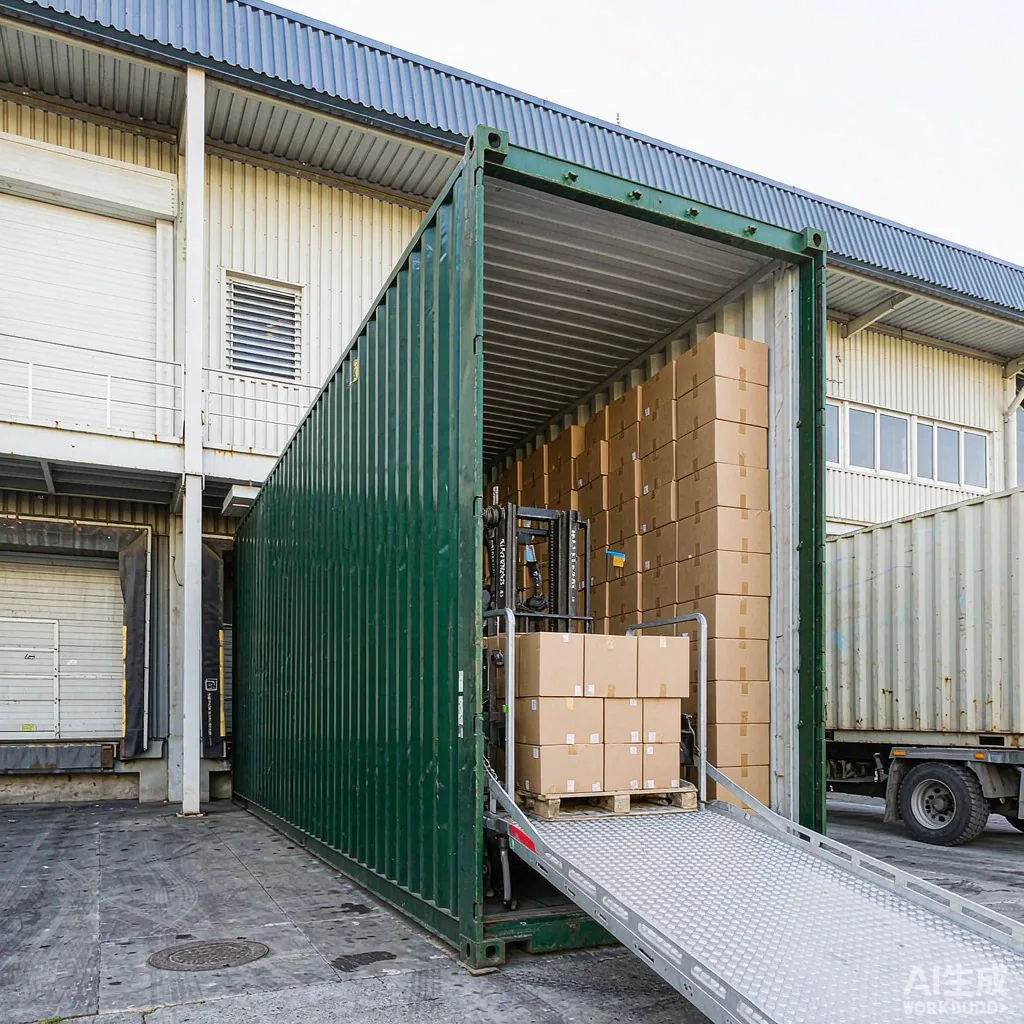
Freight behaviour deserves attention in its own right, because knitted bags are bulky rather than heavy. A flat-packed 8-litre tote weighing 210 g will typically fill a container long before it reaches any weight limit, so cubage drives the cost. A carton holding 40 pieces at roughly 0.096 cubic metres means about 290 cartons, roughly 11,600 pieces, fill a 20 ft container reasonably well.
- Confirm HS classification with a licensed broker before agreeing to a price, since duty treatment varies by material surface and intended use.
- Ask for carton dimensions and gross weight in the RFQ, then compute chargeable volume before comparing freight options.
- Add bank processing charges to the model; an international wire commonly carries roughly USD 25 to 45 in fees across both banks.
- Include third-party inspection cost, which is small relative to the order and large relative to a rejected shipment.
- Model a currency band rather than a single rate, because settlement usually happens 60 to 90 days after price agreement.
Finally, model the defect cost, not just the defect rate. If inspection allows a certain proportion of minor defects at AQL 2.5 under ISO 2859-1, decide in advance whether those units go to a secondary channel, are credited at cost, or are replaced. Writing that decision into the purchase order turns a possible argument into a process.
Lead-Time Risk: Where Programmes Actually Slip
Knit bag lead time is two fixed anchors plus everything around them: 7 working days sampling from file approval and 30 days bulk production from sample sign-off, with the variables being sample courier time, export documentation, vessel space availability, ocean transit and the buyer's own internal approval queue.
The buyer's internal queue is usually the largest hidden variable. Two working days of silence while a sample waits for sign-off costs more calendar time than most production steps, and it repeats at every revision. Setting an internal service-level agreement — for example, no sample sits more than 48 hours — often shortens a programme more than any negotiation with the partner does.
- Sampling from file approval
- 7 working days
- Bulk production from sign-off
- 30 days
- MOQ
- 100 pcs per style or colourway
- Inspection standard
- AQL 2.5, ISO 2859-1
- Reference trade term
- FOB Xiamen, CIF or DDP available
- Capacity
- 7 production lines, about 200,000 pcs per month
- Programme experience
- coordinating knit bag programmes since 2014
- Peak-season buffer
- add roughly 2 weeks around the Lunar New Year window
Seasonality deserves a specific line in the plan. Chinese New Year and the weeks either side of it compress ocean drying, container availability and inland haulage, so programmes that must be on shelves in early spring generally need to clear Xiamen before the holiday window. A small schedule buffer here almost always costs less than the air freight alternative.
Payment Terms, Contracts and What Belongs in Writing
The most common arrangement for a first order of this size is 30% deposit with the balance against a copy of the bill of lading, moving to 30% deposit and 70% at sight once a track record exists; either way, the triggering document, the currency and the party paying bank charges should all appear in the pro forma invoice.
A letter of credit at sight costs more in bank fees and requires strict document compliance from everyone, which is sometimes exactly what a buyer wants on a large first shipment. It is rarely proportionate below roughly USD 50,000 of order value, where the fee stack tends to outweigh the security benefit.
Beyond payment, four clauses belong in every purchase order: an intellectual property clause covering artwork and machine files, a defective goods clause with a defined resolution mechanism, a late delivery clause with a defined remedy, and a confidentiality clause. None is expensive to write and each one removes an argument that would otherwise cost more than the order margin.
Compliance and Certification Checks Before Signing
Request compliance evidence as documents rather than claims: OEKO-TEX STANDARD 100 covering dyed yarn lots, a REACH Annex XVII declaration, a California Prop 65 statement for US-bound goods, and CPSIA lead and phthalate reports where bags fall into children's product definitions.
Each of those costs almost nothing to request before signing and a great deal to chase afterwards, because a missing declaration discovered at customs entry stalls the shipment while somebody tries to source it retrospectively. Request expiry dates too — a declaration issued three years ago might still be circulating in somebody's sales folder.
For European programmes, the ecodesign framework introduced by Regulation (EU) 2024/1781 is reshaping what importers have to be able to declare about durability and recyclability. Programmes for EU retail are covered in detail in the sustainable knit bags reference, and the acceptance criteria in the knit bag quality control reference.
Certificate numbers should resolve on the issuing body's own verification page. Filing a PDF without verifying it means a document can be expired, suspended or belonging to a different product line entirely, and nobody will notice until an auditor asks.
Ten Sourcing Mistakes That Cost Real Money
- Contacting vendors before the specification is frozen, which produces a wide quote spread that means nothing.
- Comparing unit prices across different incoterms, effectively comparing a domestic price against a delivered one.
- Omitting carton dimensions from the RFQ, so freight quotes arrive as estimates rather than commitments.
- Accepting a certificate PDF without resolving the number against the issuer's own database.
- Skipping a second sample round because the first one looked close enough on a screen.
- Assuming CIF transfers risk as well as cost, then discovering at claim time that risk passed at load.
- Leaving colour tolerance unstated, so the debate about whether panels match happens after production.
- Booking vessels during the Lunar New Year window with no buffer for the holiday shutdown.
- Holding samples internally for a week, then asking why the programme is late.
- Treating terms as fixed when deposits, balances and settlement currency are all negotiable levers.
Get a like-for-like quote
Send a dimensioned drawing, target quantity per colourway, destination port and required certifications. The team will return a line-by-line quote on FOB Xiamen with all eight cost rows shown separately, so it can be compared directly against any other shortlisted partner.
Frequently Asked Questions
What should a knit bag RFQ include?
An RFQ should carry sixteen fields, including a dimensioned drawing with tolerances, yarn specification including denier and recycled content, gauge stated as an E number, target grams per square metre, colour reference plus a Delta E limit, artwork files and their positions, the hardware list and the packing method.
How many mock-up rounds should a knit bag programme expect?
Plan for two. The first confirms silhouette, hand-feel and construction; the second confirms artwork placement, colour and dimension against the approved specification. Because a knit structure change is a machine-file change sampling in 7 working days, second rounds cost relatively little in time compared with cut-and-sew revisions.
What is the minimum order quantity for a knitted bag programme?
Knit programmes in China typically start at 100 pcs per style or colourway, which allows several colourways to be tested without deep commitment. The practical constraint is usually yarn dye lot size rather than machine set-up, so unusual shades occasionally carry a slightly higher workable minimum.
How long does a knit bag order take from sample approval?
Bulk production runs 30 days from sample sign-off, with sampling taking 7 working days from file approval. Everything else is variable: courier time, export documentation, vessel space, ocean transit and your own internal approval queue, which is frequently the largest hidden delay in the chain.
Which trade term should first-time buyers use?
FOB Xiamen is the cleanest reference because risk and cost both transfer on board at load, making comparisons straightforward. CIF suits buyers new to freight forwarding since the seller arranges carriage and insurance, though risk still passes at load. DDP suits those wanting one delivered number.
Does CIF transfer risk to the seller?
No. Under CIF the seller pays freight and insurance, but risk still transfers when goods pass on board at the load port. If cargo is lost at sea, recovery happens through the insurance arranged by the seller. Buyers assuming CIF means seller risk until delivery frequently discover otherwise at claim time.
How do I compare two quotes that both look complete?
Normalise eight rows: unit price, programming charge, sampling cost and whether it credits back, packaging, inspection, inland haulage to port, documentation fees and payment terms. Differences almost always sit in an invisible row rather than in the headline unit price, so ask for each row separately.
What HS code applies to imported bags?
Most bags are classified in HS heading 4202 for travel, sports and similar bags, with the subheading driven by outer surface material and intended use. Classification is the importer's responsibility in most jurisdictions, so confirm it with a licensed broker before agreeing a price rather than at customs entry.
How much gets set aside for third-party inspection?
Rather than a fixed sum, treat inspection as a small fixed proportion of order value that buys avoidance of a far larger loss. Cost scales with man-days of inspection, usually one to two days per shipment at AQL 2.5 under ISO 2859-1, plus any laboratory testing for confirming the ISO 12947-2 and ISO 13934-1 targets.
What payment terms are typical for a first order?
Thirty percent deposit with the balance against a copy of the bill of lading is most common for a first order, shifting toward open account terms once a track record exists. Whatever is agreed, the pro forma invoice should name the triggering document, settlement currency and which party pays bank charges.
Is a letter of credit worth it for bag orders?
Below roughly USD 50,000 of order value, the fee stack tends to outweigh the security benefit, so a telegraphic transfer with a deposit is often more sensible. Above that, or where the relationship is untested, an at-sight letter of credit buys document discipline and payment security worth having.
How can I check whether a partner's certificates are genuine?
Resolve every number on the issuing body's own verification page rather than filing the PDF. OEKO-TEX STANDARD 100 certificates, Global Recycled Standard transaction certificates and audit references can all be checked online, including whether the document is current or suspended and whether it covers the product.
Which lead-time risks catch buyers out most often?
Internal approval queues and the Lunar New Year window. Samples sitting for a week awaiting sign-off cost more calendar time than any production step and repeat every revision. Separately, container availability and inland haulage compress sharply around Chinese New Year, so shipping before the holiday requires real buffer.
Should I ask for liability insurance and which amount?
Ask for product liability coverage naming the buyer where practical, with limits proportionate to retail exposure. More immediately, carry your own all-risks marine cargo policy set at 110% of invoice value, since under both FOB and CIF the buyer carries real exposure during the sea leg.
How much does sample cost, and is it refundable?
Sample charges vary with artwork complexity and whether custom yarn is dyed. What matters more than the amount is whether it credits against the bulk order, because credited sampling encourages iterative development rather than one risky shot. Always ask this explicitly, since some shortlisted partners include it and others do not.
What should be written into the purchase order beyond price?
Four clauses matter most: intellectual property covering artwork and machine files, defective goods with a defined resolution mechanism, late delivery with a stated remedy, and confidentiality. Each costs nothing to write and removes an argument that would otherwise be more expensive than the margin earned on the order.
People Also Ask
How do I start sourcing knitted bags from China?
Freeze a dimensioned specification first, including gauge, yarn count and grams per square metre, then issue a sixteen-field RFQ. Shortlist three partners on audit reports and current test evidence, compare quotes across eight cost rows, then select Incoterms 2020 and confirm HS classification with a licensed broker.
What is landed cost and why does it matter more than unit price?
Landed cost adds freight, insurance, duty, port charges, customs entry fees, inland delivery and bank charges to the invoice value, then divides by saleable units. It matters because a construction quoting a lower unit price can carry higher cutting waste, heavier cubage or longer assembly time that defeats it.
Which Incoterms 2020 rule is safest for bag imports?
FOB Xiamen is safest for most programmes because risk and cost transfer together on board at load, keeping cargo and freight decisions visible. DDP offers simplicity but hides duty and delivery cost inside one number, which makes future comparisons harder.
How do I control quality before shipment leaves China?
Specify test targets in the RFQ, typically ISO 12947-2 abrasion and ISO 13934-1 tensile, then require a pre-shipment inspection to AQL 2.5 under ISO 2859-1. Decide in advance whether minor-defect units are credited, replaced or sold through a secondary channel.
How many suppliers should I shortlist for one bag programme?
Three is usually right: enough to test assumptions about gauge and yarn capability, few enough to keep RFQ quality high. Below three, there is no reference for whether a quote is realistic; above five, response discipline drops because each partner senses a low award chance.
Sources and further reading
Every figure on this page is either our own programme data or attributed below. Open the originals before you write them into a specification.
- Incoterms® rules — official ICC pageInternational Chamber of Commerce (ICC) The eleven rules, first published in 1936 and revised as Incoterms 2020; always cite the rule with its edition and named place.
- ISO 2859-1 — Sampling procedures for inspection by attributes indexed by AQLISO Basis of the AQL 2.5 pre-shipment inspection standard referenced throughout this guide.
- OEKO-TEX STANDARD 100OEKO-TEX (Hohenstein) Certificate numbers issued here resolve on the OEKO-TEX verification page, which is how buyers should confirm authenticity.
- Standards and certification programmesTextile Exchange Issuer of the Global Recycled Standard behind recycled PET yarn claims and transaction certificates.
- Proposition 65 in plain languageCalifornia OEHHA Source for the Prop 65 clear and reasonable warning obligations applying to bags sold in California.
- Regulation (EU) 2024/1781 — Ecodesign requirements for sustainable productsEUR-Lex (European Union) Why European importers increasingly need declared durability and recyclability data before accepting a shipment.
Putting the Order to Work
The six judgements in this guide are only useful if they survive contact with a real calendar. Write the order down, assign an owner to each judgement, and put the dates where everyone contributing to the programme can see them — including internal reviewers, whose turnaround is usually the least visible and most expensive step in the chain.
Then keep the paperwork discipline for every subsequent drop. Approximately ninety percent of sourcing disputes trace back to something that was discussed and never written down: a tolerance, a colour limit, an incoterm edition or a defect resolution path. The programas that run smoothly are not necessarily the ones with the lowest unit price; they are the ones where both sides are pricing from identical information.
Finally, revisit the model after the first shipment rather than the tenth. Actual carton cubage, actual customs entry fees and actual defect proportions will disagree with the estimates, and two rounds of correction usually bring landed cost modelling within a percentage or two of reality — after which it becomes a genuinely useful planning tool.