Knitted Bag Collection: Twelve Silhouettes, Their Capacity Windows and the Structure Decisions Behind Each One
A knitted bag collection runs from a 1 L pouch to a 32 L travel duffel, and every silhouette in that range can be knitted to shape on the same flat-bed equipment. Twelve shapes cover most commercial briefs: tote, shopper, backpack, crossbody, duffel, laptop sleeve, pouch, bucket, shoulder, gym, beach and mini. The silhouette decides three things only: how much load the panels carry, where that load enters the body, and what the opening has to survive. Choose by capacity window and load path first; gauge, stitch and gsm follow from that decision, not the other way round.
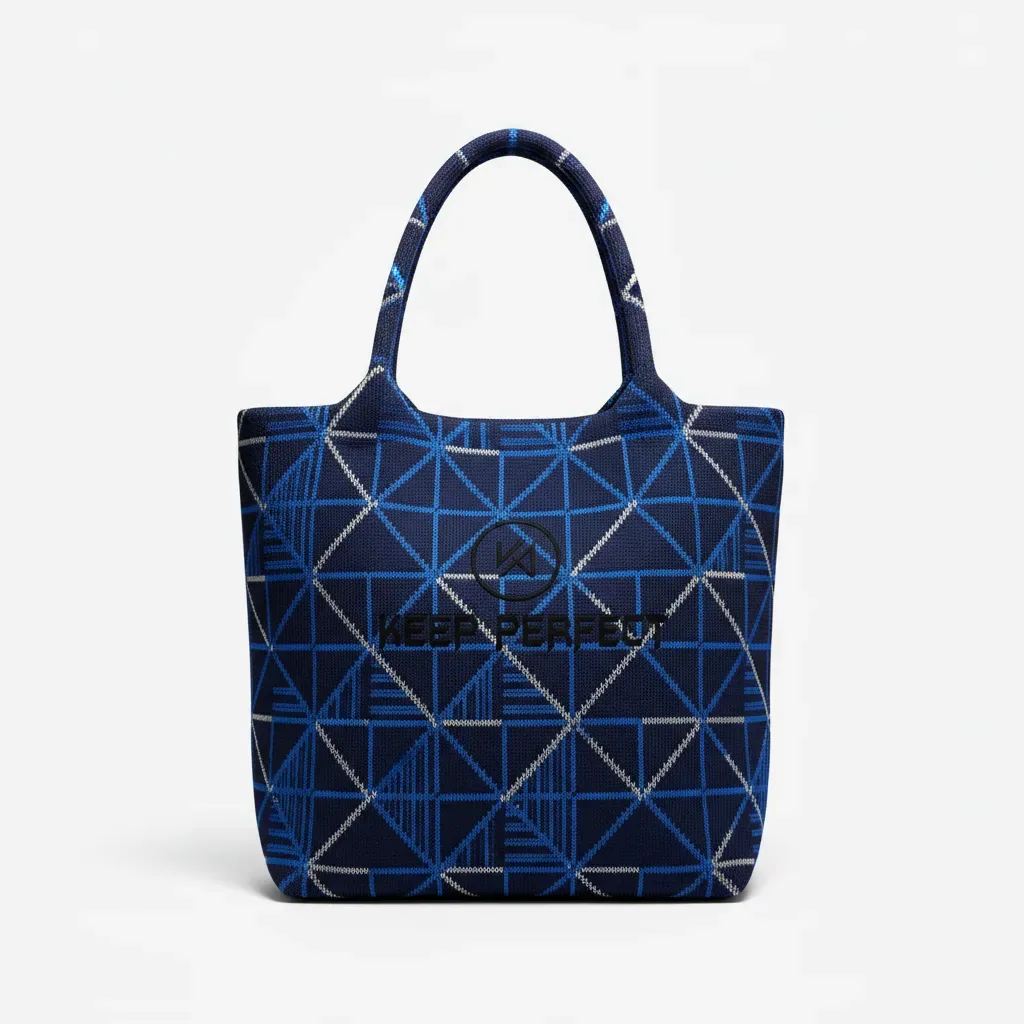
How to Read a Knitted Bag Collection: Six Checks Before You Shortlist a Shape
Read any knitted bag collection by capacity, load path, opening, gauge, finish and repeatability, in that order. Capacity and load path decide whether a shape survives its first month in the field; everything after that is a cost lever or a look. Running the six checks in sequence normally removes about two thirds of the silhouettes that look right in a photograph and fail in a wet rub test or a strap pull.
The six checks below are the same ones used to turn a buyer sketch into a quotable tech pack. Each has a pass mark, and each has a reason it sits where it does in the sequence.
- Capacity first, stated in litres rather than adjectives. A 12 L shopper and a 16 L shopper differ by about 30% yarn weight and by one extra row of handle reinforcement, which moves both the unit cost and the handle test result.
- Second, the load path: name the weight the bag normally carries, not the weight it survives once. A 2 kg daily load needs roughly 400 N of handle break force; a 6 kg gym load wants a webbing-backed strap path reaching 900 N.
- Third, the opening. Zip, magnetic snap, drawcord or open top changes the collar structure, and the collar is where most returns and most grading decisions start.
- Fourth, the gauge band. E7 gives a coarse, high-surface low-cost body for beach and shopper shapes; E12 to E14 gives the finer definition needed for laptop sleeves and minis.
- Fifth, the finish. Steam boarding, silicone wash or nothing at all moves dimensional change by 2% to 4% and changes how the same panel reads under retail lighting.
- Sixth, repeatability: can the shape be knitted at the same loop length on every repeat? If the answer depends on one technician, put that risk into the programme plan before quoting.
The Twelve-Silhouette Map, with Capacity Windows and Gauge Bands
Eight carry-load shapes, three organisation shapes and one packable mini cover the commercial range of a knitted bag collection. The table below gives each silhouette a capacity window, a gauge band, its usual yarn count and the single structure note that most often decides it. Read it as a starting position, not a rule: every row has been moved at least once to suit a real brief.
| Silhouette | Capacity window | Gauge band | Typical yarn | Structure note |
|---|---|---|---|---|
| Tote | 10-14 L | E7-E12 | 600D rPET | Handles knitted into the body web, no separate webbing |
| Shopper | 16-22 L | E7 | 600D recycled polyester | Boxed corners and a wider base panel |
| Backpack | 14-20 L | E12 | 600D rPET plus webbing | Two-layer shoulder yoke carrying the strap load |
| Crossbody | 3-6 L | E12 | 300D rPET | Webbing channel run across the gusset to the base |
| Shoulder | 8-12 L | E12 | 300D recycled nylon | Single webbing anchor taken to the base panel |
| Duffel | 24-32 L | E7-E12 | 600D rPET | Full-length zip set into a knitted-in placket |
| Laptop sleeve | 13-15 in device | E14 | 300D rPET plus spacer zone | Foam-backed spacer panels at the two corners |
| Pouch | 1-3 L | E14 | 300D recycled nylon | Zip set into a knitted collar rather than a facing |
| Bucket | 8-12 L | E12 | 600D rPET | Drawcord channel with an eyelet row above it |
| Gym | 18-24 L | E7 | 600D recycled nylon | Mesh vent zones knitted into the gusset |
| Beach | 26-34 L | E7 | 600D rPET | Open top, no hardware, machine washable |
| Mini | 1-2 L | E14 | 300D recycled nylon | Detachable wrist strap loop knitted at the side |
Notice how few different inputs the twelve rows need: three gauge bands, two yarn counts and one fibre family. That is the real commercial argument for a knitted bag collection. A cut-and-sew range of the same twelve shapes would need twelve pattern sets, several fabrics and a far longer critical path.
Where Each Silhouette Actually Gets Used
Silhouettes earn their place in a knitted bag collection through the channel they serve. Fitness, gifting and commuter programmes pull different shapes to the top of the list, and the same shape behaves differently once it carries a logo, a full pack-out or a wet towel.
Tote and shopper
Gift-with-purchase, museum and event programmes where the print face matters most. As large single panels, tote bodies also take the cleanest jacquard branding.
Backpack and gym
Commuter and fitness channels where strap comfort and venting decide repurchase. Thestrap path, not the body fabric, is the part usually upgraded first.
Crossbody and shoulder
Travel retail and concession channels with a tight price architecture. Small bodies let you spend the money on hardware and still hold landed cost.
Laptop sleeve and pouch
Corporate and electronics channels where the capacity is decided by the device, not by the buyer. Dimensional tolerance here is tighter than anywhere else in the range.
Bucket and mini
Fashion-led drops that live or die on silhouette. Lower volumes, tighter colour matching, more frequent repeats with small changes.
Duffel and beach
Travel and resort programmes with the highest load expectations. These two shapes drive most of the structural work done on any collection.
Load Paths: Handles, Straps and Where Reinforcement Belongs
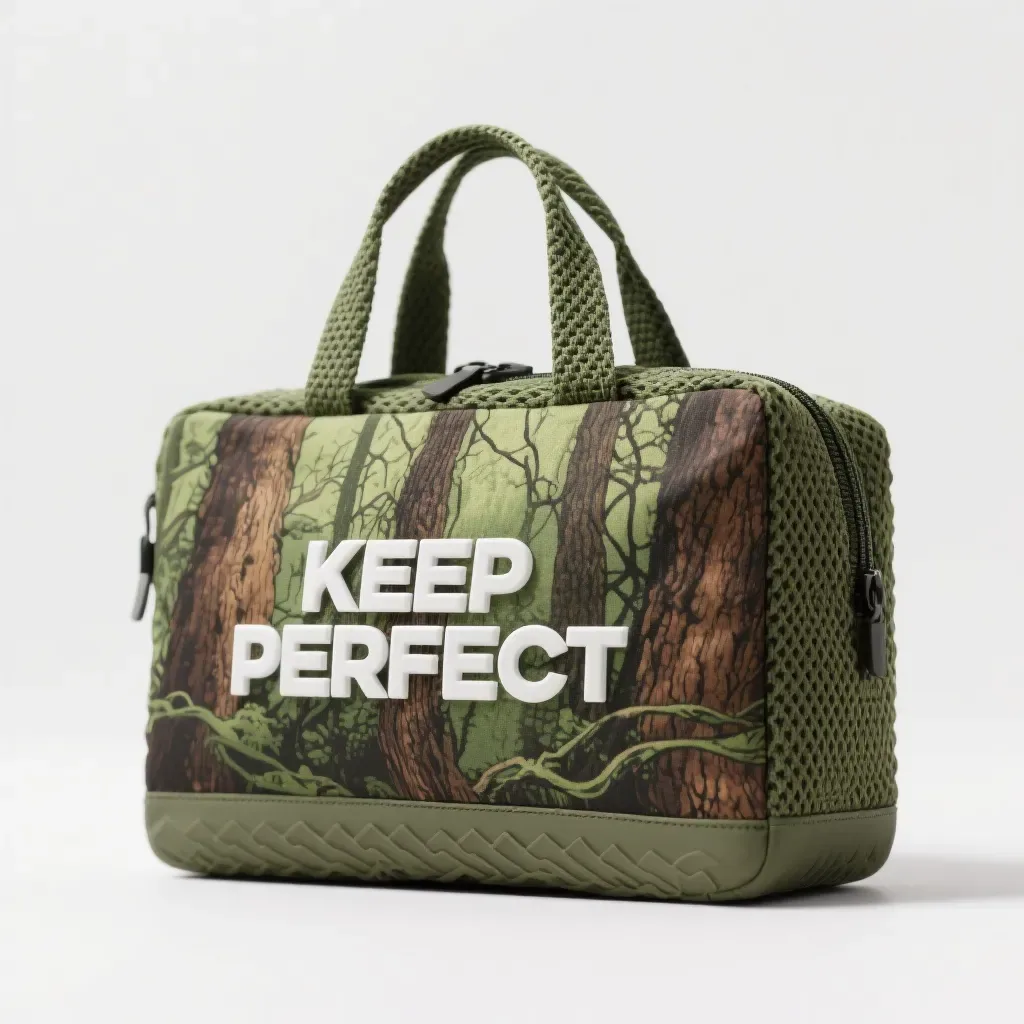
Every knitted bag fails where load enters the body, not in the middle of a panel. Handle roots, strap anchors and base corners carry concentrated stress, so those zones get thicker yarn, an extra course density or a webbing take-up. Reinforcement is placed, not spread: adding weight across the whole body costs more and usually tests worse than strengthening five local zones.
- Integral handles are knitted directly out of the body web, which removes two joining operations and one failure point; they suit loads up to about 3 kg.
- Webbing-backed handles take a 25 mm polyester webbing through the knitted channel and lift the practical limit to roughly 8 kg without adding visible bulk.
- Base corners on totes and shoppers get a denser course count rather than a second layer, because a second layer changes how the body folds and packs.
- Strap anchors on backpacks run continuously into the base panel; stopping the webbing short of the base is the single most common cause of a strap tear test failure.
- Drawcord channels on bucket shapes need an eyelet row set one course above the cord, or the cord cuts through the loop within a season.
- Handle break force
- 400 N minimum on a 25 mm webbing-backed handle root
- Shoulder strap path
- 900 N minimum, strip method to ISO 13934-1
- Panel tear resistance
- 25 N minimum, ISO 13937-2
- Abrasion resistance
- 20,000 rubs to breakdown, ISO 12947-2
- Wet and dry rubbing
- Grade 4 minimum on dark colourways, AATCC TM8
- Dimensional change
- within 3% after laundering, AATCC TM61
Openings, Closures and Hardware That Survive Knit Construction
An opening is a hole cut into a structure that was knitted to be continuous, so the collar around it has to be designed before the body is programmed. Zips need a stable placket, magnetic snaps need a backing plate, drawcords need a channel that will not stretch. Hardware itself is a small line in the cost plan; the engineering that stops it tearing out is where most of the development time goes.
- Zipped collars: set the tape into a two-course placket knitted at higher density, and test the slider pull cycle count before booking bulk hardware.
- Open tops: the leanest option in material terms and the most washable, but they rely entirely on body stiffness; they suit beach and shopper shapes and nothing else.
- Drawcords: fine with a knitted channel plus one row of metal eyelets, poor with a simple turned hem.
- Magnetic snaps: require a hidden backing plate, which adds one operation and roughly one gram each.
- Metal feet and D-rings are usually the last items removed when a cost target tightens, because they contribute least to field failures.
Across a working range, the collar and the handle root account for the majority of field failures, not the body fabric. Spending the structure allowance in those two zones buys more real durability than increasing the gsm of the whole panel.
Gauge, GSM and Stitch Structure by Shape
Gauge is the number of needles per inch on the machine bed, and it sets the loop size, the surface definition and how much yarn a shape consumes. Three bands cover almost every commercial brief. E7 produces a coarse, robust body with visible loop structure; E12 is the default for bags that must hold shape; E14 gives the fine surface used where branding detail or device fit matters.
- E7
- about 4.5 loops per cm, 520 gsm, open handle, best for beach and large shopper bodies
- E12
- about 6.5 loops per cm, 420 gsm, the default for backpacks, totes and duffels
- E14
- about 8 loops per cm, 320 gsm, used for laptop sleeves, pouches and minis
- Stitch families
- jersey, rib, interlock, spacer and pointelle; most bags use two in one body
- Loop length tolerance
- held within 0.3 mm target or panels read as two different colours after boarding
Tolerance and Fit: What Two Millimetres Means on a Knitted Body
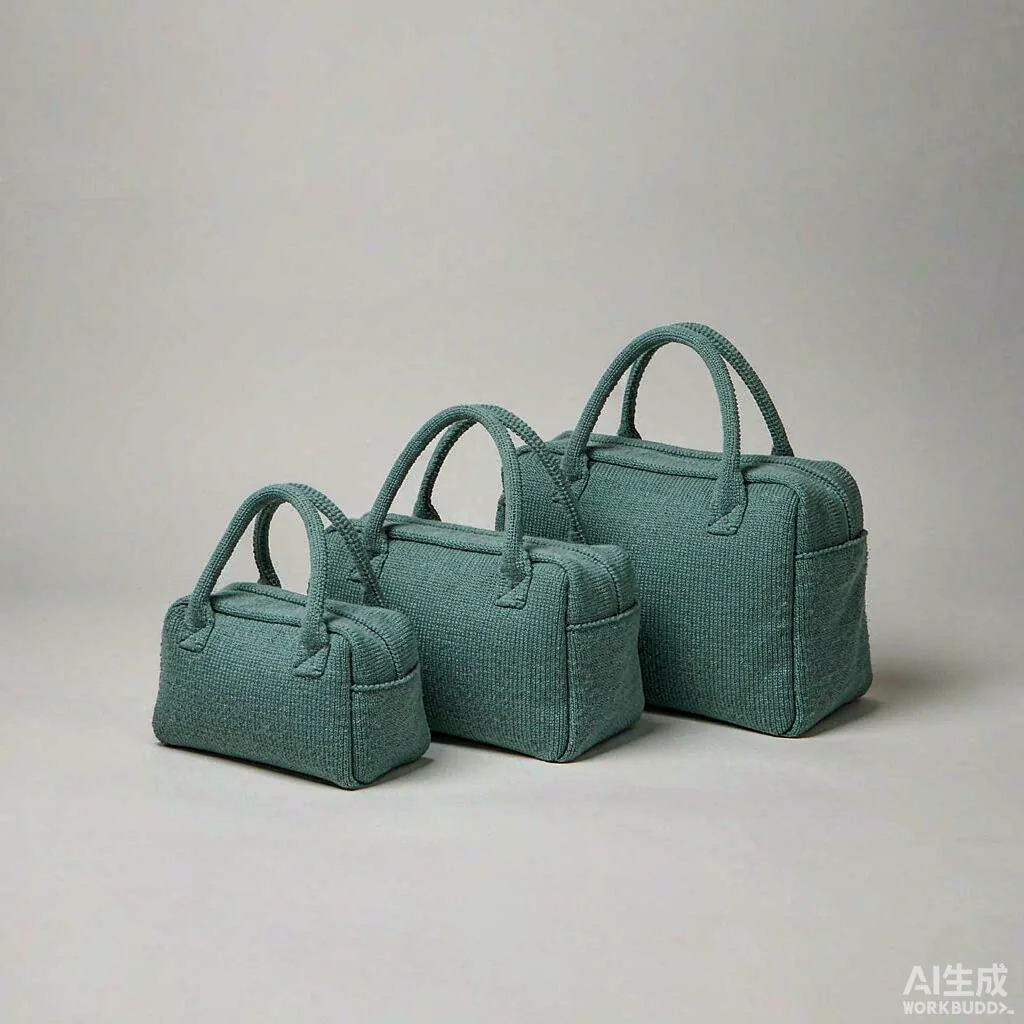
Knitted bodies hold a tolerance of roughly plus or minus 2 mm on a dimension under 400 mm, and that tolerance widens with size. A laptop sleeve is the tightest item in any knitted bag collection because it has to fit a rigid object: a 14 in device needs about 12 mm of planned fitting gap, otherwise the sleeve fights the zip on every use. Everything larger can be specified by capacity rather than by exact measurement.
Dimensional behaviour also depends on what happens after knitting. Steam boarding relaxes the loop and stabilises the panel; without it, a body that measured perfectly on the machine can move 3% before it reaches a carton. Written tolerance bands belong on the tech pack, not in an email.
Splits, Colourways and How MOQ 100 pcs per Style Works Across a Range
Commercial planning for a knitted bag collection rests on four locked figures: MOQ 100 pcs per style or colourway, sampling in 7 working days, bulk production in 30 days and inspection to AQL 2.5 under ISO 2859-1, shipped FOB Xiamen or CIF or DDP on request. The low minimum is what makes a twelve-shape test viable at all.
- MOQ 100 pcs applies per style and per colourway, so three colours of one shape is a 300 pc order, not a 100 pc one.
- Sampling runs 7 working days from an approved brief; structural changes restart the clock, colour-only changes usually do not.
- Bulk production runs 30 days; CIF and DDP are quoted alongside FOB Xiamen for buyers who want landed figures.
- Inspection follows AQL 2.5 to ISO 2859-1, with a pre-shipment report issued before release.
- Capacity sits at 7 production lines and about 200,000 pcs per month, coordinated since 2014, which sets how big a single drop can be.
The Pre-Quote Checklist for Any Knitted Bag Collection
A buyer who sends the items below receives a firm quote in the first reply rather than three rounds of questions. Eight lines of information are enough to price, engineer and sample any shape in the range, provided the capacity figure and the target landed cost are both present.
- Silhouette list with a sketch or reference photo for each shape.
- Capacity in litres, or device size where the shape carries electronics.
- Normal carried load, in kilograms, per shape.
- Preferred closure: zip, drawcord, magnetic snap or open top.
- Opening colour standard, ideally a Pantone reference for each colourway.
- Branding method: jacquard knit, woven label, print or metal badge.
- Quantity per style and per colourway, plus expected repeat volume.
- Incoterm target and destination port, so the quote can be built correctly.
Testing Each Silhouette Before You Commit
Testing a knitted bag collection before booking bulk costs little and removes most of the surprises. The critical tests are abrasion, strip tensile at the strap and handle roots, colour transfer wet and dry, and dimensional change after laundering. Run them on production-intended material, not on a lab sample knitted from a different lot.
Minimum test set per silhouette
- Abrasion to ISO 12947-2 at the load path, not on a flat untouched area.
- Strip tensile to ISO 13934-1 at every handle root and strap anchor.
- Colour transfer wet and dry to AATCC TM8, graded at 4 minimum on darks.
- Dimensional change to AATCC TM61 after the agreed wash cycle.
- Pre-shipment inspection to AQL 2.5 under ISO 2859-1 on every lot.
Sampling Timeline and Repeat Orders for a Seasonal Range
A twelve-shape seasonal range does not need twelve sequential samples. Because the shapes share a platform, most samples can be knitted in one scheduling pass, which keeps the whole development cycle inside a single 7 working day sampling window for the first drop. Revision rounds then cover fit and finish rather than structure, and later seasons start from the stored programme file rather than from a blank sheet.
Request a quote for your knitted bag collection
Send the silhouette list, target capacities and quantities per colourway. We return a completed tech pack skeleton and a firm FOB Xiamen quote covering all twelve shapes in the first reply. Start on the contact page.
Building Twelve Styles Without Twelve Tooling Bills
The economics of a knitted bag collection come from sharing inputs. One yarn platform, one colour card, one gauge family and one test protocol can produce twelve certified shapes, which is why the minimum stays at MOQ 100 pcs per style while a cut-and-sew equivalent normally asks for far more per shape. The next step is to set the yarn platform, and the step after that is to lock the structure decisions for the two shapes with the heaviest load. See knit bag materials and yarns for the yarn side, custom knit bag programmes for how the order runs, and seamless knit bag construction for how the bodies are knitted to shape.
Frequently Asked Questions
What is a knitted bag collection in B2B terms?
In B2B terms, a knitted bag collection is a set of silhouettes sharing one yarn platform, one gauge family and one colour card, so they can be quoted, sampled and produced as a single programme instead of twelve separate lines. A typical opening range carries six to twelve shapes spanning roughly 1 L to 32 L, knitted from 300D or 600D recycled polyester across E7 to E14 gauge bands.
How many silhouettes should a first knitted bag collection carry?
Start with four to six shapes: one carry hero such as a tote or backpack, one organisation piece such as a pouch, one small fashion shape such as a crossbody or mini, and one large load shape such as a duffel. Six shapes give enough range to read as a coherent offer, and the full twelve can be opened later from the same stored programme file.
Which gauge suits a knitted tote bag?
E7 suits larger totes where surface texture and lowest yarn consumption matter; it typically lands around 520 gsm. E12 suits totes that must hold shape upright when empty, landing near 420 gsm with better print and jacquard definition. Most promotional totes sit at E12, while beach and resort shapes move down to E7 for a coarser handle.
Can one knit programme produce both a pouch and a duffel?
Yes, because knitting is programmable: a pouch at E14 and a duffel at E7 are different files on compatible equipment rather than different production lines. What they share is the yarn platform and colour card. What they do not share is the loop length target, so both need their own measurement record before repeat orders run.
What capacity should a shopper be for a promotional gift programme?
Most promotional gift briefs land between 16 L and 22 L, which is large enough to hold an A4 folder and a water bottle and still small enough to keep unit cost and shipping volume under control. Below 16 L the shape competes with a tote; above 22 L the body needs base stiffening that gift programmes rarely want to pay for.
How much weight can a knitted shoulder bag carry?
A single strap anchored into the base panel comfortably carries 4 kg to 6 kg of daily load. The limiting factor is rarely the body fabric and almost always the anchor point: a webbing path taken through to the base tests near 900 N, while the same strap stopped short of the base fails well below that figure.
Are handles knitted in or added later?
Both are common and both are designed differently. Integral handles are knitted directly out of the body web, removing two joining operations, and suit loads to roughly 3 kg. Added webbing handles are fed through a knitted channel, cost two extra operations and lift the practical limit to about 8 kg for shoppers and gym shapes.
Which closure lasts longest on a knitted backpack?
A covered zip set into a dense two-course placket lasts longest, because the placket takes the slider load instead of the loop structure. The alternative is a drawcord with an eyelet row, which lasts well but gives weaker security. Whichever you choose, specify the slider cycle count on the tech pack and test the assembled bag, not the zip tape alone.
How do you stop a knitted duffel collapsing when empty?
Stiffen the base and lower panels rather than the whole body: a denser course count at the base, plus a webbing path carried along the two lower corners, keeps the shape readable. Adding gsm across the bag instead is heavier, more costly and flattens the handles, so it tends to trade one problem for two.
What is the minimum order for a knitted bag collection?
MOQ is 100 pcs per style and per colourway. That means one shape in three colours is booked as 300 pcs, while three different shapes at 100 pcs each is also 300 pcs. The low minimum exists because all shapes share one yarn platform, so no separate fabric run or pattern cost has to be recovered from a single style.
How long does sampling take for a new knitted bag shape?
Sampling takes 7 working days from an approved brief. Colour-only revisions can often be handled inside the same window, whereas a structural change such as moving from an open top to a zipped collar restarts Development because the panel file changes. Hardware-dependent samples can also depend on the sourcing time for the finished metal parts.
Does a laptop sleeve need a different knit structure?
Yes, mainly because it has to hold a tight fit against a rigid object. Sleeves run at E14 with a 320 gsm body, a fine loop structure and often a foam-backed spacer zone at the two corners. Plan about 12 mm of fitting gap over the device dimensions, or the sleeve will fight the zip and strain its own closure on every use.
People Also Ask
What sizes do knitted bags come in?
Commercial knitted bags run from a 1 L pouch through to a 32 L duffel, with totes at 10-14 L, backpacks at 14-20 L and shoppers at 16-22 L being the most frequently booked capacity bands across professional and gift channels.
Is a knitted bag strong enough for daily heavy use?
Yes, when the load path is engineered. A webbing-backed handle root tests to roughly 400 N and a continuous strap path to around 900 N, and bodies routinely pass 20,000 rubs to breakdown under ISO 12947-2 before they show any structural wear.
Which knitted bag shape sells best as a gift?
Totes at 10-14 L and shoppers at 16-22 L dominate gift programmes, because they give the largest unbroken print or jacquard panel per unit cost and they fold flat for shipping and for storage at the destination.
Can different shapes share the same colour?
Yes, provided they are knitted at compatible loop lengths and from the same yarn lot. A single Pantone target across several shapes is normal, and colour continuity across a collection is one of the strongest reasons to keep the whole range on one yarn platform.
How much does a knitted bag range cost to develop?
Development is absorbed by the programme rather than charged per shape. Sampling takes 7 working days, and because every silhouette uses the same platform, adding a twelfth shape does not add a twelfth set of tooling costs the way a cut-and-sew equivalent would.
Sources and further reading
Every figure on this page is either our own programme data or attributed below. Open the originals before you write them into a specification.
- ISO 12947-2:2016 Abrasion resistance of fabrics by the Martindale methodISO Test method cited for the 20,000 rub abrasion target used on knitted bag load paths.
- ISO 2859-1 Sampling procedures for inspection by attributes, AQL-indexed schemesISO Standard behind the AQL 2.5 pre-shipment inspection applied to every production lot.
- AATCC standard test methods and proceduresAATCC Source for AATCC TM8 wet and dry crocking and TM61 laundering colour fastness referenced here.
- WHOLEGARMENT knitting technology and its supply chain effectShima Seiki Explains why different silhouettes can be knitted to shape on one programmable platform.
- amfori BSCI social risk management overviewamfori Audit framework commonly requested by retail buyers alongside product quality inspection.
For the full picture: seamless knit bag construction explains how bodies are knitted to shape, knit bag quality control and testing sets out the inspection protocol, and knit bag sourcing covers how a collection is planned from concept to repeat order.