Knit vs Traditional Bags: How a Seamless Knitted Structure Compares with Canvas, Woven Polyester, Leather, Nylon, Neoprene, Felt and Mesh
Knit vs traditional bags is decided on four measurable axes: unit cost, finished weight, cutting waste and development speed. A seamless knitted tote body leaves the machine as one near-net-shape panel in roughly 9 minutes at E7 gauge, replacing 18 to 24 cut pieces and 15 to 22% cutting waste. Canvas of comparable carrying duty weighs about 407 g/m², against 320 g/m² for a 600D knitted shell. Knit programmes start at MOQ 100 pcs per style or colourway, sample in 7 working days, ship bulk in 30 days, and are inspected to AQL 2.5 under ISO 2859-1 before FOB Xiamen loading.
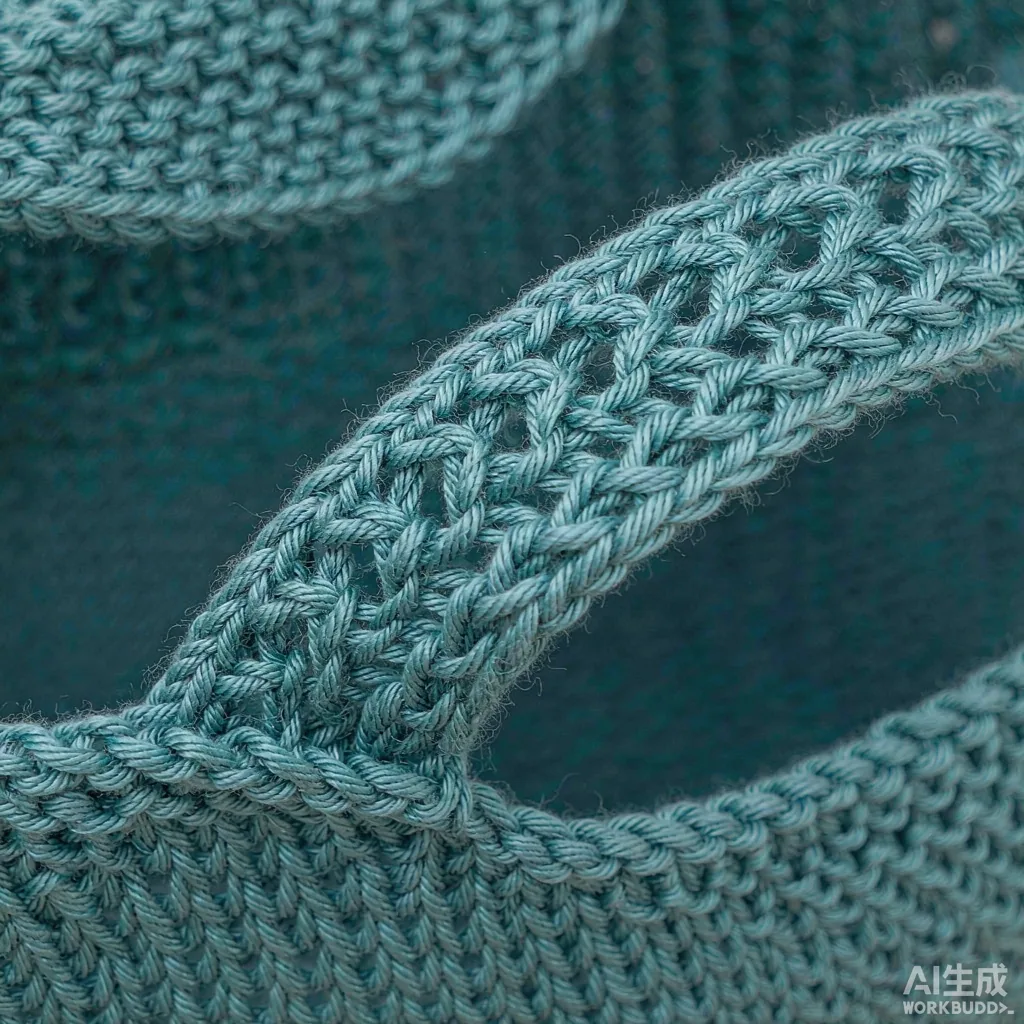
Key takeaways before the numbers
- Unit cost follows assembly minutes, not yarn invoice price: one knitted body panel replaces 18 to 24 cut pieces and removes roughly half the sewing time.
- Weight tracks substrate and construction together: 320 g/m² knitted PET shell versus 407 g/m² cotton canvas at comparable carrying duty.
- Cutting waste is the quiet cost line: 2 to 4% for near-net-shape knitting against 15 to 22% for cut-and-sewn woven programmes.
- Durability must be specified as numbers: 30,000 Martindale rubs (ISO 12947-2), 620 N tensile (ISO 13934-1), Grade 4 rubbing fastness (ISO 105-X12).
- Commitment stays small with knit: MOQ 100 pcs per style or colourway, 7 working days sampling, 30 days bulk production, AQL 2.5 inspection.
How Should Buyers Read This Comparison?
Read knit vs traditional bags on four axes — unit cost, finished weight, material waste and development speed — because every other difference between knitted and traditional construction flows directly from those four variables.
Most buyer teams open with unit price and stop there. That approach hides two thirds of the real cost picture. Unit price is quoted at the loading port, but landed economics are set much earlier, at stitch programming, marker planning and the cutting table. A knitted body is knitted straight to its final silhouette, so there is no marker to nest and almost no offcut to bin. A woven or canvas body starts life as a roll, and the roll geometry dictates how much of it survives the table.
Weight behaves in the same way. A tote that must carry 8 kg of groceries or a 15-inch laptop does not need the same density everywhere. Knitting lets stitch density vary inside a single panel, so reinforcement sits under the handle root while the side walls stay lighter and more flexible. Cut-and-sew construction applies one substrate across the whole panel and adds reinforcement by layering, which adds mass to areas that never needed it.
Development speed is the fourth axis and the one that most often decides the answer. Changing a knit structure means changing a machine file; changing a sewn silhouette means new patterns, a new sewing sequence and a second sample round. Teams that drop new colours every quarter feel that difference most. For programmes already past shortlisting, the knit bag sourcing guide covers RFQ structure, and the knit bag materials reference goes deeper on yarn and gauge selection.
Unit Cost: Where the Money Actually Goes
Unit cost for a bag programme tracks assembly minutes and cutting yield far more closely than it tracks yarn price, which is why a one-piece knitted body needing 4.5 minutes of sewing routinely lands below a sewn canvas equivalent needing 11 minutes on the line.
Break any quote into four buckets and the picture changes: material input mass, cutting loss, direct labour minutes and finishing operations such as binding, taping or turning. Canvas loses ground in buckets two and three. Leather loses badly in all four. Nylon ripstop and mesh win on material but pay it back in coating, lining and edge finishing because neither holds a load path on its own.
| Construction | Components before assembly | Sewing minutes per unit | Cutting waste | Unit-cost index |
|---|---|---|---|---|
| Seamless knit tote, E7 600D PET | 3 | 4.5 | 3% | 100 |
| Cotton canvas 12 oz | 12 | 11.0 | 18% | 118 |
| Woven polyester 600D PU coated | 14 | 12.5 | 21% | 112 |
| Split leather 1.2 mm | 18 | 19.0 | 22% | 240 |
| Nylon ripstop 70D | 9 | 8.0 | 14% | 105 |
| Neoprene 3 mm | 6 | 7.0 | 12% | 135 |
| Wool-blend felt 3 mm | 8 | 6.5 | 15% | 128 |
| Polyester mesh 220 g/m² | 10 | 9.0 | 16% | 96 |
The index column is the one to argue about internally. Mesh shows 96, lower than knitting, because the raw textile price is genuinely lower — but the mesh figure assumes a liner and binding elsewhere in the product, and those operations sit outside the index. Read the table as a starting hypothesis and then ask for a component-level quote breakdown from each shortlisted partner before deciding.
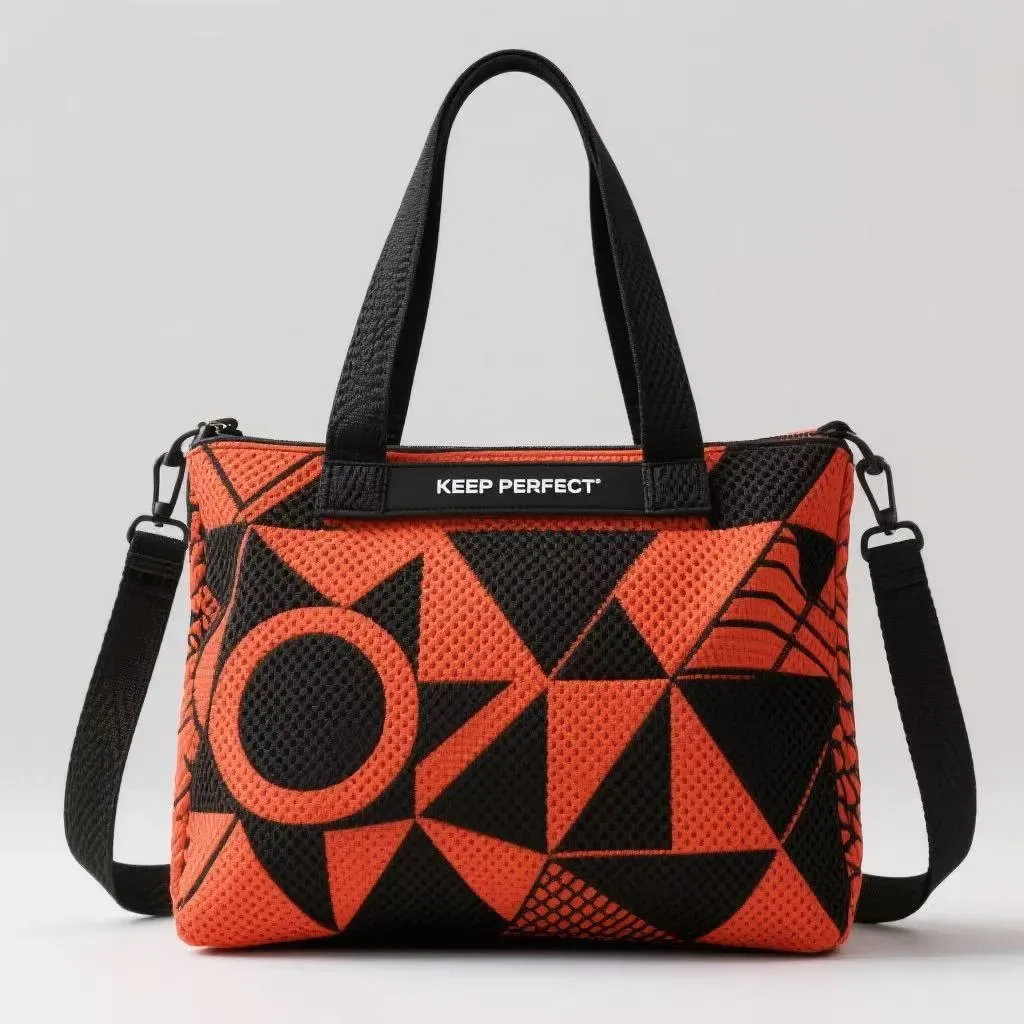
Weight and Carry Comfort at Equal Load
At equal carrying duty a knitted polyester shell sits near 320 g/m² while a 12 oz cotton canvas sits near 407 g/m², so switching construction typically removes 15 to 25% of empty bag weight before any trimming, hardware or fabric substitution is even considered.
- Knitted shell, 600D PET, E7
- 320 g/m², tolerance ±12 g
- Cotton canvas 12 oz
- 407 g/m²
- Woven polyester 600D PU
- 290 g/m², needs a liner
- Split leather 1.2 mm
- 780 g/m²
- Nylon ripstop 70D silicone
- 95 g/m², needs coating
- Neoprene 3 mm bonded
- 560 g/m²
- Wool-blend felt 3 mm
- 450 g/m²
- Typical empty 8-litre tote, knit
- 210 g
- Typical empty 8-litre tote, canvas
- 340 g
Those 130 grams matter more than they sound. On a 20,000-piece purchase order, removing 130 g per unit also removes about 2.6 tonnes of shipped mass, which shows up in freight quotes, in carton counts and, increasingly, in the emissions figures that EU importers have to report under the ecodesign framework introduced by Regulation (EU) 2024/1781.
Weight is not always the objective though. A floor-standing laundry hamper, a tool carrier or a presentation gift bag benefits from mass and self-supporting stiffness, and felt, neoprene or a laminated woven body will hold shape far better than an open knit structure without stiffener panels.
Waste, Cutting Yield and Component Count
Cutting waste is the cleanest single indicator of how efficiently a construction uses purchased material: near-net-shape knitting runs at 2 to 4% waste, while cut-and-sewn woven and canvas programmes typically run at 15 to 22% once marker loss, defects and end-of-roll residue are counted together.
Take a 40,000-piece tote programme as a worked example. A woven construction at 21% marker loss buys roughly 21% more fabric than the product contains. At 320 g/m² and about 0.55 square metres of finished panel area per bag, that surplus is close to 1.5 tonnes of textile bought and never shipped — material cost carried straight into the unit price of the pieces that do ship.
Knitting feeds yarn only where loops form, so the same programme discards 2 to 4% of input yarn mass, mostly machine start-up and cone tails. Where the yarn is recycled PET with a Global Recycled Standard chain of custody, that residual can often be re-granulated and re-spun rather than landfilled, which changes both the waste line and the sustainability narrative attached to the programme.
- Cotton canvas 12 oz: about 18% of purchased roll area becomes offcut, and offcut from laminated or PU-coated yardage cannot be re-melted into new substrate.
- Woven polyester 600D: around 21% marker loss on medium panels at usable 55-inch width, with additional loss from bow and skew.
- Seamless knit panels: 2 to 4% of input yarn mass, since the number of loops is calculated per course rather than nested on a rectangular marker.
- Split leather: up to 22% loss because hide shape and surface defects dominate the nesting layout far more than the pattern does.
Durability Benchmarks Across Eight Substrates
Durability must be specified as numbers rather than adjectives: 30,000 Martindale rubs to ISO 12947-2, 620 N grab tensile to ISO 13934-1, 32 N tear resistance to ISO 13937-2 and Grade 4 rubbing fastness to ISO 105-X12 are workable, testable targets for a 600D knitted polyester bag body.
Abrasion resistance
A 600D PET knit reaches about 30,000 rubs to ISO 12947-2 before two-thread break. Canvas often fails at the folded edge instead, typically around 25,000 rubs, because abrasion concentrates on the seam.
Tensile and elongation
Loop geometry spreads load across neighbouring wales, giving 620 N grab strength to ISO 13934-1 with roughly 38% elongation at break — useful where straps pull against the body.
Tear behaviour
ISO 13937-2 returns about 32 N on the same construction. The known risk is laddering: a single broken loop can run, so anti-ladder stitch is usually programmed under handle roots.
Colour fastness
Disperse-dyed PET knits target Grade 4 dry and Grade 3-4 wet to ISO 105-X12 or AATCC 8, plus Grade 4 after five AATCC 61 accelerated laundering cycles.
Dimensional stability
Loop geometry relaxes about 1.5 to 2.5% in the first 48 hours after knitting, so panels rest before any dimension-critical operation to keep tolerances inside ±3 mm.
Handle pull-out
The usual failure point is not fabric but attachment. Specify a bar-tacked handle root tested to 250 N minimum at 5 cycles, rather than relying on seam strength alone.
Every figure above should be confirmed against reports from an ISO/IEC 17025-accredited laboratory held by the shortlisted partner, not taken from a specification sheet. Test reports age: a report older than 12 months for the same yarn lot and gauge tells you very little about what will arrive next quarter. The knit bag quality control reference covers how to read those reports and how to set acceptance limits.
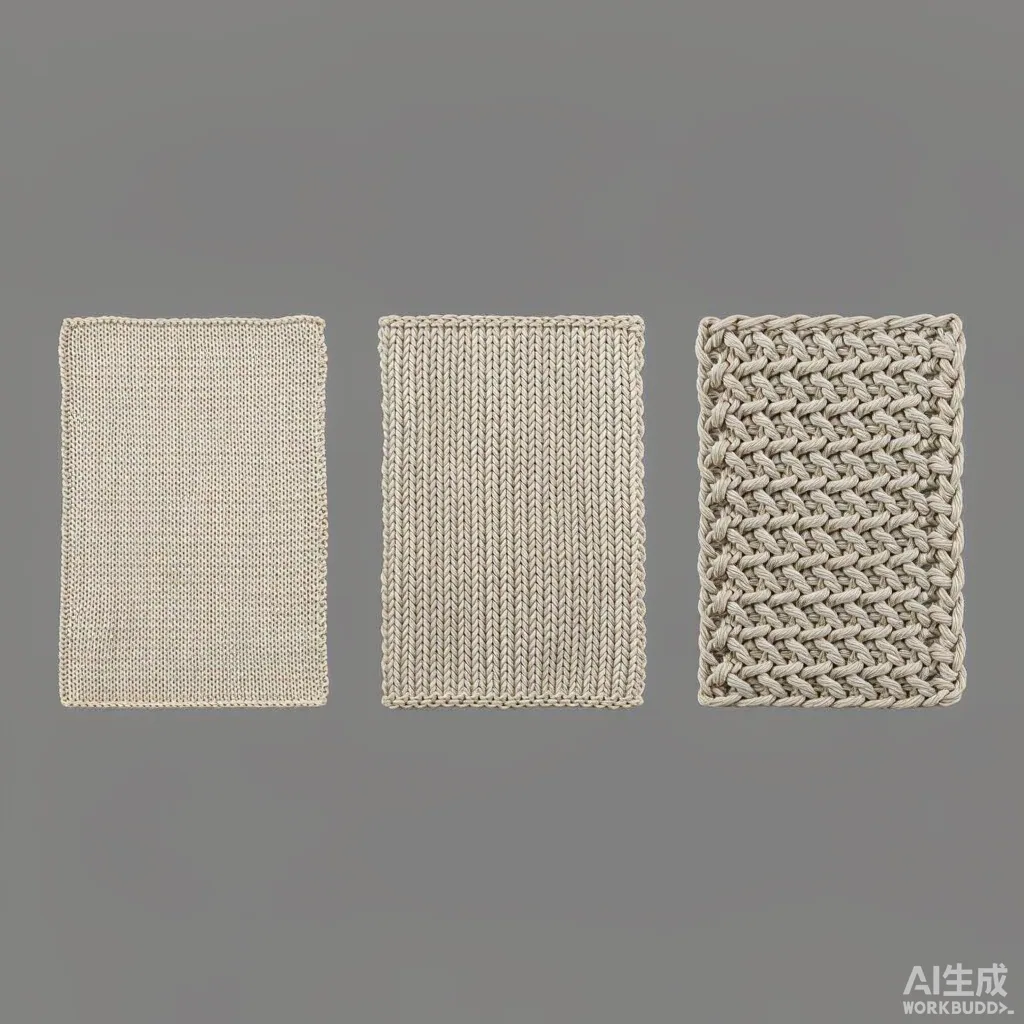
Development Speed and Minimum Order Commitment
Development speed separates the two worlds most sharply: changing a knitted structure is a machine-file change that samples in 7 working days, whereas re-engineering a multi-panel sewn body usually means new patterns, a new sewing sequence and a second paid sample round that pushes the calendar out by weeks.
- MOQ
- 100 pcs per style or colourway
- Sampling
- 7 working days from structure file approval
- Bulk production
- 30 days from sample sign-off
- Inspection standard
- AQL 2.5 (ISO 2859-1)
- Trade terms
- FOB Xiamen, with CIF or DDP available
- Capacity
- 7 production lines, about 200,000 pcs per month
- Programme experience
- coordinating knit bag programmes since 2014
- Typical gauge range
- E7 for bags, E12 for fine detail panels
A 100-piece minimum per style or colourway changes how a buyer can plan. Instead of committing 800 units across four colours, four drops of 100,000 of each are possible, letting real sell-through data drive the reorder. Canvas and leather programmes rarely offer that freedom because yarn dye lots, hide lots and cutting set-ups all reward volume. Buyers wanting a wider view of what that flexibility enables can read the custom knit bags programme overview, and the knitted bag manufacturer reference pillar for how those programmes are structured.
Print, Embroidery and Branding Surfaces
Flat knitted panels accept screen print, heat transfer and direct embroidery, but loop relief limits fine detail: below roughly 2 mm stroke width or 4 mm cap height, legibility drops and visible loop shadowing takes over from the printed edge.
Canvas and felt are the friendliest branding substrates at any detail level, because both present a flat, dense face. Woven polyester accepts transfer well once the coating is compatible, though plastisol inks can crack where the panel folds. Leather takes blind debossing beautifully but restricts the palette, and neoprene generally needs sublimation rather than any applied film because the closed-cell foam will not take liquid ink evenly.
Knitting offers one option the others cannot match: the brand mark can be knitted in. Jacquard and intarsia structures put a logo into the panel with no applied layer at all, which removes a print operation, survives abrasion better than a surface film, and keeps the construction mono-material for recycling claims. The trade-off is artwork restriction — knitted logos suit bold shapes and two to four colours, not gradients.
Water, Chemistry and End-of-Life Behaviour
A mono-material knitted polyester body is the easiest of the eight constructions to keep recyclable, because one polymer family, one dye class and no interlining leaves far fewer layers to separate than a coated, laminated or leather-laminated alternative.
Water behaviour also differs sharply. Cotton canvas absorbs up to roughly 8% of its mass in moisture on a humid day and gains more in use, which shifts panel dimensions and can move printed registration. PET knits regain under 0.4%, dry faster, and carry intrinsically anti-microbial behaviour relative to cellulosic substrates, which is why so many gym and swim programmes specify them.
Ask for OEKO-TEX STANDARD 100 certification on dyed yarn lots, a REACH Annex XVII declaration coveringazo dyes and nickel release, a California Prop 65 statement for US retail, and — for children's bags — CPSIA lead and phthalate test reports. Each one costs almost nothing to request before signing and a great deal to chase afterwards.
End of life is moving from marketing language to regulation. The EU ecodesign framework under Regulation (EU) 2024/1781 pushes toward durable, repairable and recyclable textile products, which favours constructions that can be described honestly as one polymer with one fastening family. Programmes building for European retail in that direction should also read the sustainable knit bags reference pillar before locking a substrate.
The Selection Matrix: Match Construction to Programme
Match construction to programme pattern rather than to unit price: high-mix, short-run calendars favour knitting because set-up is digital, while very long, stable runs of a simple shape favour woven construction because the price per metre falls faster at volume.
| Programme type | Recommended construction | Reason | Risk to watch |
|---|---|---|---|
| Quarterly colour drops, 4 to 8 styles | Seamless knit | Same body file, new yarn colour each drop | Per-colourway yarn minimum |
| One-off promotional tote, 5,000 pcs | Canvas or nonwoven | Lowest yardage cost for a single drop | Waste and landfill optics |
| Laptop sleeve, 13 to 16 inch | Knit with zoned density | Padding only where the device sits | Zip tape compatibility with knit |
| Gym or swim bag | Knit mesh or neoprene | Fast dry time and air circulation | Odour retention without liner |
| Premium gift presentation | Felt or faux leather | Rigid silhouette and premium hand-feel | Unit cost against the gift target line |
| High-volume retail shopping bag | Woven polyester | Lowest cost per square metre at volume | Needs liner for shape |
| Children's bag programme | OEKO-TEX certified knit | Certified chemistry and soft edges | CPSIA lead and phthalate limits |
Where Each Construction Wins — and Where It Loses
- Seamless knit wins on iteration speed and waste; loses where a rigid, self-standing silhouette is the design intent.
- Canvas wins on flat branding surface and heritage appeal; loses on weight, water gain and higher labour minutes per unit.
- Woven polyester wins on material cost per square metre at volume; loses on cutting loss and the lining it usually demands.
- Leather wins on perceived value and abrasion at edges; loses on unit cost index, waste and any recyclability claim.
- Nylon ripstop wins on packability and tear-to-weight; loses on coatings and the print compatibility that follows.
- Neoprene wins on cushioning and structure; loses on drying time, odour and unit cost above most knit equivalents.
- Felt wins on shape retention without stiffener; loses on pilling, dye consistency between lots and wet strength.
- Mesh wins on dry-air performance; loses on structural integrity and therefore always needs another layer anyway.
Compare costs with real numbers
Send a specification, target volume and destination port, and the team will return a component-level quote breakdown for both a knitted and a traditional construction so the comparison is made on landed economics rather than unit price alone.
Frequently Asked Questions
Which construction costs less for a 5,000-piece tote programme, knit or canvas?
For a plain 8-litre tote, knit usually lands lower once labour is included, because roughly 4.5 sewing minutes replace about 11 and cutting waste falls from around 18% to roughly 3%. Canvas can still win if the design is very simple and the local labour rate is low, so compare component-level quotes rather than headline unit prices.
How much lighter is a knitted bag than a canvas bag of the same size?
A knitted 600D PET shell is typically around 320 g/m² against roughly 407 g/m² for 12 oz canvas. On an 8-litre tote that works out near 210 g empty versus about 340 g, a saving of roughly 130 g or around 38% of empty bag weight before hardware and trims are counted.
Does a stretch knit structure lose shape faster than woven fabric?
Less than most buyers expect. Loop geometry relaxes about 1.5 to 2.5% within the first 48 hours after knitting, which is why panels rest before any dimension-critical operation. After that relaxation the structure is stable, and zoned density lets load-bearing areas be knitted tighter than side walls, which woven panels cannot do.
What fabric weight should I specify for a knitted shopping tote?
Around 320 g/m² in 600D PET at E7 gauge suits an 8-litre tote carrying up to roughly 8 kg. Heavier-duty formats move nearer 420 g/m², and lightweight foldable shoppers drop to about 180 g/m². Always specify a tolerance, normally ±12 g/m², plus a stated gauge and yarn count so repeat orders can be reproduced.
Can knitted bags carry the same load as 600D woven polyester bags?
Yes, provided the handle root is engineered rather than assumed. A 600D PET knit typically reaches about 620 N grab tensile to ISO 13934-1, comparable with coated woven 600D. Real-world failure nearly always happens at the attachment point, so bar-tacked handle roots tested to about 250 N matter more than fabric strength alone.
How much cutting waste does seamless knitting actually avoid?
Near-net-shape knitting typically discards 2 to 4% of input yarn mass, against roughly 15 to 22% marker loss for cut-and-sew programmes once defects and end-of-roll waste are included. On a 40,000-piece tote run that difference is roughly 1.4 tonnes of textile bought and never shipped, which sits inside the unit price of the good pieces.
Is leather ever the better choice over knitting?
Leather suits premium gift presentation where hand-feel and perceived value drive the purchase. It loses on economics almost everywhere else: the indicative unit-cost index is about 240 against 100 for knit, hide-shape waste can reach 22%, and mixed polymer coatings block most recyclability claims now required by EU importers.
Can I print a full-colour logo on a knitted panel?
Yes, heat transfer handles full-colour art on PET knits well. Direct screen print sits on loop relief, so fine lines below roughly 2 mm stroke width look ragged and misshapen. For a cleaner result on bold artwork, knit the mark in via jacquard instead, which also keeps the body mono-material for recycling claims.
What is the typical MOQ for a knitted bag in custom colours?
Knit programmes start at 100 pcs per style or colourway, which lets a buyer test four colours for 100 pieces each instead of committing to 800 units. The practical constraint is yarn dye lot size rather than machine set-up, so very unusual shades may carry a slightly higher practical minimum even where the stated minimum stays at 100.
How long does sampling take for a new knitted bag structure?
A new structure file samples in 7 working days from approval of the technical file, with bulk production running 30 days from sample sign-off. Compare that with cut-and-sew, where a revised silhouette usually needs new patterns plus a revised sewing sequence, so the calendar stretches and a second paid sample round is often unavoidable.
Are knitted bags machine washable?
PET knit totes wash well at 30 °C and hold Grade 4 appearance after five AATCC 61 accelerated laundering cycles. PET regains under 0.4% moisture and dries quickly. Canvas behaves differently: it absorbs considerably more water, shrinks more and can move printed registration, so care labels and expected wash performance should be agreed at sampling.
Which inspection standard applies when comparing knit and traditional bags?
Use the same standard for both so results can be compared directly: AQL 2.5 under ISO 2859-1 for lot-by-lot acceptance sampling. Pair it with written test targets, typically ISO 12947-2 abrasion, ISO 13934-1 tensile and ISO 105-X12 rubbing fastness, so cosmetic and mechanical acceptance criteria are both defined before production begins.
Does a lower unit price always mean a lower landed cost?
No. A construction quoting a lower price per metre can carry higher cutting loss, more labour minutes, heavier freight and more offtake to landfill. Compare landed cost by adding unit price, duty, freight, inspection and expected defect credit together, which is why a component-level quote breakdown matters more than headline unit price.
When should I choose neoprene instead of knitting?
Choose neoprene when cushioning and self-supporting structure matter most, such as electronics pouches or bottle carriers where wall thickness protects the contents. Its costs are higher unit price, slower drying and odour retention without a liner. Knitting wins whenever airflow, low empty weight or rapid iteration across colour drops is the priority.
Do knitted and canvas bags need the same quality inspection?
Yes, and that is deliberate. Applying AQL 2.5 under ISO 2859-1 to both shortlists keeps the comparison honest. The defect taxonomy differs though: knits are assessed for dropped stitches, ladders and course variation, while canvas is assessed for slubs, seam grin, skew and uneven topstitch along folded edges.
Which construction is easiest to keep recyclable at end of life?
A mono-material knitted PET body is the strongest option, since one polymer family and no interlining means separation steps are close to zero. Coated woven panels, leather, neoprene and felt all combine incompatible layers that must be split mechanically, which typically means they are downcycled or discarded regardless of what the marketing copy claims.
People Also Ask
Are knitted bags more durable than canvas bags?
Measured by standard test methods, a 600D PET knit typically reaches about 30,000 Martindale rubs to ISO 12947-2, where 12 oz canvas often fails around 25,000 rows at folded edges. Knitted construction also spreads point loads across neighbouring wales, though it remains more vulnerable to snagging and laddering.
Which bag material is lightest for a retail shopping tote?
Nylon ripstop at roughly 95 g/m² is lightest by weight, but it needs coating plus a liner to carry load, so the finished bag is rarely lightest. A knit built around 180 to 320 g/m² usually delivers the lowest finished weight for a reusable tote that still carries 8 kg.
Why do some knitted bags ladder when snagged?
Knitted structures are interlocking loops, so a broken loop can release the ones below it along the wale. Specifying anti-ladder stitch constructions under handle roots and high-abrasion zones typically stops propagation, alongside a tighter gauge such as E12 for surfaces exposed to rough handling.
How do I compare quotes between a knit and a canvas programme?
Request a component-level breakdown covering material mass, cutting loss, labour minutes and finishing operations, then add duty, freight and inspection cost for each route. Comparing only unit price hides the two largest variables, namely assembly minutes on the line and how much purchased fabric never becomes product.
Is switching from canvas to knit worth it for volume retail?
It depends how often the programme changes. Stable, high-volume lines with fixed artwork favour woven or canvas because material price per metre keeps falling. Calendars that refresh colours quarterly gain more from knitting, where a new shade is a yarn change rather than a new cutting and sewing set-up.
Sources and further reading
Every figure on this page is either our own programme data or attributed below. Open the originals before you write them into a specification.
- ISO 12947-1:1998 — Determination of the abrasion resistance of fabrics by the Martindale methodISO Defines the Martindale apparatus used for the 30,000-rub abrasion targets quoted in this comparison.
- ISO 2859-1:1999 — Sampling procedures for inspection by attributes, Part 1: AQL-indexed sampling schemesISO Source of the AQL 2.5 lot-by-lot acceptance sampling used to compare both constructions fairly.
- ISO 2859-1:2026 — Sampling procedures for inspection by attributes (current revision)ISO Current revision; note ISO 2859-1:1999 was withdrawn after 2026-01-22, so specify the edition in inspection contracts.
- Textile Exchange standards and certification programmesTextile Exchange Chain-of-custody rules behind Global Recycled Standard claims on recycled PET yarn.
- Regulation (EU) 2024/1781 — Ecodesign requirements for sustainable products (ESPR)EUR-Lex (European Union) The framework driving durability, recyclability and digital product passport expectations for textile bags sold in the EU.
- Shima Seiki — WHOLEGARMENT and flat knitting machineryShima Seiki Machinery lineage behind the near-net-shape seamless knitting described in this comparison.
Turning the Comparison into a Decision
A comparison only becomes useful once it is written into a specification. Take the four axes — unit cost, finished weight, cutting waste and development speed — and attach one numeric target to each: a landed unit-price ceiling, a maximum empty weight, a maximum declared waste percentage and a sampling window. Then ask every shortlisted partner the same four questions. Answers that come back as adjectives rather than numbers usually mean the number does not exist yet.
The second step is to sample both routes at the same time. A physical knit sample next to a physical canvas sample settles arguments in minutes that email threads never do, particularly around hand-feel, print registration and how a panel actually folds under load. Both should be built to the same nominal dimensions, so the only real variable is construction.
The last step is to keep optionality. Because knit structures sample in 7 working days and bulk takes 30 days, a buyer can hold knitting as a responsive second route even when the primary award goes elsewhere, which is worth more than most single-source arrangements deliver during a demand spike.