Knitted Messenger Bag Layout: Panel Planning, Pocket Placement and Flap Geometry
A knitted messenger bag is a layout problem before it is a knitting problem: panel order, pocket reach, flap geometry and strap angle all have to be settled before programming. The working build is 14 litres at 380 x 300 x 110 mm with a 14-inch device sleeve, a flap dropping 180 mm from the top edge, a 45 mm adjustable strap and a junction rated about 480 N. Minimum 100 pcs, sampling 7 working days, FOB Xiamen.
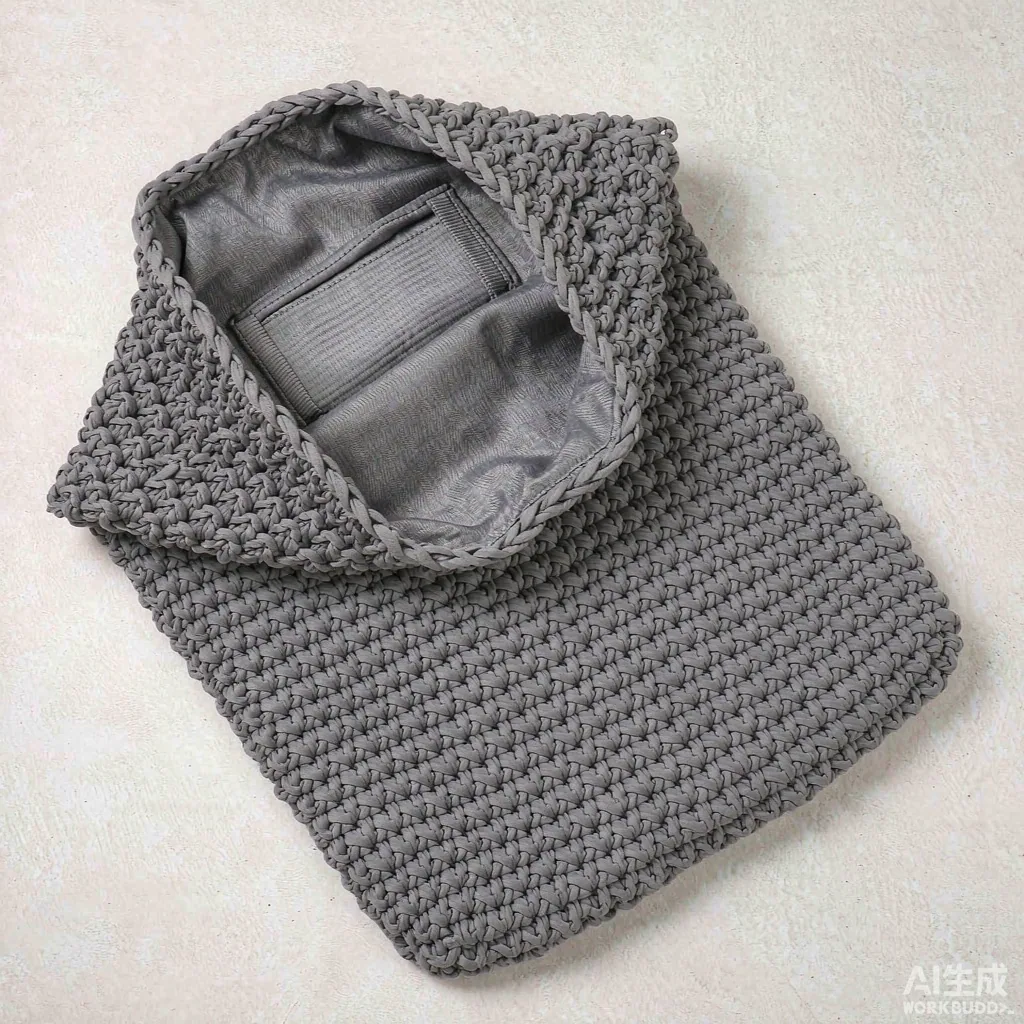
The Layout Checklist for a Messenger Body
Messenger bag briefs fail on layout more often than on material, because the bag has more functional zones than any other knit silhouette and each one competes for the same surface. The checklist below fixes the order of decisions, and each line has a default so the conversation moves quickly. Settling these before the machine programme is written is what keeps a messenger sample to one round.
- Device size: what the padded sleeve must physically clear, not the bag capacity.
- Panel order: back body, gusset, front body, flap, knitted in that sequence.
- Flap geometry: 180 mm drop, covering about 55 percent of the front face.
- Pocket reach: front slip pocket within one-hand reach of the carrying position.
- Strap angle: a 45 mm tube, adjustable 700 to 1300 mm for crossbody wear.
- Closure: two magnetic snaps at about 20 N each, or a webbing strap and buckle.
- Junction rating: about 480 N at 7 kg carried, with 14 tighter courses.
- Tolerance: +/- 4 mm, with the flap alignment checked separately.
- Wash shrinkage: 2.3 percent, graded into every panel before knitting.
Item one is where most briefs go wrong, and it deserves a sentence of its own. Capacity is a derived number on a messenger bag; the sleeve is the dimension that governs the body. A 14-inch laptop needs about 330 x 230 mm of clear space, and once that is fixed the rest of the bag is built outward from it rather than inward from a chosen outer size.
Panel Planning: Front, Back, Flap and Gusset
A knitted messenger body is one continuous piece with four functional zones, and the order they are knitted in determines how clean the transitions are. Back body first, then the gusset, then the front body, then the flap. Knitting in that sequence puts the flap at the end of the programme where its density can be set independently without affecting the body structure.
| Zone | Dimensions (mm) | Gauge and yarn | Function |
|---|---|---|---|
| Back body | 380 x 300 | E7, 600D, 340 g/m2 | Carries the strap junctions and the load |
| Gusset | 110 deep, 1160 around | E7, 600D, denser stitch | Sets depth and holds the profile |
| Front body | 380 x 300 | E7, 600D, 340 g/m2 | Carries the flap closure and front pocket |
| Flap | 380 wide, 180 drop | E7, 600D, 8 tighter courses at the edge | Covers the mouth and hides the closure |
| Device sleeve | 340 x 240 internal | E14, 150D lining with a foam insert | Clears a 14-inch device with margin |
The gusset deserves more attention than it gets. A 110 mm depth is shallow for a messenger bag and it is chosen deliberately: a deeper gusset makes the bag swing away from the body when it is worn crossbody, which is the complaint that sends messenger bags back. Depth, not capacity, is the number that governs comfort in this silhouette.
Pocket Placement: Reach Rather Than Capacity
A pocket on a messenger bag is only useful if it can be reached while the bag is worn. The bag sits on the opposite hip from the shoulder it hangs from, so the front slip pocket has to fall within one-hand reach of that position, which puts it in the lower half of the front face rather than at the top. That is a layout rule, not a style preference.
- Capacity
- 14 L at 380 x 300 x 110 mm
- Device sleeve
- 340 x 240 mm internal, clears a 14-inch laptop
- Body gauge and yarn
- E7, 600D recycled polyester, 340 g/m2
- Flap
- 380 mm wide, 180 mm drop, about 55 percent front coverage
- Front slip pocket
- 200 x 150 mm, placed in the lower half of the front face
- Strap
- 45 mm knitted tube, adjustable 700 to 1300 mm
- Closure
- Two magnetic snaps at about 20 N each, or webbing with a buckle
- Junction rating
- About 480 N under ISO 13934-1 at 7 kg carried
- Cycle time
- 15.4 minutes per 14 L body
- Wash shrinkage
- 2.3 percent, graded into every panel before knitting
Interior organisation follows the same logic. A phone pocket belongs on the side of the interior nearest the body, because that is the panel the wearer can reach without taking the bag off, and a pen slot belongs above it rather than beside it. Organising an interior by reach rather than by symmetry is what makes a messenger bag genuinely usable.
Pocket mouth treatment is the last detail and the one that shows up in returns. A slip pocket knitted at the body gauge stretches open over time and small items work out of it. Knitting the pocket mouth with 6 courses at a tighter setting keeps it closed against the body, and it costs about 15 seconds of cycle time.
Flap Geometry: Coverage, Drop and Closure
Flap geometry is a trade between coverage and access. A 180 mm drop on a 300 mm body covers about 55 percent of the front face, which hides the mouth completely without making the bag awkward to open. A shorter flap leaves the mouth exposed to rain; a longer one means the wearer has to lift more fabric every time the bag is opened.
Two magnetic snaps
About 20 N each, one at each lower corner of the flap. One-handed opening and a clean front face with no visible hardware.
Webbing and buckle
A webbing strap from flap to body with a side-release buckle. Secure and adjustable, but it puts hardware on the front face.
Turn-lock
A single metal turn-lock at the flap centre. Reads as premium hardware and needs a reinforced panel behind the flap.
Magnetic snap plus zip
A snap for daily access and a zip underneath for travel. Doubles the operation count but covers both use cases.
Whichever closure is chosen, the flap needs a reinforced edge. Eight courses at a tighter setting along the flap edge stop it curling, and a dense patch behind each snap spreads the pull. Without both, a flap starts to wave at the corners within weeks, which is the most visible wear sign on this silhouette.
The Padded Sleeve: What a 14-Inch Device Actually Needs
A 14-inch laptop measures about 330 x 230 mm, so the sleeve needs roughly 340 x 240 mm of internal space to clear it with margin for the seam and the padding. Specifying the sleeve by device size rather than by bag capacity is the rule that prevents the classic failure: a bag that is large enough overall and too tight at the sleeve.
Padding is a separate specification from the sleeve itself. A 4 mm closed-cell foam insert gives drop protection without making the bag rigid, and it is held in a knitted pocket rather than bonded to the body so it can be replaced or removed. A bonded pad cannot be repaired and it makes the whole panel stiff.
Strap Geometry for Crossbody Carry
A messenger strap is the longest strap in a knit range at 700 to 1300 mm adjustable, because the bag has to sit at the opposite hip and the adjustment range has to cover a coat in winter and a shirt in summer. The strap is a 45 mm knitted tube, wider than the 32 mm used on a shoulder bag because the load is carried on one shoulder for longer.
Angle matters as much as length. A messenger strap crosses the body diagonally, so the junction points are offset rather than opposite each other, and each takes a load with a sideways component. That is why the junction reinforcement here is 14 courses rather than the 12 used on a shoulder bag, and why the rating is quoted at about 480 N.
Load Path and Junction Rating at 7 kg
A loaded messenger bag with a laptop, a charger and a notebook reaches about 7 kg, and all of it funnels through two junctions that are offset across the back panel. The reinforced junctions test at about 480 N under ISO 13934-1, and the back panel is knitted at a denser stitch for the full height so the load spreads rather than concentrating at the two points.
The sideways component is what makes this harder than a tote. On a tote the load is vertical and split across four junctions; on a messenger bag it is diagonal and split across two, so each junction carries more than half the nominal weight. Specifying the back panel density alongside the junction reinforcement is what handles that.
Tolerance, Shrinkage and the Flap Alignment Problem
Tolerance on a messenger body is +/- 4 mm, but flap alignment needs its own figure. A flap knitted to the same tolerance as the body can still sit off-centre, because the two panels relax at slightly different rates after knitting. The working answer is to check flap alignment as a separate inspection item against a 2 mm offset limit rather than assuming body tolerance covers it.
Shrinkage compounds the problem at 2.3 percent, because the body and the flap shrink by different absolute amounts depending on their stitch density. Both panels are graded up individually at the pattern stage, and the approval sample is washed before the flap alignment is signed off. Approving an unwashed sample here guarantees a mismatch in bulk.
Decoration Zones on a Messenger Body
A messenger bag offers three decoration zones and they behave very differently. The flap is the best of them: it is a flat, reinforced panel with a stable edge, and a jacquard mark up to about 90 mm wide holds its shape there. The front body below the flap is partly covered when worn, and the gusset is almost invisible in use.
Placing a mark across the flap edge is the mistake to avoid. The edge is knitted at a tighter setting to stop it curling, so a mark that crosses it changes density mid-artwork and reads as a distortion. Keeping the mark at least 20 mm inside the flap edge preserves both the structure and the artwork.
A branded hardware choice is often the better answer at this silhouette. Because the closure sits on the front face, a marked buckle or a branded snap plate puts the brand where the hand goes and where the eye lands, and it costs no cycle time at all.
Programme Timing and How the Messenger Fits a Capsule
Sampling runs 7 working days from an approved tech pack and bulk production runs 30 days from sample approval, on a minimum of 100 pcs per style and colourway. A 14 L messenger body knits in about 15.4 minutes, which is the longest cycle in a knit capsule after a weekender, and that is reflected in the unit price.
Final inspection follows AQL 2.5 under ISO 2859-1 with messenger-specific items: flap alignment against the 2 mm offset limit, snap holding force, sleeve internal dimensions checked with a device gauge, strap adjustment range and pocket mouth integrity. Those five catch the failures that a generic bag checklist would miss entirely.
The messenger shares the 600D yarn and colour reference with the rest of the range, so it sits naturally beside a knitted laptop bag, a knitted shoulder bag and a knitted weekender bag. One colour approval therefore covers four silhouettes at 100 pcs per style.

Lay out a messenger bag that works worn
Send the device size, flap preference and strap range. The team returns a layout spec, a 7-working-day sampling plan and an FOB Xiamen quote. Start a messenger programme.
Frequently Asked Questions
What size should a knitted messenger bag be?
14 litres at 380 x 300 x 110 mm is the working band, sized around a padded sleeve rather than around capacity. A 14-inch laptop needs about 330 x 230 mm, so the sleeve is built at 340 x 240 mm internal and the body grows outward from it.
Why is the gusset only 110 mm deep?
Because depth governs comfort on a crossbody bag. A deeper gusset makes the bag swing away from the body when worn, which is the complaint that sends messenger bags back. Capacity is a derived number here, not the design driver. Going wider or taller adds far more usable space than going deeper at this silhouette.
How far should a messenger flap drop?
180 mm on a 300 mm body, covering about 55 percent of the front face. That hides the mouth from rain without making the bag awkward to open. A shorter flap exposes the mouth, and a longer one means lifting more fabric every time. A shorter flap exposes the mouth to rain, and a longer one is awkward to lift.
Where should the front pocket go?
In the lower half of the front face, at about 200 x 150 mm. The bag sits on the opposite hip from the shoulder it hangs from, so a pocket is only reachable while worn if it sits low and toward the body. Pockets placed high look better in a photograph and are unreachable while the bag is worn.
What closure works best on a messenger flap?
Two magnetic snaps at about 20 N each, one at each lower corner. They open one-handed and leave the front face clean. A webbing strap and buckle is more secure but puts visible hardware on the front. A turn-lock is the premium-looking option and needs a reinforced panel behind the flap.
How is the flap edge kept flat?
Eight courses knitted at a tighter setting along the flap edge stop it curling, and a dense patch behind each snap spreads the pull. Without both, a flap begins to wave at the corners within weeks of use. Both add almost no cycle time and both prevent the corner wear that shows first.
What padding does a device sleeve need?
A 4 mm closed-cell foam insert held in a knitted pocket rather than bonded to the body. It gives drop protection without making the panel rigid, and it can be replaced or removed, which a bonded pad cannot be. A bonded pad cannot be repaired and it makes the whole back panel stiff.
Why is the messenger strap wider than a shoulder strap?
45 mm rather than 32 mm, because the load sits on one shoulder for longer and the strap crosses the body diagonally. The range is 700 to 1300 mm adjustable so the bag sits correctly with a coat or a shirt. The range covers a coat in winter and a shirt in summer without re-threading.
How strong are the messenger strap junctions?
About 480 N under ISO 13934-1 with 14 tighter courses at each junction. The load is diagonal and split across two points rather than vertical across four, so each junction carries more than half the nominal 7 kg weight. The back panel is therefore knitted denser for its full height, not only at the joins.
Why is flap alignment checked separately?
Because the body and the flap relax at slightly different rates after knitting, so a flap can sit off-centre even when both panels are within the +/- 4 mm body tolerance. Alignment is inspected against a 2 mm offset limit. Both panels are graded individually because their stitch densities differ.
How much does a messenger bag shrink?
2.3 percent, and the body and flap shrink by different absolute amounts because their stitch densities differ. Both panels are graded up individually at the pattern stage and the approval sample is washed before alignment is signed off. The approval sample is washed before flap alignment is signed off, not after.
What are the order terms for a messenger bag?
Minimum 100 pcs per style and colourway, sampling 7 working days from an approved tech pack, bulk 30 days from sample approval. Inspection follows AQL 2.5 under ISO 2859-1 and shipment is FOB Xiamen. Inspection follows AQL 2.5 under ISO 2859-1 and shipment is FOB Xiamen.
People Also Ask
Should a messenger bag be sized by capacity?
No. Size the device sleeve first at about 340 x 240 mm internal, then build the body outward. A bag that is large overall and too tight at the sleeve is the classic failure at this silhouette.
Is a deeper messenger bag better?
Rarely. Depth above about 110 mm makes a crossbody bag swing away from the body, which costs more comfort than the extra capacity is worth. Go wider or taller instead of deeper.
Can a messenger flap be knitted in a contrast colour?
Yes, and it is one of the cleanest two-tone options in a knit range. The flap is the last zone programmed, so its colour can be set independently without affecting the body structure.
Why do messenger interiors feel unusable?
Because they are organised by symmetry instead of by reach. A phone pocket belongs on the body-side panel where the wearer can reach it without removing the bag, with pen slots above rather than beside it.
How is a device sleeve verified in bulk?
With a physical device gauge at final inspection rather than a tape measure. The gauge either passes into the sleeve or it does not, which removes interpretation from the check that matters most.
Sources and further reading
Every figure on this page is either our own programme data or attributed below. Open the originals before you write them into a specification.
- ASTM D5035 Breaking Strength and Elongation of Textile Fabrics (Strip Method)ASTM International Used alongside ISO 13934-1 to rate the messenger strap junction at about 480 N.
- ASTM D2061 Strength Tests for ZippersASTM International Referenced where a messenger flap uses a zip under the flap as well as magnetic snaps.
- OEKO-TEX STANDARD 100OEKO-TEX Limit-value testing for the 600D body yarn and the 150D sleeve lining.
- Global Recycled Standard (GRS)Textile Exchange Documents the recycled content in the 600D yarn used across the messenger body.