Knitted Bag Set Size Range: Planning a Nested Three-Piece Knit Programme
A knitted bag set works when the three sizes nest, share one dye lot and are ordered as one programme. The working range is 2.5 L, 9 L and 22 L at gusset depths of 70, 110 and 160 mm, knitted in 600D recycled polyester with the smallest piece at E14 and the two larger at E7. A full set nests to about 1.35 times the large bag. Minimum 100 pcs per style and colourway, sampling 7 working days, FOB Xiamen.
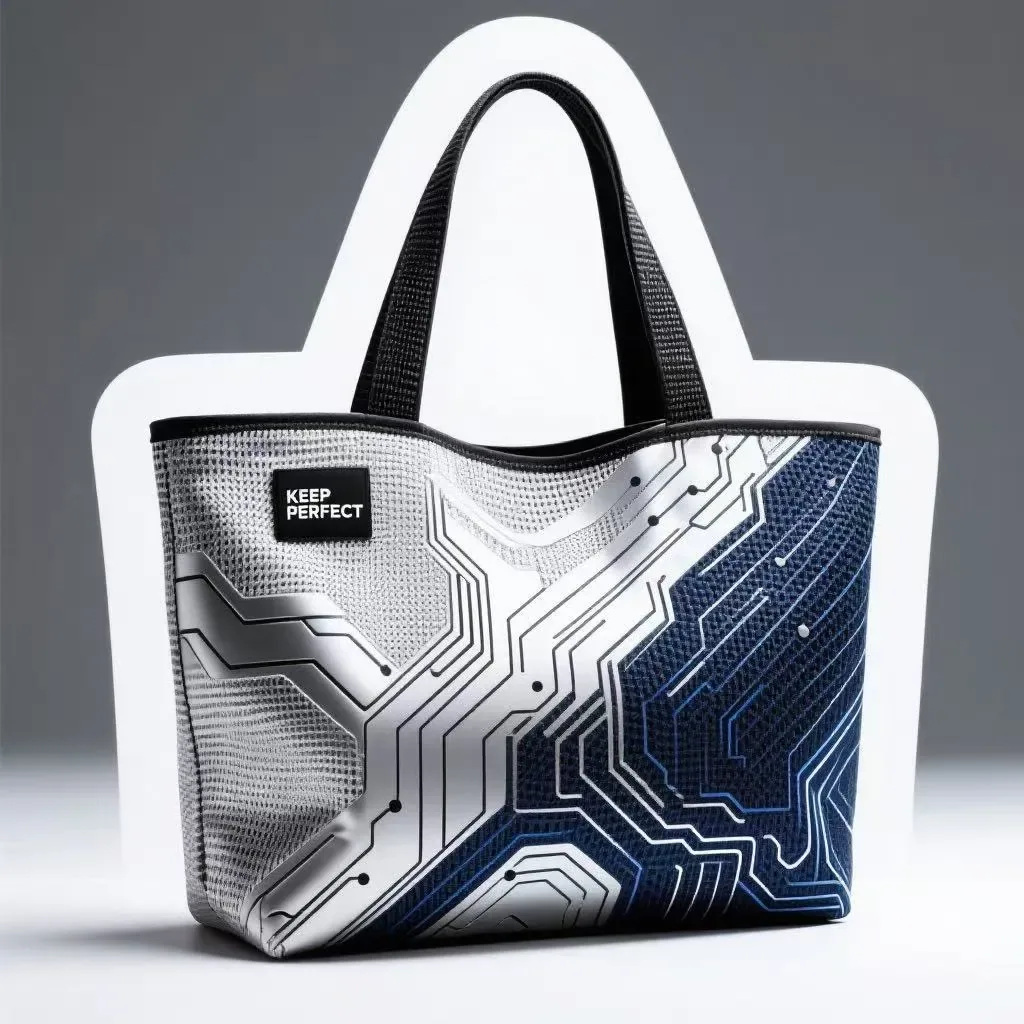
How Many Pieces Should a Knit Set Have?
Three is the answer that works commercially and structurally. Two pieces do not create a set a buyer perceives as a set, and four pieces push the minimum order to a level most first programmes do not want and create a nesting problem in the carton. Three gives an obvious progression, nests cleanly, and keeps the order at three times one style rather than four.
The three roles should be distinct rather than three sizes of the same bag. The small piece is a pouch or mini that carries a brand mark into a handbag, the medium is a day bag, and the large is a shopper or travel piece. When all three are the same silhouette at different scales, the set competes with itself at retail.
How Should the Three Sizes Relate to Each Other?
The sizes need a visible gap between them, not an even progression. An even progression of 8, 16 and 24 litres reads as arbitrary because the eye cannot tell 16 from 24 across a shelf. A geometric gap, where each piece is roughly two and a half times the one below it, makes the hierarchy obvious and makes each piece's role clear.
| Piece | Capacity | Flat size (mm) | Gusset depth | Gauge | Role in the set |
|---|---|---|---|---|---|
| Small | 2.5 L | 230 x 160 x 70 | 70 mm | E14 | Pouch or mini, carries the mark |
| Medium | 9 L | 320 x 240 x 110 | 110 mm | E7 | Day bag, the everyday piece |
| Large | 22 L | 420 x 320 x 160 | 160 mm | E7 | Shopper or travel piece |
Gusset depth is the dimension that makes the progression legible. At 70, 110 and 160 mm each piece is visibly deeper than the one below it, which is what a shopper reads across a shelf. A set where the depths are close together reads as one bag in three sizes, which is the failure mode this sizing rule exists to prevent.
Do All Three Pieces Have to Use the Same Gauge?
No, and using two gauges is usually the better answer. The small piece knits at E14 because at 2.5 L the loop is seen close up and a finer gauge gives it the finish of a small accessory. The medium and large knit at E7 because they need body and stiffness to hold a shape. The visual difference between the two gauges is small once the yarn matches.
- Set composition
- Three pieces at 2.5 L, 9 L and 22 L
- Yarn
- 600D recycled polyester throughout, one dye lot per colourway
- Gauges
- E14 on the small piece, E7 on the medium and large
- Gusset depths
- 70 mm, 110 mm and 160 mm
- Cycle time per set
- 4.2 + 8.9 + 12.8 = 25.9 min for one complete set
- Nesting efficiency
- A nested set occupies about 1.35 times the large bag alone
- Colour consistency
- One dye lot per colourway, checked to a visual shade band
- Minimum order
- 100 pcs per style and colourway, so 300 pcs per colourway per set
- Carton
- About 30 nested sets per export carton
- Sampling
- 7 working days for all three pieces from one approved tech pack
- Decoration limits
- Jacquard marks hold to about 35 mm at E14 and about 120 mm at E7
- Bulk timing
- 30 days from sample approval, shipped FOB Xiamen
What must match across the three pieces is the yarn, not the gauge. Running 600D recycled polyester from one dye lot through all three is what makes a set read as a set. Two gauges in one yarn lot shade-match closely enough for retail, while two yarn lots at one gauge frequently do not, which is the reason the lot constraint exists.
What Makes Three Bags Nest Properly?
Nesting is a gusset and mouth problem rather than a volume problem. For the small piece to sit inside the medium, its width has to clear the medium's internal width by a margin, and the same relationship has to hold between medium and large. With the dimensions in the table above the gap works out at about 35 mm at each step, which is enough for the inner bag to drop in freely without being forced.
The second requirement is that the mouths collapse. A bag with a bound, rigid mouth will not nest regardless of its volume, because the mouth holds its width. Knitting the mouth with 8 courses at a tighter setting gives enough definition without making the opening rigid, which is the compromise that lets a bag look crisp and still nest.
How Is Colour Kept Consistent Across Three Pieces?
By knitting all three from the same dye lot and approving them together. A single lot is held for the whole set and allocated across the three programmes, so there is no possibility of the small piece reading warmer than the large. Where a colourway runs across more than one production week, the lot is reserved at yarn procurement rather than at knitting.
Approval follows the same discipline. The three pieces are knitted as one sample set and signed off together against a visual shade band, not individually. Approving pieces separately is how a set ends up with three shades that each passed their own check and do not sit together on a shelf.
Does the Minimum Apply per Piece or per Set?
The minimum is 100 pcs per style and colourway, and each piece of a set is a style. A three-piece set in one colourway is therefore 300 pieces in total, and the same set in three colourways is 900. That is the arithmetic buyers most often mis-read, and it is worth stating plainly at quotation rather than after the order is placed.
One colourway
Three styles at 100 pcs each, 300 pieces total. The usual first order for a set programme.
Two colourways
Three styles in each of two shades, 600 pieces total, with each colourway held to its own dye lot.
Mixed sizes
Some programmes order 200 large, 150 medium and 100 small. Each style still clears its own 100 pcs minimum.
Replacement runs
A single piece reordered later still clears 100 pcs, and the dye lot is matched to the reserved shade reference.
Ordering unequal quantities is worth considering, because a set rarely sells evenly. The large piece is usually the slowest mover and the small piece the fastest, so an order weighted toward small and medium reduces the risk of leftover stock in the large. Each style still has to clear 100 pcs, which sets the floor for that weighting.
How Does a Set Ship and Pack?
A nested set ships as one retail unit, which is one of the real advantages of knit over rigid bags. Three nested bags occupy about 1.35 times the volume of the large bag alone, so the freight impact of adding two pieces is roughly 35 percent rather than 200 percent. That is what makes a set commercially viable where three separate boxes would not be.
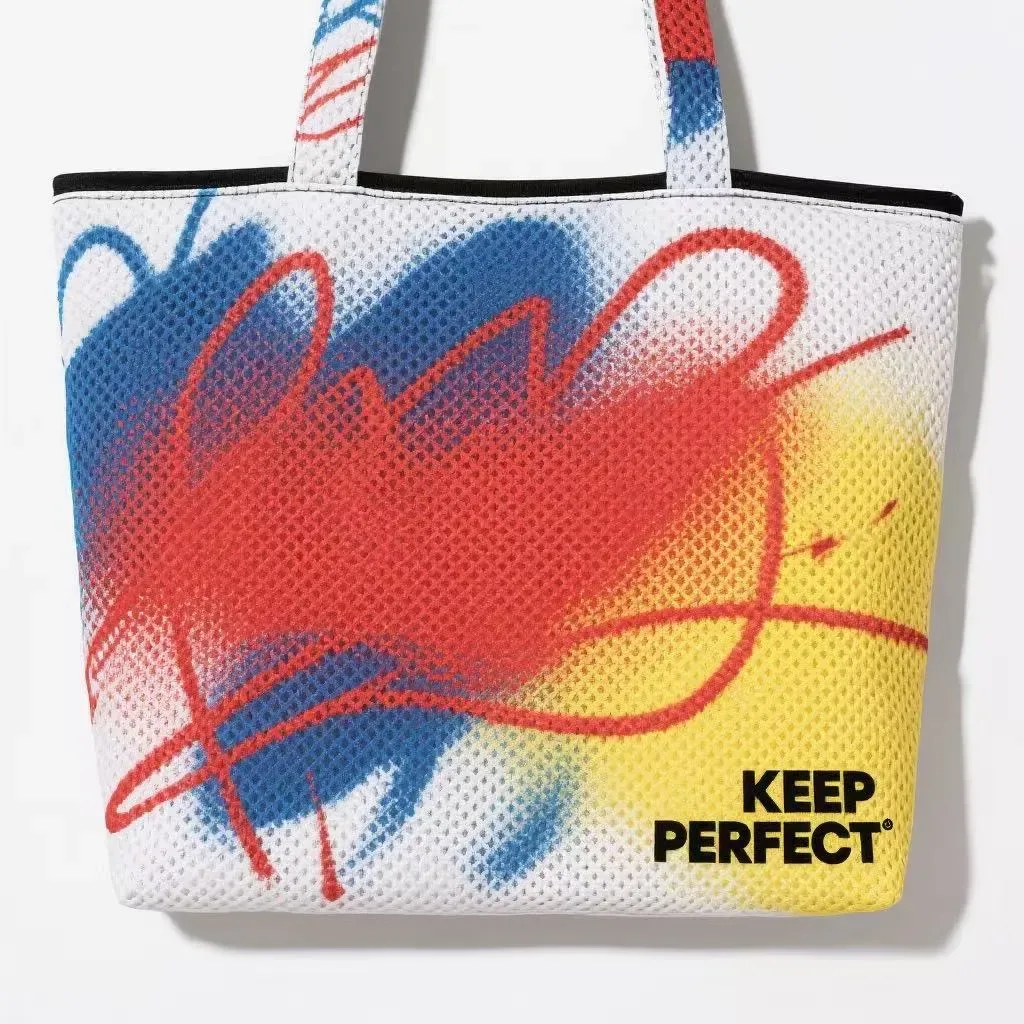
Retail presentation is the other half of packing. A set is usually banded with a printed band rather than boxed, because the band holds the nesting and shows all three pieces at once. A box hides the progression that makes a set appealing, and it adds cube that the nesting has just saved.
A hangtag or a printed band is also where the set story is told, and it should state the three capacities explicitly. Shoppers compare sets by size progression, and a band that reads 2.5 L, 9 L and 22 L does more work than any photography, because it makes the hierarchy concrete at the shelf edge.
What Does a Set Cost Compared to Three Separate Styles?
A set costs less than three separately developed styles because artwork, yarn procurement and machine programming are shared. The three programmes run from one tech pack rather than three, and the dye lot is held once. The saving is in development time and consistency rather than in machine time, which still totals 25.9 minutes for a complete set.
The area where a set costs more is inspection. Each piece is inspected to AQL 2.5 under ISO 2859-1 as its own lot, and the set is additionally checked for nesting fit and shade match across the three. Those two extra checks take only minutes and they are what protects the set from the failure a customer notices first.
Decoration Across a Set: One Mark, Three Scales
A set carries one brand mark at three scales, and that is harder than it sounds. The same artwork knitted at E14 on the small piece and at E7 on the large will not look identical, because the loop size changes how the edge resolves. The usual answer is to redraw the mark for each gauge rather than to scale one file.
Size limits differ by gauge as well. A jacquard mark holds cleanly to about 35 mm wide at E14 on the small piece and to about 120 mm at E7 on the large. Those two figures are not proportional to the bag sizes, which is why the artwork has to be drawn twice and approved on physical samples rather than on screen.
Placement should be consistent rather than proportional. Putting the mark in the same relative position on each piece, for example centred in the upper third, makes the three read as a family even when the artwork is redrawn. Inconsistent placement is what makes a set look like three unrelated bags in one colour.
How Is a Set Sampled and Approved?
All three pieces are sampled together in 7 working days from one approved tech pack, and the protocol runs three bodies per piece: one washed to confirm the shrinkage figure, one checked for nesting gap against the piece above it, and one kept sealed as the reference for final inspection.
The nesting check is the one that belongs specifically to a set and is often skipped. Dropping the small piece into the medium and the medium into the large, with the mouths collapsed as they would be packed, confirms the 35 mm gap works in practice rather than on a drawing. It takes a minute and it catches the error that makes a set unshippable.
Bulk production then runs 30 days from sample approval, and shipment is FOB Xiamen with CIF and DDP available. Because a set order is three styles rather than one, it is worth confirming line scheduling at quotation: with 7 production lines running at about 200,000 pcs per month, a 300-piece set order slots in comfortably but should still be booked.
Where a Set Fits in a Knit Range
A set is usually the second programme a brand runs, after a single style has proven the yarn and the colour. The pieces map onto existing silhouettes: the small onto a small knitted pouch bag, the medium onto a knitted bucket bag and the large onto a large knitted shopper tote.
That mapping is what makes a set efficient to develop, because the panel logic already exists. See the knitted bag collection for the full silhouette grouping and the custom knit bags pillar for how a multi-piece programme is specified and scheduled across a season.
Plan a three-piece knit set
Send the three capacities, the colourway count and the nesting requirement. The team returns a set spec, a 7-working-day sampling plan and an FOB Xiamen quote. Start a set programme.
Frequently Asked Questions
How many pieces should a knitted bag set have?
Three. Two does not read as a set to a shopper, and a fourth piece raises the minimum order and creates a nesting problem in the carton. Three gives a clear hierarchy, nests cleanly and keeps the order at three times one style rather than four.
What sizes work for a three-piece knit set?
2.5 L, 9 L and 22 L works well, because each piece is roughly two and a half times the one below it. An even progression such as 8, 16 and 24 L reads as arbitrary because the eye cannot separate the larger two on a shelf.
Why do gusset depths matter more than capacity?
Because depth is what reads across a shelf. At 70, 110 and 160 mm each piece is visibly deeper than the one below it. Depths that are close together make the set look like one bag in three sizes. Depths that are close together make the set read as one bag in three sizes.
Should all three pieces use the same gauge?
No. The small piece knits at E14 for a fine finish at close viewing, and the medium and large knit at E7 for body and stiffness. What must match is the yarn lot, not the gauge. What must match is the yarn lot, not the gauge, and that is what makes it a set.
How is colour kept consistent across a set?
By knitting all three from one 600D dye lot, reserved at yarn procurement, and approving the three pieces together against a visual shade band. Approving pieces separately is how a set ends up with three shades that do not sit together. Approving pieces separately is how a set ends up with three shades that do not sit together.
What makes three knitted bags nest properly?
About 35 mm of width gap at each step and mouths that collapse. A bound rigid mouth will not nest regardless of volume, so the mouth is knitted with 8 tighter courses for definition without rigidity. A bound rigid mouth will not nest, so the mouth is knitted with eight tighter courses.
Does the 100 pcs minimum apply per piece or per set?
Per piece, because each piece is a style. A three-piece set in one colourway is 300 pieces in total, and the same set in three colourways is 900. That arithmetic should be stated clearly at quotation. A three-piece set in three colourways is therefore 900 pieces in total.
Can a set be ordered in unequal quantities?
Yes, and it is often wise. The large piece is usually the slowest mover and the small the fastest, so weighting toward small and medium reduces leftover stock. Each style still clears its own 100 pcs minimum. Each style still clears its own 100 pcs minimum, which sets the floor for that weighting.
How much freight does a set add over a single bag?
About 35 percent rather than 200 percent, because three nested bags occupy roughly 1.35 times the large bag alone. That nesting efficiency is the main reason a knit set is commercially viable where rigid sets are not. Nesting efficiency is the reason a knit set works where three boxed bags would not.
Should a set be boxed or banded?
Banded. A printed band holds the nesting and shows all three pieces at once, while a box hides the size progression that makes a set appealing and adds cube the nesting just saved. A band shows the progression that sells a set, and a box hides it.
How is a set sampled?
All three pieces are sampled together in 7 working days from one tech pack, with three bodies per piece: one washed, one checked for nesting gap against the piece above it, and one sealed as the inspection reference. The nesting check confirms the 35 mm gap works in practice rather than on a drawing.
How is a set inspected in bulk?
Each piece is inspected to AQL 2.5 under ISO 2859-1 as its own lot, and the set is additionally checked for nesting fit and shade match across the three. Those two extra checks protect against the failure a customer notices first. Those two extra checks take minutes and protect against the failure a customer notices first.
People Also Ask
Does a set cost less than three separate styles?
On development, yes. One tech pack, one dye lot and shared programming cut the work substantially. Machine time is unchanged at about 25.9 minutes for a full set, so the saving is in consistency and lead time rather than in knitting.
Why not make all three pieces the same silhouette?
Because the set then competes with itself at retail. Distinct roles work better: a pouch or mini, a day bag, and a shopper or travel piece, so each item has its own reason to be bought.
What is the most common set failure?
Shade drift between pieces. Each piece can pass its own colour check and still fail as a set, which is why the three are knitted from one dye lot and approved together against a single shade band.
Can a single piece be reordered later?
Yes, subject to the 100 pcs minimum for that style. The replacement run is matched to the reserved shade reference so it sits with the original pieces rather than reading as a different colour.
How should a set be presented in retail?
Nested and banded rather than boxed. The nesting itself demonstrates the size progression, which is the thing that sells a set, and it keeps the retail footprint close to that of the large bag alone.
Sources and further reading
Every figure on this page is either our own programme data or attributed below. Open the originals before you write them into a specification.
- ISO 2859-1 Sampling procedures for inspection by attributesISO The AQL 2.5 scheme applied to each piece of a bag set as its own inspection lot.
- Global Recycled Standard (GRS)Textile Exchange Documents the recycled content in the 600D yarn shared across all three pieces of a set.
- OEKO-TEX STANDARD 100OEKO-TEX Limit-value testing applied to the single yarn lot used across a full bag set.
- ASTM D5034 Breaking Strength and Elongation of Textile Fabrics (Grab Test)ASTM International Used to confirm the mouth and gusset strength of each piece in a nested set.