Knitted Bag Silhouette Development: Pricing Every Shaping Move in Courses, Grams and Minutes
A knitted bag silhouette is priced in shaping moves, not in sketch complexity. Four shaping moves is the practical ceiling for one bag body at E7: each move adds 6 to 9 courses and about 1.8 minutes of cycle time, and a fifth move pushes a 14.6 minute body past the point where the programme earns its keep. The working range is E7 in 600D recycled polyester at 420 g/m², 62 g of yarn per body, 100 pcs per style and colourway, sampling in 7 working days, FOB Xiamen.
What Does a Silhouette Cost on the Machine?
A silhouette costs cycle time, and cycle time is the only number that converts directly into money on a knitting programme. Every change of width, every gusset and every narrowed shoulder is paid for in courses, and courses are paid for in minutes. A body that knits in 14.6 minutes and a body that knits in 23.5 minutes differ by 61 percent of machine occupancy for the same retail ticket.
The second cost is yarn, and it moves with silhouette more than most buyers expect. A tall narrow bucket and a wide shallow tote can hold similar litres and differ by 18 percent in yarn weight, because the bucket pays for wall area twice. Grams matter twice in a programme: once in material cost and once in the freight weight of a full container.
| Silhouette family | Cycle time | Yarn per body | Gauge | Shaping moves |
|---|---|---|---|---|
| Flat pouch | 6.4 min | 31 g | E12 | 1 |
| Crossbody | 11.8 min | 44 g | E12 | 3 |
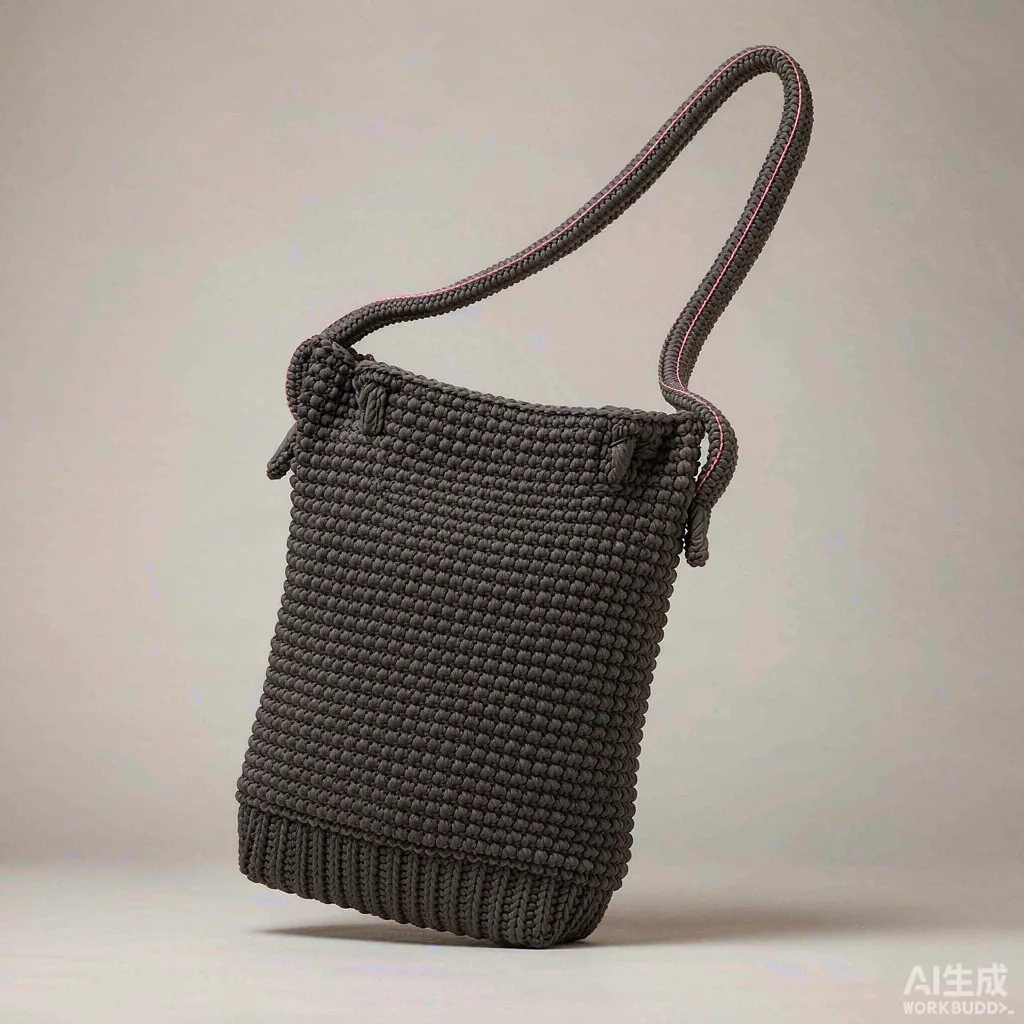
| Shopper tote | 14.6 min | 62 g | E7 | 3 |
| Bucket | 17.2 min | 71 g | E7 | 4 |
| Backpack body | 23.5 min | 96 g | E7 | 4 |
Read the table as a bracket rather than as a target. A first programme belongs in the 11 to 18 minute band, where the cycle is long enough to carry real structure and short enough that a 100 pcs run does not monopolise a line. Above 20 minutes the body starts competing with itself on cost per piece.
How Many Shaping Moves Can One Body Carry?
Four is the practical ceiling for one knitted bag body, and three is what most programmes should specify. A shaping move is any point where the knitting width changes: a taper, a gusset take-up, a narrowed shoulder, a stepped base. Each move costs 6 to 9 courses of programming and knitting time, roughly 1.8 minutes, and each one adds a place where a needle selection error can show.
The reason three beats four is yield rather than time. Every shaping move is a transition zone, and transition zones are where dropped stitches and loop distortion concentrate. A body with three moves typically runs a first-pass yield above 96 percent; the same body with five moves drops toward 92 percent, and that difference is recovered by reknitting, which costs more than the shaping was worth.
Does the Silhouette Decide the Gauge, or the Other Way Round?
The silhouette decides the gauge, and specifying it the other way round is the most common early mistake. E12 gives about 12 needles per inch and a loop fine enough for a small bag seen at arm's length, but the same gauge on a 22 litre tote produces a body with no self-supporting stiffness. E7 gives about 7 needles per inch, a visibly larger loop and enough body for a bag that has to stand on a shelf.
The practical rule is capacity first. Below roughly 5 litres, E12 is right. Between 5 and 15 litres either gauge works and the choice becomes aesthetic, driven by how visible the loop should be. Above 15 litres, E7 is the default, and going finer requires a lining or an inserted base panel to stop the bag from slumping.
- Gauge options
- E7 for bodies above 15 L, E12 for bodies below 5 L, either between
- Yarn
- 600D recycled polyester, 420 g/m² finished, GRS-documented
- Shaping moves
- Three specified, four as the ceiling, each 6 to 9 courses
- Cycle time band
- 11 to 18 minutes for a first programme
- Yarn per body
- 31 g at pouch scale, 62 g at tote scale, 96 g at backpack scale
- Shrinkage allowance
- 3.5 percent lengthwise after a 40 degree wash, programmed in
- Minimum order
- 100 pcs per style and colourway
- Sampling
- 7 working days from an approved tech pack
- Bulk timing
- 30 days from sample approval
- Inspection
- AQL 2.5 under ISO 2859-1
- Capacity context
- 7 production lines at about 200,000 pcs per month
- Shipment
- FOB Xiamen, with CIF and DDP available
Which Silhouettes Knit in One Piece and Which Need a Second Stage?
Open-top totes, pouches and shoppers knit in one piece on a flat or seamless knitting machine because their shape is a rectangle with a closed bottom. Anything with a three-dimensional bottom that is wider than its mouth, or with a curved shoulder line, needs either a second knitting stage or a closing operation, and that decision belongs in the tech pack rather than on the floor.
The test is simple: if the widest point of the bag is not at the mouth, the shape cannot be knitted and removed in one pass without a take-up. A bucket bag is the classic case, and it is handled by knitting the body wider than the finished base and taking up the bottom courses, which is the fourth shaping move in the table above. Details of that take-up are covered in the knitted bag base construction guide.
How Much Yarn Does Each Silhouette Family Use?
Yarn weight follows wall area, and wall area does not follow capacity. A 22 litre tote at 420 x 320 x 160 mm uses 62 g, while a 14 litre bucket at 300 x 260 x 180 mm uses 71 g, because the bucket's wall runs deeper relative to its footprint. Programmes that estimate yarn by litre consistently under-buy for tall shapes.
The percentage is worth carrying into costing. Moving a programme from a tote silhouette to a bucket silhouette of similar retail price adds about 14 percent in yarn weight and about 18 percent in cycle time, which is a real cost increase hidden inside what looks like a stylistic change. That is the single most useful number in a silhouette review.
What Does the Base Add to the Silhouette Bill?
The base is where silhouette ambition gets paid for. A flat closed base costs nothing extra beyond the closing courses. A gusseted base costs two shaping moves and about 3.6 minutes. A shaped or elliptical base costs a take-up sequence, a fourth move and, in most programmes, a separate approval step because the take-up is the part most likely to distort in the first wash.

Because the base carries load, it also carries the testing burden. Base and gusset seams are checked to ISO 13934-1 for tensile strength and to ISO 13937 for tear resistance before a silhouette is released to bulk. A shape that passes visually and fails tear at the base corner is a silhouette problem, not a yarn problem, and it costs far less to find it at sample stage.
How Fast Can a New Silhouette Be Sampled?
Seven working days from an approved tech pack, and that clock starts when the pack is signed rather than when it is sent. The week is spent roughly as follows: one day on programming the shaping sequence, two days on knitting and finishing three bodies, one day on washing and measuring shrinkage, and the balance on correction and re-submission if the first body misses the drawing.
Three bodies is the standard because silhouette sampling needs three different tests on three different pieces. One body is washed to confirm the 3.5 percent shrinkage figure, one is loaded and measured for dimensional stability, and one is kept sealed as the reference for final inspection. Sampling a single body is the shortcut that produces bulk that does not match the approved sample.
Where Do Silhouettes Fail Between Sample and Bulk?
They fail at the shoulder and at the base, in that order. A shoulder taper that looks right on one hand-knitted sample will drift on a run of 100 pieces because the take-up tension varies slightly across the needle bed, and the drift shows as bags that are not the same width at the top. The fix is to specify the shoulder in courses and needles rather than as a drawn curve.
Base distortion is the second failure, and it appears after washing rather than at knitting. A take-up sequence knitted at the sampling tension can relax differently once the yarn has been through a wash, and the result is a base that is 6 to 10 mm out of square. That is why the wash test is part of the 7 working days and not an optional extra.
How Do You Choose Between Three Candidate Silhouettes?
Score them on cycle time, yarn weight and shaping moves, then let the retail role break the tie. A silhouette that is 18 percent more expensive to knit may still be right if it is the one that reads at three metres on a shelf, but that decision should be made knowing the number rather than discovering it in the invoice.
Tote, 14.6 min, 62 g
The default first programme. Three shaping moves, E7, self-supporting, and the shape most buyers recognise as a knit bag.
Bucket, 17.2 min, 71 g
Four moves and a base take-up. Costs about 18 percent more in cycle time and reads as a design piece rather than a utility piece.
Crossbody, 11.8 min, 44 g
Three moves at E12. The lowest yarn cost in the range and the best first style for a brand testing a knit category.
Backpack body, 23.5 min, 96 g
Four moves, highest cycle time, and worth it only where the strap structure is part of the product story.
The tie-breaker that usually settles it is the strap. A silhouette whose carrying structure is knitted in the same pass needs no assembly step and carries less field-failure risk, which is why integral knitting of handles is worth reading alongside this silhouette review before the shape is frozen.
What Should a Silhouette Tech Pack State?
It should state capacity in litres, finished flat dimensions in millimetres, gauge, yarn and gsm, the number of shaping moves, and the shrinkage allowance. Those six items are the whole specification. Sketches support them but never replace them, because a drawn curve cannot be programmed and a course count can.
It should also state the tolerance, and the sensible tolerance on a knitted body is 5 mm in any linear dimension. Tighter than that is achievable only on rigid substrates, and specifying 2 mm on knit invites a dispute at inspection that neither side wins. Full silhouette groupings sit on the knitted bag collection pillar.
How Does Silhouette Change Freight and Carton Cube?
A silhouette that folds flat ships for a fraction of one that holds its shape, and that difference is decided at the design stage. A flat-packed tote at 420 x 320 mm and 18 mm folded thickness puts about 60 pieces in one export carton, while the same bag packed as a shaped body with a rigid base puts closer to 22.
The rule to apply at silhouette review is that any structural insertion, whether a base board or a stiffened mouth, converts a flat shipper into a cubed one. Where a programme ships more than one container, the cube difference is frequently larger than the knitting cost difference between two candidate silhouettes, which is why it belongs in the same review.
Price a silhouette before it is frozen
Send the capacity, the target gauge and the shaping ambition. The team returns a course count, a cycle time and an FOB Xiamen quote on 100 pcs per style. Start a silhouette review.
Frequently Asked Questions
What determines the cost of a knitted bag silhouette?
Cycle time first and yarn weight second. Every width change, gusset and taper is paid for in courses, and courses convert directly into machine occupancy. A 14.6 minute body and a 23.5 minute body differ by 61 percent of line time for the same retail price.
How many shaping moves can one knitted bag body carry?
Four is the practical ceiling and three is what most programmes should specify. Each move adds 6 to 9 courses and about 1.8 minutes. Past four, first-pass yield falls from above 96 percent toward 92 percent, and the reknitting costs more than the shaping was worth.
Which gauge should a knitted bag silhouette use?
Let capacity decide. Below about 5 litres, E12 gives the fine finish a small piece needs. Above 15 litres, E7 gives enough loop size and stiffness for the bag to stand. Between 5 and 15 litres either works and the choice becomes aesthetic. The two gauges in one yarn lot still shade-match closely enough for a retail range.
Why does a bucket bag cost more than a tote of similar size?
Because yarn follows wall area, not volume. A 14 litre bucket uses 71 g against 62 g for a 22 litre tote, and its base take-up adds a fourth shaping move. The combined effect is roughly 14 percent more yarn and 18 percent more cycle time.
Which silhouettes knit in one piece?
Open-top totes, pouches and shoppers, because their shape is a rectangle with a closed bottom. If the widest point of the bag is not at the mouth, the shape needs a take-up or a second stage, which is why bucket bags sit at four shaping moves.
What does a base add to the silhouette cost?
A flat closed base adds nothing beyond the closing courses. A gusseted base adds two shaping moves and about 3.6 minutes. A shaped or elliptical base adds a fourth move and a separate approval step, because take-up is the most distortion-prone part of the body.
How long does silhouette sampling take?
Seven working days from an approved tech pack, with the clock starting at sign-off rather than at submission. One day goes to programming the shaping sequence, two to knitting and finishing three bodies, one to washing and measuring, and the balance to correction. Programming the shaping sequence is the step most often underestimated inside that week.
Why are three sample bodies knitted for one silhouette?
Because three different tests need three separate pieces. One is washed to confirm the 3.5 percent shrinkage figure, one is loaded and measured for dimensional stability, and one is kept sealed as the reference for final inspection against AQL 2.5. A sealed reference body is what settles any dispute at final inspection.
Where do silhouettes fail between sample and bulk?
At the shoulder and at the base, in that order. Shoulder tapers drift across the needle bed on a run of 100 pieces, and base take-up can relax 6 to 10 mm out of square after washing. Both are prevented by specifying in courses rather than drawn curves.
How should a silhouette be specified in a tech pack?
State capacity in litres, finished flat dimensions in millimetres, gauge, yarn and gsm, the number of shaping moves and the shrinkage allowance. Those six items are the specification. A drawn curve cannot be programmed, but a course count can. Those six items replace a drawing, which cannot be programmed at all.
What tolerance is realistic on a knitted bag body?
Five millimetres in any linear dimension is the sensible figure. Knit is a loop structure and relaxes after washing, so tolerances borrowed from rigid substrates produce disputes at inspection that neither side wins. Shrinkage is programmed in at 3.5 percent. Tighter figures belong on rigid substrates and invite disputes on a knitted body.
Does changing silhouette change the minimum order quantity?
No. The minimum is 100 pcs per style and colourway regardless of silhouette, because the minimum is set by yarn procurement and line changeover rather than by body complexity. A more complex silhouette changes the unit price, not the minimum. What does change is unit price, because a complex body occupies more line time.
How is a silhouette checked before bulk release?
Base and gusset areas are tested to ISO 13934-1 for tensile strength and to ISO 13937 for tear resistance, and the washed body is measured against the approved sample. Finished lots are then inspected to AQL 2.5 under ISO 2859-1. Abrasion on the base panel is checked to ISO 12947-2 at the same time.
Can a silhouette be changed after sampling has started?
Yes, but the 7 working day clock restarts on the change. Altering capacity or gauge re-opens programming; altering surface colour or decoration usually does not. Keeping the shaping sequence frozen until after the first body is knitted is the lowest-risk way to work. Altering surface colour or decoration usually leaves the shaping sequence untouched.
People Also Ask
Which knitted bag silhouette costs least to develop?
A flat pouch at 6.4 minutes and 31 g of yarn, followed by a crossbody at 11.8 minutes and 44 g. Both sit at E12 with three or fewer shaping moves, which keeps programming short and first-pass yield high.
Is a backpack silhouette worth the extra cycle time?
Only when the carrying structure is part of the product story. At 23.5 minutes and 96 g it is the most expensive body in the range, so it suits programmes where the strap engineering is the reason to buy rather than a detail.
Why not simply draw the silhouette and let programming solve it?
Because a drawn curve has no course count. Programming needs needle numbers and course numbers at each transition, and a sketch leaves those decisions to interpretation, which is where shoulder drift and base distortion originate.
How much does gauge change the look of a silhouette?
E7 shows a visibly larger loop that reads as structure at three metres, while E12 reads as a fine surface at arm's length. The same silhouette in the two gauges looks like two different products to most retail buyers.
Should capacity or gauge be decided first?
Capacity. It sets the gauge band, the yarn weight and the number of shaping moves, and gauge decided first tends to produce a body without enough stiffness at large sizes or an over-heavy body at small ones.
Sources and further reading
Every figure on this page is either our own programme data or attributed below. Open the originals before you write them into a specification.
- ISO 2859-1 Sampling procedures for inspection by attributesISO The sampling scheme behind the AQL 2.5 inspection applied to every silhouette lot.
- ISO 13934-1 Tensile properties of fabrics (strip method)ISO Used to confirm base and gusset strength before a silhouette is released to bulk.
- ISO 12947-2 Martindale abrasion resistanceISO Applied to the base panel, which carries the highest abrasion load on a bag body.
- Recycled Claim Standard and Global Recycled StandardTextile Exchange Documents the recycled content in the 600D yarn specified for these silhouettes.