Knitted Bag Handle Options: A Load-Rated Checklist for Knit Bag Carrying Structures
A knitted bag handle is specified by load, not by look. Seven handle types cover the range, from an 8 kg cord on a pouch to a 25 kg reinforced webbing strap on a travel piece, and the specification that matters is width times courses per 10 mm. A 24 mm flat handle knitted at 12 courses per 10 mm in 600D polyester carries 18 kg with 4 percent elongation. Minimum 100 pcs per style, sampling 7 working days, FOB Xiamen.
Seven Handle Types and What Each One Carries
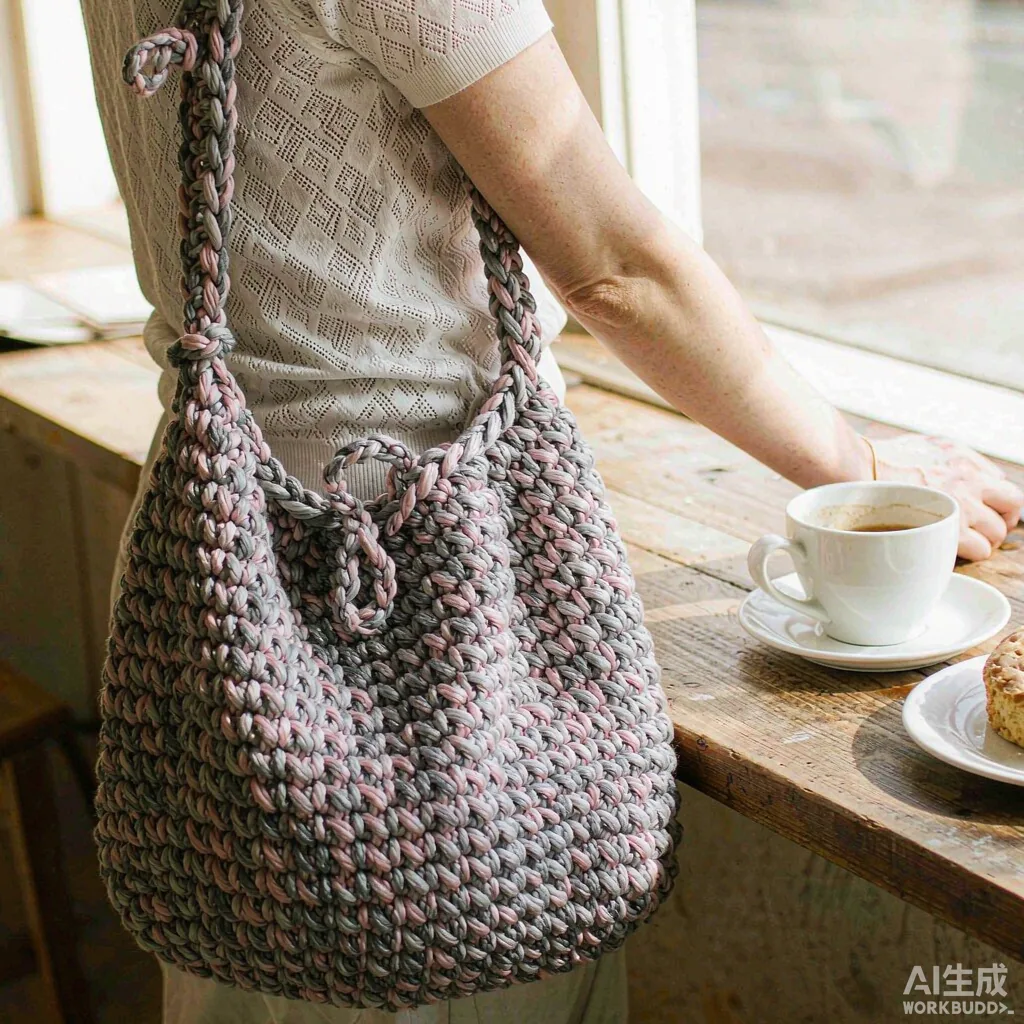
Seven handle constructions cover every knit bag programme, and each has a load figure attached rather than a style description. The list runs from light to heavy: knitted cord, integral ribbed strap, flat knitted band, doubled tubular handle, webbing insert with a knitted sleeve, padded shoulder panel, and cut-and-sewn reinforced strap with a bar-tack.
| Handle type | Width | Rated load | Added time | Typical use |
|---|---|---|---|---|
| Knitted cord | 18 mm | 8 kg | 0.6 min | Pouch, gift piece |
| Integral ribbed strap | 24 mm | 12 kg | 0.9 min | Shopper tote |
| Flat knitted band | 24 mm | 14 kg | 1.4 min | Day bag |
| Doubled tubular | 30 mm | 18 kg | 2.2 min | Market tote |
| Webbing insert | 40 mm | 25 kg | 3.4 min offline | Travel and gear |
| Padded shoulder panel | 60 mm | 22 kg | 4.1 min offline | Commuter, laptop |
| Reinforced cut-and-sewn | 40 mm | 25 kg | 3.8 min offline | Heavy retail tote |
Rated load here means the load a handle survives for 2,000 load andrelease cycles at 40 degrees washed condition, not the load at which it breaks. A strap that fractures at 30 kg in a single pull can still fail in the field at 12 kg through cyclic loading, which is why the cycle figure rather than the break figure is the specification.
Handle Checklist: Nine Items Before You Freeze the Spec
Work down this list in order, because each item constrains the one after it. A handle specified out of order produces a strap that tests well and does not fit the way the bag is carried, which is the most common outcome of a handle decision made from a photograph.
- Set the rated load first, from what the bag carries, not from how it looks. A laptop commuter bag and a gift pouch do not belong in the same handle category.
- Set the carry mode: hand at a 250 mm drop, shoulder at 550 mm, crossbody at 900 mm. The drop is measured from the mouth line to the top of the strap arc.
- Set the width from the load: 18 mm carries 8 kg, 24 mm carries 12 to 14 kg, 30 mm carries 18 kg, 40 mm and above carries 25 kg.
- Set the stitch density: 12 courses per 10 mm in the strap body, rising to 16 in the attachment zone where the strap meets the bag.
- Decide whether the handle knits in pass or is applied offline. In-pass handles add 0.6 to 2.2 minutes; offline handles add 3.4 to 4.1 minutes of handling.
- Specify the attachment: knitted-in roots, sewn roots with a 20 mm overlap, or a bar-tack through a reinforcement patch.
- Confirm the reinforcement insert. Above 18 kg rated load, a webbing core inside the knitted sleeve is the default, not an option.
- Confirm the wash behaviour: measure elongation after three 40 degree cycles and hold it under 4 percent at rated load.
- Confirm the inspection method: 2,000-cycle testing on two straps per style, plus AQL 2.5 under ISO 2859-1 on the finished lot.
Items three and four are the pair most often skipped, and they are the pair that decide whether a handle holds. Width without stitch density tells the knitting programme nothing, because 24 mm at 8 courses per 10 mm and 24 mm at 12 courses per 10 mm are different straps with the same visual width.
How Wide Should a Knitted Handle Be?
Width follows load, and the relationship is roughly linear up to 40 mm and then flattens. Eighteen millimetres carries 8 kg, 24 mm carries 12 to 14 kg, 30 mm carries 18 kg, and 40 mm carries 25 kg. Past 40 mm the gain comes from reinforcement and padding rather than from width, which is why a 60 mm padded panel is rated below a 40 mm webbing insert.
Comfort sets a second, independent floor. Below 18 mm a strap cuts into a shoulder under load, and a handle that tests correctly and hurts to carry fails at retail. Where a bag is carried on the shoulder for more than about 20 minutes, 30 mm is the practical minimum regardless of what the load figure says.
- Rated loads
- 8 kg cord, 12 kg integral rib, 14 kg flat band, 18 kg tubular, 25 kg webbing insert
- Widths
- 18 mm, 24 mm, 30 mm, 40 mm and 60 mm padded
- Stitch density
- 12 courses per 10 mm in the strap, 16 in the attachment zone
- Drop lengths
- 250 mm hand, 550 mm shoulder, 900 mm crossbody
- Elongation limit
- Under 4 percent at rated load after three 40 degree wash cycles
- Cycle test
- 2,000 load and release cycles on two straps per style
- Attachment overlap
- 20 mm minimum on sewn roots
- Yarn
- 600D recycled polyester, 420 g/m² body, GRS-documented
- Gauge
- E7 for straps above 30 mm, E12 for cord and narrow strap work
- Minimum order
- 100 pcs per style and colourway
- Sampling
- 7 working days from an approved tech pack
- Shipment
- FOB Xiamen, CIF and DDP available
What Drop Length Does Each Carry Mode Need?
Two hundred and fifty millimetres for a hand carry, 550 mm for a shoulder carry and 900 mm for a crossbody, measured from the mouth line to the top of the strap arc. The figures are not arbitrary: 250 mm clears a closed fist with the bag hanging, 550 mm puts the bag at hip height on an average frame, and 900 mm puts it at the opposite hip.
Tolerance on drop is 10 mm, which is looser than the body tolerance because a strap arc is flexible. Specifying 3 mm on a drop length produces rejections over a dimension the customer cannot perceive, and it is the clearest example of a tolerance copied from a rigid product onto a knit one.
How Is a Handle Load-Tested Before Bulk?
Two straps per style go through 2,000 load and release cycles at rated load on a cyclic tester, after three wash cycles at 40 degrees, and the acceptance criterion is no visible loop breakage plus elongation under 4 percent. That is the check that separates a strap that holds from one that only looked right.
Tensile testing runs alongside it. Strap bodies and attachment roots are pulled to ISO 13934-1 and to ASTM D5034 by the grab method, and the root is the part that governs, because a knitted strap almost always fails where it meets the bag rather than in its own length.
Which Handles Need a Reinforcement Insert?
Anything rated above 18 kg, and anything with a padded shoulder panel. Above that load a knitted strap on its own elongates too far under cyclic loading, and the insert is a polyester webbing core running the length of the strap inside a knitted sleeve. The sleeve is what the customer sees and the core is what carries the load.
The insert changes the assembly rather than the knitting. The knitted sleeve is produced in pass with a gap left for the core, the core is threaded, and the root is bar-tacked through both layers. That sequence is what the 3.4 minutes of offline handling pays for, and it is the reason reinforced straps sit in a different cost band from knitted-only ones.
What Does a Handle Add to the Programme Cost?
Between 0.6 and 4.1 minutes per bag, and the spread matters more than the absolute figure. An integral ribbed strap adds 0.9 minutes to a 14.6 minute tote body, about 6 percent. A padded shoulder panel adds 4.1 minutes of offline handling, which is a 28 percent increase on the same body and a different category of product.
Gift and pouch programmes
Knitted cord at 18 mm and 8 kg. Adds 0.6 minutes and suits a bag that carries under 2 kg in practice.
Everyday shoppers
Integral ribbed strap at 24 mm and 12 kg. Adds 0.9 minutes in pass and needs no assembly operation.
Market and grocery totes
Doubled tubular at 30 mm and 18 kg. Adds 2.2 minutes and is the widest strap that still knits entirely in pass.
Travel, gear and commuter
Webbing insert or padded panel at 22 to 25 kg. Adds 3.4 to 4.1 minutes offline and carries the load properly.
The cost that is easy to miss is attachment rather than strap. A sewn root with a 20 mm overlap and a bar-tack is a separate operation from the strap itself, and on a heavy bag it is where the minutes actually go. Planning strap time without root time is the error that makes a heavy-handle programme slip.
How Are Handles Sampled and Approved?
Handles are sampled with the body, not after it, in the same 7 working days. Three bodies are knitted with their handles attached: one goes to the cyclic tester, one is washed three times and measured for elongation, and one is kept sealed as the inspection reference. Sampling a strap separately from its bag misses the root failure entirely.
The approval criterion should be stated before sampling rather than negotiated afterwards. No loop breakage at 2,000 cycles, elongation under 4 percent at rated load, and a root that survives the grab test at the specified overlap. Those three are checkable in a week and they remove the argument later.
Which Handle Failures Show Up in the Field?
Root separation first, elongation second, and abrasion at the shoulder third. Root separation is the dominant one by a wide margin, because the attachment zone is where stitch density changes and where the load path turns. It is prevented by the 16 courses per 10 mm density and the 20 mm overlap in the checklist above.
Elongation shows as a bag that drags after a month of use, and it is a yarn and density problem rather than an attachment one. Abrasion at the shoulder is assessed to ISO 12947-2 with a Martindale head, and on a strap that rubs against a coat seam it is the failure that generates returns long after the sale.
Where Handle Choice Meets the Body Silhouette
The handle decides how the silhouette behaves when it is loaded, and the two have to be specified together. A tall narrow bucket with a 250 mm hand drop swings and tips under load, while the same body with a 550 mm shoulder drop carries stably. Silhouette first, then handle, then a re-check of the silhouette.
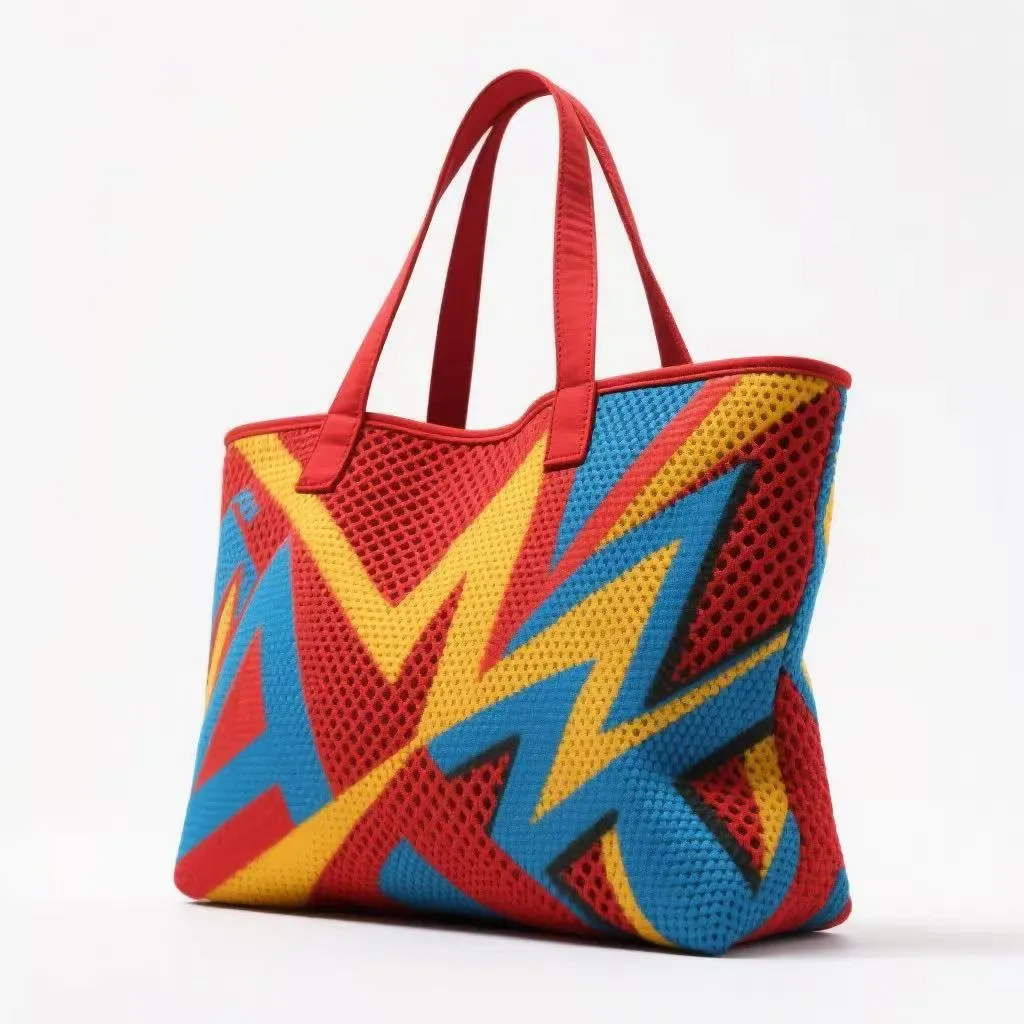
Where a programme runs several sizes from one silhouette, the handle should scale with capacity rather than stay constant. A 2.5 litre pouch and a 22 litre tote in the same family do not want the same strap, and carrying one strap across both is what makes the large piece feel under-built. The full groupings sit on the knitted bag collection pillar, and the knitted bag silhouette development guide covers the body side of the same decision.
Specify a handle by load, not by look
Send the carry load, the carry mode and the strap width you have in mind. The team returns a rated handle option, a test plan and an FOB Xiamen quote on 100 pcs. Start a handle review.
Frequently Asked Questions
How many handle options are there for a knitted bag?
Seven: knitted cord, integral ribbed strap, flat knitted band, doubled tubular handle, webbing insert with a knitted sleeve, padded shoulder panel, and reinforced cut-and-sewn strap. They run from 8 kg rated load to 25 kg and from 0.6 to 4.1 minutes of added time.
What load should a knitted bag handle be rated for?
Rate it from what the bag actually carries, not from how it looks. A gift pouch needs 8 kg, an everyday shopper 12 kg, a market tote 18 kg and a travel or commuter piece 22 to 25 kg. Rating high is not free: it costs reinforcement minutes.
How wide should a knitted handle be?
Eighteen millimetres carries 8 kg, 24 mm carries 12 to 14 kg, 30 mm carries 18 kg and 40 mm carries 25 kg. Past 40 mm the gain comes from reinforcement and padding rather than width. Comfort sets a separate floor of 30 mm for shoulder carry.
What stitch density should a handle use?
Twelve courses per 10 mm in the strap body and 16 in the attachment zone where the strap meets the bag. Width without stitch density specifies nothing, because two straps of the same width at different densities carry different loads. Two straps of the same width at different stitch densities carry different loads.
What drop length is right for each carry mode?
Two hundred and fifty millimetres for hand, 550 mm for shoulder and 900 mm for crossbody, measured from the mouth line to the top of the strap arc. Tolerance is 10 mm, because a strap arc is flexible and a tighter figure rejects pieces nobody can perceive.
How is a knitted handle load-tested?
Two straps per style run 2,000 load and release cycles at rated load after three washes at 40 degrees. Acceptance is no visible loop breakage and elongation under 4 percent. Tensile work runs to ISO 13934-1 and ASTM D5034. Tensile work runs to ISO 13934-1 and ASTM D5034 on both the strap and the root.
Where does a knitted handle fail?
At the root, where the strap meets the bag. Root separation dominates field failures because that is where stitch density changes and the load path turns. It is prevented by 16 courses per 10 mm in the attachment zone and a 20 mm sewn overlap.
When does a handle need a reinforcement insert?
Above 18 kg rated load, and on any padded shoulder panel. The insert is a polyester webbing core threaded inside a knitted sleeve, bar-tacked through both layers at the root. It adds 3.4 minutes of offline handling to the bag. It adds 3.4 minutes of offline handling and carries load that knit alone cannot.
How much does a handle add to the cost of a bag?
Between 0.6 and 4.1 minutes. An integral ribbed strap adds about 6 percent to a 14.6 minute tote body, while a padded shoulder panel adds roughly 28 percent. Attachment time is separate and is easy to forget when costing a heavy handle.
Should handles be sampled separately from the bag body?
No. Handles are sampled with the body in the same 7 working days, on three bodies: one tested cyclically, one washed and measured for elongation, one sealed as the inspection reference. Sampling a strap alone misses root failure entirely. Sampling a strap alone misses the root failure, which is the dominant one.
Does the handle change the minimum order quantity?
No. The minimum stays at 100 pcs per style and colourway regardless of handle type. What changes is unit price and, for offline handles, the amount of assembly time booked on the line for the run. What changes is unit price and, for offline handles, the assembly time booked.
Can one handle be used across a whole size family?
It can, but it should not be. A 2.5 litre pouch and a 22 litre tote do not want the same strap, and carrying one strap across both makes the large piece feel under-built. Scale handle width and rated load with capacity. A 2.5 litre pouch and a 22 litre tote want different strap widths and different ratings.
How is handle abrasion assessed?
To ISO 12947-2 with a Martindale abrasion head. A strap that rubs against a coat seam generates returns long after the sale, so abrasion is the failure to test for when a bag is carried on the shoulder daily. A strap rubbing against a coat seam generates returns long after the sale.
What causes a bag to drag after a month of use?
Elongation, which is a yarn and stitch density problem rather than an attachment one. A strap that stretches past 4 percent under rated load lengthens the drop, and the bag starts to touch the ground. Wash first, then measure. Wash the strap first, then measure elongation at rated load against the limit.
How should handle approval criteria be written?
Before sampling rather than after. State no loop breakage at 2,000 cycles, elongation under 4 percent at rated load, and root survival in the grab test at the specified overlap. Three checkable criteria remove the argument later. Three checkable criteria written before sampling remove the argument afterwards.
People Also Ask
Is a knitted-in handle stronger than a sewn-on one?
Not necessarily. A knitted-in root has no seam but a lower stitch density at the transition. A sewn root with a 20 mm overlap and bar-tack usually outperforms it above 18 kg, which is why heavy bags use reinforcement.
Why is cyclic testing used instead of a break test?
Because a strap that fractures at 30 kg in one pull can still fail at 12 kg in service. Cyclic loading reproduces what a customer does over a month, and 2,000 cycles separates straps that hold from straps that only look right.
Does gauge affect handle strength?
Yes. E7 is used for straps above 30 mm because the larger loop carries more yarn per course, and E12 suits cord and narrow strap work. Running a wide strap at E12 produces a strap that tests low and feels thin.
Should drop length be specified before or after the body size?
After. The body sets the mouth line and capacity, and the drop is measured from that line. A drop specified from a drawing before the body is frozen routinely ends up 30 mm wrong on the finished bag.
What is the most expensive handle mistake?
Costing the strap and forgetting the root. Attachment is a separate operation, and on a heavy bag the bar-tack and overlap minutes exceed the strap knitting minutes, which is what pushes a programme past its quote.
Sources and further reading
Every figure on this page is either our own programme data or attributed below. Open the originals before you write them into a specification.
- ASTM D5034 Breaking Strength and Elongation of Textile Fabrics (Grab Test)ASTM International Used to test strap bodies and the attachment root where a handle meets the bag.
- ISO 12947-2 Martindale abrasion resistanceISO Applied to shoulder straps that rub against clothing during daily carry.
- ISO 13934-1 Tensile properties of fabricsISO Tensile reference for the strap body and the sewn root overlap.
- ISO 2859-1 Sampling procedures for inspection by attributesISO The AQL 2.5 scheme applied to finished lots after handle testing.