Small Knitted Pouch Bag Uses: Volume Bands, Gauge Choice and Low-Volume Programme Maths
Where does a small knitted pouch bag earn its place in a range? It works as the low-ticket, high-repeat item that carries a brand mark across 1.2 L to 4.0 L volumes. On a seamless knitting line it knits in about 4.2 minutes at E12 gauge in 300D recycled polyester at 220 g/m2. Minimum is 100 pcs per style and colourway, sampling takes 7 working days, bulk runs 30 days, and final inspection follows AQL 2.5 under ISO 2859-1.
What Counts as a Small Knitted Pouch Bag in a B2B Range?
A small knitted pouch bag is a single-piece knit body between 1.0 and 4.5 litres, closed by a coil zipper or a drawcord, with no separate side gusset sewn in. That definition matters commercially because the pouch is the lowest-commitment way for a brand to put a logo into a knit programme without ordering to a tote or a weekender. The body knits flat or as a tube, the mouth is finished on the machine, and only the closure and any lining need secondary operations. For a buyer building a first knit capsule, the pouch is usually the first style sampled and the one that sets the colour standard for everything that follows.
Because the panel count is one, the pouch is also the style with the shortest knitting cycle and the fewest defect opportunities. A tote needs two body panels plus a handle junction; a pouch needs one panel plus a closure. Fewer joins means fewer places for a needle line, a dropped stitch or a seam pucker to show up, which is why pouches consistently pass AQL 2.5 inspection at a higher first-pass rate than multi-panel silhouettes on the same line.
Volume Bands: 1.2 L, 2.5 L and 4.0 L and What Each One Sells Into
Three volume bands cover almost every pouch brief that reaches a knit programme: 1.2 L for cosmetics and tech accessories, 2.5 L for wash-kit and stationery sets, and 4.0 L for shoe or garment storage. Picking the band first is faster than picking dimensions first, because volume fixes the loop count on the machine and therefore the cycle time, the yarn consumption and the unit cost before a single sample is knitted.
| Volume band | Typical flat size (mm) | Closure | Knit cycle | Common end use |
|---|---|---|---|---|
| 1.2 L | 180 x 120 x 55 | #3 coil zipper | 3.1 min | Cosmetics, cables, cards |
| 2.5 L | 230 x 160 x 70 | #3 coil zipper | 4.2 min | Wash kit, stationery, gift sets |
| 4.0 L | 280 x 200 x 90 | #5 coil zipper | 5.8 min | Shoe bag, garment storage |
The cycle times in that table assume E12 gauge, 300D recycled polyester and a single-colour body on a modern electronic flat knitting machine. Moving to E14 adds roughly 18 percent to cycle time because there are more needles per inch to traverse, while dropping to E7 cuts about 22 percent because the carriage travels further per course but forms fewer loops. Buyers who need a pouch under a firm price ceiling usually land on E12 rather than E14 for exactly this reason.
Gauge and Yarn: Why E12 at 300D Is the Pouch Default
E12 gauge with 300D recycled polyester is the default pouch specification because it balances loop definition against abrasion life. At E12 the loop is large enough to hide minor yarn irregularity, which keeps the surface clean in photography, and tight enough that a 220 g/m2 body does not feel slack in the hand. Fine-gauge E14 work looks sharper but the finer loop exposes every thick place in the yarn, so it needs a more expensive, more consistent feed yarn to hold the same visual grade.
- Machine gauge
- E12 standard; E7 for a chunkier hand, E14 for fine loop definition
- Feed yarn
- 300D recycled polyester (GRS); 150D for light linings, 600D for base panels
- Fabric weight
- 220 g/m2 body, 180 g/m2 lined interior
- Loop structure
- Single jersey face with tuck stitch for surface texture
- Cycle time
- 3.1 min at 1.2 L, 4.2 min at 2.5 L, 5.8 min at 4.0 L
- Dimensional tolerance
- +/- 3 mm on width and height at 2.5 L
- Wash shrinkage
- 1.8 percent after ISO 6330 4N cycle, measured flat
Yarn choice follows the end use rather than the look. A 150D lining yarn keeps the interior smooth so sunglasses and phone screens do not pick up loop marks, while a 600D base panel roughly doubles the abrasion life where the pouch is set down on rough surfaces. Specifying two yarn counts in one knitted body is possible on a seamless machine without a seam, which is the main structural advantage knit holds over cut-and-sew at this size.
Cost Drivers on a 100-Piece Pouch Order
On a 100 pcs per style and colourway minimum, four variables move the unit price: yarn count, closure hardware, decoration method and the number of colourways in the run. Yarn is usually the largest single line because a 2.5 L pouch consumes around 95 grams of 300D body yarn plus 40 grams of lining. Closure is second, and moving from a #3 to a #5 coil zipper typically adds more per unit than moving from one-colour to two-colour knitting.
Decoration is where buyers either save or overspend. A knitted-in logo costs nothing extra in yarn and adds no cycle time beyond the jacquard carriage pass, roughly 25 seconds, whereas an applied patch or a heat-transfer mark adds a secondary operation, a fixture and a rejection risk. For a 100-piece run the knitted-in route is almost always the better arithmetic, because the set-up cost of an applied mark is spread over very few units.
Where the money goes on a small pouch programme
- Yarn mass: about 135 g total per 2.5 L pouch including lining, priced per kg of 300D recycled polyester.
- Closure hardware: a #3 coil zipper with a knitted tape guard; #5 adds cost and weight but survives heavier loads.
- Machine time: 4.2 min per 2.5 L body, billed against line capacity of about 200,000 pcs per month across 7 production lines.
- Decoration: knitted-in marks cost machine seconds; applied marks cost a fixture plus labour per unit.
- Colourways: the 100 pcs minimum applies per style and per colourway, so three colourways triples the yarn lot count.
Closure and Lining Options That Survive Sampling
A pouch closure fails in sampling for one of three reasons: the zipper tape puckers against a knitted mouth, the puller snags the loop structure, or the mouth stretches out of shape after repeated opening. All three are solved by knitting a denser band, typically 8 courses at a tighter stitch setting, into the mouth area, which stabilises the opening without adding a woven tape. ASTM D2061 covers zipper strength testing and is the reference used when a buyer wants the closure rated rather than eyeballed.
Lining is optional at 1.2 L but worth specifying at 4.0 L, where the contents are heavier and the body is more likely to distort. A 150D plain-knit liner tacked at four points keeps its shape through washing and adds about 40 grams. Where a buyer wants a wipe-clean interior, the liner can be a coated knit, but that changes the hand and usually pushes the pouch out of the soft-structure category that makes knit appealing in the first place.
Decoration: How a Pouch Carries a Brand Mark Without Extra Panels
Knitted-in jacquard
Two-colour logo worked into the body during knitting. Adds about 25 seconds of cycle time and no secondary operation. Best for marks under 60 mm wide.
Intarsia block
Large single-colour blocks with clean edges. Higher yarn waste but sharper colour boundaries. Suited to wordmarks above 60 mm.
Knitted label tab
A small woven-look tab knitted at the mouth and folded back. Low cost, keeps the brand mark visible on shelf hooks.
Moulded puller
A branded zipper puller instead of a body mark. Adds hardware cost but reads well at small pouch sizes.
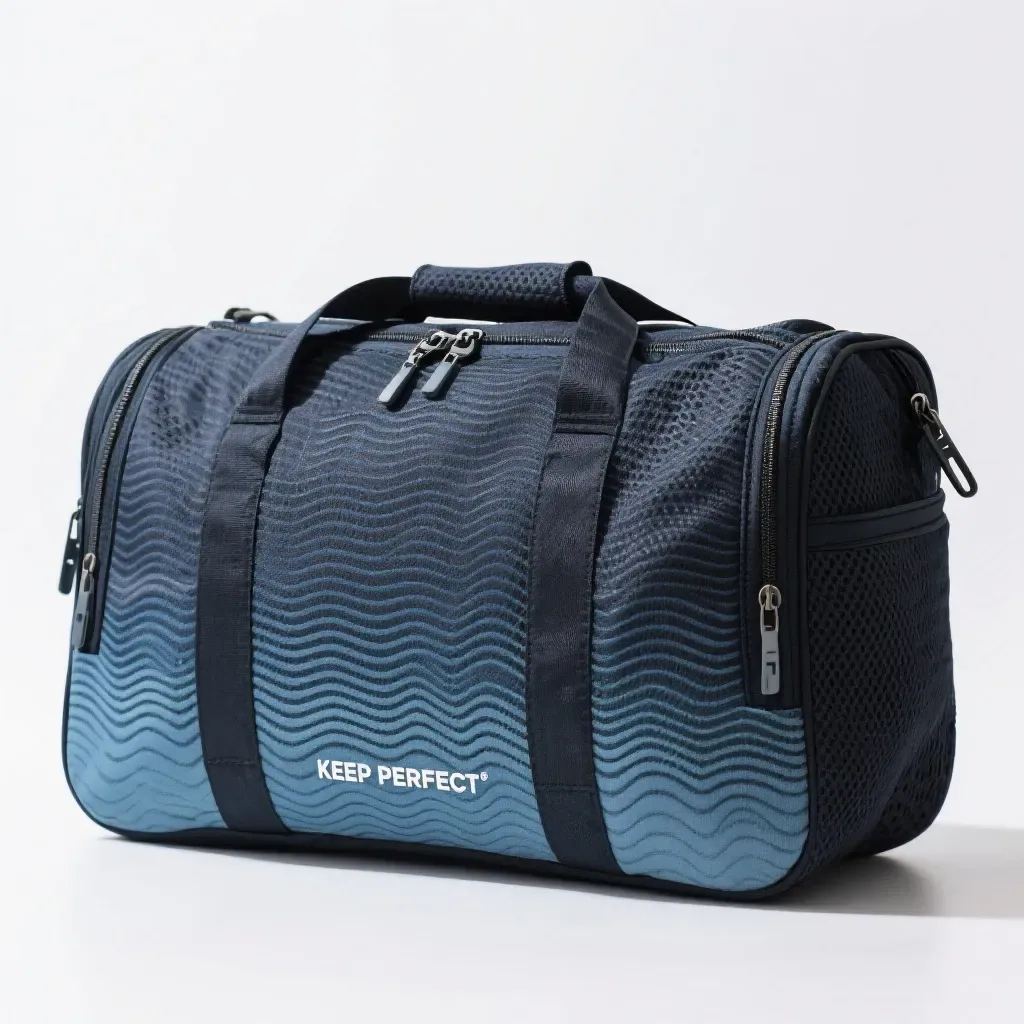
Choosing between these routes is a function of mark size and order size. A mark under 60 mm wide reads acceptably in jacquard at E12; above that the loop structure starts to soften the edges and intarsia gives a cleaner boundary at the cost of more yarn waste. Because the 100 pcs minimum is per colourway, a two-colour jacquard mark does not raise the minimum, which is a useful lever for small brands.
Tolerance, Shrinkage and Inspection on Small Knit Pouches
Dimensional tolerance on a 2.5 L pouch is +/- 3 mm on width and height, and that figure should appear on the tech pack before sampling starts. Knit relaxes after it leaves the machine, so a pouch measured hot off the needle bed will read smaller than the same pouch measured 24 hours later. Wash shrinkage of 1.8 percent after an ISO 6330 4N cycle is the working assumption for 300D polyester, and the pattern is graded up to compensate rather than the tolerance being relaxed.
Final inspection runs to AQL 2.5 under ISO 2859-1, with the defect list written around the pouch specifically: dropped stitches, oil stains, closure failure, mouth distortion and colour deviation against the approved shade band. Because the pouch is small, a single sample size covers a large share of the lot relative to a tote, which is one reason small knit items are easier to hold to a tight acceptance number.
Timing: 7 Working Days to Sample, 30 Days to Bulk
Sampling a knitted pouch takes 7 working days from an approved tech pack, and that window covers yarn procurement, machine programming, the first knitted body, closure fitting and the courier dispatch. Bulk production runs 30 days from sample approval and deposit. Both figures assume the yarn is a stock colour; a custom-dyed 300D shade adds a dye-lot step that should be quoted separately rather than folded into the standard window.
Programmes are coordinated from FOB Xiamen, with CIF and DDP available where a buyer wants a landed figure. Capacity across 7 production lines runs at about 200,000 pcs per month, which is why a 100-piece pouch order can be slotted into a line without displacing a larger programme. For a brand testing knit for the first time, that is the practical argument for starting with a pouch rather than a structured silhouette.
Where a Knitted Pouch Sits Next to Other Knit Silhouettes
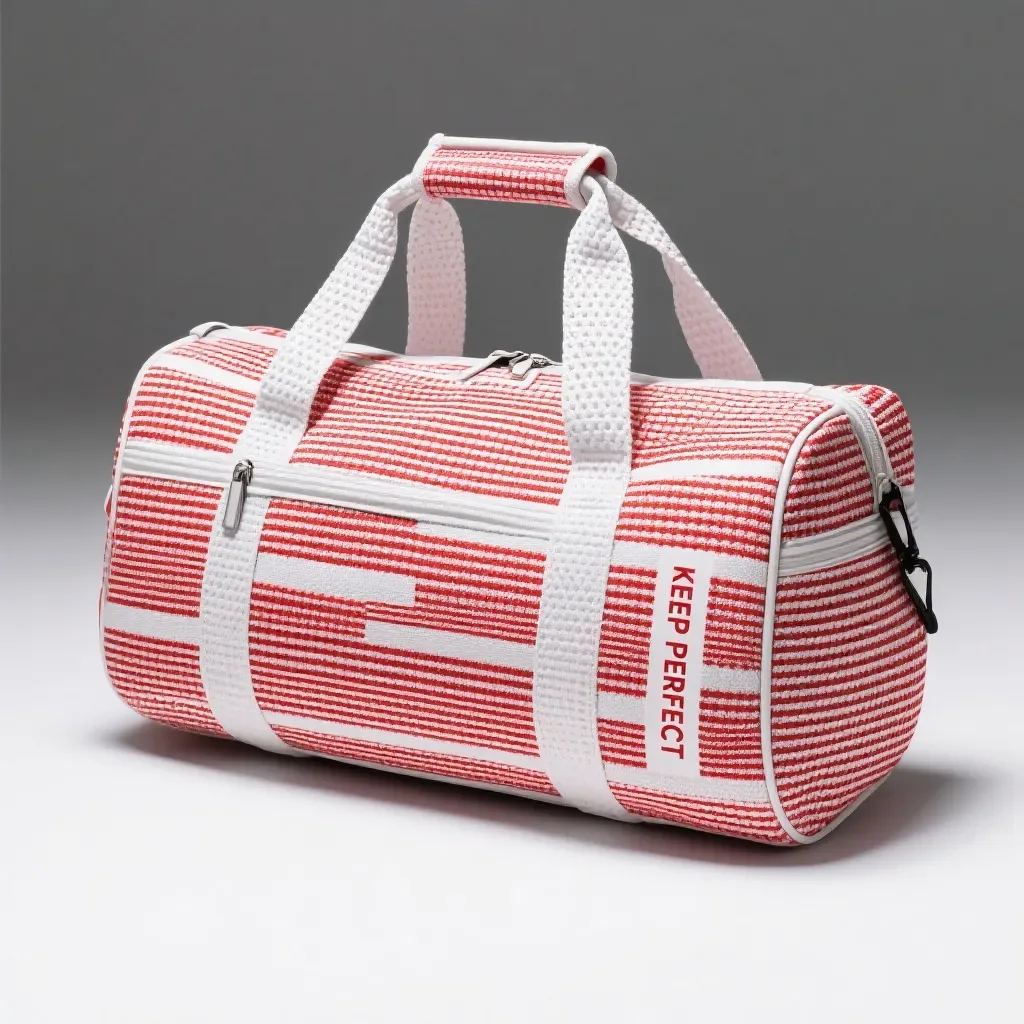
The pouch is the anchor of a knit capsule and the natural companion to larger silhouettes. A brand that opens with a pouch usually extends into a knitted bucket bag for weekend use, a knitted shoulder bag for everyday carry and a knitted laptop bag for work. Sharing one yarn lot and one colour standard across those styles is what turns four separate 100-piece orders into a coherent range.
The same logic applies in reverse: a buyer who already runs a tote programme adds a pouch as a gift-with-purchase item because it reuses the yarn, the colour reference and the decoration artwork with almost no new development cost. See the full knitted bag collection for how these silhouettes are grouped, and the knit bag sourcing guide for how a multi-style programme is scheduled.
Build a pouch capsule at 100 pcs
Send the volume band, gauge preference and artwork. The team returns a tech pack, a 7-working-day sampling plan and an FOB Xiamen quote. Start a pouch programme.
Frequently Asked Questions
What is the minimum order for a small knitted pouch bag?
The minimum is 100 pcs per style and per colourway. That means a 2.5 L pouch in one colour is a 100-piece order, while the same pouch in three colourways is three separate 100-piece commitments. The figure is deliberately low so a brand can test knit without carrying a large inventory position.
Which volume band should a first pouch order use?
Start at 2.5 L. It is large enough to be genuinely useful as a wash kit or stationery pouch, small enough to ship economically, and it knits in about 4.2 minutes at E12 gauge. The 1.2 L band is better as a gift-with-purchase item and the 4.0 L band suits shoe or garment storage.
How long does sampling take for a knitted pouch?
Sampling takes 7 working days from an approved tech pack. That covers yarn procurement, machine programming, the first knitted body, closure fitting and dispatch by courier. A custom-dyed shade rather than a stock colour adds a dye-lot step that is quoted separately. A two-colour jacquard mark does not extend that window, because the mark is knitted rather than applied afterwards.
What does E12 gauge mean for a pouch body?
E12 means 12 needles per inch on the knitting machine. It gives a loop size that hides minor yarn irregularity while keeping a 220 g/m2 body firm in the hand. E14 looks finer but exposes thick places in the yarn, and E7 gives a chunkier hand with a shorter cycle time.
Can a knitted pouch be washed without losing shape?
Yes, with the right specification. Wash shrinkage is 1.8 percent after an ISO 6330 4N cycle for 300D polyester, and the pattern is graded up to compensate. Specifying a 150D lining tacked at four points helps at 4.0 L where the contents are heavier.
Which closure works best on a knitted pouch?
A #3 coil zipper is standard up to 2.5 L and a #5 above that. The important detail is the mouth band: 8 courses knitted at a tighter stitch setting stop the zipper tape from puckering against the loop structure. ASTM D2061 is the reference for rating zipper strength.
How is a logo applied to a small knitted pouch?
A knitted-in jacquard mark is the usual answer. It adds roughly 25 seconds of cycle time and no secondary operation, and because the 100 pcs minimum applies per colourway rather than per colour used, a two-colour mark does not raise the minimum. Moulded zipper pullers are the alternative where the pouch surface is too small to carry a knitted mark.
What tolerance should be written into a pouch tech pack?
Write +/- 3 mm on width and height for a 2.5 L pouch. Knit relaxes after it leaves the needle bed, so the spec should also state that measurement happens 24 hours after knitting rather than hot off the machine, otherwise samples and bulk will disagree.
What inspection standard applies to pouch orders?
Final inspection follows AQL 2.5 under ISO 2859-1. The defect list is written around pouches specifically: dropped stitches, oil stains, closure failure, mouth distortion and colour deviation against the approved shade band. Because the pouch is small, one sample covers a genuinely useful share of the whole lot.
Does a lining make sense on a 1.2 L pouch?
Usually not. At 1.2 L the contents are light and the body holds its shape without help, so a lining adds about 40 grams and cost for little benefit. At 4.0 L the lining is worth specifying because heavier contents distort an unlined body.
How much yarn does one pouch consume?
A 2.5 L pouch uses roughly 95 grams of 300D body yarn plus 40 grams of 150D lining yarn. That mass is the largest single cost line in the unit price, which is why yarn count and fabric weight are the first two numbers to review when a quote needs to come down.
What trade terms are available for pouch shipments?
Programmes are quoted FOB Xiamen as standard, with CIF and DDP available where a buyer wants a landed cost. Because capacity is 7 production lines at about 200,000 pcs per month, a 100-piece pouch order slots into a line without displacing larger programmes. Consolidating a pouch order with other styles in the same colourway reduces freight per unit.
People Also Ask
Why do brands start a knit range with a pouch?
A pouch needs one knitted panel and one closure, so it has the shortest cycle time and the fewest defect opportunities of any knit silhouette. It also sets the colour standard that larger styles in the same capsule are matched against.
Is a seamless knitted pouch stronger than a sewn one?
At pouch size the advantage is fewer joins rather than higher tensile strength. Removing the side seam removes the most common place for a needle line or a pucker to show up, which lifts first-pass acceptance rates.
What gauge gives the sharpest logo on a pouch?
E14 gives the sharpest colour boundary, but it needs a more consistent and more expensive feed yarn. At E12 a mark under 60 mm wide reads acceptably, and above 60 mm an intarsia block gives a cleaner edge than jacquard.
Can one yarn lot cover several pouch styles?
Yes. Sharing a single 300D recycled polyester lot and one colour reference across a pouch, a bucket bag and a shoulder bag is what turns separate 100-piece orders into a coherent capsule with consistent shade.
How is pouch capacity measured for a tech pack?
Capacity is stated in litres from the flat dimensions, not from a water fill test. A 230 x 160 x 70 mm body is written as 2.5 L, and the tolerance of +/- 3 mm applies to the flat dimensions rather than to the litre figure.
Sources and further reading
Every figure on this page is either our own programme data or attributed below. Open the originals before you write them into a specification.
- ISO 2859-1 Sampling procedures for inspection by attributesISO Defines the AQL 2.5 single-sampling scheme used for final inspection of pouch orders.
- ASTM D2061 Standard Test Methods for Strength Tests for ZippersASTM International Referenced when a pouch closure needs a rated strength rather than a visual check.
- Global Recycled Standard (GRS)Textile Exchange The chain-of-custody standard behind the 300D recycled polyester used for pouch bodies.
- OEKO-TEX STANDARD 100OEKO-TEX Limit-value testing applied to knitted pouch bodies and linings that contact skin or cosmetics.