Knitted Duffel Bag Size Guide: Choosing Between 45, 55 and 70 Litres
Knitted duffel bag size is chosen from trip length and carry rules, and the three working capacities are 45, 55 and 70 litres. A 55 litre duffel measures about 55 x 30 x 30 cm, carries up to 15 kg, and is the size most buyers should specify first. Body fabric at about 480 g/m² knitted at E12 from 450D yarn suits all three, while the base needs around 640 g/m² because a duffel is set down and dragged more than any other bag type.
Which Duffel Size Fits Which Trip?
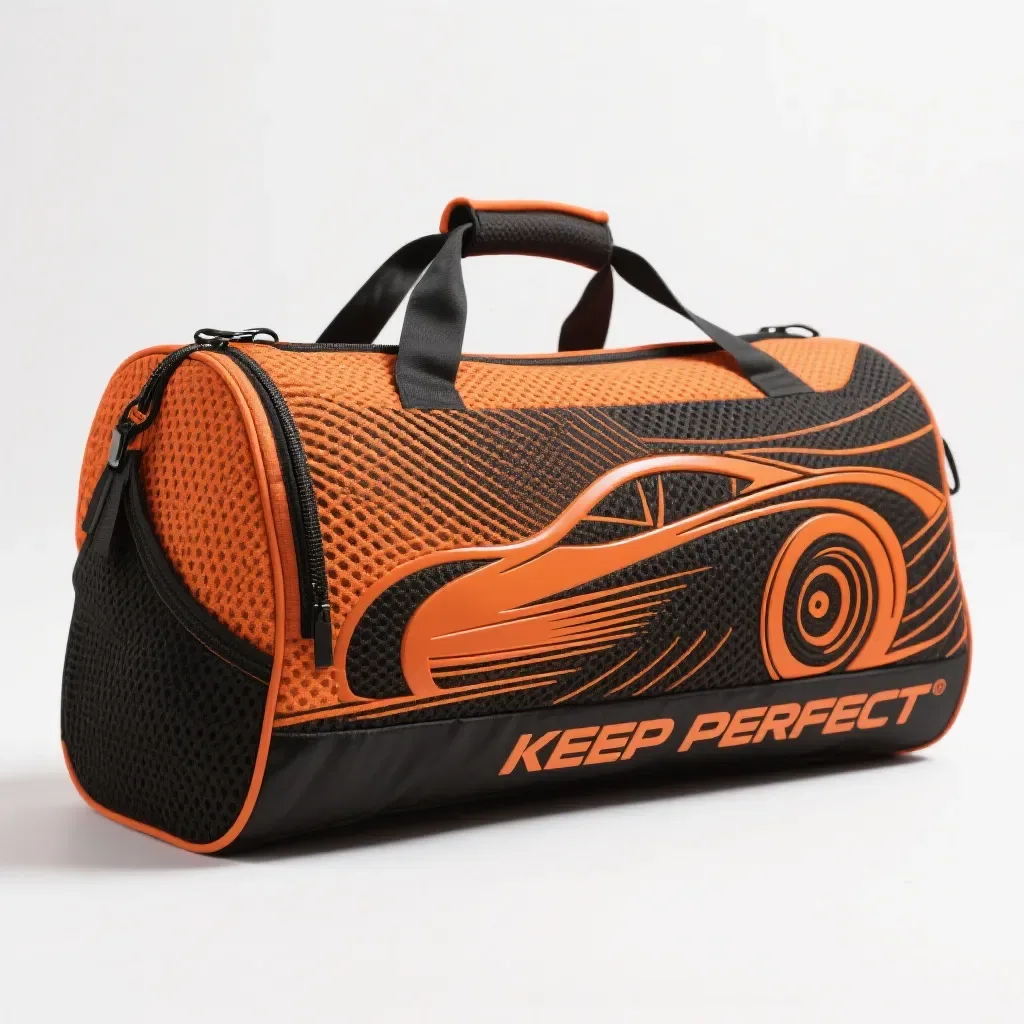
The three working capacities map to trip length with unusual clarity. A 45 litre duffel suits a weekend or a gym bag, roughly 50 x 28 x 28 cm. A 55 litre duffel suits three to five days, around 55 x 30 x 30 cm, and it is the size most programmes should start with because it is the most versatile. A 70 litre duffel suits a week or a shared family bag, around 65 x 34 x 34 cm, and it is a different product commercially rather than a bigger version of the same one.
The reason 55 litres is the recommended starting point is that it sits inside most airline carry dimensions when packed short, while 70 litres does not. A bag that a customer has to check is used less often, and a bag used less often is a bag that does not generate repeat purchases. Where a range is being planned, 45 and 55 together cover most of the market, and 70 should be added only when there is a specific use case for it.
Capacity is not the only sizing question; shape matters just as much. A cylindrical duffel packs efficiently and looks traditional; a flatter, wider duffel stands better and is easier to pack in layers. Knitted construction favours the second shape, because the base can be knitted with a denser and more stable structure while the sides stay lighter. Choose the shape alongside the capacity, because the two together decide how the bag behaves when full.
| Capacity | Dimensions | Trip length | Load | Position |
|---|---|---|---|---|
| 45 litres | about 50 x 28 x 28 cm | weekend or gym | about 10 kg | entry and gift |
| 55 litres | about 55 x 30 x 30 cm | three to five days | about 15 kg | the core size |
| 70 litres | about 65 x 34 x 34 cm | a week or shared | about 18 kg | specific use cases only |
How Much Can a Knitted Duffel Actually Carry?
A duffel is rated by volume but limited by structure, and the limiting factor is almost always the base rather than the body. A 55 litre knitted duffel at 480 g/m² carries about 15 kg comfortably, and it will physically hold more, but beyond that the base distorts and the bag stops holding its shape. The load rating should therefore be written alongside the volume, because volume alone invites a customer to overload a bag whose base was not built for it.
Compression is the feature that makes the rating usable. External compression straps let a partially filled duffel be pulled tight, which keeps the contents from shifting and keeps the bag from slumping. Without them, a half-full duffel looks and carries badly, and a customer will blame the bag rather than the packing. Two compression straps on a 55 litre bag is the sensible number, positioned at roughly the one-third and two-thirds points.
Why Does the Base Matter More Than the Body?
A duffel is set down on concrete, dragged across a floor and pushed into overhead space, and all of that happens at the base. The two places a duffel wears are the corners of the base and the full length of the bottom edge. On a knitted duffel both can be addressed by knitting the base at about 640 g/m² while the body stays at 480 g/m², which places mass where the wear is and keeps the total down.
The base also decides whether the bag stands up when full, which is the difference between a bag that looks considered and one that looks like a sack. A denser knitted base helps, and on larger capacities a removable board helps more. Where a board is used, it should be specified with the bag's packed dimensions in mind, because a board that is too stiff prevents the bag from being compressed for storage and defeats the point of a duffel.
- Body fabric
- about 480 g/m² at E12 from 450D yarn
- Base zone
- about 640 g/m², knitted denser in the same cycle
- Abrasion floor, body
- about 30,000 cycles ISO 12947-2 at 12 kPa
- Abrasion floor, base
- about 40,000 cycles ISO 12947-2 at 12 kPa
- Tensile floor
- about 560 N, ISO 13934-1
- Load rating, 55 litre
- about 15 kg
- Compression straps
- two, at roughly one-third and two-thirds points
What Closure and Opening Does a Duffel Need?
A duffel needs a wide, straight opening, because the whole point of the shape is access to a single large volume. That means a full-length zip along the top, and on a 55 litre bag that is a #10 coil zip with a substantial pull, because the zip is worked under tension when the bag is overfilled. A #8 is adequate on a 45 litre bag and a #10 is marginal on a 70 litre one, where a heavier gauge or a two-slider arrangement is worth considering.
The zip is also the most common failure on a duffel, and it fails in a characteristic way: the tape pulls away from the panel because the bag was closed against resistance. The control is a reinforced panel along the zip line rather than a heavier zip, so specify a denser knitted zone either side of the opening. Where a duffel has an end pocket, that pocket usually needs a #8 zip and its own reinforcement, because it is opened against a full bag.
Should a Duffel Have Backpack Straps or a Shoulder Strap?
The carry system is the decision that most affects how a duffel is actually used. A single detachable shoulder strap is traditional, simple and adequate up to about 10 kg. Above that, a shoulder strap becomes uncomfortable quickly, because the whole load hangs from one point and the bag swings. For a 55 litre bag carrying 15 kg, padded backpack straps are the better answer, and they are what most customers now expect at that size.
The knitted construction supports either, but the attachment differs. A shoulder strap loads two D-rings at the ends of the bag, and those need a denser knitted zone and a reinforcement run of at least 8 cm. Backpack straps load the upper back of the bag across a wider area, which knitted zoning handles well, but they add hardware, padding and operations. The honest recommendation is a shoulder strap on 45 litres and padded backpack straps from 55 litres upward.
What Fabric Weight Does a Duffel Need?
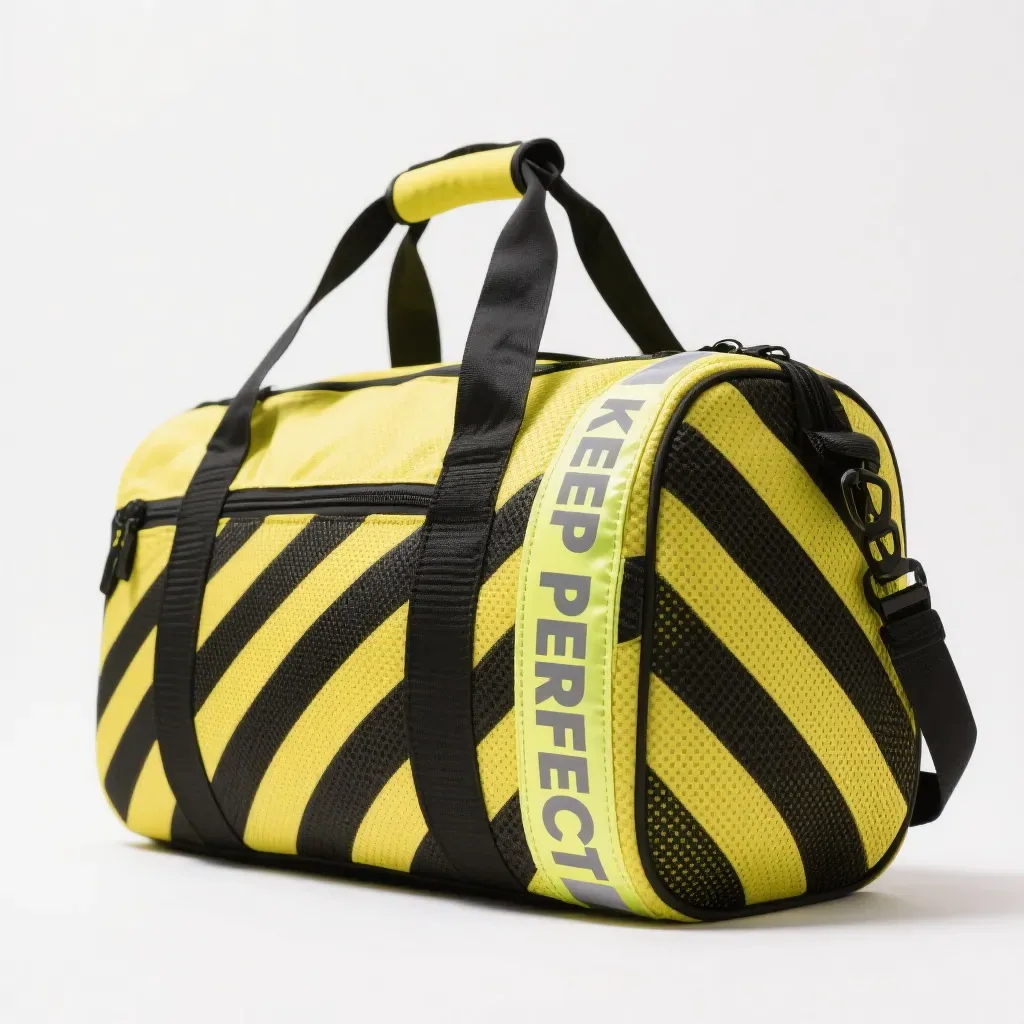
About 480 g/m² knitted at E12 from a 450D yarn is the working body fabric for a duffel, with the base knitted at around 640 g/m². A 45 litre duffel can run lighter at 420 to 460 g/m² because the load is lower, and a 70 litre duffel should run heavier at 520 g/m² because the volume puts more stress on the panel. The range is narrower than it looks, because a duffel takes abuse rather than weight alone.
Gauge choice follows the yarn and the surface. E12 with 450D is the standard; E7 with 600D gives a heavier, more open and more textured surface that suits an outdoor or utility programme and resists abrasion better for the same mass. E14 is not appropriate for a duffel, because the fine loop snags on the rough surfaces a duffel meets. Where a softer hand is wanted at the same mass, a textured yarn helps but reduces abrasion resistance.
How Does a Knitted Duffel Differ From a Woven One?
The differences are structural rather than cosmetic. A woven duffel is built from cut panels joined by seams, and every seam is a potential failure under the kind of abuse a duffel takes. A knitted duffel body can be produced as one shaped piece, removing the side seams and the base seam, which are exactly the seams that split when a duffel is overfilled and dragged. Fewer seams is the strongest practical argument for knitting this category.
The second difference is zoning and it matters more on a duffel than anywhere else, because a duffel needs three different properties in one bag: abrasion resistance at the base, stability along the zip line, and lighter weight across the top. A knitted panel delivers all three in one cycle. A woven bag needs three materials or three reinforcements, each with a seam attached, which is why woven duffels carry more of their weight in reinforcement than in body fabric.
Fewer seams
A one-piece knitted body removes the side and base seams that split when a duffel is overfilled and dragged, which is the most common structural failure in the category.
Zoned density
Abrasion resistance at the base, stability along the zip line and lighter weight across the top, all knitted in one cycle rather than assembled from three materials.
Better compression response
A knitted panel compresses and recovers, so a half-full duffel pulled tight by compression straps holds its shape rather than creasing permanently.
Lower reinforcement mass
Because reinforcement is knitted in rather than added as patches, a knitted duffel spends less of its weight on reinforcement than a woven equivalent.
What Does a Duffel Cost Compared With a Tote?
More, for two clear reasons: area and hardware. A 55 litre duffel has far more surface area than a tote, so it uses substantially more yarn even at the same fabric mass, and it carries a heavy duty zip, compression hardware and a carry system that a tote does not. Both lines are larger, and neither can be reduced much without changing what the bag is. That makes duffel programmes more sensitive to fabric mass than tote programmes.
The counter-lever is zoning, and it is worth more here than in any other category. Because a duffel needs heavy properties in specific places, zoning the base and the zip line while keeping the top light removes real mass without removing performance. A well-zoned 55 litre duffel can sit comfortably below a uniformly heavy one on cost while performing better, which is the clearest example of the general principle in knit bag design.
How Do You Write a Duffel Specification?
A duffel specification needs four sections and three of them are about things other than fabric. Write the capacity and the dimensions, then the carry system and how it is attached, then the closure and its reinforcement, then the fabric and its zones. Most incomplete duffel specifications are fabric specifications with a capacity mentioned, which leaves the three things that actually fail undescribed and untested.
- Capacity and dimensions: 55 litres, about 55 x 30 x 30 cm, with a tolerance of about ±1 cm.
- Load rating: 15 kg, stated as a number so the base and the carry system can be sized.
- Carry system: padded backpack straps from 55 litres upward, a detachable shoulder strap below that.
- Reinforcement: denser knitted zones at the strap and D-ring attachments, running at least 8 cm.
- Closure: #10 coil zip on 55 litres with a denser zone either side of the opening.
- Fabric and zones: body 480 g/m² at E12, base 640 g/m², abrasion 30,000 cycles body and 40,000 base.
- Programme: 100 pcs per style and colourway, 7 working days sampling, 30 days bulk, AQL 2.5, FOB Xiamen.
What Should Be Tested Before Bulk?
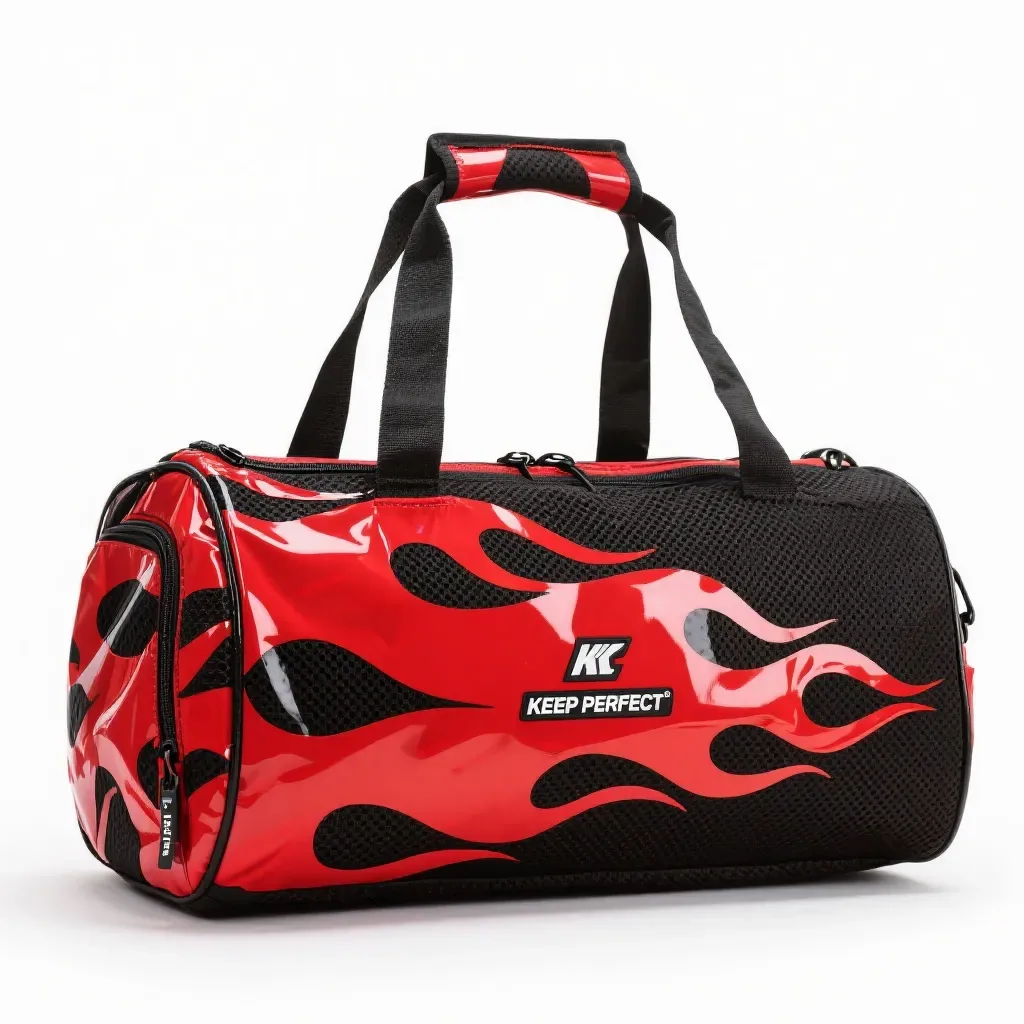
A duffel should be tested loaded, because its failure modes are abuse rather than wear. The minimum set is a static load test on the carry system, a drag test on the base, and a zip test under tension, and each should be written with a number. Fabric tests alone will pass while the assembled bag fails, which is the pattern that produces the returns this category is known for.
Testing also has a calendar function. Sampling takes 7 working days from a locked specification and bulk takes 30 days from approved sample. Running these tests inside the sampling window is what allows a fix to land on a sample rather than on a shipment. A duffel programme that skips the drag test to save a day is a programme that discovers its base problem in the returns data instead, which costs far more than the day.
Duffel specification in one line
- 55 litres at about 55 x 30 x 30 cm, body 480 g/m² at E12, base 640 g/m², padded backpack straps, #10 coil zip with reinforced sides, tested at 15 kg.
Choose a duffel size with a costing
Send the capacity, carry system and destination market. We will confirm fabric mass, zoned density and hardware, quote FOB Xiamen at 100 pcs per style and colourway, and book the 7 working day sampling window. Start on the contact page.
Frequently Asked Questions
What size duffel bag should I specify first?
Fifty-five litres, measuring about 55 x 30 x 30 cm and carrying up to 15 kg. It is the most versatile size and it sits inside most airline carry dimensions when packed short, while a 70 litre duffel usually does not. A bag a customer has to check gets used less often.
What is the difference between 45, 55 and 70 litre duffels?
Forty-five litres suits a weekend or a gym bag at about 10 kg, 55 litres suits three to five days at about 15 kg, and 70 litres suits a week or shared family use at about 18 kg. The 70 litre is a different product commercially rather than a larger version of the same one.
How much weight can a knitted duffel carry?
A 55 litre knitted duffel at 480 g/m² carries about 15 kg comfortably. It will physically hold more, but beyond the rating the base distorts and the bag stops holding its shape. Write the load rating alongside the volume so the base and carry system can be sized correctly.
Why does the base of a duffel need more fabric weight?
Because a duffel is set down on concrete, dragged across floors and pushed into overhead space, all of which happen at the base. Knit the base at about 640 g/m² while the body stays at 480 g/m², which places mass where the wear is and keeps the total down.
What zip does a duffel bag need?
A full-length #10 coil zip on a 55 litre bag, because the zip is worked under tension when the bag is overfilled. A #8 is adequate on 45 litres and a heavier gauge or two sliders is worth considering on 70 litres. Reinforce the panel either side of the opening rather than only upgrading the zip.
Should a duffel have backpack straps or a shoulder strap?
A detachable shoulder strap is adequate up to about 10 kg, so it suits 45 litres. From 55 litres upward, padded backpack straps are better and are what most customers now expect, because a single strap carrying 15 kg swings and becomes uncomfortable quickly.
What fabric weight suits a knitted duffel?
About 480 g/m² knitted at E12 from a 450D yarn for the body, with the base at about 640 g/m². A 45 litre duffel can run at 420 to 460 g/m² and a 70 litre should run at about 520 g/m², because volume puts more stress on the panel at that size.
Which gauge suits a knitted duffel?
E12 with 450D is the standard. E7 with 600D gives a heavier, more textured surface that suits an outdoor or utility programme and resists abrasion better at the same mass. E14 is not appropriate, because the fine loop snags on the rough surfaces a duffel meets.
How is a knitted duffel different from a woven one?
A knitted body can be produced as one shaped piece, removing the side and base seams that split when a duffel is overfilled and dragged. It can also zone density, giving abrasion resistance at the base, stability along the zip line and lower weight across the top in one cycle.
Do compression straps matter on a duffel?
Yes, because a half-full duffel without them slumps and its contents shift. Two straps positioned at roughly the one-third and two-thirds points on a 55 litre bag is the sensible arrangement. A knitted panel compresses and recovers, so it responds to compression better than a stiffer woven material.
Why does a duffel cost more than a tote?
Two reasons: surface area and hardware. A 55 litre duffel uses substantially more yarn than a tote at the same fabric mass, and it carries a heavy duty zip, compression hardware and a carry system a tote does not. That makes duffel programmes more sensitive to fabric mass.
How can duffel cost be reduced without losing performance?
By zoning. A duffel needs heavy properties only at the base and along the zip line, so knitting those zones denser while keeping the top light removes real mass without removing performance. A well-zoned duffel can sit below a uniformly heavy one on cost while performing better.
What tests should a duffel programme run?
A static load test on the carry system, a drag test on the base and a zip test under tension, each with a number written into the spec. Fabric tests alone pass while the assembled bag fails, which is the pattern behind most duffel returns.
Should a duffel have a base board?
It helps larger capacities stand up when full, but it should be specified with packed dimensions in mind, because a board that is too stiff prevents the bag being compressed for storage. On a 45 litre bag a denser knitted base is usually sufficient without a board.
How does shape affect a duffel?
A cylindrical duffel packs efficiently and looks traditional, while a flatter, wider one stands better and packs in layers. Knitted construction favours the flatter shape, because the base can be knitted denser and more stable while the sides stay lighter.
How long does a duffel programme take?
Sampling takes 7 working days from a locked specification and bulk takes 30 days from approved sample. Running the load, drag and zip tests inside the sampling window lets a fix land on a sample rather than on a shipment, which is well worth the day it costs.
People Also Ask
What size duffel bag do I need?
Forty-five litres for a weekend or gym, 55 litres for three to five days, and 70 litres for a week or shared family use. Most programmes should start at 55 litres, since it fits most carry dimensions.
What GSM is right for a knitted duffel?
About 480 g/m² at E12 from 450D yarn for the body, with the base knitted at about 640 g/m². Lighter on 45 litres, heavier around 520 g/m² on 70 litres.
Why do duffel bags fail at the base?
Because they are set down on concrete, dragged and pushed into overhead space. The corners and the bottom edge wear first, so the base needs a denser knitted zone and a higher abrasion floor than the body.
What zip size does a duffel need?
A #10 coil zip on 55 litres, #8 on 45 litres, and a heavier gauge or two sliders on 70 litres. Reinforce the panel either side of the opening, because tape pull-away is more common than zip failure.
Are knitted duffels better than woven ones?
They have fewer seams, since the body can be knitted as one shaped piece, removing the side and base seams that split under abuse. Zoned density also targets the base and zip line rather than adding reinforcement patches.
Sources and further reading
Every figure on this page is either our own programme data or attributed below. Open the originals before you write them into a specification.
- ISO 2859-1:1999 Sampling procedures for inspection by attributesISO Sampling plan behind the AQL 2.5 inspection applied at final inspection on duffel programmes.
- ASTM textile test standardsASTM International Includes ASTM D5034 for tensile and ASTM D4966 for abrasion, used alongside the ISO methods named here.
- OEKO-TEX STANDARD 100OEKO-TEX Finished-article certificate covering the assembled duffel including straps, zip and hardware.
- Shima Seiki wholegarment knitting machineryShima Seiki Machine capability behind one-piece duffel bodies and zoned base density in a single cycle.
- Textile Exchange standardsTextile Exchange Recycled content framework for duffel programmes specifying recycled yarn in the body.