Seamless Knitted Backpack Guide: Load Paths, Straps and a Complete Specification Checklist
A seamless knitted backpack specification should be built around the load path, not around the panel: a 30 litre body around 45 x 30 x 16 cm carrying 12 kg, straps 45 mm wide with 8 mm padding, and a body knitted at E12 from 450D yarn to about 520 g/m². Seamless here means the body is knitted as one shaped piece rather than assembled from cut panels, which removes the side and base seams where packs normally split. Strap attachment remains the critical joint.
What Seamless Means on a Knitted Backpack
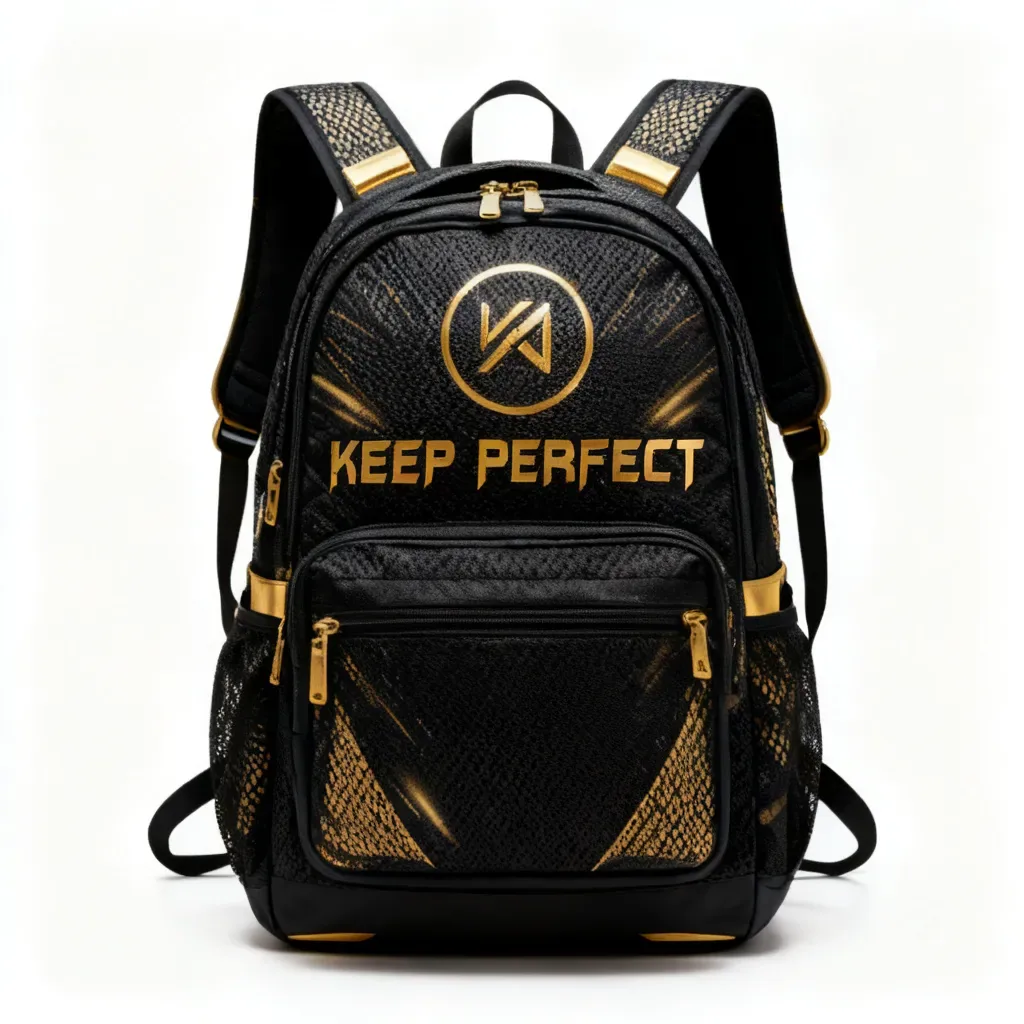
Seamless in this context means the backpack body is knitted as one shaped piece on the machine, so there are no side seams and no base seam, rather than assembled from several cut panels sewn together. It does not mean the whole pack has no stitching: straps, zips, linings and hardware are still attached. The value is that the two seams most likely to split under load, the side seams and the base seam, are gone, and the panel can be zoned so density sits where the pack actually wears.
The engineering consequence is that the load path changes. In a sewn pack, load travels from the straps through seam lines into the body fabric. In a seamless knitted pack, load travels from the strap attachment into a continuous loop structure, which distributes it over a wider area before it reaches any joint. That is a genuine advantage and it is why a seamless pack can be lighter than a sewn equivalent at the same load rating, provided the strap attachment is designed to take advantage of it.
The risk moves rather than disappears. Because the body no longer has seams to fail, the strap attachment becomes the dominant failure point, and it now carries load into a knitted structure that can tear progressively rather than into a seam that would fail abruptly. Progressive tearing is slower and more visible, which is helpful, but it still fails. Every checklist item below is ordered around that single fact: the body is rarely the problem, and the attachment almost always is.
Seamless in one line
- The body comes off the machine as one shaped piece with no side or base seam, so the strap attachment becomes the joint that carries the whole load.
Checklist 1: Set the Volume and the Load Case
Volume and load are the two numbers every other decision follows from, and they are frequently left implicit. A daypack at 20 litres and a travel pack at 35 litres carry different loads, sit differently on the back and need different strap geometry. Write both into the spec with a number: litres, and the maximum load in kilograms the pack is expected to carry in normal use. Without the load figure, nothing downstream can be sized correctly.
A working standard for a retail daypack is 30 litres, about 45 cm high, 30 cm wide and 16 cm deep, carrying up to 12 kg. That is enough for a laptop, a water bottle and a layer of clothing, and it is within the range where a 45 mm strap remains comfortable. Pushing beyond 35 litres or 12 kg changes the strap specification, the back panel specification and the fabric mass, so it should be treated as a different product rather than a variation.
- State the volume in litres and the maximum load in kilograms, both as numbers in the spec.
- A 20 litre daypack carries about 8 kg and works with 38 mm straps.
- A 30 litre pack carries about 12 kg and needs 45 mm straps with 8 mm padding.
- Above 35 litres or 12 kg, treat it as a different product with its own strap and back panel design.
- State whether the pack will be dragged or set down hard, because that sets the abrasion floor.
Checklist 2: Design the Load Path Before the Panel
Before choosing yarn or gauge, trace where the load goes. It leaves the shoulders through the straps, concentrates at the strap attachment, spreads into the upper back panel, and then travels down the body to the base. The body fabric only carries part of that load; the attachment and the upper back panel carry the concentration. Designing the pack means putting density and reinforcement along that path, and it should be drawn rather than described.
On a seamless knitted body the drawing becomes a knitting instruction, because zones can be placed exactly where the load path runs. A denser zone under each strap attachment, a firmer zone across the upper back panel, and a denser abrasion zone at the base can all be knitted in one cycle. That is the practical payoff of the seamless approach and it is wasted if the spec simply asks for uniform fabric and lets the attachment be added afterwards.
Checklist 3: Strap Width, Padding and Attachment
Straps are sized by load, and the relationship is straightforward: narrower straps concentrate the same load into less contact area, which is what makes a pack uncomfortable long before it makes it fail. At 8 kg, 38 mm is workable; at 12 kg, 45 mm is the sensible minimum; at 15 kg and above, 50 mm with firmer padding. Padding thickness matters as much as width: 8 mm of foam is the working figure for a 12 kg pack, and thinner padding bottoms out under load and stops distributing anything.
The attachment is the joint that decides the pack's life. A strap sewn directly to the knitted panel concentrates load into the stitch line and tears progressively. The better construction is a continuous webbing loop that runs from the strap, under the panel and back up, so the load path is the webbing rather than the seam, combined with a denser knitted zone where the loop meets the panel. Carry the reinforcement at least 10 cm down the panel on a 30 litre pack.
- Volume
- 30 litres for a standard daypack
- Body dimensions
- about 45 x 30 x 16 cm
- Maximum load
- 12 kg
- Strap width
- 45 mm, with 50 mm above 12 kg
- Padding thickness
- 8 mm foam
- Reinforcement run
- at least 10 cm down the panel
- Attachment type
- continuous webbing loop, not a strap sewn to the panel
Checklist 4: Back Panel Comfort and Airflow
The back panel is the part a customer judges within thirty seconds of putting the pack on, and it is also the part most often left to chance. On a knitted pack there is a real opportunity here, because the panel can be knitted with an open structure in the centre and a denser structure at the edges, giving airflow without adding a spacer mesh component. That is worth specifying, because it removes an operation and a material.
The trade-off is between airflow and load distribution. An open central structure breathes well and distributes poorly, while a dense structure distributes and does not breathe. The resolution is zoning again: dense where the straps and the lumbar area load the panel, open in between. Where a pack is intended for hot climates or for commuting, the open zone is worth more; where it is intended for carrying weight, the dense zone is.
Checklist 5: Openings, Compartments and Hardware
Hardware on a backpack is where cost and failure both concentrate. A full-length main zip, a front pocket zip, a laptop compartment and two side pockets can easily cost more than the knitted body of a small pack, and each is an operation and a potential defect. The economical approach is to decide which compartments the customer will actually use and to knit the ones that can be knitted, keeping sewn hardware for the openings that genuinely need a closure.
Zip specification deserves a number rather than a size name. A main opening on a 30 litre pack normally takes a #8 coil zip, front pockets a #5, and the pull type should be specified because branded pulls add cost and lead time. Side pockets are the clearest saving: a knitted stretch pocket holds a bottle without any hardware at all, and it is one of the few places where knitting removes a component entirely rather than just a seam.
| Component | Recommendation | Why |
|---|---|---|
| Main opening | #8 coil zip | carries the widest opening and the most cycles |
| Front pocket | #5 coil zip | lighter duty, lower cost |
| Side pockets | knitted stretch pocket | removes hardware and an operation entirely |
| Laptop compartment | knitted sleeve with 6 mm padding | no separate component needed |
| Strap adjustment | ladderlock buckle in acetal or metal | metal adds cost and weight |
| Top grab handle | webbing loop, 25 mm | useful and low cost |
Checklist 6: Fabric Mass, Gauge and Abrasion Zones
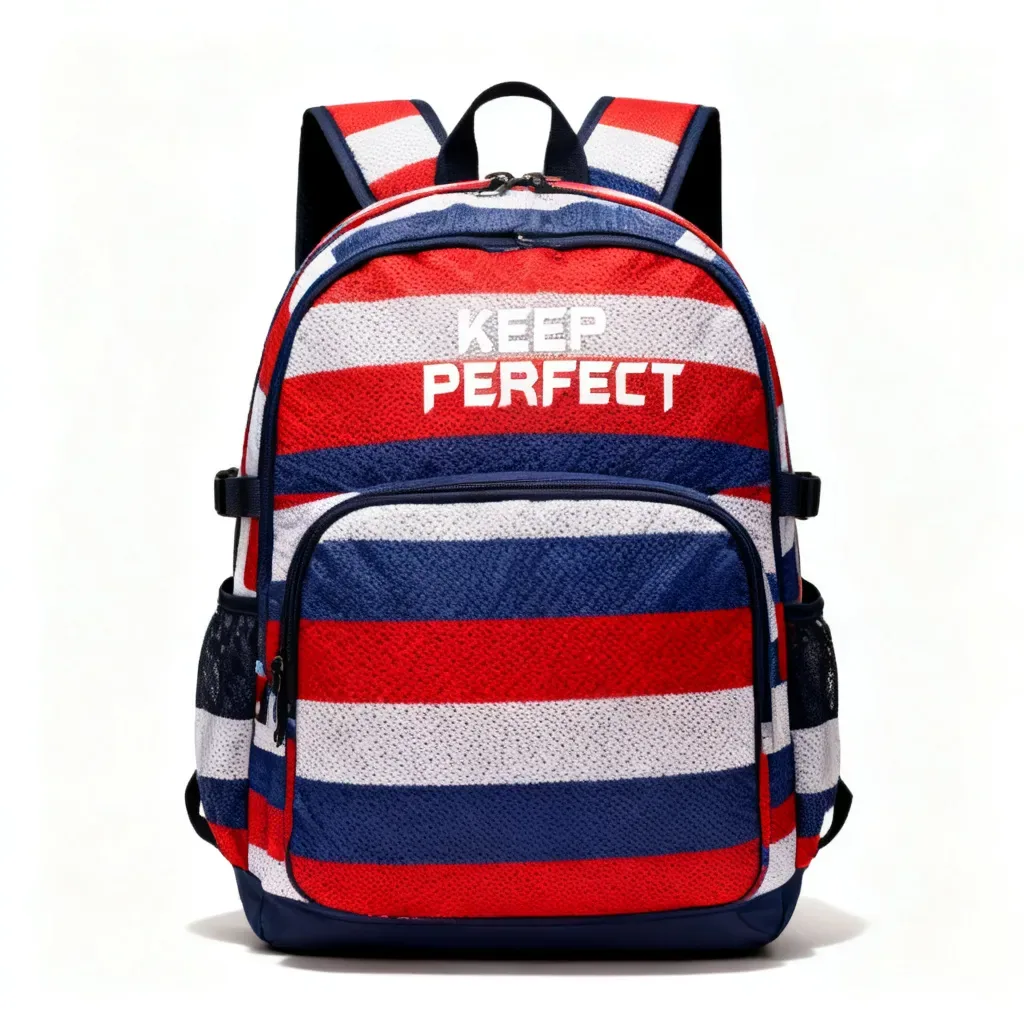
For a 30 litre pack carrying 12 kg, about 520 g/m² knitted at E12 from a 450D yarn is the working fabric specification. It clears roughly 520 N tensile under ISO 13934-1 and around 30,000 Martindale cycles under ISO 12947-2, which is appropriate for a pack that will be set down on rough surfaces. Lighter packs at 20 litres and 8 kg work at 420 to 460 g/m², and the saving is real because a pack body uses more fabric than a tote does.
Abrasion zoning matters more on a backpack than on any other bag type, because the base and the lower back panel are both dragged and both pressed against clothing. Knit the base at around 640 g/m² and the lower back panel at around 560 g/m² while the upper body stays at 520 g/m². That places mass where the pack wears and keeps the total down, and on a seamless body it is one instruction in the knitting programme rather than a set of additional panels.
Checklist 7: Testing the Assembled Pack
Fabric testing is necessary and insufficient. A backpack should be tested as an assembled product, because the strap attachment and the zip are the components that fail, and neither appears in a fabric test. The minimum set is a static load test on the straps, a cyclic load test, and a drop test, and each should be written into the spec with a number rather than left to the inspector's judgement.
- Static strap load: 12 kg for 30 minutes suspended by both straps, then inspect both attachments.
- Cyclic load: 12 kg lifted and set down 500 times, then inspect the attachments and the base.
- Drop test: loaded to 12 kg, dropped from 50 cm onto a hard surface, inspect for split seams or torn panels.
- Zip cycling: 1,000 open and close cycles on the main zip, then check slider and tape.
- Abrasion on the base zone: ISO 12947-2 at 12 kPa, 40,000 cycles minimum.
- Colour fastness: ISO 105-C06 grade 4 and AATCC 8 grade 4-5 dry.
Checklist 8: Cost, Quantity and Calendar
A backpack uses more fabric than a tote, so the yarn line is proportionally larger and the zoned design matters more. A 30 litre pack at 520 g/m² consumes noticeably more yarn than a 420 g/m² tote, and hardware adds a line that a tote barely has. The two levers that work are zoning, which keeps mass off the areas that do not need it, and hardware consolidation, which removes both material and operations.
Programmes start at 100 pcs per style and colourway, quoted FOB Xiamen with CIF and DDP available, and inspection runs to AQL 2.5 under ISO 2859-1. Sampling takes 7 working days from a locked specification and bulk takes 30 days from approved sample. For a backpack the specification lock matters more than for simpler bags, because the strap attachment and the zoned structure are knitted into the body and cannot be adjusted after the panel is made.
Copy-Ready Seamless Backpack Specification
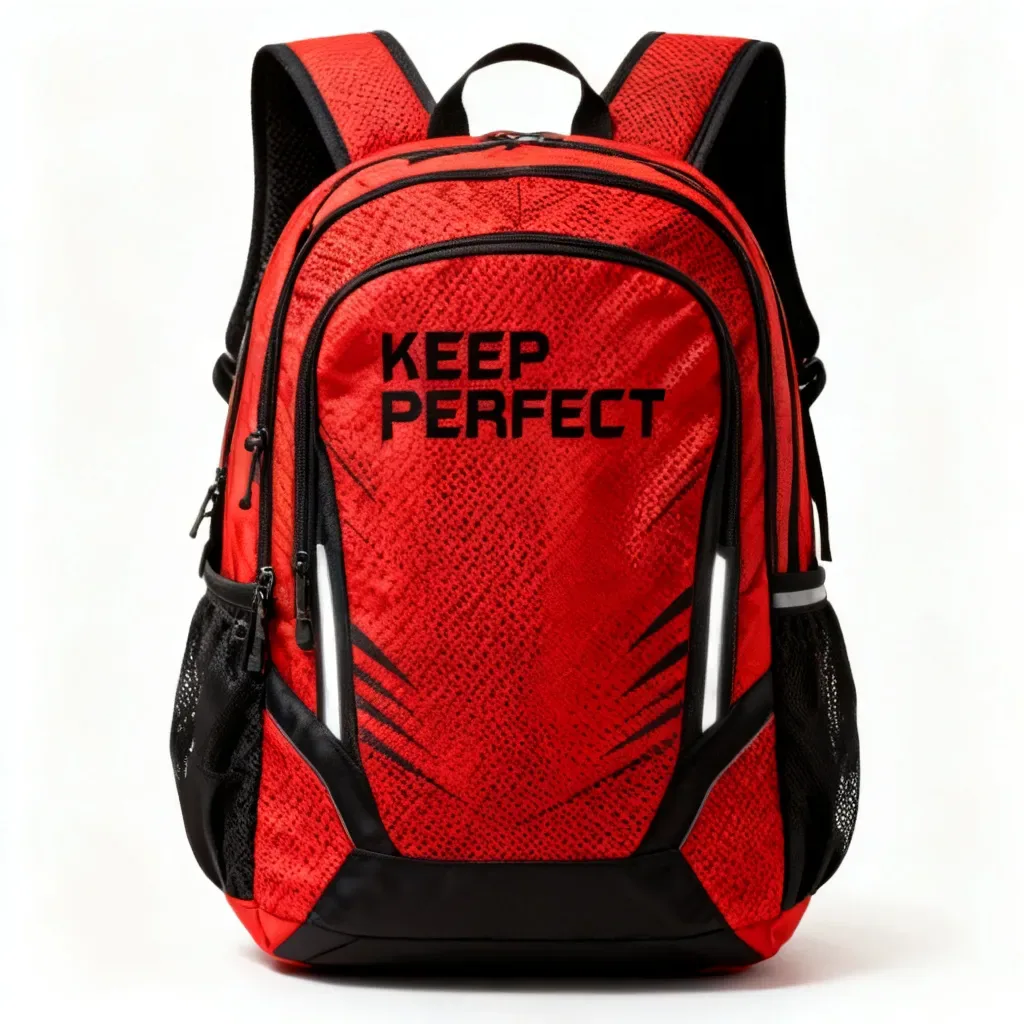
The fastest way to start a backpack programme is to copy a complete specification and edit the numbers. The sheet below is a realistic 30 litre retail daypack with zoned density and a continuous strap attachment. It is deliberately conservative in the right places: the abrasion floor is raised only at the base and lower back panel, and the hardware list is short, which keeps both the cost and the defect surface down at 100 pcs per style and colourway.
- Volume and dimensions
- 30 litres, about 45 x 30 x 16 cm
- Load rating
- 12 kg maximum
- Yarn and gauge
- 450D recycled or virgin polyester, E12
- Body fabric
- 520 g/m², tolerance ±5%
- Zoned density
- base about 640 g/m², lower back about 560 g/m²
- Straps
- 45 mm webbing, 8 mm foam padding, continuous loop attachment
- Reinforcement
- denser zone extending 10 cm below each attachment
- Hardware
- #8 main zip, #5 front pocket zip, knitted stretch side pockets
- Tests
- ISO 13934-1 at 520 N, ISO 12947-2 at 30,000 cycles, static strap load 12 kg for 30 minutes
- Programme
- 100 pcs per style and colourway, 7 working days sampling, 30 days bulk
- Inspection and terms
- AQL 2.5 under ISO 2859-1, FOB Xiamen, CIF and DDP available
Backpack specification in one line
- 30 litres at 520 g/m² and E12.
- 45 mm straps with 8 mm padding on a continuous webbing loop.
- base zoned to 640 g/m².
- tested at 12 kg for 30 minutes.
Build a seamless knitted backpack programme
Send the target volume, load rating and hardware list. We will confirm yarn, gauge and zoned density, quote FOB Xiamen at 100 pcs per style and colourway, and book the 7 working day sampling window. Start on the contact page.
Frequently Asked Questions
What does seamless mean on a knitted backpack?
It means the body is knitted as one shaped piece, so there are no side seams and no base seam. Straps, zips, linings and hardware are still attached. The value is that the two seams most likely to split under load are removed, and the panel can be zoned so density sits where the pack wears.
Why does the strap attachment fail on a seamless pack?
Because removing the body seams moves the failure to the remaining joint. The strap now carries load into a knitted structure that can tear progressively rather than into a seam that fails abruptly. A continuous webbing loop plus a denser zone extending 10 cm below the attachment is the construction that addresses it.
What volume and load suit a retail knitted daypack?
Thirty litres, about 45 x 30 x 16 cm, carrying up to 12 kg, is the working standard. It holds a laptop, a bottle and a layer of clothing and stays within the range where a 45 mm strap is comfortable. Above 35 litres or 12 kg the strap and back panel design changes, so treat it as a different product.
How wide should backpack straps be?
Size them by load: 38 mm at 8 kg, 45 mm at 12 kg, and 50 mm with firmer padding above that. Padding thickness matters as much as width, and 8 mm of foam is the working figure at 12 kg, because thinner padding bottoms out under load and stops distributing anything.
What fabric weight suits a seamless knitted backpack?
About 520 g/m² knitted at E12 from a 450D yarn for a 30 litre pack carrying 12 kg. That clears roughly 520 N tensile under ISO 13934-1 and around 30,000 Martindale cycles under ISO 12947-2. Lighter packs at 20 litres and 8 kg work at 420 to 460 g/m².
Where should a knitted backpack be reinforced?
Along the load path: under each strap attachment, across the upper back panel, and at the base. Knit the base at about 640 g/m² and the lower back panel at about 560 g/m² while the body stays at 520 g/m². On a seamless body that is one knitting instruction rather than several added panels.
Can the back panel be knitted for airflow?
Yes, by knitting an open structure in the centre and a denser structure at the edges, which gives airflow without adding a spacer mesh component. The trade-off is load distribution, so keep the dense zones where the straps and the lumbar area load the panel.
Can side pockets be knitted instead of sewn?
Yes, and it is one of the clearest savings available. A knitted stretch pocket holds a bottle with no hardware and no separate operation, which removes both a material and a defect opportunity. It is one of the few places where knitting removes a component entirely rather than only a seam.
Which zip sizes are used on a backpack?
A #8 coil zip for the main opening on a 30 litre pack and a #5 for front pockets. Specify the pull type as well, because branded pulls add cost and lead time. Zip cycling of 1,000 open and close cycles is a reasonable test on the main zip.
How should a knitted backpack be tested?
As an assembled product. Minimum set: 12 kg static load for 30 minutes suspended by both straps, a cyclic load test of about 500 lift and set down cycles, a drop test from 50 cm loaded to 12 kg, plus fabric tests for tensile, abrasion and colour fastness.
What abrasion floor suits a backpack base?
About 40,000 Martindale cycles at 12 kPa under ISO 12947-2 for the base zone, against roughly 30,000 for the body. The base and the lower back panel are both dragged and both pressed against clothing, so they wear faster than any other part of the pack.
How does a backpack programme differ from a tote on cost?
It uses more fabric and adds a hardware line a tote barely has. That makes zoned density more valuable, because it keeps mass off the areas that do not need it, and hardware consolidation more valuable, because it removes material and operations together.
Why does the specification lock matter more for backpacks?
Because the strap attachment and the zoned structure are knitted into the body rather than added afterwards. A change after the panel is made means re-knitting rather than adjusting, so the specification should be locked before the 7 working day sampling clock starts.
How long does a seamless backpack programme take?
Sampling takes 7 working days from a locked specification and bulk takes 30 days from approved sample. Both assume yarn and hardware are on hand, so hardware availability is worth confirming at the same time as the yarn when booking the slot.
What should be checked at backpack inspection?
Strap attachment integrity, zip function, base abrasion appearance and any density variation across the back panel. Inspection runs to AQL 2.5 under ISO 2859-1, and these defect classes should be written before the inspector arrives rather than judged on the day.
Is a seamless knitted pack lighter than a sewn one?
It can be, at the same load rating, because removing the side and base seams removes the reinforcement those seams need and lets density be placed only where the load path runs. The saving is modest and it depends entirely on the design using the zoning capability.
People Also Ask
What is a seamless knitted backpack?
A pack whose body is knitted as one shaped piece, so there are no side or base seams. Straps, zips and hardware are still attached, and the advantage is fewer failure points plus the ability to place density where the load path runs.
How much weight can a knitted backpack carry?
A 30 litre retail daypack is rated to about 12 kg. Strap width follows the load: 38 mm at 8 kg, 45 mm at 12 kg and 50 mm above that, with 8 mm foam padding as the working figure at 12 kg.
What GSM is right for a knitted backpack?
About 520 g/m² at E12 from 450D yarn for a 30 litre pack carrying 12 kg. Zone the base to about 640 g/m² and the lower back panel to about 560 g/m², since both are dragged.
How do you stop backpack straps tearing off?
Use a continuous webbing loop that runs under the panel rather than sewing the strap to the fabric, and knit a denser zone extending at least 10 cm below each attachment. Then test the assembled pack at 12 kg for 30 minutes.
Does a seamless pack still need stitching?
Yes. Seamless refers to the body being knitted in one piece; straps, zips, linings and hardware are still attached. What disappears are the side and base seams, which are the joints most likely to split under load.
Sources and further reading
Every figure on this page is either our own programme data or attributed below. Open the originals before you write them into a specification.
- ISO 2859-1:1999 Sampling procedures for inspection by attributesISO Sampling plan behind the AQL 2.5 inspection applied at final inspection on backpack programmes.
- ASTM textile test standardsASTM International Includes ASTM D5034 for tensile and ASTM D4966 for abrasion, used alongside the ISO methods named here.
- OEKO-TEX STANDARD 100OEKO-TEX Finished-article certificate covering the assembled pack including straps, padding and hardware.
- Shima Seiki wholegarment knitting machineryShima Seiki Machine lineage behind one-piece seamless bodies and zoned density in a single knitting cycle.
- Textile Exchange standardsTextile Exchange Recycled content framework for programmes specifying recycled yarn in the backpack body.