Unisex Knitted Bag Design Language: A Six-Point Checklist for Buyers and Designers
A unisex knitted bag is not a women's bag in a darker colour. Six variables decide whether a piece reads as gender-neutral at the fixture: silhouette symmetry, strap drop, volume against carry height, colour neutrality, hardware finish and loop scale. The working ranges are narrow — a strap drop of 28 to 32 cm, a body volume of 18 to 22 litres, and a loop scale most often delivered at E12. This article sets out all six as a checklist, with the number that settles each one.
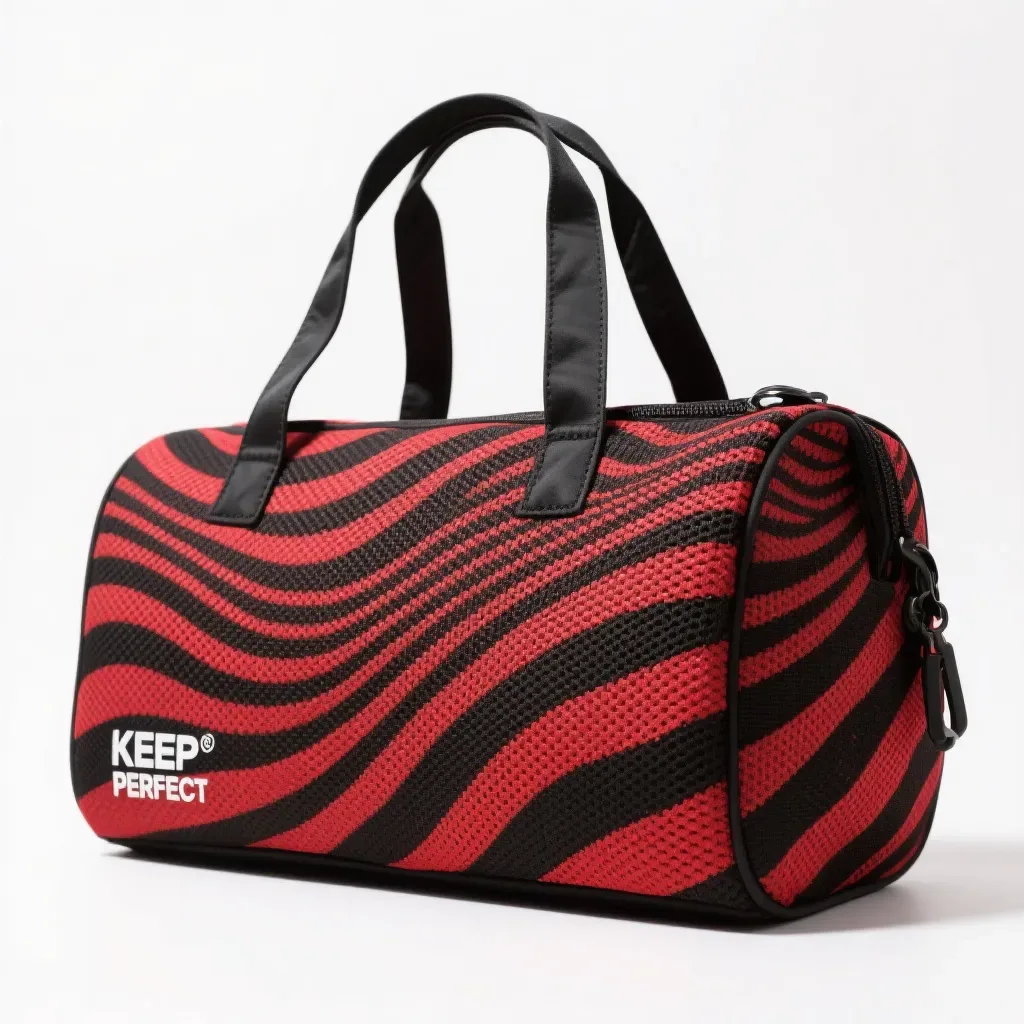
The Six Variables That Decide Whether a Bag Reads as Unisex
Six variables decide whether a knitted bag reads as gender-neutral: silhouette symmetry, strap drop, body volume against carry height, colour neutrality, hardware finish and loop scale — and of the six, strap drop is the one shoppers notice first and designers specify last.
The reason these six matter more on a knitted bag than on a cut-and-sew one is that knitting removes the decorative vocabulary that usually carries gender coding. There is no quilting, no contrast piping, no shaped flap, no decorative stitch line at the edge. What is left is proportion, surface and hardware, and those are exactly the six variables above. A designer who specifies a knit bag by adapting a woven bag drawing is therefore working without most of the signals they normally rely on, and the result is usually a piece that reads as feminine by default because the proportions carried over from a women's pattern.
The checklist below is ordered by how much each variable costs to change late in a programme. Silhouette and strap drop are fixed in the knitting programme and are expensive to revisit after yarn booking. Colour and hardware are fixed at the booking stage but can be changed with less disruption. Loop scale sits between the two, because it is a programme parameter that can be adjusted within a gauge band. Work the list top to bottom and the expensive decisions are made while they are still inexpensive.
Check One: Silhouette Symmetry and Where to Break It
Default to a symmetrical silhouette on a unisex knit bag, and break symmetry only in one place at most — because a single deliberate asymmetry reads as design, while two read as a mistake.
The most reliable unisex knit silhouettes are a rectangular tote, a squared bucket and a flat messenger, all with the opening centred and the base parallel to the top edge. A break that works well is an offset strap attachment, which introduces asymmetry at the top line while keeping the body itself symmetrical. A break that almost never works is an asymmetric base, because a bag that does not sit flat on a table looks unstable rather than designed. Where a shaped body is wanted, shaping should be delivered through the knitting programme as a whole-garment form rather than through a panel and a seam, since a seam is itself a decorative signal.
Check Two: Strap Drop, Width and the Load Line
Specify a strap drop of 28 to 32 cm for a shoulder-carried unisex bag and 40 to 45 cm for a crossbody, with a strap width of 25 mm at minimum, because a narrower strap reads as a dress accessory and a wider one reads as equipment.
Strap drop is the variable most often carried over unexamined from a women's pattern block, where 24 to 26 cm is common, and it is the variable that most reliably mis-genders a piece. The load line matters as much as the number: on a knitted bag the strap junction is knitted into the body, so the drop is fixed by the programme and cannot be adjusted with a slider afterwards unless a slider is specified. A 25 mm strap is the working minimum for a unisex read, and 32 to 38 mm is the range most unisex programmes land on. Below 25 mm the strap visually cuts the shoulder and reads as delicate.
- Shoulder strap drop
- 28 to 32 cm, measured from the top edge to the strap underside
- Crossbody strap drop
- 40 to 45 cm, adjustable by a slider inside that range
- Strap width
- 25 mm minimum, 32 to 38 mm preferred for a unisex read
- Handle drop on a tote
- 22 to 26 cm, enough to clear a rolled coat sleeve
- Strap junction reinforcement
- Loop density raised across a 60 mm band at each junction
- Strap attachment
- Integral knitted loop, or a boxed bar-tack on a webbing strap
Check Three: Volume Against Carry Height
Set body volume at 18 to 22 litres for a unisex daily bag and keep the body height below 38 cm, because above roughly 40 cm a soft knitted body slumps at the base and reads as a holdall rather than as a personal bag.
Volume and height are separate constraints and both are needed. A 20-litre bag that is 30 cm tall reads as a day bag; the same 20 litres at 45 cm tall reads as an overnight bag, and the shopper assigns it a different use and a different gender. The height limit is structural as well as visual. A seamless knitted body has no internal frame, so height beyond about 40 cm without a reinforced base band will slump under load, and the slump is most visible on the base corners. Where a taller body is genuinely required, the base band should be knitted at a higher loop density and the gusset should be shaped rather than straight.
Check Four: Colour Neutrality Without Ending Up Grey
Neutral does not mean grey: the four shades that sell most consistently across a unisex knit range are ecru, charcoal, deep olive and ink navy, and a grey-only palette is the most common reason a unisex capsule underperforms on the floor.
Grey fails because it is the absence of a decision rather than a decision. A unisex palette needs chroma somewhere, and the four shades above carry it without coding masculine or feminine. Ecru reads warm and natural, charcoal reads architectural, deep olive reads utilitarian, ink navy reads formal. Two of the four in a three-colourway launch is the usual approach, with the third being a seasonal accent that is allowed to move. On a knitted body, shade is delivered either by dope-dyed yarn or by piece dyeing, and the two do not produce the same result: dope dyeing gives better fastness and a more consistent lot, piece dyeing gives more flexibility at a shorter lead time.
Unisex design checklist, in the order the decisions should be made
- Silhouette: symmetrical by default, at most one deliberate asymmetry, and never at the base.
- Strap drop: 28 to 32 cm shoulder, 40 to 45 cm crossbody, measured before the sample is knitted.
- Strap width: 25 mm minimum, 32 to 38 mm preferred, since width carries the gender signal.
- Volume: 18 to 22 litres for a daily bag, with body height held under 38 cm.
- Colour: two of ecru, charcoal, deep olive and ink navy, plus one seasonal accent.
- Hardware: one metal finish across the piece, brushed rather than polished or antique.
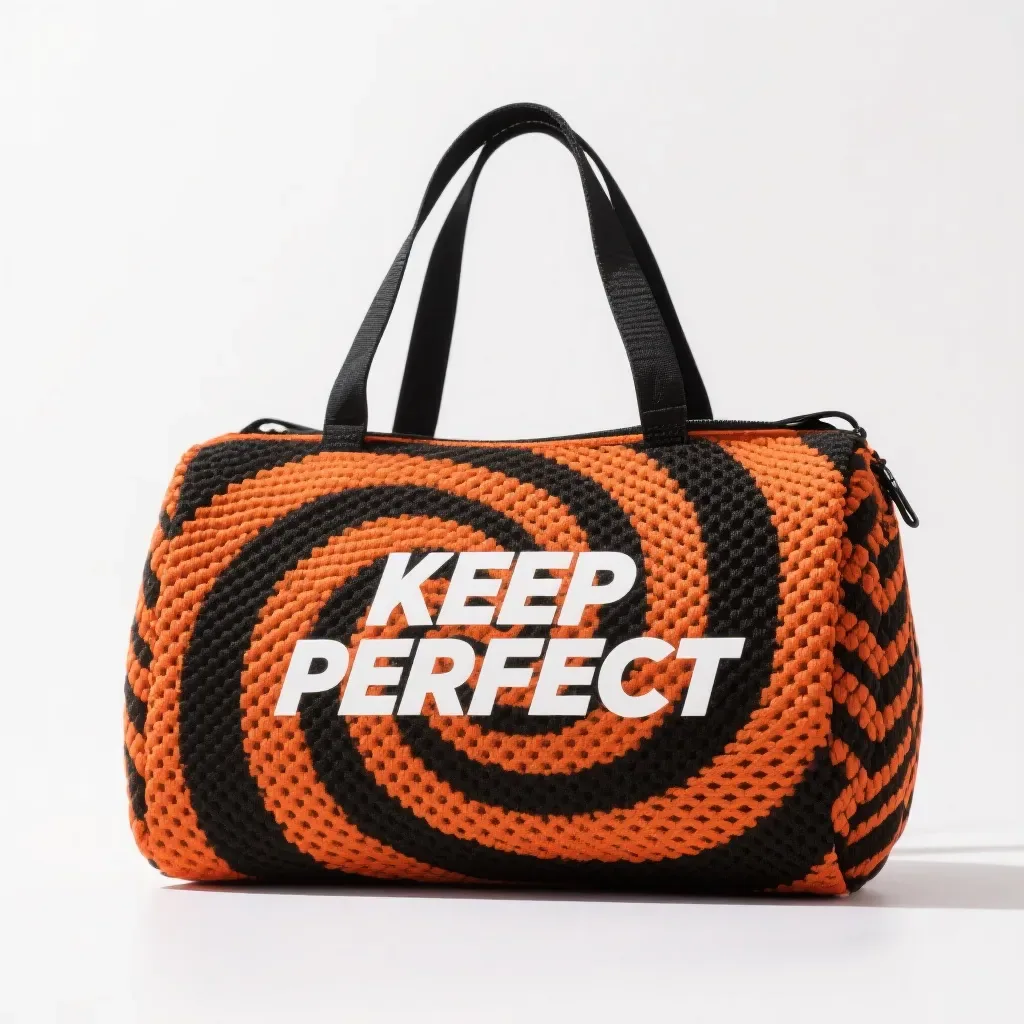
Check Five: Hardware Finish and the One-Metal Rule
Use one metal finish across the whole bag and make it brushed rather than polished or antique, because polished hardware reads as dress and antique hardware reads as heritage, and both are gendered signals that brushed finishes avoid.
The one-metal rule is simple and often broken. A bag with a brushed zip and a polished D-ring looks assembled rather than designed, and on a knitted body, where there is no other decorative vocabulary to absorb the inconsistency, it is very visible. The finish choice should also account for how the hardware meets the knit: a metal zip tape set into a knitted channel should be specified with the tape colour matched to the body yarn, since a contrast tape is itself a decorative signal. Where the brand wants a visible hardware signature, the answer is a single considered piece — a closure or a strap end — rather than a family of mixed finishes.
Check Six: Loop Scale and the Gauge Decision
Loop scale is the surface signal a knitted bag has that a woven bag does not, and E12 is the gauge that most reliably reads as unisex: E14 reads fine and delicate, E7 reads coarse and overtly utilitarian.
Gauge on a knit bag is doing two jobs at once, and this is where design and engineering have to be reconciled. Structurally, gauge sets loop density, which sets strength, abrasion behaviour and GSM. Visually, gauge sets the scale of the surface texture, which is the nearest thing a knit bag has to a pattern. E12 sits in the middle of that trade and is why it is the default for most unisex programmes. A designer who wants a finer surface should be told what it costs in abrasion terms, and one who wants a coarser surface should be told that E7 reduces the legible logo stroke width to about 5 mm.
Branding Placement That Does Not Gender the Piece
Place the mark on the lower third of the front panel, centred horizontally and no larger than about 60 cm², because a large centred mark on a soft knitted body behaves like a print placement and pulls the piece toward a fashion read.
Placement is the last of the signals and the easiest to get wrong at the end of a programme. On a knitted body the mark is usually knitted in rather than applied, which means its position is fixed in the programme and cannot be moved after the first knit without reprogramming. The lower third works because it reads as a maker's mark rather than as decoration, and because it stays visible when the bag is carried rather than only when it is displayed. The size ceiling matters for the same reason the strap width does: above roughly 60 cm² the mark becomes the primary visual element, and the bag becomes a branded surface rather than a bag.
| Variable | Unisex working range | What breaks the read | Cost of changing it late |
|---|---|---|---|
| Silhouette symmetry | Symmetrical, one break at most | An asymmetric base or a shaped flap | High: reprogramming plus rebooking |
| Strap drop | 28 to 32 cm shoulder, 40 to 45 cm crossbody | A 24 to 26 cm drop carried over from a women's block | High: fixed in the knitting programme |
| Strap width | 25 mm minimum, 32 to 38 mm preferred | A strap under 25 mm, which reads delicate | Medium: strap is a separate component |
| Volume and height | 18 to 22 litres, height under 38 cm | Height above 40 cm on a soft unlined body | High: needs a reinforced base band |
| Colour | Two of ecru, charcoal, olive, navy | A grey-only palette, or a saturated pastel | Medium: yarn rebooking, about 10 days |
| Hardware finish | One brushed finish throughout | Mixed polished and antique finishes | Low: trim change, no reprogramming |
| Loop scale | E12, with E14 or E7 as deliberate departures | E14 specified by default because it photographs well | Medium: parameter change, GSM moves with it |
What Unisex Sizing Costs and Where It Saves
A unisex knit specification typically costs about 4% more per unit than a single-gender equivalent, because of the wider strap, the higher GSM needed to hold a taller soft body, and the brushed hardware finish — and it saves more than that by consolidating two colourways into one.
The saving side is the argument that actually lands with a buying team. A unisex programme runs one silhouette where a gendered programme runs two, which halves the number of programmes to sample, halves the set-up count and consolidates the yarn booking. At MOQ 100 pcs per style and per colourway, a unisex range of four colourways in one silhouette is 400 pieces, against 800 for two silhouettes in two colourways each. The sampling calendar is the same 7 working days either way, and bulk is the same 30 days, but the number of approvals a design team has to sit through is halved.
Rectangular tote, 20 L
E12 in 300D rPET, 320 g/m², 24 cm handle drop, unlined, centred mark in the lower third. The safest unisex starting point.
Squared bucket, 18 L
E12 in 450D, 340 g/m², drawstring channel with a brushed toggle, reinforced base band. Shaped by the programme, not by a seam.
Flat messenger, 14 L
E12 in 300D, 300 g/m², 42 cm crossbody drop on a 32 mm webbing strap, single brushed closure.
Structured holdall, 32 L
E7 in 600D rPET, 380 g/m², base band knitted at raised loop density, height held under 40 cm. The one place E7 earns its cost.
Validating the Design Language With a Buy Panel
Validate a unisex design language with a panel of at least 12 people split evenly, and ask one question only — who is this bag for — because any question that names gender produces the answer it names.
The question design matters more than the panel size. Ask whether a bag is for men or for women and every respondent answers, and the answers cluster by the respondent's own assumptions rather than by the object. Ask who the bag is for, unprompted, and the responses that come back with a gender attached are the ones that indicate a specification problem. Twelve is a workable minimum because fewer than that cannot separate a genuine signal from individual taste. Where the panel does attach a gender, the checklist above gives the order in which to look: strap drop first, then width, then colour, and only then hardware and loop scale.
Turning the Checklist Into a Specification
A unisex knit design language becomes purchasable when all six variables are written as numbers into the tech pack rather than as adjectives, because adjectives resolve to whatever default the production team happens to hold.
Write strap drop as 28 to 32 cm, strap width as 32 mm, volume as 20 litres with height under 38 cm, the two base colours by name against a shade reference, the hardware finish as one brushed tone, and the gauge as E12. That is six numbers, and six numbers is what it takes to get the piece that was designed rather than the piece that a default produced. Sampling runs 7 working days from that specification and bulk runs 30 days from the approved handover, released against AQL 2.5 under an ISO 2859-1 sampling plan, on FOB Xiamen terms with CIF and DDP available.
Specify a unisex knit bag range
Send the silhouette, the intended carry height and the colourway split. Our knit team will return a six-point specification with the working numbers for each variable, then sample in 7 working days and produce in 30 against MOQ 100 pcs per style and colourway. Start on the contact page.
Frequently Asked Questions
What makes a knitted bag read as unisex?
Six variables: silhouette symmetry, strap drop, body volume against carry height, colour neutrality, hardware finish and loop scale. Of these, strap drop is the one shoppers notice first and designers specify last, so it is the first thing to check.
What strap drop should a unisex knitted bag use?
28 to 32 cm for a shoulder-carried bag and 40 to 45 cm for a crossbody, measured from the top edge to the strap underside. A drop of 24 to 26 cm is common on women's pattern blocks and is the most reliable way to mis-gender a piece.
How wide should a unisex bag strap be?
25 mm is the working minimum and 32 to 38 mm is preferred. Below 25 mm the strap visually cuts the shoulder and reads as delicate, which is a gendered signal. Above 38 mm it begins to read as equipment rather than as a personal bag.
What volume suits a unisex daily knitted bag?
18 to 22 litres, with the body height held under 38 cm. Volume and height are separate constraints: the same 20 litres at 45 cm tall reads as an overnight bag, and the shopper assigns it a different use and a different gender.
Why should body height stay under 38 cm?
Because a seamless knitted body has no internal frame. Above roughly 40 cm without a reinforced base band, a soft body slumps under load and the slump shows first at the base corners. A denser base band is the structural answer.
Which colours work in a unisex knit range?
Ecru, charcoal, deep olive and ink navy. Each carries chroma without coding masculine or feminine. A grey-only palette is the most common reason a unisex capsule underperforms, because grey is the absence of a decision rather than a decision.
Should hardware be polished or brushed on a unisex bag?
Brushed, and one finish throughout. Polished hardware reads as dress and antique hardware reads as heritage; both are gendered signals. Mixing a brushed zip with a polished D-ring looks assembled rather than designed.
Which gauge reads as unisex on a knitted bag?
E12. It sits in the middle of the trade between structure and surface: E14 reads fine and delicate, E7 reads coarse and overtly utilitarian. Gauge also sets loop density, so it moves GSM, strength and abrasion behaviour at the same time.
Where should the brand mark go on a unisex knit bag?
On the lower third of the front panel, centred horizontally, at no more than about 60 cm². Above that the mark becomes the primary visual element and the bag becomes a branded surface, which pulls it toward a fashion read.
Is symmetry required for a unisex knitted bag?
It is the safe default. One deliberate asymmetry reads as design; two read as a mistake. An offset strap attachment works well, while an asymmetric base almost never does, because a bag that does not sit flat looks unstable.
Does a unisex specification cost more to produce?
About 4% more per unit, from the wider strap, the higher GSM needed to hold a taller soft body and the brushed hardware finish. It saves more than that by consolidating two silhouettes into one and halving the set-up count.
How does a unisex range affect MOQ?
It reduces the total commitment. At MOQ 100 pcs per style and per colourway, four colourways in one unisex silhouette is 400 pieces, against 800 for two gendered silhouettes in two colourways each.
How should a unisex design language be tested with shoppers?
With a panel of at least 12 people split evenly, asked one unprompted question: who is this bag for. Any question that names gender produces the answer it names, so the responses that attach a gender unprompted are the signal.
In what order should the six variables be decided?
By the cost of changing them late. Silhouette and strap drop first, since both are fixed in the knitting programme. Then colour and hardware at the booking stage. Then loop scale, which is a parameter that can move within a gauge band.
People Also Ask
How do I make a knitted bag unisex?
Work the six variables: symmetrical silhouette, 28 to 32 cm strap drop, 18 to 22 litres under 38 cm tall, a neutral palette with chroma, one brushed hardware finish, and E12 loop scale. Write all six as numbers in the tech pack.
What is the most common mistake in unisex bag design?
Carrying the strap drop over from a women's pattern block. A 24 to 26 cm drop reads delicate regardless of how neutral the colour and hardware are, and it is fixed in the knitting programme so it is expensive to correct later.
Is grey the safest neutral for a unisex bag range?
No. A grey-only palette underperforms because grey is the absence of a decision. Ecru, charcoal, deep olive and ink navy each carry chroma without coding masculine or feminine, and two of the four is the usual launch mix.
Can a knitted bag be shaped without adding a seam?
Yes. Whole-garment knitting shapes the body through the programme rather than through panels, so a squared bucket or a structured base can be achieved with no seam and therefore no decorative signal.
How much extra does a unisex knit specification cost?
About 4% per unit, mainly from the wider strap, the higher GSM and the brushed finish. The consolidation of two silhouettes into one saves more than that across sampling, set-up and yarn booking.
Sources and further reading
Every figure on this page is either our own programme data or attributed below. Open the originals before you write them into a specification.
- ISO 3801:1977 — Textiles, woven fabrics, determination of mass per unit length and mass per unit areaISO The method behind the GSM figures quoted for each gauge band in the unisex specification.
- ISO 13934-1:2013 — Textiles, tensile properties of fabrics, Part 1: maximum force using the strip methodISO Referenced for the strap junction strength behind the 60 mm raised-density reinforcement band.
- ISO 12947-2:2016 — Textiles, determination of abrasion resistance, Part 2: specimen breakdownISO The abrasion method used when a finer gauge such as E14 is proposed for a daily-carry body.
- OEKO-TEX STANDARD 100OEKO-TEX Finished-textile testing applied to the yarn and trim set used across a unisex range.
- WHOLEGARMENT knitting machinesShima Seiki The machine class behind shaping a knit body through the programme rather than through panels and seams.
- ISO 2859-1:2026 — Sampling procedures for inspection by attributes, Part 1: AQL-indexed sampling schemesISO Defines the AQL 2.5 release that follows bulk production on a unisex range.
Six Numbers Replace Six Adjectives
A unisex design language fails when it stays in the register of adjectives: neutral, clean, understated, considered. Each of those resolves to a different default depending on who is reading the brief. Six numbers resolve to one object. The checklist exists to convert a design conversation into a specification that survives contact with a production programme.
For the silhouettes the checklist applies to, see knitted bag collection. For the accessory decisions that sit under check five, see knitted bag accessory pairings, and for the field-by-field structure of the specification, see knitted bag tech pack template.