Knitted Bag Accessories: Which Closures, Straps, Hardware and Linings Actually Suit a Knitted Body
Accessories are where most knitted bag programmes lose their margin and their field performance, because hardware specified for a woven body behaves differently against a loop structure. Six pairings decide the outcome: a #5 rather than a #3 zip, 32 mm rather than 20 mm webbing, a 90 g/m² rather than a 150 g/m² lining, a bar-tacked rather than a stitched attachment, a knitted-in rather than an applied mark, and a single metal finish throughout. This article works through the pairings as a sequence of questions.
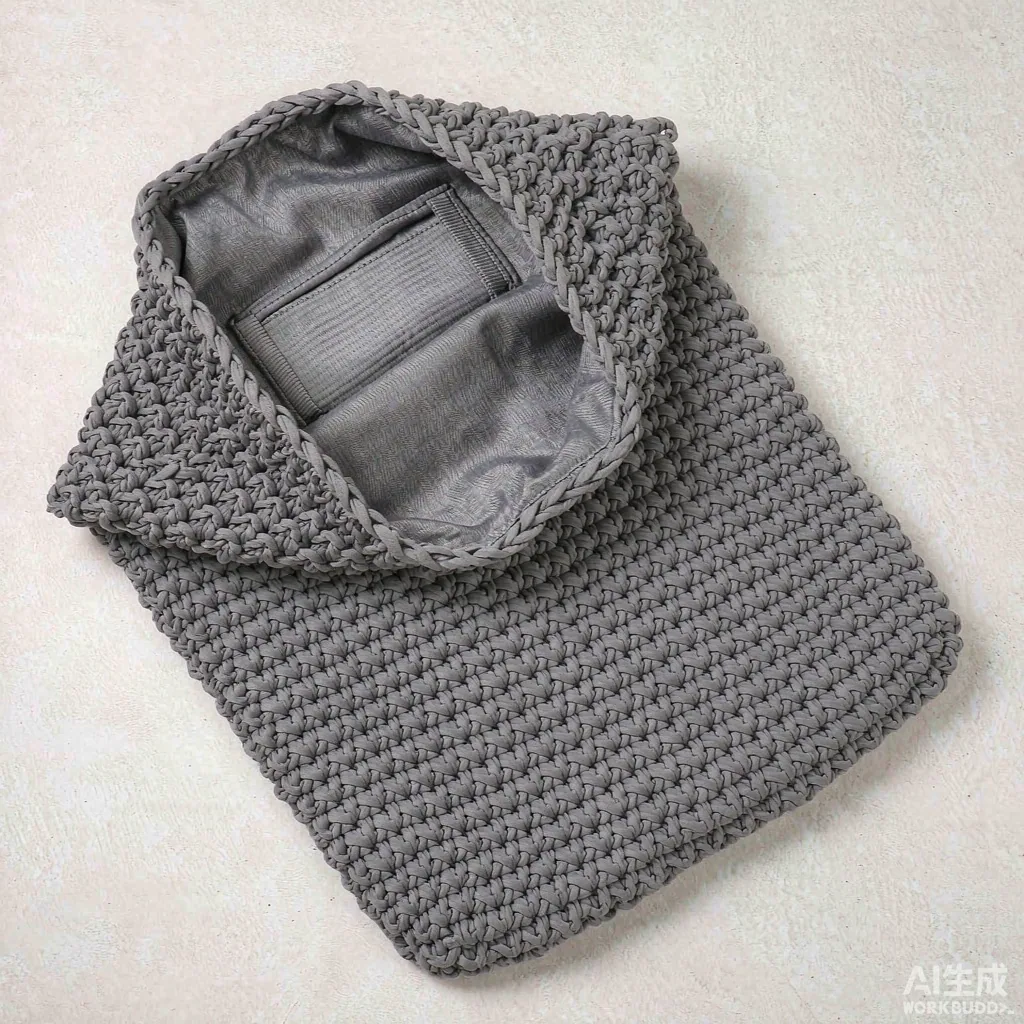
Which Closure Actually Suits a Knitted Body?
A #5 coil zip is the default closure for a knitted bag body, not a #3, because a knitted channel has no woven selvedge to stabilise a fine tape and a #3 tape will creep and pucker inside about 20 wash cycles.
The reason is structural rather than cosmetic. A woven fabric resists along both axes, so a fine zip tape can be set into it and will stay set. A knitted structure has significantly more extensibility in the course direction, and a narrow tape set into that structure is pulled by it every time the bag is loaded. The result is a wavy tape and a zip that binds at the point where the wave is worst. A #5 tape is wide enough and stiff enough to resist that movement, and setting it into a knitted channel with the tape colour matched to the body yarn removes the last of the visual tell.
The alternatives each have a place. A drawstring channel is the right answer on a bucket or a gift bag, because it needs no tape at all and the channel is knitted integrally with the body. A magnetic closure is workable on a structured piece but requires a backing plate, and the plate has to sit on a reinforced panel rather than on the knit itself. A hook-and-loop tab is the weakest option on a knitted body, because the hook side abrades loops every time it opens, and it should be reserved for a pocket that is opened rarely.
What Strap Construction Works With an Integral Knit Handle?
Where a knitted bag has an integral handle, the strap junction should carry a raised loop density across about 60 mm; where it has a webbing strap, the strap should be 32 mm wide and attached with a boxed bar-tack rather than a straight stitch line.
Two constructions exist and they fail differently. An integral knitted handle has no attachment to fail, which is its advantage, and its failure mode is instead loop breakdown at the junction where the load concentrates. Raising the loop density across a 60 mm band at each junction addresses that directly and costs nothing in operations, because it is a programming parameter. A webbing strap fails at the attachment instead: a straight stitch line through a knitted body tears progressively, one stitch at a time, while a boxed bar-tack distributes the load across a rectangle and holds.
Width matters independently of attachment. A 20 mm webbing strap on a knitted body looks correct in a photograph and cuts the shoulder in use, which is why 32 mm is the working default for a unisex or a daily-carry piece and 25 mm is the floor. The strap should also be tested at the attachment rather than in the free length, since the free length of a polyester webbing is almost never the weak point; a 32 mm webbing typically breaks above 2,000 N, while its bar-tacked attachment to a knitted body fails well below that.
How Much Hardware Can a Soft Body Actually Carry?
A soft unlined knitted body should carry no more than about 90 grams of hardware in total, because beyond that the hardware dictates the drape of the panel it is attached to and the bag stops behaving like a knit.
This is a design constraint that is rarely stated and frequently broken. Metal hardware is roughly six times denser than a knitted panel by volume, so a cluster of rings, a heavy closure and a branded pull will pull the panel into a permanent set that no amount of steam boarding removes. The visual symptom is a front panel that hangs in a fold. The fix is either to reduce the count or to put the hardware on a reinforced band, which is the approach a structured piece should take: a denser knitted band across the top edge, carrying the load, with the rest of the body left soft.
- Total hardware mass, soft body
- About 90 g maximum across the whole piece
- Total hardware mass, reinforced band
- About 180 g, carried on a denser knitted band
- D-ring and strap end pull strength
- 250 N minimum on the attachment, tested on the body
- Webbing width
- 32 mm default, 25 mm floor for a daily-carry piece
- Zip gauge
- #5 coil for a body closure, #3 only on a lined pocket
- Metal finish
- One brushed tone across the piece, matched to the tape
Should a Knitted Bag Be Lined, and in What?
Lining is worth adding above about 320 g/m² or wherever the contents need protection, and the right specification is a 90 g/m² polyester taffeta rather than a 150 g/m² one, because a heavy lining defeats the reason for choosing a knit in the first place.
The argument against lining a knitted bag is weight and hand: a seamless knit body is chosen partly because it is light and soft, and a heavy lining removes both. The argument for lining is abrasion protection for the contents, shape retention on a structured piece, and a clean interior that hides the reverse face of the knit. The resolution is a light lining. A 90 g/m² taffeta adds almost nothing in weight, contains small items that would otherwise catch in the loops, and gives a pocket something to be set into. On a body below about 320 g/m², lining is usually unnecessary and the money is better spent on GSM.
There is one case where lining is not optional: where the bag carries electronics. A laptop sleeve needs a layer between the device and the knit, and the sleeve itself should be specified with a closed-cell padding of about 4 mm rather than relying on the knit for impact protection. A seamless knitted body has no padding and should not be sold as though it does.

Which Label and Trim Placements Survive Washing?
Five trim placements survive repeated washing on a knitted bag: a knitted-in jacquard mark, a top-edge woven label set into a channel, a heat-transfer care label on the lining, an exterior loop label at a junction, and a hanging loop integral to the body.
Everything else eventually fails, and the failure is usually adhesive rather than mechanical. An applied patch on a knitted body is anchored to loops, and loops move; the adhesive is asked to bridge a substrate that stretches, and it does so for a while and then it does not. A knitted-in mark has no interface to fail, which is the whole argument for it. Where an applied brand mark is unavoidable, it should be placed on a lining or on a reinforced band rather than on the open knit, and it should be tested to AATCC 61 wash fastness before it is approved.
What Does the Accessory Set Add to Unit Cost?
A full accessory set — zip, lining, hardware and labels — typically adds about 38% to the unit cost of a knitted bag, and roughly two thirds of that is placement operations rather than materials.
The split matters because it tells a buyer where the cost actually is. Materials are the visible part: a zip, a metre of webbing, a set of rings, a length of tape. Operations are the invisible part, and they dominate: each trim is a jig, a placement and a check, and a five-trim bag carries five of them. A buyer looking to hold a cost target should therefore remove trim operations before removing trim quality, and the highest-value removal is usually the interior organisation — a slip pocket and a key clip cost two operations and are noticed by far fewer people than a considered closure.
| Accessory | Material add | Placement operations | Field failure mode |
|---|---|---|---|
| #5 coil zip, tape dyed to body | Moderate | 1, set into a knitted channel | Tape creep in a stretchy structure if a #3 is used |
| 32 mm webbing strap, bar-tacked | Low | 2, one per attachment | Progressive tearing at a straight stitch line |
| 90 g/m² taffeta lining | Low | 1, plus 1 per pocket | Seam slip if the lining is heavier than the body |
| D-rings and strap ends | Moderate | 2, plus a reinforcement band | Pull-out at the attachment below about 250 N |
| Knitted-in jacquard mark | None beyond programming | 0 | None; there is no interface to fail |
| Applied patch or transfer | Low to moderate | 1 | Adhesive failure, since the loop substrate stretches |
| Interior slip pocket and key clip | Low | 2 | Rarely fails, but costs two operations for low noticeability |
How Is Hardware Attached to a Knitted Structure?
Hardware on a knitted body should be attached to a reinforced band or to a bar-tacked webbing tab rather than directly through the knit, because a fastener loaded against unstabilised loops will pull through them progressively rather than fail once and cleanly.
The distinction between a clean failure and a progressive one is what separates a repairable bag from a discarded one. A rivet through a reinforced band fails at once, at a known load, and can be replaced. A rivet through an open knit enlarges its hole each time the bag is loaded, until the hole is larger than the rivet head and there is nothing left to attach to. The reinforced band is a programming decision — a region of the body knitted at higher loop density — and it costs nothing in operations, which makes it the highest-value accessory-related specification on a knit programme.
Pairing rules that hold on a knitted body
- Closure: #5 coil, tape dyed to match the body, set into a knitted channel rather than a cut opening.
- Strap: 32 mm webbing bar-tacked at both ends, or an integral knitted handle with a 60 mm denser junction band.
- Hardware: one brushed finish, under about 90 g in total, and always on a reinforced band.
- Lining: 90 g/m² taffeta, added above about 320 g/m² or wherever contents need protection.
- Mark: knitted-in jacquard wherever the artwork allows it, since there is no adhesive interface to fail.
- Compliance: hardware screened to REACH, Prop 65 and CPSIA where the destination market requires it.
Which Accessories Fail First in the Field?
In field returns on knitted bags, three accessories account for most failures: fine-gauge zips, applied brand marks and hardware attached directly through open knit — and all three are specification decisions rather than quality defects.
Calling these specification decisions rather than quality defects is the point. A zip that creeps was specified too narrow; a patch that lifts was specified in the wrong place; a ring that pulls out was specified without a reinforcement band. None of them is a production fault, and none of them will be caught by an inspection that checks appearance rather than attachment strength. The remedy is to specify a pull test on the attachment — 250 N is a workable minimum for a D-ring — and to require it on the pre-production sample rather than discovering the figure after the bulk run has shipped.
Foldable shopper set
Integral drawstring channel, no metal, knitted-in mark, unlined. About 15 g of hardware in total and the lowest placement count.
Daily tote set
#5 zip, 32 mm bar-tacked webbing, 90 g/m² lining, one slip pocket, knitted-in mark. The reference pairing.
Commute set
Reinforced top band carrying D-rings, 4 mm padded sleeve, #5 zip, brushed hardware, exterior loop label.
Structured set
Denser base band, metal feet on the band, full lining, magnetic closure on a backing plate, hardware to about 180 g.

How Should an Accessory Set Be Specified in the Tech Pack?
An accessory set belongs in the tech pack as a numbered trim list with a specification per line — gauge, width, finish, colour reference and attachment method — because a trim described only by name will be substituted with whatever the trim market holds.
Substitution is the quiet risk in accessories. A zip described as a coil zip will be supplied in whatever gauge is available; a ring described as a D-ring will be supplied in whatever finish is to hand. Writing #5, 32 mm, brushed nickel tone, shade reference and bar-tacked attachment makes the line auditable at the pre-production check, and it is the difference between an accessory set that matches across two seasons and one that drifts. The same logic applies to the attachment method, which is the field most often left blank and the one that determines whether the bag survives.
What Compliance Applies to Hardware and Trim?
Hardware and trim on a knitted bag need the same substance screening as the body — REACH Annex XVII, California Prop 65 and CPSIA where the market requires it — and metal components additionally carry a nickel-release and a lead-content question that the yarn does not.
Buyers often assume that screening the yarn covers the bag, and it does not. A metal ring, a zip slider and a plated coating are separate articles with separate exposure routes, and a plated coating is the one most likely to fail a screen on a component that passed it last season, because plating baths change. The practical approach is to screen the trim set once per programme and to re-screen whenever a finish changes, treating a finish change as a new trim rather than as a substitution. On a children's product, CPSIA applies to the whole article including the coating, and the third-party testing requirement is not avoidable.
Pulling the Pairings Into One Specification
A knitted bag accessory set resolves to six lines: closure, strap, hardware, lining, mark and compliance — and writing all six with a number and an attachment method is what makes the difference between a bag that performs and one that only looks right on the sample table.
Sampling runs 7 working days from that trim list and bulk runs 30 days from the approved handover, released against AQL 2.5 under an ISO 2859-1 sampling plan. MOQ is 100 pcs per style and per colourway, FOB Xiamen is the standard term with CIF and DDP available, and the reference unit cost for a standard E12 tote with a #5 zip, a 90 g/m² lining and a knitted-in mark is USD 4.80. Behind the programme sit 7 production lines running about 200,000 pcs per month.
Specify an accessory set for your knit bag
Send the silhouette, the carry load and the intended trim list. Our knit team will return a recommended pairing with gauge, width, finish and attachment method for every line, then sample in 7 working days against MOQ 100 pcs per style and colourway. Start on the contact page.
Frequently Asked Questions
Which zip gauge should a knitted bag use?
A #5 coil for a body closure. A #3 tape will creep and pucker inside about 20 wash cycles, because a knitted structure has more extensibility in the course direction and there is no woven selvedge to stabilise a fine tape against it.
Why does a zip tape pucker on a knitted body?
Because the knit stretches along the course direction and pulls the tape every time the bag is loaded. The result is a wavy tape and a zip that binds at the worst point. A wider, stiffer #5 tape resists that movement and a matched tape colour hides the rest.
Should a knitted bag have a webbing strap or an integral handle?
Either. An integral knitted handle has no attachment to fail but needs a 60 mm band of raised loop density at each junction. A webbing strap should be 32 mm wide and attached with a boxed bar-tack, since a straight stitch line tears progressively.
How wide should a knitted bag strap be?
32 mm is the working default for a daily-carry or unisex piece and 25 mm is the floor. A 20 mm strap looks correct in a photograph and cuts the shoulder in use. The webbing itself rarely fails; the attachment does.
How much hardware can a soft knitted body carry?
About 90 grams in total. Metal is roughly six times denser than a knitted panel by volume, so beyond that the hardware dictates the drape and the panel hangs in a permanent fold that steam boarding will not remove.
Should a knitted bag be lined?
Above about 320 g/m² body weight, or wherever the contents need protection, yes — at 90 g/m² polyester taffeta. A 150 g/m² lining defeats the reason for choosing a knit. Below 320 g/m², spend the money on GSM instead.
When is a lining not optional on a knitted bag?
When the bag carries electronics. A laptop sleeve needs a layer between the device and the knit, and the sleeve should carry about 4 mm of closed-cell padding. A seamless knitted body has no padding and should not be sold as though it does.
Which label placements survive repeated washing?
Five: a knitted-in jacquard mark, a top-edge woven label set into a channel, a heat-transfer care label on the lining, an exterior loop label at a junction, and an integral hanging loop. Anything applied to open knit is anchored to moving loops.
Why do applied patches lift off knitted bags?
Because the adhesive has to bridge a substrate that stretches. It holds for a while and then it does not. Where an applied mark is unavoidable, place it on the lining or on a reinforced band and test it to AATCC 61 wash fastness before approving.
How much does a full accessory set add to unit cost?
About 38%, and roughly two thirds of that is placement operations rather than materials. Each trim is a jig, a placement and a check, so a buyer holding a cost target should remove trim operations before removing trim quality.
How should hardware be attached to a knitted structure?
To a reinforced band or a bar-tacked webbing tab, never directly through open knit. A fastener in unstabilised loops enlarges its hole under each load until there is nothing left to attach to, which is a progressive rather than a repairable failure.
What pull strength should a D-ring attachment meet?
About 250 N minimum, tested on the body rather than on the webbing alone. A 32 mm polyester webbing typically breaks above 2,000 N in free length, so the attachment is always the weak point and is the figure worth specifying.
Which accessories fail first on knitted bags?
Fine-gauge zips, applied brand marks and hardware attached directly through open knit. All three are specification decisions rather than quality defects, which is why an appearance-only inspection will not catch them before shipment.
Does screening the yarn cover the whole bag for compliance?
No. A metal ring, a zip slider and a plated coating are separate articles with separate exposure routes. Plating baths change between seasons, so a finish change should be treated as a new trim and re-screened rather than as a substitution.
People Also Ask
What hardware works best on a knitted bag?
One brushed metal finish, under about 90 g in total, attached to a reinforced band rather than through open knit. Attachments should meet about 250 N of pull strength, tested on the body rather than on the webbing alone.
Can I use a #3 zip on a knitted bag?
Only on a lined interior pocket. On a body closure a #3 tape creeps and puckers inside about 20 washes, because a knitted structure stretches along the course and there is no woven selvedge to stabilise a narrow tape.
Do I need a lining in a knitted tote bag?
Only above about 320 g/m² or where contents need protection. Use 90 g/m² taffeta rather than 150 g/m², since a heavy lining removes the lightness and softness that made a knit body worth choosing.
Why does my bag patch keep peeling off?
Because it is anchored to loops that move. Adhesive on a stretchy substrate holds briefly and then fails. Move the mark to a reinforced band or the lining, or knit it in as a jacquard, which has no interface to fail.
How do I stop a strap tearing out of a knitted bag?
Use a boxed bar-tack instead of a straight stitch line and widen the strap to 32 mm. A straight line tears progressively through knit loops one stitch at a time; a boxed tack spreads the load across a rectangle.
Sources and further reading
Every figure on this page is either our own programme data or attributed below. Open the originals before you write them into a specification.
- Substances restricted under REACH (Annex XVII)ECHA The restriction list that applies separately to metal hardware, coatings and yarn on a knitted bag.
- The Consumer Product Safety Improvement Act (CPSIA)U.S. Consumer Product Safety Commission Sets the lead-content and third-party testing requirements that apply to hardware and coatings on children's products.
- About Proposition 65California OEHHA The listing behind the metal component screen applied to the trim set on a knitted bag programme.
- AATCC test methodsAATCC Source of AATCC 61, the wash fastness method used to qualify an applied brand mark before approval.
- ISO 13934-1:2013 — Textiles, tensile properties of fabrics, Part 1: maximum force using the strip methodISO Referenced for the attachment pull test applied to bar-tacked webbing on a knitted body.
- ISO 2859-1:2026 — Sampling procedures for inspection by attributes, Part 1: AQL-indexed sampling schemesISO Defines the AQL 2.5 release that follows bulk production once the trim set is complete.
Accessories Decide Whether the Bag Survives
A knitted body is rarely what fails in the field. The closure, the strap attachment and the brand mark are, and all three fail for reasons that were decided at specification rather than at production. Six lines in a tech pack — closure, strap, hardware, lining, mark and compliance — are what separate a bag that comes back from a bag that does not.
For the styles these pairings apply to, see knitted bag collection. For the categories each accessory set suits, see knitted bag category map, and for the field-by-field trim list structure, see knitted bag tech pack template.