Knitted Tote Size Chart in Litres: Seven Sizes With Dimensions, Yarn Weight and Cycle Time
Seven sizes cover the knitted tote range, from 2.5 litres to 32 litres, and the number that governs cost is not capacity but cycle time. A 22 litre tote measures 420 by 320 by 160 mm, uses 62 g of 600D recycled polyester at E7 and knits in 14.6 minutes, while a 32 litre version uses 88 g and knits in 19.4 minutes. Minimum 100 pcs per style and colourway, sampling 7 working days, bulk 30 days, FOB Xiamen.
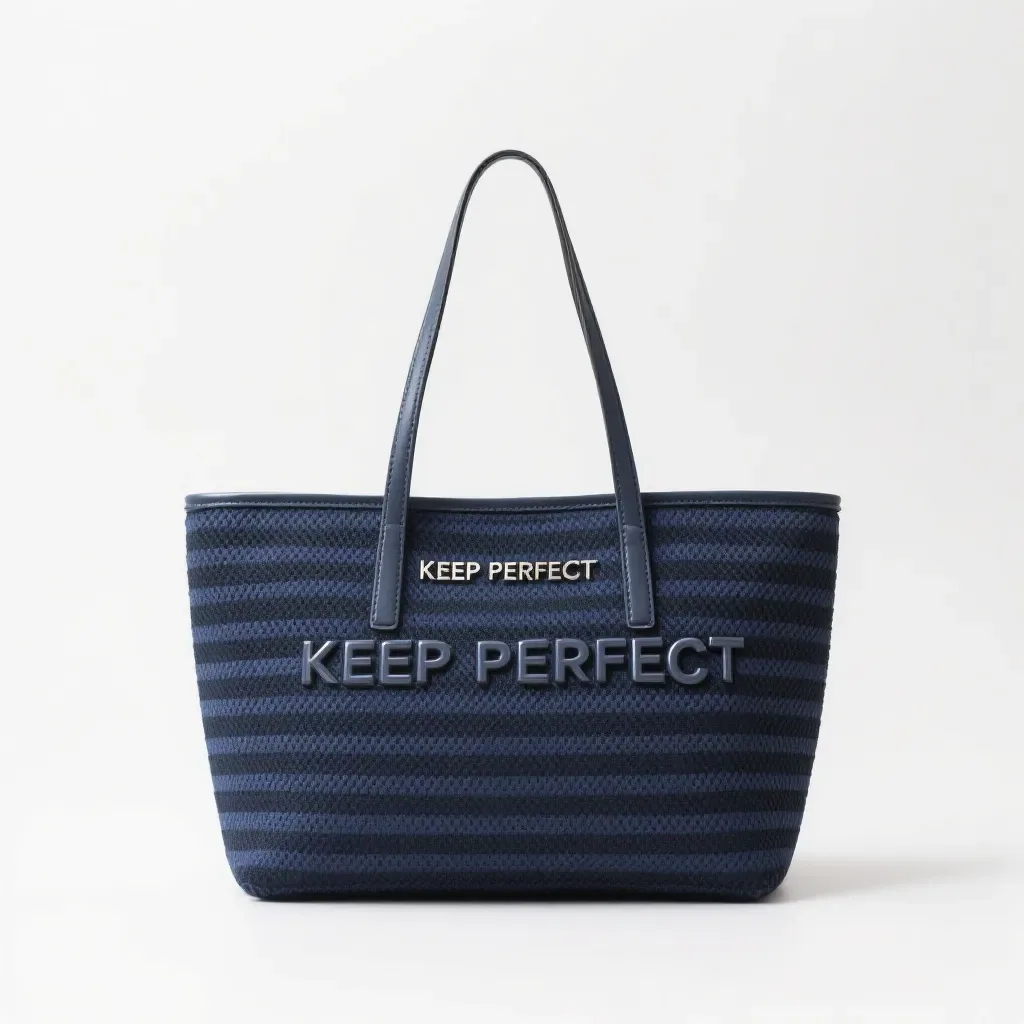
The Seven Sizes and What Each One Costs
A knitted tote range runs across seven capacities, and each one has a distinct cost profile that is visible before a single sample is knitted. The figures below are the ones to read when a size is being chosen, because capacity alone tells a buyer what fits and tells a programme nothing about what it will pay.
| Capacity | Flat size (mm) | Gauge | Yarn | Cycle time | Load | Per carton |
|---|---|---|---|---|---|---|
| 2.5 L | 230 x 160 x 70 | E12 | 31 g | 6.4 min | 3 kg | 110 pcs |
| 5 L | 280 x 200 x 90 | E12 | 36 g | 8.1 min | 4 kg | 96 pcs |
| 9 L | 320 x 240 x 110 | E7 | 44 g | 11.8 min | 6 kg | 84 pcs |
| 14 L | 360 x 270 x 130 | E7 | 52 g | 12.9 min | 8 kg | 72 pcs |
| 18 L | 390 x 290 x 145 | E7 | 58 g | 13.8 min | 10 kg | 66 pcs |
| 22 L | 420 x 320 x 160 | E7 | 62 g | 14.6 min | 12 kg | 60 pcs |
| 32 L | 480 x 360 x 190 | E7 | 88 g | 19.4 min | 14 kg | 44 pcs |
The row to read first is cycle time, because it sets machine occupancy and therefore the price. Moving from 22 litres to 32 litres adds 10 litres of capacity, 26 g of yarn and 4.8 minutes of machine time, which is a 33 percent increase in cycle time for a 45 percent increase in capacity. That asymmetry is the whole economics of a size range.
How Is Litre Capacity Actually Measured?
By filling the finished washed bag with a measured volume of standard beads and reading the displaced volume, not by multiplying the three dimensions. Multiplying 420 by 320 by 160 mm gives 21.5 litres, which happens to sit close to the 22 litre nominal figure, but that coincidence does not hold across the range.
It fails on the small sizes, where the mouth taper and the rounded base corners remove volume that a rectangular calculation credits. A 230 by 160 by 70 mm pouch multiplies to 2.6 litres and measures 2.5, but a 280 by 200 by 90 mm bag multiplies to 5.0 and measures 4.6. Stating a measured litre figure is what keeps a range honest.
Why Does Yarn Weight Not Scale With Litres?
Because yarn follows surface area and capacity follows volume, and the two scale at different rates. Doubling every linear dimension multiplies volume by eight and surface area by four, so a larger bag uses proportionally less yarn per litre. That is visible in the table: 2.5 litres uses 12.4 g per litre while 32 litres uses 2.75 g per litre.
- Size range
- 2.5, 5, 9, 14, 18, 22 and 32 litres
- Reference size
- 22 L at 420 x 320 x 160 mm, 62 g, 14.6 min, E7
- Gauge split
- E12 at 2.5 and 5 L, E7 from 9 L upward
- Yarn per litre
- 12.4 g/L at 2.5 L falling to 2.75 g/L at 32 L
- Cycle time spread
- 6.4 min at 2.5 L to 19.4 min at 32 L
- Load ratings
- 3 kg at 2.5 L rising to 14 kg at 32 L
- Carton counts
- 110 pcs at 2.5 L down to 44 pcs at 32 L
- Dimensional tolerance
- 5 mm on any linear dimension, 3 percent on stated capacity
- Yarn
- 600D recycled polyester at 420 g/m², GRS-documented
- Minimum order
- 100 pcs per style and colourway
- Sampling
- 7 working days from an approved tech pack
- Bulk timing
- 30 days from sample approval, FOB Xiamen
The practical consequence is that a large bag is more material-efficient per litre and a small bag is not, which inverts the intuition most buyers bring to a size chart. A programme that assumes yarn cost is linear in capacity will over-price its large sizes and under-price its small ones.
What Does Each Size Cost in Cycle Time?
Cycle time runs from 6.4 minutes at 2.5 litres to 19.4 minutes at 32 litres, and the curve is flatter than the capacity curve. Between 9 and 22 litres, capacity more than doubles while cycle time rises by only 24 percent, because most of the machine time is spent on the mouth, the base and the handle roots rather than on the body panels.
That flatness is what makes a mid-range tote the most efficient product in a knit programme. The 14 to 22 litre band carries most of the costs that any bag carries and spreads them over the largest volume, so the cost per litre bottoms out around 18 litres and rises at both ends of the range.
How Many Pieces Fit in One Export Carton?
From 110 pieces at 2.5 litres down to 44 at 32 litres, folded flat. Carton count matters more than it appears to, because freight is charged on cube rather than on piece count, and the per-piece landed cost therefore varies by a factor of 2.5 across the same range of bags in the same yarn.
The number to watch is the 32 litre size. It takes 44 pieces per carton against 60 for the 22 litre, which means a third less product in the same cube. On a container-rate shipment that difference is frequently larger than the knitting cost difference between the two sizes, and it is the reason the 32 litre size is quoted carefully.
Which Size Carries What Load?
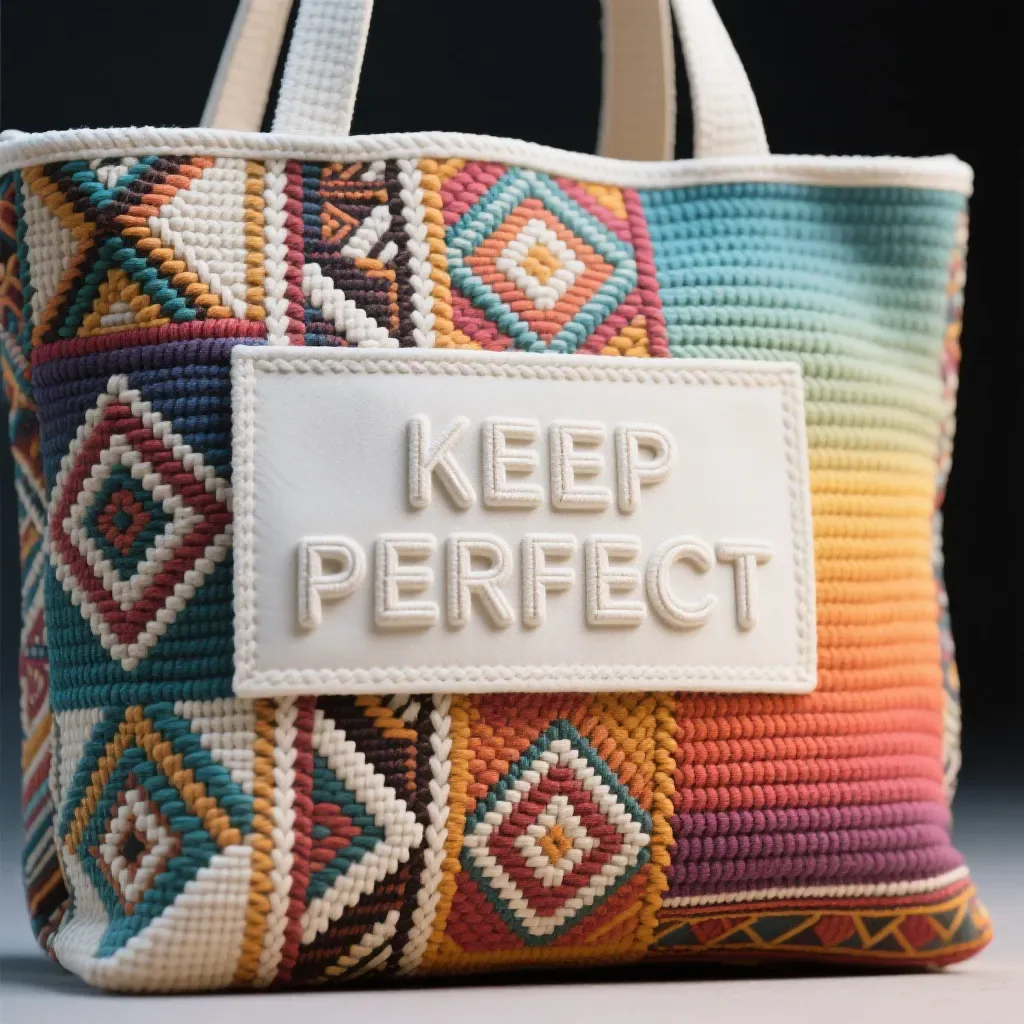
Load rating runs from 3 kg at 2.5 litres to 14 kg at 32 litres, and it is set by the handle and the base rather than by the body. A tote body at 420 g/m² will hold far more than its rated load; what fails first is always the strap root or the base seam, which is why the rating tracks those two components.
For specification purposes, the useful rule is that a tote carries about 0.55 kg per litre of capacity up to 22 litres and less beyond it. The 32 litre size is rated at 14 kg rather than 17.6 kg because a bag that large becomes awkward to carry before it becomes structurally unsafe.
How to Read the Size Chart When Specifying
Read the capacity row for the retail story, the cycle time row for the price and the carton row for the landed cost. Those three rows together tell a buyer everything a size decision needs, and the other rows are supporting detail that explains why the three main ones move the way they do.
2.5 to 5 L, E12
Gift, cosmetic and accessory sizes. High yarn cost per litre at 12.4 g/L, low cycle time, and 110 pieces per carton.
9 to 14 L, E7
Everyday day bags. The entry point for a knit range and the sizes most first programmes specify.
18 to 22 L, E7
The efficient core of the range. Cost per litre bottoms out near 18 L and the 22 L is the reference size.
32 L, E7
Travel and beach. Highest cycle time at 19.4 min, lowest carton count at 44 pieces, and quoted carefully.
What Tolerance Applies to Each Dimension?
Five millimetres on any linear dimension and 3 percent on stated capacity, both measured on a washed and relaxed body. A 22 litre tote can therefore measure between 21.3 and 22.7 litres and between 415 and 425 mm in width and still be within specification.
The capacity tolerance is the one buyers find surprising, because a litre figure reads as precise. It is not: the same bag filled by two people with the same beads can differ by about 2 percent depending on how the mouth is held. Stating 3 percent avoids an argument that has no technical resolution.
Both tolerances are checked at inspection against the approved washed sample rather than against the drawing, and every size is inspected as its own lot to AQL 2.5 under ISO 2859-1. Where a range ships two sizes in one container, the lots are declared separately so a dimensional finding on one size does not hold the other.
Which Sizes Sell Together in a Range
Three sizes is the range that works: a small at 5 litres, a core at 18 or 22 litres, and a large at 32 litres. Two sizes leaves a gap a customer notices, and four sizes splits demand without adding sales. The three-size range also shares one yarn lot and one dye batch, which is what keeps the shades matched.
Where a set rather than a range is the goal, the nested three-piece approach in the knitted bag set size range guide applies instead, and the sizes are chosen for nesting rather than for shelf progression. The two approaches answer different retail questions and should not be mixed.
How Do the Seven Sizes Compare on Cost per Litre?
Cost per litre falls from 2.5 litres to about 18 litres and then flattens, which is the single most useful curve in a size chart. At 2.5 litres the bag costs roughly 2.56 minutes per litre of capacity; at 18 litres it is about 0.77 minutes per litre, and at 32 litres it is 0.61. The small end of the range is four times less efficient per litre than the large end.
That curve explains why a gift-sized tote is priced closer to a mid-sized one than its capacity suggests. The 2.5 litre bag is not a scaled-down version of a low-cost product; it is a product whose fixed costs, the mouth, the base and the handle roots, are spread over very little volume.
The same curve is why a first programme is usually advised into the 14 to 22 litre band. It is where the fixed costs are best spread, where the carton count is still healthy at 60 to 72 pieces, and where the gauge changeover has already happened, so the body has the stiffness a retail shelf requires.
How Does Size Choice Affect the Order Quantity?
The minimum is 100 pcs per style and colourway, and every size is a style. A three-size range in one colourway is 300 pieces, and the same range in three colourways is 900. Sizes cannot be mixed to reach a single minimum, which is the question that comes up most often at quotation.
With 7 production lines running at about 200,000 pcs per month, a 300-piece three-size order is a small booking and slots in comfortably, but it should still be booked. Line scheduling is confirmed at quotation rather than at order, because a colourway that runs across two production weeks needs its dye lot reserved. The full range sits on the knitted bag collection pillar, and the knitted bag base construction guide covers the load side of each size.
Size a tote range from the numbers
Send the capacities you want and the colourway count. The team returns dimensions, cycle times, carton counts and an FOB Xiamen quote on 100 pcs per size. Start a size review.
Frequently Asked Questions
How many sizes are in a knitted tote range?
Seven: 2.5, 5, 9, 14, 18, 22 and 32 litres. A retail range usually takes three of them, typically 5, 22 and 32, because two leaves a gap customers notice and four splits demand without adding sales. Two leaves a gap customers notice and four splits demand without adding sales.
What are the dimensions of a 22 litre knitted tote?
Four hundred and twenty by 320 by 160 mm, knitted at E7 in 600D recycled polyester, using 62 g of yarn and taking 14.6 minutes of cycle time. It is the reference size for the whole range and carries a 12 kg load rating.
How is litre capacity measured on a knitted bag?
By filling the finished washed bag with a measured volume of standard beads and reading the displaced volume. Multiplying dimensions gives a different answer, especially on small sizes where mouth taper and rounded base corners remove volume. Multiplying dimensions gives a different answer, especially on the small sizes.
Why does a large tote use less yarn per litre?
Because yarn follows surface area and capacity follows volume, and they scale at different rates. Doubling every dimension multiplies volume by eight and area by four, so yarn per litre falls from 12.4 g at 2.5 L to 2.75 g at 32 L.
Which tote size is the most efficient to produce?
Around 18 litres, where cost per litre bottoms out. Between 9 and 22 litres capacity more than doubles while cycle time rises only 24 percent, because most machine time goes on mouth, base and handle roots rather than body panels. Yarn per litre falls from 12.4 g at 2.5 L to 2.75 g at 32 L.
How many pieces ship in one export carton?
One hundred and ten at 2.5 litres, 96 at 5, 84 at 9, 72 at 14, 66 at 18, 60 at 22 and 44 at 32. Freight is charged on cube, so per-piece landed cost varies by a factor of 2.5 across the range.
What load should each tote size be rated for?
Three kilograms at 2.5 litres rising to 14 kg at 32 litres. The rating is set by the handle root and the base seam rather than by the body, because those fail first regardless of how strong the fabric is. Freight is charged on cube, so per-piece landed cost varies by a factor of 2.5.
What gauge should each tote size use?
E12 at 2.5 and 5 litres, where the loop is seen close up, and E7 from 9 litres upward, where the body needs stiffness to hold a shape. The changeover at 9 litres is where most ranges split their two gauges. Those two fail first regardless of how strong the body fabric is.
What tolerance applies to tote dimensions?
Five millimetres on any linear dimension and 3 percent on stated capacity, measured on a washed and relaxed body. A 22 litre tote may therefore measure between 21.3 and 22.7 litres and still be within specification. The changeover at 9 litres is where most ranges split their two gauges.
Why is capacity given a tolerance at all?
Because the same bag filled by two people with the same beads can differ by about 2 percent depending on how the mouth is held. Stating 3 percent avoids an argument that has no technical resolution at inspection. A 22 litre tote may measure between 21.3 and 22.7 litres and still pass.
Can sizes be mixed to reach the minimum order?
No. The minimum is 100 pcs per style and colourway and every size is a style. A three-size range in one colourway is 300 pieces, and the same range in three colourways is 900 pieces. Stating 3 percent avoids an argument with no technical resolution at inspection.
Which three sizes should a first range specify?
A small at 5 litres, a core at 18 or 22 litres and a large at 32 litres. They share one yarn lot and one dye batch, which is what keeps shades matched across the range. A three-size range in one colourway is 300 pieces and in three colourways 900.
Is a set the same as a size range?
No. A range is three sizes sold separately; a set is three sizes nested and sold as one unit. The sizes are chosen for nesting in a set and for shelf progression in a range, and the two should not be mixed. They share one yarn lot and one dye batch, which keeps shades matched.
How long does it take to sample a new size?
Seven working days from an approved tech pack, with bulk at 30 days from sample approval. Three bodies are knitted per size: one washed and measured, one load tested, one sealed as the inspection reference. The two should not be mixed, because they answer different retail questions.
Does a larger size change the inspection standard?
No. Every size is inspected to AQL 2.5 under ISO 2859-1 as its own lot, with the same dimensional tolerances. The larger sizes simply have more surface to inspect, so the sample size per lot rises with piece count. Three bodies are knitted per size: one washed, one load tested, one sealed.
People Also Ask
Why is the 32 litre tote quoted carefully?
It packs 44 pieces per carton against 60 for a 22 litre, so it uses a third more cube per piece. On a container-rate shipment that exceeds the knitting cost difference between the two sizes.
Should capacity or dimensions be specified first?
Capacity. It drives the retail story and the gauge band, and the dimensions follow from it. Specifying dimensions first tends to produce a bag whose measured litre figure does not match the marketing copy.
What is the most useful single row in a size chart?
Cycle time. Capacity tells a buyer what fits and carton count tells them what it costs to ship, but cycle time is the one that sets machine occupancy and therefore the unit price.
Do all seven sizes use the same yarn?
Yes, 600D recycled polyester at 420 g/m² throughout. Running one yarn across the range is what lets a single dye lot cover every size and keeps shades matched across a shelf.
How far apart should range sizes be?
Far enough to be told apart at three metres. Five, 22 and 32 litres gives a visible progression; sizes 10 litres apart read as the same bag in two sizes and compete with each other.
Sources and further reading
Every figure on this page is either our own programme data or attributed below. Open the originals before you write them into a specification.
- ISO 2859-1 Sampling procedures for inspection by attributesISO The AQL 2.5 scheme applied to each size as its own inspection lot.
- ISO 13934-1 Tensile properties of fabricsISO Tensile reference behind the load ratings carried by each tote size.
- ASTM D5034 Breaking Strength and Elongation of Textile Fabrics (Grab Test)ASTM International Used to confirm the handle root and base seam that set each size load rating.
- Recycled Claim Standard and Global Recycled StandardTextile Exchange Documents the recycled content in the 600D yarn shared across all seven sizes.