Knitted Bag Recyclability by Structure: How Stitch Architecture, Density and Finishing Determine Whether a Bag Is Reprocessed
Two knitted bags made from identical 300D recycled polyester can end up in different places at end of life — one reprocessed into new fibre, the other set aside — and the difference is almost entirely structural rather than material. Recyclability follows from how an article is built — how many polymer families it contains, how its parts are joined and whether a sorting line can identify it — rather than from what the yarn is made of.

Recyclability Starts With Structure, Not Material
Recyclability is decided by how easily an article can be identified, reduced to a single polymer stream and melted — three steps governed by construction, not by the recycled content of the yarn.
The framing matters because most circularity conversations start with the material. A buyer asks for recycled polyester, the certificate arrives, and the product is assumed to be circular. But the certificate describes an input, not an outcome. What decides the outcome is whether a sorting facility can tell what the article is made of and whether a recycler can melt it without contamination.
Structure controls all three steps. A plain monomaterial jersey body is identified by near-infrared scanning in seconds and shreds cleanly. The same bag with a polyurethane-coated base panel, a printed PVC band and a metal clasp fails identification, contaminates the melt, and has to be removed by hand — which in practice means it is not removed.
This is also why knitted construction has a structural advantage rather than only a material one. Because handles, openings and reinforcement zones can be knitted into the body, the component count falls, and with it the number of places where a second polymer can enter. See seamless knit bag construction for the mechanics.
Six Structures Ranked by Recyclability
Ranked by recovery, plain structures with a single yarn type come first, textured and multi-yarn structures later, and laminated or coated structures last — with the ranking driven by identification and melt tolerance rather than by fabric weight.
| Structure | Polymer mixing risk | Ease of identification | Typical GSM range | Recovery assessment |
|---|---|---|---|---|
| Single jersey | None if all components match | High | 320 - 480 g/m² | Best case |
| Rib 1x1 or 2x2 | None if all components match | High | 380 - 520 g/m² | Best case |
| Interlock | None if all components match | High | 420 - 560 g/m² | Best case |
| Spacer or 3D structure | Low, if the monofilament shares the family | Moderate | 480 - 620 g/m² | Good |
| Intarsia or jacquard | Low to moderate, colour carriers may differ | Moderate | 400 - 560 g/m² | Good, verify carrier yarn |
| Plating | Moderate, face and back yarns may differ | Lower | 380 - 540 g/m² | Verify both yarns |
The plain structures lead for a reason that has nothing to do with their performance as bags. A single jersey or rib body made from one yarn type presents a uniform surface to the identification scanner and a uniform melt to the extruder. Every additional yarn type adds a variable.
Plating deserves a specific note because it is commonly used to put a durable yarn on the face and a softer or stretch yarn on the back. That is a perfectly good design decision for performance, but it produces a two-polymer structure unless both yarns are chosen from the same family. Where plating is needed, plating polyester over polyester preserves the circularity case.
Loop Density and Fabric Weight Effects
Loop density and GSM affect the energy needed to melt the article and the melt filtration load, but they do not change whether an article is recyclable — polymer uniformity does.
That distinction resolves a common misconception. A heavy bag is not less recyclable than a light one; it simply carries more material, so it takes more energy to process and yields more output. The ranking of structures is governed by what the article is made of and how it is assembled, not by how much it weighs.
Where weight does matter is in the economics of collection and transport, and in the use-phase comparison. A lighter bag that fails after twenty trips is worse per functional unit than a heavier one that lasts for hundreds. That is why the functional unit, not the gram weight, is the right basis for comparison.
- Shell yarn
- 300D/96f recycled polyester
- Gauge
- E12
- Courses per cm
- 5.2
- Wales per cm
- 4.6
- Loop length
- 6.35 mm ± 0.1 mm
- Shell GSM
- 460 g/m²
- Lining GSM
- 95 g/m²
- Tenacity delivered
- 4.2 cN/dtex
- Elongation at break
- 28%
- Abrasion resistance
- 40,000 cycles to ISO 12947-2 at 12 kPa
- Colour fastness to rubbing
- Grade 4 to AATCC 8
- Rated load
- 8 kg
- Inspection
- AQL 2.5 (ISO 2859-1)
- Shipment terms
- FOB Xiamen
- MOQ
- 100 pcs per style / colourway
- Sampling / bulk
- 7 working days / 30 days
Coatings, Laminates and Finishes Compared
Every coating and laminate is a foreign polymer from the recycler's point of view; the practical question is whether the add-on is low enough and the chemistry compatible enough to pass melt filtration.
| Finish | Polymer family | Compatible with a PET body? | Effect on the melt | Notes |
|---|---|---|---|---|
| PU coating | Polyurethane | No | Foreign polymer, can gel | Common for water repellency; consider alternatives |
| Acrylic coating | Acrylic | No | Foreign polymer | PFAS-free grades available for repellency |
| PVC coating | PVC plus plasticiser | No | Foreign polymer plus phthalate risk | Avoid in circular specifications |
| TPU coating | Thermoplastic polyurethane | No | Foreign polymer | Better abrasion than PU, still incompatible |
| Silicone finish | Siloxane | Usually tolerated at low add-on | Can affect filtration | Check the add-on level and declaration |
The uncomfortable conclusion is that most water-repellent coatings are incompatible with mechanical polyester recycling at typical add-on levels. Where repellency is a genuine requirement, the choices are to use a lower add-on of a more compatible chemistry, to accept a shorter service life, or to design the bag so the coated panel can be removed.
What is worth avoiding is the third option dressed up as circularity: a bag described as recyclable that carries a bonded coating applied at a level that no mechanical recycler will accept. The claim and the construction have to agree.
Mechanical Versus Chemical Recycling Routes
Mechanical recycling shreds, melts, filters and re-extrudes, and tolerates almost no polymer mixing; chemical recycling depolymerises PET or PA6 back to monomer and tolerates more, at higher energy and cost.
The mechanical route is the realistic destination for most knitted bag programmes, because it is widely available and because a well-designed monomarticle meets its input requirements. Its limitation is melt filtration: foreign polymer, elastane above a low ceiling and metal all cause defects in the extruded output.
The chemical route is the answer for inputs that mechanical recycling cannot handle, and for programmes that need output quality matching virgin. Depolymerisation returns PET to monomer, which is repolymerised into material analytically indistinguishable from virgin. Capacity is limited and costs more, but for a programme with a bright brand shade that must match year after year, it is often the only route that works.
| Route | Input requirement | Tolerance for mixed polymer | Output quality | Relative cost |
|---|---|---|---|---|
| Mechanical | Clean single-polymer stream | Low | Reprocessed fibre, often downgraded | Lower |
| Chemical, PET | PET-rich input | Moderate | Near-virgin polymer | Higher |
| Chemical, PA6 | PA6 input | Low to moderate | Caprolactam monomer | Higher |
For a buyer the practical guidance is to design for the mechanical route and verify which route the claim depends on. A recyclability claim that assumes chemical recycling is only as strong as the availability of that capacity in the market where the claim is made.
What Happens to a Knitted Bag in a Sorting Facility
A returned bag is identified by near-infrared scanning, separated from non-textile material, then either reprocessed or set aside — and set-aside articles are almost always landfilled or incinerated regardless of their theoretical recyclability.
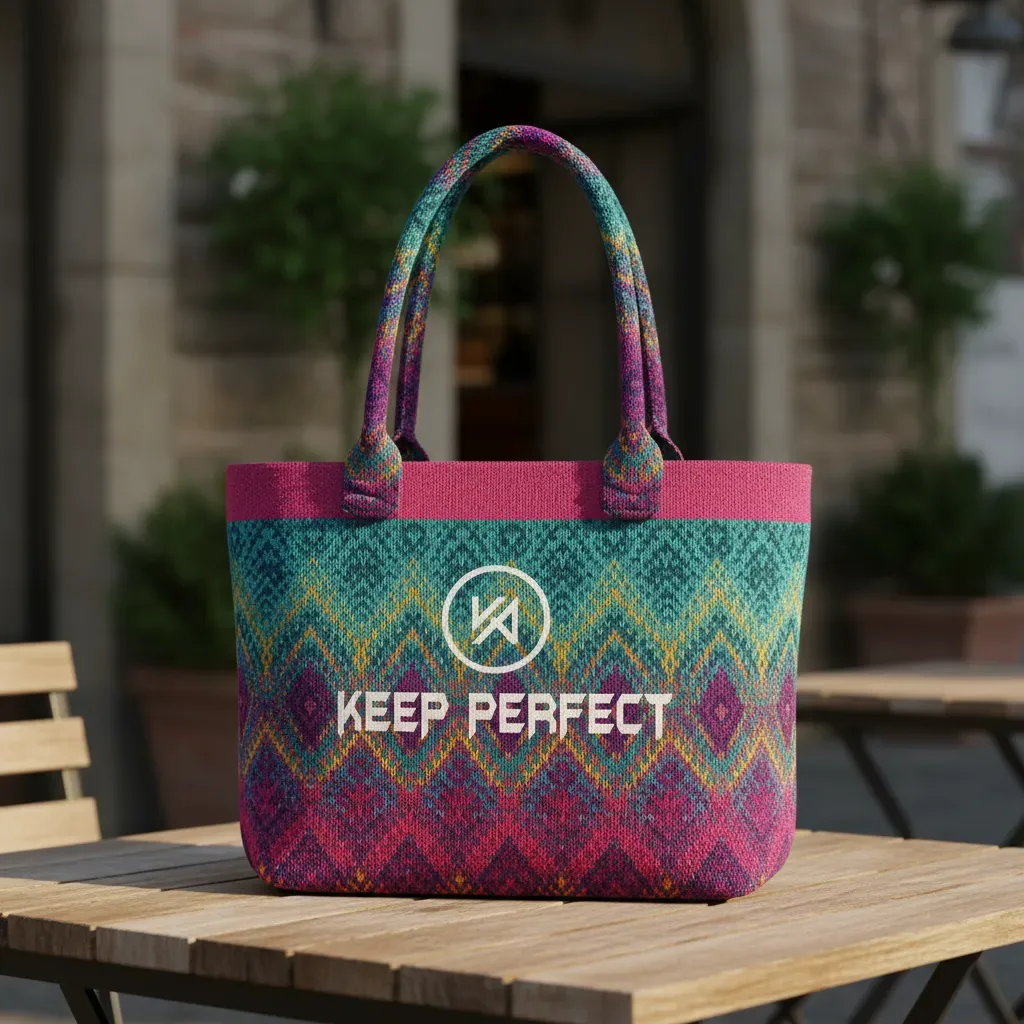
Identification is the first gate and the one that decides most outcomes. Near-infrared reading is reliable on large, flat, single-polymer surfaces and less reliable on small articles, textured surfaces and mixed constructions. A knitted bag body presents well; a bag with a coated panel, a printed band and hardware presents badly.
The second gate is removal. Where a non-compatible component exists, the question is whether it can be removed in the seconds a sorting line allocates. A clasp that pulls free is removed; one that is bonded or riveted is not. This is why removability is a design requirement rather than a recycling detail.
A practical consequence is that the fastest improvement is usually deletion. Removing a decorative clasp, a bonded base panel or a laminated label improves recovery more reliably than searching for a compatible substitute, because there is no longer anything to separate.
Metal is handled separately by magnets and eddy-current separators, which is effective for loose metal and largely ineffective for metal captured inside a textile assembly. The practical conclusion is that metal should be designed to come away, not to be detected.
Design Choices That Improve Recovery Yield
Four design decisions account for most of the difference in recovery yield: eliminate the second polymer, knit components in rather than attaching them, remove adhesive bonds, and mark the polymer visibly.
One polymer family
Shell, lining, webbing and thread in the same family. This is the single decision with the largest effect on outcome.
Knit components in
Handles, openings and reinforcement knitted into the body remove parts, declarations and failure modes together.
No adhesive bonds
Adhesive stays in the melt and cannot be filtered out. Use stitching or a releasable system instead.
Visible polymer mark
A mark on the outer face lets a sorter route the article when scanning is inconclusive.
The ordering is not arbitrary. Eliminating the second polymer family determines whether the article can be processed at all; the other three determine how reliably it will be, in practice, at a facility that has seconds to decide.
A useful test before sampling is to ask what a sorting operator would do with the bag if it arrived unsorted today. If the honest answer involves cutting, prising or guessing, the design is not yet circular no matter what the yarn certificate says.
How to State a Recyclability Claim Honestly
A defensible recyclability claim names the route, the polymer, the conditions under which recovery applies, and any component that must be removed first.
Most problematic claims fail on omission rather than on falsehood. The statement that a bag is recyclable is usually true under some conditions — a clean, single-polymer, hardware-free article in a market with the relevant collection infrastructure. The problem is that the conditions are not stated, so the claim is read as unconditional.
Regulators have converged on this point. Guidance on environmental claims requires that an unqualified claim be substantiated across the life cycle rather than on a single attribute, and that any qualification material to the consumer be stated with the claim. In practice that means the sentence on the hangtag has to carry its own conditions.
The European framework moves in the same direction. The Ecodesign for Sustainable Products Regulation provides for product-specific rules and a digital product passport, which makes composition and end-of-life information part of the product record rather than a marketing decision.
Testing Your Structure Before You Commit
Two checks settle whether a knitted structure will be recovered in practice: identification testing on the finished article, and a disassembly trial timed to under sixty seconds without powered tools.
- Identification — confirm the article reads as a single polymer to a near-infrared scanner, testing the coated and printed areas rather than plain fabric.
- Disassembly — time the removal of every non-compatible component, targeting under a minute without powered tools.
- Mass balance — list each component with its weight so the recoverable share can be calculated rather than estimated.
- Contamination check — identify any adhesive, coating or metal that will remain in the melt and record it as a known exception.
- Retained sample — keep an approved sample of the structure so later production can be compared against it.
These five checks take about a day and they are the difference between a circularity claim that can be evidenced and one that has to be defended. Run them at sample approval, before the bulk slot opens, and the result can still change the specification.
Documenting the result is part of the exercise rather than an afterthought. A one-page record naming the structure, the component list with weights, the identification result and any exception gives the compliance team something it can act on, and it can be reused across colours and repeat orders rather than rebuilt each season.
Where a programme runs several structures across one collection, the practical approach is to test the most complex one first. If the most demanding structure passes identification and disassembly, the simpler ones will too, and the testing spend goes further than it would starting from the easiest case.
The calendar is unchanged: 7 working days for sampling, 30 days for bulk, inspection at AQL 2.5 (ISO 2859-1). Circularity is decided in the technical pack, not in the shipping schedule. For the structural side of the specification, see knitted bag structure anatomy.
Send the bag specification, structure and target market and we will return a recyclability assessment with a sampling slot. Request a structure review
Frequently Asked Questions
Does structure or material matter more for bag recyclability?
Structure, in the sense of how many polymer families the article contains and how its parts are joined. Two bags from identical recycled polyester can end in different places at end of life, and the deciding factor is construction rather than the yarn. The ranking is consistent because identification and melt behaviour decide the outcome, not appearance.
Which knitted structure is most recyclable?
Plain monomaterial constructions — single jersey, rib and interlock — rank best, because they present a uniform surface to identification scanning and a uniform melt to the extruder. Each additional yarn type adds a variable. A heavier structure is not worse in itself; it carries more material and yields more output per bag.
Is a heavier knitted bag less recyclable?
No. Weight changes the energy needed to melt the article and the output yield, not whether it can be recycled. Polymer uniformity governs that question. A lighter bag that fails early is worse per functional unit. Verifying the most demanding structure first is the efficient way to spend a testing allowance.
Are water-repellent coatings recyclable?
Most are not, at typical add-on levels, because polyurethane, acrylic, PVC and thermoplastic polyurethane coatings are foreign polymers in a polyester melt. Use a lower add-on of a compatible chemistry, or make the coated panel removable. Deletion usually outperforms substitution, because a part that is gone needs no separation at all.
What happens to a knitted bag at a sorting facility?
It is identified by near-infrared scanning and separated from non-textile material. If identification fails or a non-compatible component cannot be removed quickly, the article is set aside, and set-aside material is rarely reprocessed. State the conditions with the claim, since an unqualified green claim invites substantiation requests. Composition records are the hard part of compliance and are far less costly to build early than late.
Why does metal trim cause problems?
Magnets and eddy-current separators handle loose metal well but not metal captured inside a textile assembly. The practical answer is design for removal, so the hardware leaves the stream before reprocessing. Composition records are the hard part of compliance and are far less costly to build early than late.
How should a recyclability claim be worded?
Name the route, the polymer, the conditions under which recovery applies and any component that must be removed first. Unqualified claims are read as unconditional, which is usually where the problem starts. Sorting facilities allocate seconds per article, which is what makes removability a design requirement. Recovery depends on collection and economics as well as design, so any claim has to be conditional.
Does EU policy affect how recyclability is stated?
Yes. The Ecodesign for Sustainable Products Regulation provides for product-specific rules and a digital product passport, which makes composition and end-of-life data part of the product record rather than a marketing choice. Recovery depends on collection and economics as well as design, so any claim has to be conditional.
Is plating a problem for monomaterial design?
It can be, where the face and back yarns come from different polymer families. Plating polyester over polyester preserves the circularity case; verify both yarns before committing. The ranking is consistent because identification and melt behaviour decide the outcome, not appearance. A heavier structure is not worse in itself; it carries more material and yields more output per bag.
What is a realistic disassembly target?
Under sixty seconds without powered tools. Sorting lines allocate seconds per article, so anything slower is set aside regardless of how recyclable the main material is. A heavier structure is not worse in itself; it carries more material and yields more output per bag. Verifying the most demanding structure first is the efficient way to spend a testing allowance.
How is the recoverable share calculated?
List every component with its weight, identify which sit outside the dominant polymer family, and divide the compatible mass by the total. Include coating, print, thread and interlining in the denominator. Verifying the most demanding structure first is the efficient way to spend a testing allowance. Deletion usually outperforms substitution, because a part that is gone needs no separation at all.
Does loop density change recyclability?
It changes processing energy and melt-filtration load rather than recyclability itself. A denser fabric has more material per bag, so it takes more energy to melt and yields more output. Deletion usually outperforms substitution, because a part that is gone needs no separation at all. State the conditions with the claim, since an unqualified green claim invites substantiation requests.
Do intarsia and jacquard structures recycle cleanly?
Usually, provided the colour carrier yarns share the polymer family. That is the item to verify, because carrier yarns are often chosen for colour rather than compatibility. State the conditions with the claim, since an unqualified green claim invites substantiation requests. Composition records are the hard part of compliance and are far less costly to build early than late.
Should a recyclability claim depend on chemical recycling?
Only where that capacity genuinely exists in the market where the claim is made. Designing for the mechanical route is the safer default, because a well-built monomaterial meets its input requirements. Composition records are the hard part of compliance and are far less costly to build early than late.
When should structural testing happen?
At sample approval, before the bulk slot opens. On a 7-working-day sampling and 30-day bulk calendar, a day of structural checks fits comfortably and the result can still change the specification. Sorting facilities allocate seconds per article, which is what makes removability a design requirement. Recovery depends on collection and economics as well as design, so any claim has to be conditional.
People Also Ask
Does stitch structure affect bag recyclability?
Yes. Structure decides how easily an article is identified, reduced to a single polymer stream and melted. Plain monomaterial constructions perform best; plated and coated variants need verification. Verifying the most demanding structure first is the efficient way to spend a testing allowance.
Which knitted structure recycles most reliably?
Plain monomaterial structures such as single jersey, rib and interlock. They give a uniform reading to identification scanners and a uniform melt to the extruder. Deletion usually outperforms substitution, because a part that is gone needs no separation at all.
Are coatings a problem for bag recycling?
Usually yes. Polyurethane, acrylic, PVC and thermoplastic polyurethane coatings are foreign polymers in a polyester melt and can cause gel defects in the output. State the conditions with the claim, since an unqualified green claim invites substantiation requests.
What is the difference between mechanical and chemical recycling?
Mechanical shreds, melts, filters and re-extrudes with almost no tolerance for mixing. Chemical depolymerises PET or PA6 back to monomer, tolerating more at higher energy and cost. Composition records are the hard part of compliance and are far less costly to build early than late.
How can I test whether my bag will be recycled?
Run identification testing on the finished article including coated and printed areas, and time a tool-free disassembly trial targeting under sixty seconds. Sorting facilities allocate seconds per article, which is what makes removability a design requirement.
Sources and further reading
Every figure on this page is either our own programme data or attributed below. Open the originals before you write them into a specification.
- EU Strategy for Sustainable and Circular TextilesEuropean Commission Authoritative source for EU policy direction on design for recycling and material recovery.
- Ecodesign for Sustainable Products Regulation (ESPR)European Commission Framework providing for product-specific requirements and a digital product passport.
- Waste Framework DirectiveEuropean Commission Reference for separate collection and end-of-life recovery obligations affecting articles.
- StandardsTextile Exchange Background on recycled content certification and chain of custody for circular claims.
- European Environment AgencyEuropean Environment Agency Source for published data on textile waste volumes and material recovery rates.