Knitted Bag Anatomy: The Nine Structural Zones to Specify Before You Approve a Sample
What is the anatomy of a knitted bag? It starts at the loop, not the panel. A seamless knit body is produced as one shaped piece, so the anatomy reads as nine measurable zones rather than a cut-and-sew parts list: body panel, base, handle, shoulder drop, opening lip, closure, transition radius, internal pocket and edge binding. In a 450 x 300 x 220 mm weekender knitted at E12 from 300D polyester, the shell sits near 520 g/m² and the handle carries the entire load path. MOQ is 100 pcs per style/colourway, sampling 7 working days, bulk 30 days, FOB Xiamen.
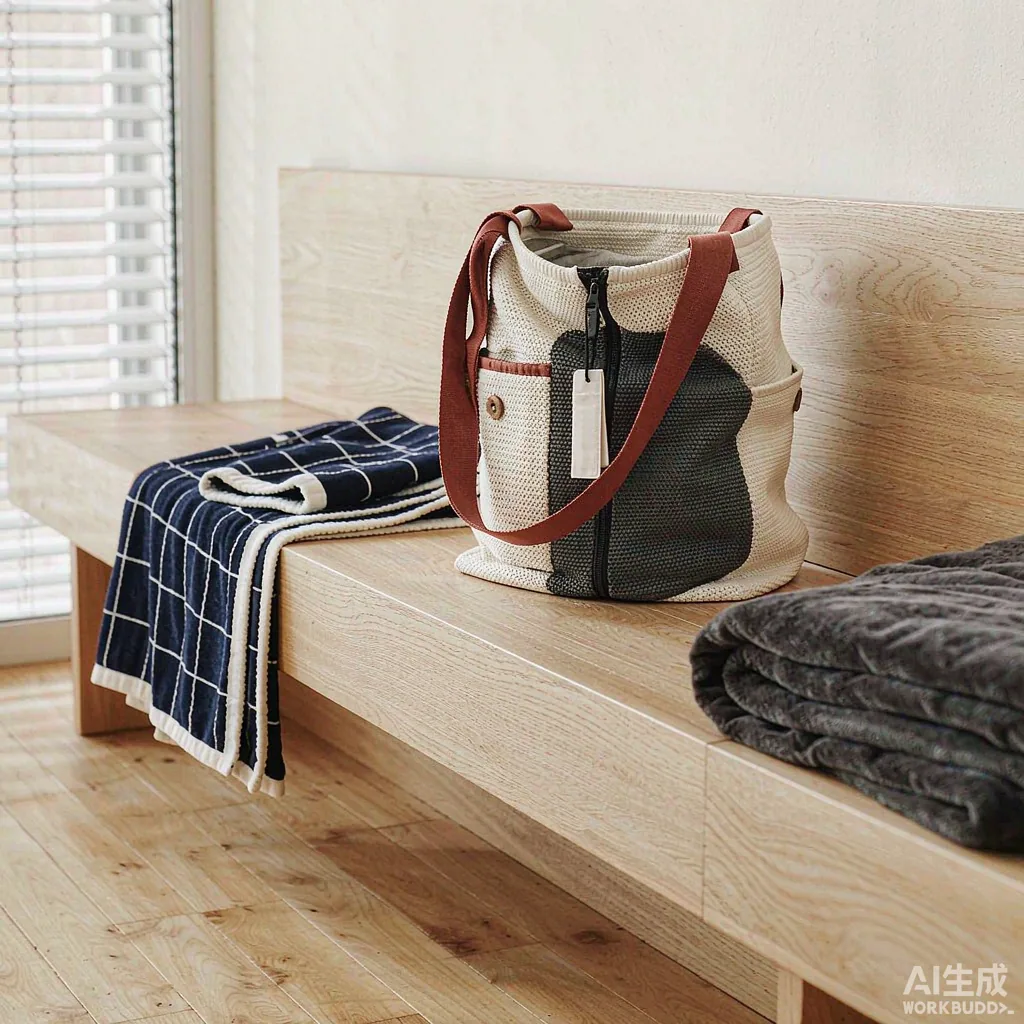
The Nine Zones of a Knitted Bag, and Why Counting Them Saves Money
A seamless knit bag has nine structural zones — body panel, base, handle, shoulder drop, opening lip, closure, transition radius, internal pocket and edge binding — and each one can be costed in grams and machine minutes before a first sample is knitted.
In a cut-and-sew bag the bill of materials is a parts list: shell, lining, webbing, binding, zip, hardware. In a seamless knit bag those parts never exist separately. The programme knits the body, shapes the base, and can knit the handle as a continuation of the same panel. What replaces the parts list is a zone map, and the zone map is what makes a specification negotiable. A buyer who can point at a zone and ask for its grams, its tolerance and its machine minutes is buying engineering, not guessing at a price.
The practical difference shows up in the sampling calendar. A buyer who writes panel dimensions, gauge and grams per square metre into the first email gets a quotation that can be checked line by line. A buyer who sends only a reference photo gets a quotation built on assumptions, and the assumptions surface later as a second sampling round. At MOQ 100 pcs per style/colourway, one extra round costs more in calendar time than in money: 7 working days for the first sample, 7 more for the revision, and the 30-day bulk slot moves with it.
Zones 1 and 2: Body Panel and Base, Where the Grams Sit
The body panel carries roughly 60 to 65 per cent of the shell mass on a typical weekender, and the base is the only zone that routinely needs a second knitted layer.
Take a 450 x 300 x 220 mm weekender knitted at E12 gauge from 300D textured polyester. The shell consumes about 0.62 square metres of fabric, which at 520 g/m² is roughly 322 g before hardware and before the binding is added. Loop length is the lever behind that figure: at 3.6 mm loop length and 5.2 wales per centimetre the fabric lands at 520 g/m², while opening the loop to 4.0 mm drops it to about 470 g/m². The saving looks attractive on a costing sheet and is a mistake on a shopper, because the looser loop reduces cover and lets the structure show through against a dark lining.
The base takes the abrasion and takes it in one place. A 45 mm corner radius spreads load at the point where the panel turns from front face into the floor of the bag, and the base zone is normally knitted as a two-layer structure with a finished thickness near 2.4 mm. Abrasion is verified to ISO 12947-2 at 12 kPa; a specification calling for 40,000 cycles to breakdown is realistic for 300D polyester and is the figure most retail buying teams already recognise from luggage test reports.
Zones 3 and 4: Handle and Shoulder Drop, the Load Path
The handle is the only zone that carries 100 per cent of the packed load, so it is where a knitting programme either proves its value or fails.
A knitted handle 22 mm wide, produced in a 620 g/m² rib structure, reaches a breaking force around 480 N when tested to ISO 13934-1 at 200 mm/min. Shoulder drop for a hand-carried weekender sits near 260 mm, and the tolerance worth enforcing is ±5 mm. Drop it to 235 mm and the bag rides awkwardly under the arm with a full load; push it to 290 mm and the base drags on the pavement, which is exactly where abrasion failure starts.
Load testing is where programmes get caught out. A static hold at 8 kg for 30 minutes, followed by a recovery check, catches the two failure modes that matter: permanent extension above 4 mm, and loop distortion at the handle-to-body junction. The first is a yarn and gauge problem, solved by moving from 300D to 450D or tightening the loop. The second is a programme problem, and it is solved by knitting a reinforcement course across the junction rather than by changing yarn.
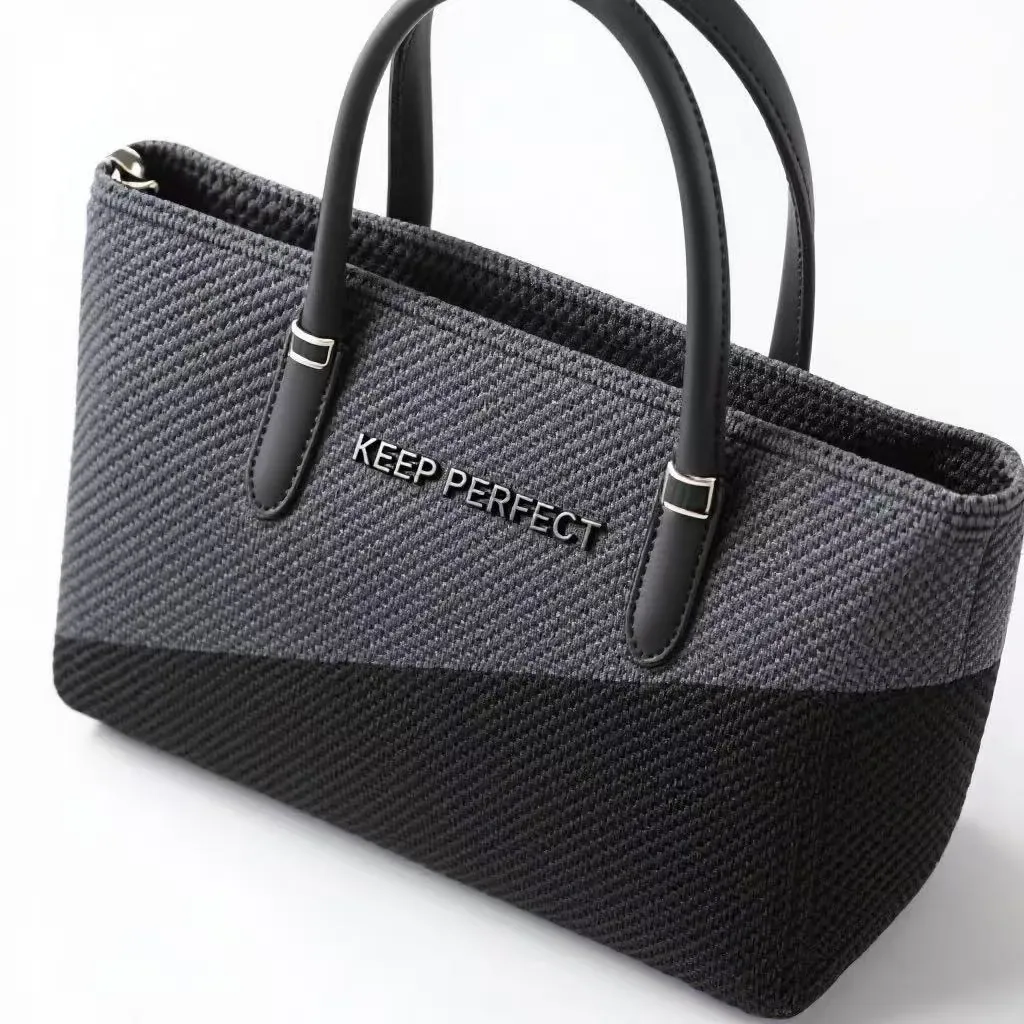
Zones 5 and 6: Opening Lip and Closure, Where Fit Is Won
The opening lip is the one zone where tolerance matters more than strength: ±2 mm of length error shows up as a wavy zip and a lid that will not sit flat.
A 35 mm double-layer lip carries a #5 zip tape without curling. Knit that lip single-layer and the tape pulls the edge into a shallow S-curve, which reads as poor quality on a shelf even though nothing has technically failed. Where a magnetic snap is specified instead of a zip, the lip needs an internal stiffener course, because a snap concentrates load into roughly 15 mm of fabric where a zip spreads it along 400 mm of tape.
Closure choice also drives the sampling plan. A zip needs tape length, pull style and end-stop type written down before the first sample; a snap needs cap diameter and spring force. Both are inexpensive to correct at sample stage and expensive to correct after 30 days of bulk, because by then the fabric, the tape and the hardware are all committed.
Zones 7, 8 and 9: Transition Radius, Internal Pocket and Edge Binding
The transition radius, the internal pocket and the edge binding are the three zones most often missing from a knit bag specification, and they are the three that decide whether a bag looks finished.
The transition radius — usually 45 mm on a weekender and 25 mm on a small crossbody — controls how the panel turns from the front face into the gusset. Too tight and the loops buckle into a permanent crease; too generous and the silhouette goes soft and the bag slumps when empty. The internal pocket, typically 160 x 120 mm, is knitted integrally rather than sewn in, which removes a seam and roughly 4 g of binding tape per bag.
The edge binding is the last 12 mm and the first thing a retailer looks at. A knitted binding dyed in the same lot as the body keeps colour consistent across the style; a contrast binding knitted in a second pass gives a design accent but adds one yarn change and about 40 seconds per bag on the line. Across a 100-piece run that is negligible; across a 20,000-piece seasonal programme it is a full extra shift.
What Each Zone Costs in Machine Minutes
On an E12 seamless knitting line a weekender body takes about 11.5 minutes of machine time, and the handle and base zones together account for just under half of it.
| Zone | Machine minutes | Grams | Tolerance | Failure mode |
|---|---|---|---|---|
| Body panel | 4.8 | 322 | ±3 mm | GSM drift between lots |
| Base, two-layer | 2.1 | 96 | ±2 mm | Abrasion at corner radius |
| Handle | 3.0 | 24 | ±5 mm drop | Extension above 4 mm |
| Opening lip | 0.9 | 18 | ±2 mm | Zip wave and lid lift |
| Internal pocket | 0.4 | 9 | ±3 mm | Sagging pocket mouth |
| Edge binding | 0.3 | 6 | ±1 mm | Frayed or curled edge |
The value of this table is that it turns a design conversation into an arithmetic one. If a buyer wants a bag that weighs less, the only zones with meaningful grams to give up are the panel and the base. Taking 50 g out of the panel means either dropping shell GSM from 520 to about 440 g/m² or reducing the panel area, and each has a visible consequence. Taking grams out of the handle is possible but unwise, because the handle is the load path.
Gauge, Loop Length and the GSM Arithmetic
Gauge sets the loop size, loop length sets the grams per square metre, and GSM sets the yarn cost: change any one of the three and the other two move with it.
- Gauge
- E12 — 12 needles per inch
- Yarn
- 300D / 96f textured polyester
- Wale density
- 5.2 per cm
- Course density
- 7.1 per cm
- Loop length
- 3.6 mm
- Shell GSM
- 520 g/m²
- Handle GSM
- 620 g/m²
- Finished thickness
- 2.4 mm body, 3.1 mm base
- Dimensional tolerance
- ±3 mm height, ±2 mm width
- Steam boarding
- 110 °C for 45 s, 3.5 % relaxation shrinkage
Steam boarding is the step that makes those tolerances real. A body comes off the machine relaxed and slightly oversized; 45 seconds at 110 °C sets the loop and takes out about 3.5 % of the linear dimension. Skip it, or board at the wrong temperature, and the panel that measured correctly on the bench measures 8 mm short after the first wash, which is the single most common reason a second sample round is needed.
Gauge selection follows the same logic. E7 gives a chunkier loop for beach and market totes where a soft, open structure is wanted; E14 gives a tight face for laptop sleeves and pouches that need to hide what is inside. A programme that wants both in one style normally knits the body at E12 and the trim at E14, accepting a second pass on the line rather than a compromise in the middle.
The Four Measurements That Decide Whether a Sample Passes
Finished weight, body height, handle drop and abrasion cycles are the four measurements that decide a first sample, and all four can be written into a purchase order as acceptance criteria.
Finished weight
Weigh the empty bag to ±5 g against the approved sample. A drift above 5 % usually means the yarn lot changed or the loop length moved on the machine.
Body height
Measure flat, unloaded, after boarding, to ±3 mm. Height is the dimension most sensitive to relaxation shrinkage and the easiest to argue about after bulk.
Handle drop
Measure from the top of the lip to the apex of the handle, ±5 mm. Drop errors are visible on the body and are the top cause of retail rejection.
Abrasion cycles
Test the base zone to ISO 12947-2 at 12 kPa and record cycles to breakdown. 40,000 cycles is a realistic target for 300D polyester.
Packaging these four into the purchase order turns a subjective approval into a checkable one. The sampling plan then defines how many pieces from the lot get measured: AQL 2.5 to ISO 2859-1 sets the sample size and the accept/reject number for a given lot size, and the switching rules in the same standard tell a buyer when to tighten inspection after a failed lot. This is the point where anatomy meets commercial terms — a zone that was never dimensioned cannot be inspected.
Spec Errors That Appear When the Anatomy Is Never Written Down
Most knit bag sample failures trace back to four omissions: no gauge stated, no GSM stated, no tolerance stated, and no load test defined.
- No gauge stated — the programme defaults to whatever the line was running, usually E12, and the loop scale is wrong for the product.
- No GSM stated — the panel comes back light, the bag feels flimsy, and the fix requires a new yarn lot rather than a machine setting.
- No tolerance stated — every measurement becomes a negotiation at goods-in instead of a pass or fail.
- No load test defined — the handle passes a visual check and fails in the first week of real use.
- No colour reference — the body and the binding are knitted in different lots and the two readings differ by more than the agreed delta.
None of these are knitting problems. They are documentation problems that a knitting programme inherits. Writing the nine zones into the first enquiry removes four of the five, and the fifth — colour — is handled by agreeing a reference swatch and a tolerance before the yarn is ordered.
Get the nine-zone spec template
Send panel dimensions, target GSM and handle drop and we will return a zone-by-zone specification with gram and minute estimates, a 7-working-day sampling slot and a 30-day bulk plan on FOB Xiamen. Start a knit programme
Frequently Asked Questions
What are the nine structural zones of a knitted bag?
The nine zones are the body panel, base, handle, shoulder drop, opening lip, closure, transition radius, internal pocket and edge binding. They exist because a seamless knit body leaves the machine as one shaped piece, so there is no parts list to work from. Writing a specification zone by zone is what makes a knitted bag quotable and later inspectable.
Why does the body panel carry most of the mass?
The panel is by far the largest area, so it dominates both mass and yarn cost. On a weekender the shell accounts for roughly 60 to 65 per cent of shell weight, with the base, handle and trim sharing the rest. A programme trying to cut weight should start here, because the remaining zones are too small to move the finished figure.
Which gauge suits a knitted weekender?
E12 is the usual choice, pairing cleanly with 300D to 450D yarns and giving a shell near 520 to 600 g/m². E7 suits coarse open totes at 600D or heavier, while E14 suits fine pouches and sleeves at 150D. Moving more than one gauge step from the natural pairing costs production yield and consistency.
How much does a weekender shell weigh before hardware?
At E12 with 450D and a 600 g/m² shell, the fabric area is about 0.62 square metres, giving roughly 372 g of shell before hardware. Once the zip, end stops, pull and D-rings are added at around 48 g, the finished empty weight lands near 420 g for the style.
What tolerance should a knitted bag specification state?
A practical set is ±3 mm on body height, ±2 mm on width and lip length, ±5 mm on handle drop and ±1 mm on binding width. Those figures are wide enough to hold on a running line and tight enough to keep a style consistent between the sampling round and bulk production.
Why is the handle the most heavily loaded zone?
Because it carries the entire packed weight through a concentrated section, and because the load turns a corner where the handle meets the body. That junction is normally the first place to show distortion. It is fixed with a reinforcement course in the programme rather than by moving to a heavier yarn.
How is handle breaking force measured?
A strip specimen is pulled on a constant-rate-of-extension machine to ISO 13934-1 at a 200 mm gauge length, and the maximum force is recorded in newtons. A 22 mm handle knitted at 620 g/m² reaches about 480 N. Permanent extension after a static hold is measured separately.
What causes a wavy zip on a knitted bag?
Almost always a lip that is too light for the tape. A single-layer lip lets a #5 zip tape pull the edge into a shallow S-curve that reads as poor quality on a shelf. Specify a 35 mm double-layer lip and hold lip length to ±2 mm in bulk production.
Why is the base knitted as two layers?
The base takes abrasion as well as load, and it takes both in one concentrated place. A two-layer base of about 3.1 mm finished thickness outlasts a single layer of twice the denier while using less yarn. Check this against the approved sample rather than the drawing alone.
What does steam boarding change in a knitted bag?
It relaxes and sets the loop structure after knitting. Running a panel at 110 °C for about 45 seconds removes roughly 3.5 per cent of linear dimension. Skip the step and a body can measure correctly on the bench, then lose up to 8 mm of height after its first wash.
Can internal pockets be knitted instead of sewn?
Yes, and it is the usual approach. A 160 x 120 mm pocket knitted integrally with the body removes a seam and about 4 g of binding tape per bag. The limitation is placement, since an integral pocket sits wherever the programme puts it and cannot shift between sizes.
What belongs in a knitted bag purchase order?
Finish weight to ±5 g, body height to ±3 mm, handle drop to ±5 mm, abrasion cycles on the base zone, the inspection level of AQL 2.5 to ISO 2859-1, and a retained colour reference. Any zone left undimensioned simply cannot be inspected at goods-in.
People Also Ask
How many structural zones does a seamless knit bag have?
Nine: body panel, base, handle, shoulder drop, opening lip, closure, transition radius, internal pocket and edge binding. Specifying all nine makes a knitted bag quotable, producible and inspectable. Check this against the approved sample rather than the drawing alone.
Why does gauge matter in knit bag production?
Gauge sets loop size, which drives GSM, yarn consumption and handle. Each denier has a usable window of about one gauge step either side of its natural pairing. Record the value on the tech pack before the sample round starts.
What GSM should a knitted tote use?
About 520 g/m² at E12 with 300D polyester. Move to 600 g/m² for a structured weekender that must hold its shape, and down to about 320 g/m² for a lightweight pouch knitted at E14.
How is a knitted bag handle load tested?
By pulling a strip specimen to ISO 13934-1 at a 200 mm gauge length to record breaking force in newtons, then holding 8 kg statically for 30 minutes and checking permanent extension after recovery.
What tolerance is realistic for knitted bag dimensions?
±3 mm on height, ±2 mm on width and lip length, and ±5 mm on handle drop, provided panels are steam boarded at about 110 °C before measurement. Confirm it again after the first wash, since knit dimensions move.
Sources and further reading
Every figure on this page is either our own programme data or attributed below. Open the originals before you write them into a specification.
- ISO 2859-1 Sampling procedures for inspection by attributesISO Defines the AQL-indexed sampling schemes, sample sizes and accept/reject numbers used for lot-by-lot inspection of finished knit bag orders.
- ASTM D5035 Breaking Force and Elongation of Textile Fabrics (Strip Method)ASTM International The strip test method used to record breaking force in newtons on knitted bag bodies and handle structures.
- ASTM D1424 Tearing Strength of Fabrics by Falling-Pendulum ApparatusASTM International Elmendorf tear method, relevant where a knitted panel has a snag or a structural opening that could propagate under load.
- Computerized Flat Knitting Machines and Design SystemsShima Seiki Machine and programming platform behind shaped and whole-garment knitting, the basis for producing a knit bag body in one piece.