How 3D Knitting Works: From Yarn Cone to a Finished Knitted Bag Body
How does 3D knitting actually work when the product is a bag? A V-bed machine holds two opposing rows of latch needles, reads a programme file, and builds the body course by course as interlocking loops, with no cutting table and no side seam. On a 34 x 38 cm tote knitted at E12 from two ends of 300D recycled polyester that means 160 courses, a loop length of 4.2 mm, a 9-minute machine cycle and a finished weight of 143 g. This article walks the six stages in order, names the parameter that governs each one, and shows exactly where knitting stops and assembly begins.
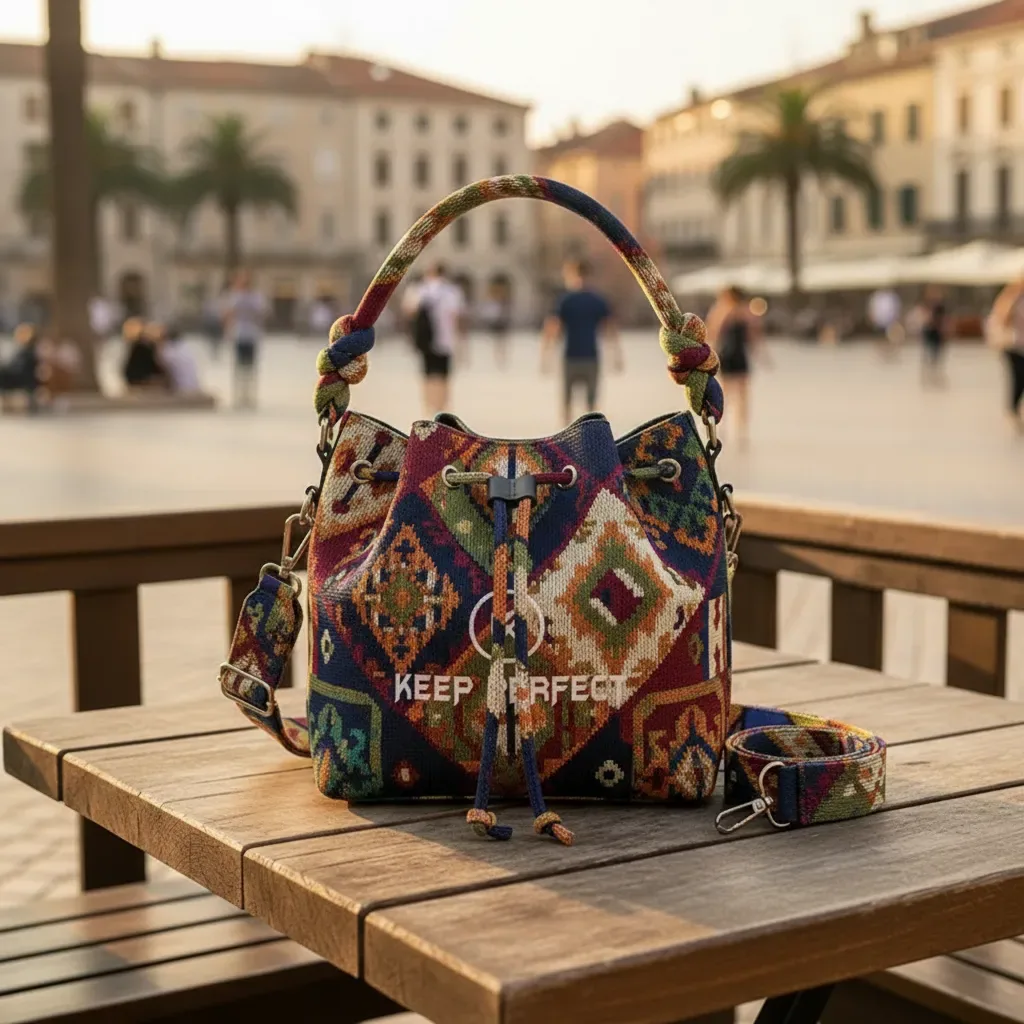
Six Stages Carry a Cone to a Packed Carton
Six stages take a knitted bag from yarn cone to packed carton: cone creeling and tension setting, knitting on the V-bed, off-machine inspection of the loop structure, joining and assembly, finishing and relaxation, and final inspection to AQL 2.5 (ISO 2859-1). Every one of the six has an owner parameter, and programmes that go wrong almost always fail in stage one or stage six rather than in the knitting itself.
That ordering matters because it tells a buyer where to spend attention. Yarn delivery problems are quick to fix on the creel and expensive to diagnose in the finished fabric. Final inspection fails far more often on an unstated acceptance criterion than on a badly made body. The four middle stages are where value is added, but the two outside stages are where disputes start.
- Stage 1 — cone creeling, yarn tension devices set against the count being fed.
- Stage 2 — knitting: the file drives courses, structure changes and shaping on the bed.
- Stage 3 — off-machine loop inspection before any needle-out or drop-stitch reaches assembly.
- Stage 4 — joining, base insertion, lining, hardware and any sewn reinforcement.
- Stage 5 — finishing: steaming or heat setting, then controlled relaxation before measurement.
- Stage 6 — AQL 2.5 (ISO 2859-1) inspection, packing and documentation release.
The Numbers Behind One Tote
A 34 x 38 cm tote at E12 in two ends of 300D recycled polyester occupies the bed for about 9 minutes, builds roughly 160 courses at a loop length of 4.2 mm, and leaves the machine at approximately 143 g before finishing; those five numbers are the fastest way to judge whether any quotation you receive is describing the same bag you specified.
| Parameter | Value on this tote | What moves it |
|---|---|---|
| Machine gauge | E12 (12 needles per inch) | Silhouette detail and required surface definition |
| Needle pitch | 2.12 mm | Gauge choice alone — a fixed geometric consequence |
| Loop (stitch) length | 4.2 mm | Cam setting, yarn count, take-down tension |
| Courses for the body | 160 courses for 38 cm | Course density, currently 42 per 10 cm |
| Wales across the panel | 160 wales for 34 cm | Working width used, currently 47 per 10 cm |
| Machine cycle | about 9 minutes per piece | Gauge, structure changes, integral handle work |
| Finished weight | about 143 g at 420 g/m² | Yarn count, number of ends, stitch density |
| Yarn consumed | about 150 g including waste | Take-down waste, cone tails, colour changes |
Notice how few of those lines respond to labour. Knitting is a capital-intensive process: once the file runs, the bed does the shaping and the cost per piece is governed by how long the bed is occupied. That is why cycle time, not hourly rate, is the honest lens for comparing quotes.
What the Needle Bed Does, Row by Row
Two needle beds face each other in a V; each latch needle draws yarn through the loop already hanging from it, so a course is formed needle by needle, and the travelling carriage decides which needles knit, which tuck, and which hold their loop while it passes. Nothing is cut and nothing is joined during that operation — the structure arrives joined as it is made.
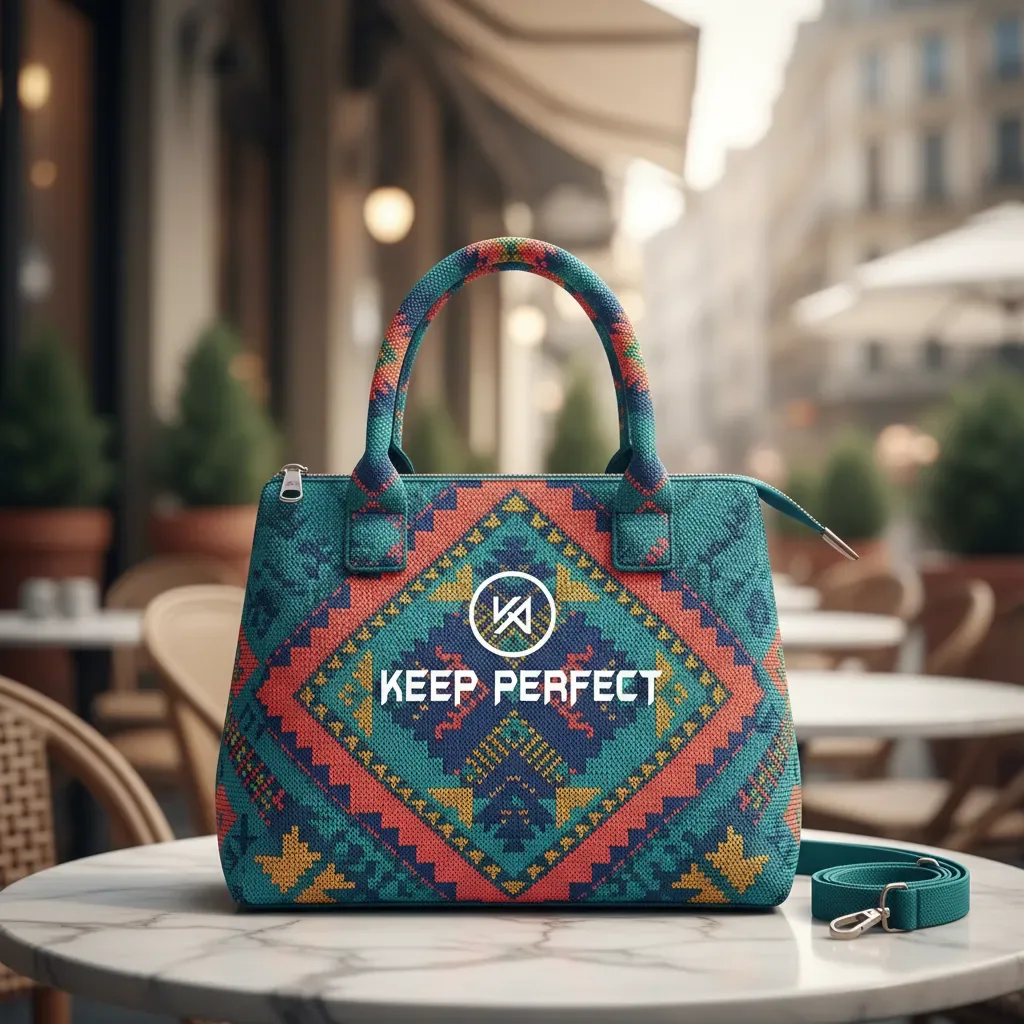
A machine with a 127 cm working width at E12 carries 600 needles per bed, and each of those needles can be selected independently on every course. That independence is the whole reason shaping is possible: narrowing and widening are not operations added to knitting, they are the same knitting with a different selection pattern.
Take-down tension pulls the formed fabric down between the beds and sets how tightly courses stack. Too little and the fabric balloons and drops stitches; too much and loop length collapses, the body shrinks in the wash and the handle feels boardy. It is the single most commonly mis-set variable when a programme transfers between machines.
Gauge Chooses Loop Size, and Loop Size Chooses Everything Else
Gauge is simply needles per inch, and it fixes the needle pitch: 3.63 mm at E7, 2.12 mm at E12 and 1.81 mm at E14. Pitch sets the largest loop the bed can form, and loop size then determines fabric density, surface definition,hand feel and how many courses are needed to cover the body — so one gauge decision propagates into every subsequent number in the specification.
The practical reading for a buyer is that gauge is a cost lever disguised as an aesthetic one. Moving from E12 to E14 for finer branding detail does not make expensive yarn; it makes more courses, which lengthens the cycle, which lengthens the cost line. Choosing the coarsest gauge the brief tolerates is the most reliable saving available before a single stitch is knitted.
Shaping on the Bed: Where Three-Dimensional Structure Comes From
A bag gains three-dimensional shape because the file changes how many needles are in work from course to course: knitting fewer needles narrows a panel, knitting more widens it, and knitting part of a row while others hold rotates a section without cutting anything. Widening and narrowing are not separate machines or separate operations; they are selection patterns written into the file.
There is a physical limit to how fast that can happen. Near the border of a shape, transferring one needle per side every two courses is routine; beyond roughly two needles per side per course the loop begins to distort and the edge shows tension marks that survive finishing. Radii tighter than about 12 mm on the border are the classic place where a paper design becomes an unrepeatable sample.
What the Programme File Tells the Machine
The file is a per-course instruction set: which needles knit, tuck or miss; which structure applies in which zone; which feeder carries which yarn; what tension applies in that zone; and where widening, narrowing or short-row work begins and ends. Nothing else about the bag exists except what this file states explicitly, which is why an ambiguous drawing becomes an expensive conversation on day nine of sampling.
- Needle selection map for every course, including beds in use.
- Structure zones: jersey, rib, tuck, float or pointelle by region of the panel.
- Yarn allocation per feeder, including plating and striping where two shades alternate.
- Tension values by zone, set on the machine and recorded against the style number.
- Shaping sequence, with the rate expressed in needles per course per side.
- Start and stop marks so the piece separates cleanly and repeatably from the string.
Get a costed read on your knit file
Send the silhouette, target dimensions and carried load. You receive a file-based quote with cycle time, gauge recommendation and a sampling window inside one business day. Open the contact page.
Where Knitting Stops and Assembly Begins
Knitting delivers the body, sometimes with handles and openings already integral, and assembly contributes everything the bed cannot honestly produce: metal hardware, moulded bases, linings set into a knitted shell, and zips inserted into openings that were knit to receive them. Choosing which of those stays on the machine is the largest structural decision in the whole programme.
Fully integral
Body, handles and opening all leave the bed as one piece. Fewest operations, highest file complexity, tightest restriction on zip and hardware choice.
Integral body, assembled base
The knit tube closes with an inserted or moulded base. Best carried-load behaviour where the bag sits down on the floor repeatedly.
Knit panels, sewn assembly
Flat panels joined by sewing or welding. Simplest files, most flexibility on trim, and the easiest route to change size later.
Hybrid with reinforcement
Knit body with webbing or reinforcement applied at the load path. Usually the answer when carried load exceeds about 8 kg.
How to Read a First Knit Sample
Read a first sample in a fixed order: let it relax for 24 hours, measure the critical dimensions, inspect loop uniformity under a pick glass, load the handles, then judge colour under two light sources. Approving a sample in any other order usually means approving a bag that will measure differently after washing.
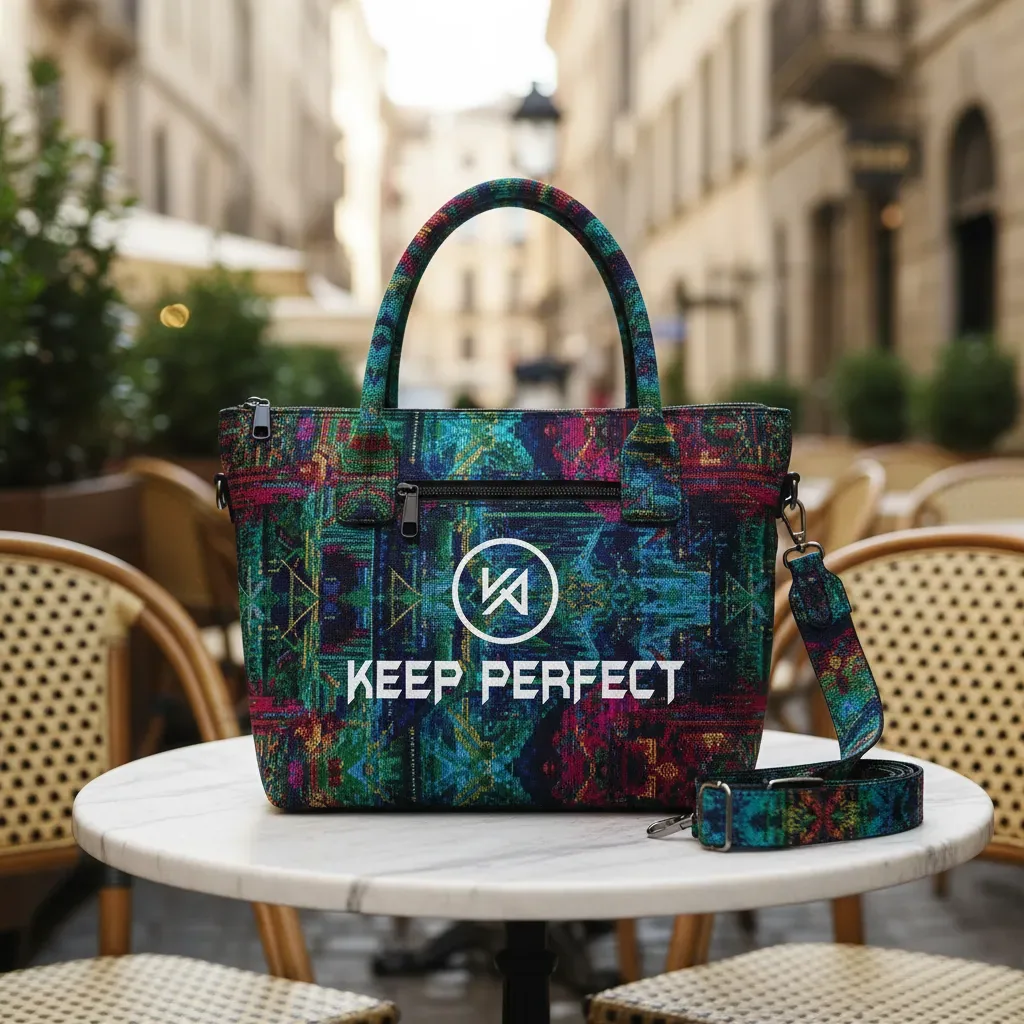
Sample approval checklist
- Relax the piece flat for 24 hours at ambient condition before a tape touches it.
- Measure the three dimensions named on the spec sheet, not the whole bag.
- Check loop uniformity under a pick glass across the full width, not only at the centre.
- Load the handles to the stated carried weight and hold for one minute.
- View colour under daylight-equivalent and store lighting at 65% and 100% reflectance.
- Record every value against the style number so round two has something to compare with.
Turning the Process Into a Quote
A quote is credible when it names the gauge, the yarn count, the loop length target and the expected cycle time, because those four lines determine the unit cost more than any negotiation ever will. Ask for all four early; a quote that gives only a price is a quote that cannot be compared with anything.
- MOQ
- 100 pcs per style / colourway
- Sampling
- 7 working days
- Bulk production
- 30 days
- Inspection
- AQL 2.5 (ISO 2859-1)
- Incoterm
- FOB Xiamen, CIF or DDP on request
- Capacity
- 7 production lines, about 200,000 pcs per month
- Programme experience
- coordinating knit bag programmes since 2014
- Facility
- SGS-validated partner production facility
Frequently Asked Questions
How does 3D knitting differ from ordinary flat knitting?
Flat knitting produces a rectangular panel that is later cut into shape. Three-dimensional knitting changes the number of needles in work from course to course, so the panel leaves the bed already shaped, often with handles and openings included. The machine is the same family; the difference is entirely what the programme file instructs it to do course by course.
What machine gauge should I specify for a knit tote?
E12 is the default for a tote that must hold shape, giving a 2.12 mm needle pitch and enough loop definition for most branding. E7 suits a coarse, open promo piece where cycle time matters most. E14 is reserved for body shapes that carry fine jacquard detail or a tight device pocket. Choose the coarsest gauge the brief tolerates.
How long does one bag body take to knit?
A 34 x 38 cm tote at E12 takes about 9 minutes of machine time. Stage work dominates: shaping sequences, integral handle courses and structure changes all run at reduced carriage speed. A plain rectangular panel of the same size clears faster, while the same silhouette at E14 can exceed 14 minutes because it carries substantially more courses.
Can the handles really be knitted as part of the body?
Yes, and they frequently are. Integral handles are built by knitting a reinforced band structure while the rest of the row continues, with the junction crossing several courses so load spreads rather than concentrates. The alternative is a webbing insert sewn on afterwards, which is stronger per gram but adds an operation and joins two materials with different stretch behaviour.
Why do two quotes for the same knitted bag differ so much?
Because they usually answer different questions. One assumes E12 and the other E14, which changes course count by a wide margin. One assumes a carried load of 5 kg and the other 8 kg, changing the reinforcement design. Ask each quotation to state gauge, yarn count, loop length target and cycle time, then compare again.
What is loop length and why does it appear on a specification?
Loop length is the amount of yarn in one stitch, typically 4.2 mm at E12 for a bag body. It governs fabric density, weight, how much the body shrinks in laundering and how much yarn the programme consumes. It is the single most useful process parameter to hold fixed between sampling rounds, because holding it fixed is what makes two samples comparable.
How many courses does a bag body actually need?
At 42 courses per 10 cm, a 38 cm tall body needs about 160 courses. That figure scales directly with course density: tightening stitch density to 48 courses per 10 cm takes the same body to roughly 182 courses, which lengthens the cycle and adds yarn with no change to the visible silhouette.
What causes dropped stitches and barré in a knitted bag?
Dropped stitches come from take-down tension that is too low for the structure, or from a yarn that spikes in friction on one cone. Barré — repeating horizontal bands — usually traces to yarn lot variation or a tension device that reads differently between feeders. Both are best diagnosed on the machine, before the piece reaches assembly and the evidence is cut away.
Is there a minimum quantity for a new knit bag programme?
Yes. The minimum is 100 pcs per style or colourway, which is deliberately set low enough for a first drop to test a colourway inside one season. Sampling takes 7 working days and bulk production runs 30 days, so a new style can go from approved file to shipped carton inside roughly six weeks.
What inspection standard applies to a bulk knit bag shipment?
Inspection runs to AQL 2.5 under ISO 2859-1, which sets the sample size against lot size and the accept and reject numbers for each defect class. For a knit bag the useful extra step is to add a mechanical acceptance limit, such as a minimum handle pull-out force, because appearance criteria alone do not catch a weak joint.
Which tests should appear on a knit bag tech pack?
Abrasion resistance to ISO 12947-2, tensile strength to ISO 13934-1, tearing resistance to ISO 13937, colour fastness to rubbing under AATCC 8 and to laundering under AATCC 61, plus dimensional change after laundering. Where the retail channel requires it, OEKO-TEX STANDARD 100 covers testing for harmful substances on the finished article.
Can a knitted bag be made from recycled yarn?
Yes, and most programmes specify it. Recycled polyester at 300D or 600D runs cleanly on bag gauges and carries a Global Recycled Standard chain of custody so the claim can be evidenced. Ask for the transaction certificate at yarn booking rather than at shipment, because tracing a lot backwards through two suppliers rarely works.
People Also Ask
Is 3D knitting faster than cut-and-sew?
Usually, once the file exists. Sampling takes 7 working days because there is no pattern to grade and no cutting marker to make, and bulk runs 30 days. The saving is largest for programmes that change colour or detail often, because a new colourway is a yarn change rather than a new cutting set-up.
Does knitting really produce less waste than cutting?
Knitting feeds yarn only where loops form, so the process discards cone tails and start-up waste rather than offcuts from a marker. Where the yarn carries recycled content and a chain of custody, that residue can often be reprocessed instead of landfilled.
Can a knit bag carry a heavy load?
Yes, up to roughly 8 kg on an integral body with a designed handle root. Beyond that the sensible route is a reinforcement insert at the load path, because the failure point is almost always the junction rather than the fabric itself.
What does ISO 2859-1 actually define?
It defines sampling schemes indexed by acceptance quality limit, giving the sample size, and the accept and reject numbers for a given lot size and inspection level. It answers how many pieces to examine, not what good looks like — that part belongs on your own specification.
How is a jacquard logo built into a knit bag?
The programme file selects different colours or structures for individual needles within one course, so the mark is formed by the loops themselves rather than applied afterwards. Fine detail is limited by loop size: below roughly 2 mm stroke width at E12 the edge reads fuzzy.
Sources and further reading
Every figure on this page is either our own programme data or attributed below. Open the originals before you write them into a specification.
- ISO 2859-1 — Sampling procedures for inspection by attributesISO Defines the AQL-indexed sampling plan applied at final inspection for knit bag shipments.
- WHOLEGARMENT knitting and how shaped articles come off the bedShima Seiki The technical lineage behind three-dimensional knitting of complete articles rather than panels.
- ISO 12947-2 — Abrasion resistance of fabrics by the Martindale methodISO The abrasion test referenced for bag bodies expected to survive repeated carry and set-down.
- Global Recycled StandardTextile Exchange Chain-of-custody standard behind recycled polyester yarn claims at 300D and 600D.
Where This Fits in the Wider Knit Bag Reference
The six stages above describe what happens on the machine, but most sourcing questions sit either side of it: what the structure should be, what yarn it should use, and how the finished body will be judged. The three references below cover those questions in the depth a technical buyer needs before writing a specification, and each one returns to the same principle stated here — that the file, not the conversation, decides what the bag becomes.