Knitted Bag Material Cost Drivers: Where the Money Goes in a Knit Bag Programme
Knitted bag material cost is dominated by seven drivers, and the first three account for most of the unit price: yarn price per kilogram, fabric mass in grams per square metre, and knitting cycle time set by gauge and structure. On a mid-weight tote at 420 g/m² from 300D yarn, a reference landed figure sits near USD 4.80 at 100 pcs per style and colourway on FOB Xiamen. Understanding which driver moves which number is what makes a cost discussion productive.
Where the Money Goes: A Cost Breakdown First
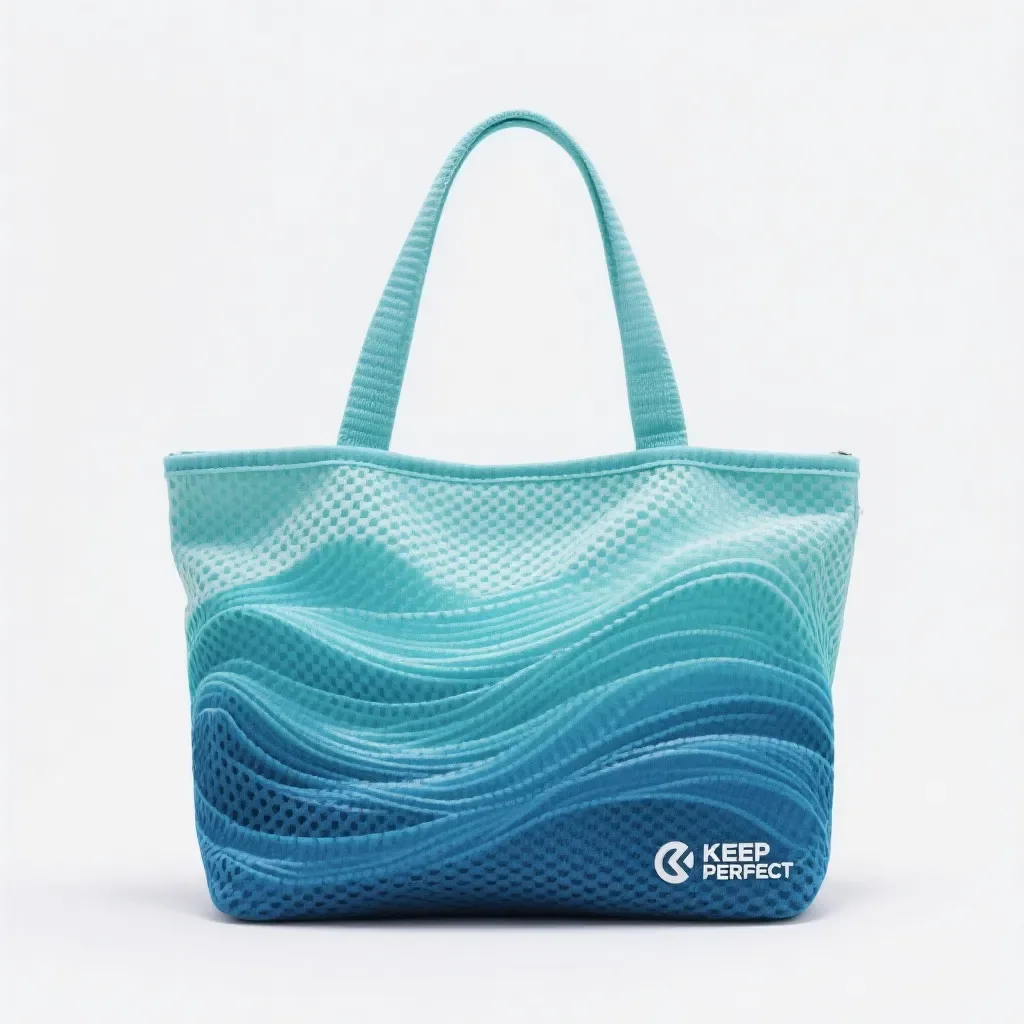
Start with the breakdown, because most cost arguments in knit bag sourcing are really arguments about which line is being discussed. For a mid-weight knitted tote at 420 g/m², yarn is the largest single material line, followed by dyeing and finishing, then trims and hardware, then packing. Knitting conversion is a smaller line than most buyers expect, because a knitted panel comes off the machine as a shaped piece that needs little cutting, and cutting and sewing labour is where a cut-and-sew bag spends its money.
The arithmetic that matters is grams per bag. A tote at 420 g/m² with a surface area around 0.55 square metres consumes roughly 230 g of fabric before waste, and with knitting and cutting waste at around 10% the yarn requirement lands near 255 g per bag. Multiply by the yarn price per kilogram and the yarn line is known within a small margin. Everything else in the costing conversation is smaller than this line, which is why the first three drivers deserve the most attention.
The second thing to understand is that material cost and conversion cost move in opposite directions. A heavier yarn costs more per bag and also knits more slowly, so it raises two lines at once. A finer gauge gives a better surface but a longer cycle time, so it raises conversion while lowering material. A cost discussion that looks at only one of the two will pick the wrong option more often than not.
| Cost line | Relative size | Main variable | Moves up when |
|---|---|---|---|
| Yarn | largest single line | price per kilogram and grams per bag | count rises, GSM rises, recycled content specified |
| Dyeing and finishing | second line | dye class, depth of shade, number of lots | deep shades, many colourways, small lots |
| Trims and hardware | third line | zip type, buckle, webbing width | metal hardware, branded pulls, wide webbing |
| Knitting conversion | modest | cycle time set by gauge and structure | finer gauge, complex zoned structures |
| Assembly | modest | number of components and operations | lined bags, internal pockets, binding |
| Packing | small | carton specification and folding method | individual polybags, retail-ready packing |
| Compliance and testing | small but fixed | number of standards and markets | children's items, multiple markets |
Driver 1: Yarn Count and Price per Kilogram
The first driver is yarn price per kilogram, set by polymer, count and route. Polyamide is generally priced above polyester at the same count, recycled routes carry a premium over virgin, and core spun constructions cost more again because spinning is an additional process. The mistake buyers make is comparing price per kilogram between yarns that deliver different performance, when the comparison that matters is cost per bag at the required performance floor.
Cost per bag is price per kilogram multiplied by grams per bag, and grams per bag is where a low price can lose. A yarn at a lower price per kilogram that needs 520 g/m² to clear the abrasion floor costs more per bag than a higher-priced yarn that clears it at 420 g/m². Set the performance floor first, then compare yarns on the mass needed to reach it, and the ranking often changes. This is the most useful reframing available in a knit bag cost discussion.
Driver 2: Fabric Mass and GSM
The second driver is fabric mass, and it is the one buyers control most directly. Mass in grams per square metre comes out of yarn count, gauge and loop length, so it is not an independent setting, but from a costing point of view it behaves as one: every 10% of added fabric mass adds close to 10% to the yarn line. Moving a tote from 420 to 560 g/m² raises fabric mass by roughly a third, and the yarn line with it.
The important nuance is that mass can be placed rather than spread. A zoned structure puts density into the base and the handle roots, which is where knit bags fail, while the body stays lighter. A panel engineered that way can hit the same abrasion and tear floors at lower total mass than a uniform heavy panel, which lowers the yarn line without lowering performance. That is why the mass conversation should always be a zoned-versus-uniform conversation before it is a heavy-versus-light one.
- Reference bag
- mid-weight tote, surface area about 0.55 square metres
- Fabric mass
- 420 g/m², tolerance ±5%
- Fabric per bag before waste
- about 230 g
- Knitting and cutting waste
- about 10%
- Yarn per bag
- about 255 g
- Mass sensitivity
- every 10% added mass adds close to 10% to the yarn line
- Zoned alternative
- denser base and handle roots, lighter body
Driver 3: Gauge and Knitting Cycle Time
The third driver is machine time, and it is the one most often overlooked because it does not appear as a material at all. A knitted panel takes a fixed number of minutes to produce, set by gauge, structure and panel size, and machine time is what capacity is made of. With 7 production lines and output around 200,000 pcs per month, a style that takes noticeably longer per piece occupies a larger share of that capacity, and capacity is what the 30-day bulk plan is built from.
Gauge drives cycle time because finer gauge means more needles per inch and therefore more stitches per panel. An E14 panel has roughly twice the needle count of an E7 panel over the same width, so at comparable yarn feed it takes materially longer to knit. Complex structures add time again: a zoned panel with tuck and float sections runs slower than a plain jersey panel. None of this makes zoned design wrong, but it does mean the cycle time has to be counted rather than assumed.
The practical consequence shows up at quotation, not at design. Two constructions with identical yarn consumption can carry different conversion costs because one takes meaningfully longer on the machine. Asking for the cycle time alongside the yarn consumption is the fastest way to see the true difference between two options, and it is a reasonable question to put to any production partner at quotation stage.
Driver 4: Colour Count and Dye Lot Economics
The fourth driver is the number of colourways, and it costs more than buyers expect because dyeing has batch economics. Each colourway is a separate dye lot with its own minimum, its own lab dip and its own approval cycle. At 100 pcs per style and colourway, the yarn quantity for one colourway may sit below the dye lot minimum, which means the programme pays for more yarn than it uses or accepts a surcharge for a short lot.
The lever is consolidation rather than negotiation. Five colourways at 100 pcs each cost more in total than four colourways at 125 pcs each, because the fifth lot's fixed cost is avoided entirely. Where a colour range is being planned, cutting one shade can save more than trimming the yarn specification, and it saves a sampling round as well. This is usually the fastest cost reduction available in a knit bag programme and it is the one merchandising teams resist most.
Driver 5: Recycled Content and Certification
The fifth driver is compliance, and it behaves differently from the others because it is largely fixed rather than variable. A recycled yarn premium is a per-kilogram cost that scales with volume, but the certification, testing and documentation around it are fixed costs per programme. At 100 pcs those fixed costs are spread over a small quantity, so compliance carries a higher share of unit cost at low volume than at high volume.
What this means practically is that the compliance decision should be made once per programme rather than per colourway. Testing a construction and certifying an article covers the colourways within that article when the scope is written correctly, so adding a colourway inside a certified scope costs far less than certifying a new article. Ask how the certificate scope is defined before planning the colour range, because the answer changes which colourways are economical.
- Recycled yarn premium is variable: it scales with kilograms purchased.
- Certification and testing are fixed: they cost the same whether the run is 100 or 10,000 pcs.
- Write the certificate scope to cover the planned colour range rather than one shade.
- Children's items add CPSIA testing, which is a further fixed cost per run for many retailers.
- Multiple destination markets add declarations, and the union of requirements has to be built before yarn booking.
Driver 6: Hardware, Trims and Assembly
The sixth driver is everything that is not knitted: zips, buckles, webbing, labels and binding. On a knitted bag this line is often proportionally higher than on a cut-and-sew bag, because the knitted panel itself is efficient and the trims are not. A metal zip and a branded pull can cost more than the fabric in a small pouch, and webbing width is a quiet multiplier: moving from 25 mm to 38 mm webbing adds material and usually a heavier slider and a wider attachment.
The assembly side of this driver is operation count. A bag that closes with a drawcord and a cord lock has far fewer operations than one with a lined interior, an internal pocket, a bound top edge and a zip garage. Each operation is labour and each is an opportunity for a defect that inspection has to catch. Trimming operations is therefore a cost reduction and a quality improvement at the same time, which is rare and worth pursuing before trimming materials.
Driver 7: Yield, Wastage and Inspection
The seventh driver is what is lost rather than what is used. Knitting waste comes from start-up, from colour changes and from panels that fail inspection; cutting waste comes from nesting; and defect waste comes from everything in between. A well-run programme typically lands near 10%, and the difference between 10% and 15% is a direct hit on unit cost that never appears on a material quote because it is spread across the whole run.
Inspection cost belongs to the same driver, and it is worth understanding that inspection is priced by effort rather than by outcome. Inspection runs to AQL 2.5 under ISO 2859-1, which sets the sample size and the acceptance number, so a tighter defect definition costs more inspection time rather than less. The efficient approach is to define defects precisely and to fix the causes in the process, which lowers both the inspection effort and the defect rate together.
| Driver | Type of cost | Typical lever | Risk of cutting it |
|---|---|---|---|
| Yarn price per kilogram | variable | compare cost per bag at the performance floor | a lower price may need more mass |
| Fabric mass | variable | zone the density instead of spreading it | uniform thinning raises returns at the base |
| Cycle time | variable | avoid finer gauge where the surface allows | affects capacity inside the 30-day plan |
| Colourway count | fixed per lot | consolidate the colour range | merchandising resistance, not quality risk |
| Recycled content | mixed | choose the route once per programme | changing later invalidates certificates |
| Hardware and trims | variable | reduce operation count before material | fewer features may lower perceived value |
| Yield and inspection | variable | define defects precisely and fix causes | weaker inspection raises downstream cost |
How Order Quantity Moves Unit Cost
Quantity moves unit cost through the fixed lines rather than the variable ones. Doubling the quantity roughly halves the fixed cost per piece: the sampling, the lab dip, the certificate, the pattern setup and the machine setup are all spread across more units. The variable lines, yarn above all, barely move at all, because a kilogram of yarn costs the same whether it goes into 100 bags or 1,000.
This explains why a programme starting at 100 pcs per style and colourway looks expensive per piece and improves quickly. It also explains the shape of the right question to ask: not what price reduction a larger quantity brings, but which fixed costs the larger quantity absorbs. A second colourway absorbs the sampling cost again, while a larger run of the first colourway does not, which is why consolidation usually beats volume when both are available.
Quantity in one line
- Volume halves the fixed cost per piece; it barely moves the yarn line.
- Consolidating colourways removes fixed costs outright, which is why it usually beats adding volume.
Where to Cut Without Creating Returns
Not every line can be cut safely, and the ordering below reflects where the risk actually sits. Start with colourway consolidation, then operation count, then zoned rather than uniform mass, then gauge. Leave the performance floors alone: tensile, abrasion and tear are what keep the bag out of the returns pile, and a saving of a few percent on the yarn line is not worth a measurable rise in returns at the handle root.
- Consolidate the colour range; each colourway removed deletes a fixed dye lot cost.
- Reduce operation count; fewer operations means less labour and fewer defect opportunities.
- Zone the density so mass sits only where the bag fails, rather than thinning the whole panel.
- Review gauge against the surface requirement; a coarser gauge knits faster at the same yarn.
- Review hardware width and specification, which is often over-specified for the load case.
- Hold the performance floors: tensile, abrasion and tear numbers are what prevent returns.
How Cost Decisions Land on the Calendar
Cost decisions have a calendar effect that is worth stating plainly. Sampling takes 7 working days from a locked spec, and a cost-driven change to yarn, gauge or structure after sampling starts resets that window. Bulk takes 30 days from approved sample, quoted FOB Xiamen with CIF and DDP available. A cost change requested after bulk begins is the most expensive kind, because it affects goods rather than plans.
The efficient sequence is therefore to make cost decisions during specification, before the 7 working day clock starts. Decide the performance floor, the colourway count and the recycled route up front, get the costed options on the table together, and lock one. That sequence fits inside the calendar; the alternative, costing each option by running it, does not, and the difference is usually several weeks.
Get a costed breakdown for your bag programme
Send the bag type, target GSM, colourway count and destination market. We will return a line-by-line cost breakdown, quote FOB Xiamen at 100 pcs per style and colourway, and confirm the 7 working day sampling slot. Start on the contact page.
Frequently Asked Questions
What is the largest cost driver in a knitted bag?
Yarn. It is price per kilogram multiplied by grams per bag, and for a mid-weight tote at 420 g/m² that is roughly 255 g of yarn including about 10% waste. Dyeing and finishing is the second line, trims and hardware the third. Knitting conversion is smaller than most buyers expect, because a knitted panel needs little cutting.
How much yarn does a knitted tote bag use?
A tote at 420 g/m² with a surface area around 0.55 square metres consumes roughly 230 g of fabric before waste. Add knitting and cutting waste at about 10% and the yarn requirement lands near 255 g per bag. Every 10% added fabric mass adds close to 10% to the yarn line.
Why is comparing yarn by price per kilogram misleading?
Because the comparison that matters is cost per bag at the required performance floor. A yarn with a lower price per kilogram that needs 520 g/m² to clear the abrasion floor costs more per bag than a higher-priced yarn that clears it at 420 g/m². Set the floor first, then compare the mass needed to reach it.
How does gauge affect cost?
Through machine time rather than through materials. Finer gauge means more needles per inch and therefore more stitches per panel, so an E14 panel takes materially longer to knit than an E7 panel of the same width. Ask for cycle time alongside yarn consumption when comparing two constructions.
Why do extra colourways cost so much?
Because each colourway is a separate dye lot with its own minimum, lab dip and approval cycle. At 100 pcs per colourway the yarn quantity may sit below the dye lot minimum, so the programme either pays for surplus yarn or pays a short lot surcharge. Five colourways cost more than four at higher volume each.
Is recycled yarn a cost saving or a cost increase?
An increase, in most programmes. Recycled polyamide and recycled polyester carry a premium per kilogram over virgin, and the premium is largest on small lots. The decision is usually a marketing and compliance one, and part of the premium can be offset by zoned design that keeps total fabric mass down.
How much does compliance add to unit cost?
It is mostly a fixed cost per programme rather than a per-piece cost, so it carries a larger share of unit cost at 100 pcs than at higher volume. Testing and certification cost the same whether the run is 100 or 10,000 pieces, which is why the compliance decision should be made once per programme.
Why is hardware proportionally expensive on a knitted bag?
Because the knitted panel itself is efficient. A metal zip and a branded pull can cost more than the fabric in a small pouch, and moving from 25 mm to 38 mm webbing adds material plus a heavier slider and a wider attachment. Reducing operation count saves labour and reduces defect opportunities at the same time.
What is a normal waste allowance for a knit bag programme?
Around 10% covering knitting start-up, colour changes, cutting nesting and panels that fail inspection. The difference between 10% and 15% is a direct hit on unit cost that never appears on a material quote, because it is spread across the whole run rather than shown as a line.
Does a larger order reduce the yarn cost per bag?
Very little. A kilogram of yarn costs the same whether it goes into 100 bags or 1,000. What volume does is halve the fixed cost per piece: sampling, lab dip, certification, pattern setup and machine setup are spread across more units. Consolidating colourways removes fixed costs outright.
What is the safest place to cut cost in a knit bag?
Colourway consolidation first, then operation count, then zoned rather than uniform mass, then gauge. Leave the performance floors alone, because tensile, abrasion and tear numbers are what keep the bag out of the returns pile and a small yarn saving is not worth a measurable rise in returns.
How does a cost change affect the sampling window?
A change to yarn, gauge or structure after sampling has started resets the 7 working day window, because the panel geometry changes with it. The efficient sequence is to make cost decisions during specification, get the costed options together and lock one before the clock starts.
What is a realistic reference price for a knitted tote?
Around USD 4.80 per piece for a mid-weight tote at 420 g/m² on a 100 pcs programme, quoted FOB Xiamen with CIF and DDP available. The figure moves with yarn route, fabric mass, colourway count and hardware, so it should be treated as a reference point rather than a fixed price.
How does inspection cost behave?
It is priced by effort rather than by outcome. Inspection runs to AQL 2.5 under ISO 2859-1, so a tighter defect definition costs more inspection time, not less. The efficient approach is to define defects precisely and fix causes in the process, lowering inspection effort and defect rate together.
Why do material and conversion costs move in opposite directions?
Because a heavier yarn raises the material line and also knits more slowly, while a finer gauge lowers material and raises machine time. A cost discussion that looks at only one of the two will pick the wrong option more often than not, so both should be quoted together.
When is the least expensive point to make a cost change?
During specification, before the 7 working day sampling clock starts. A change at that stage costs nothing but a recalculation. The same change after bulk has begun is the most expensive kind, because it affects finished goods rather than plans, and it puts the 30-day shipment at risk.
People Also Ask
What drives knitted bag material cost?
Seven drivers, led by yarn price per kilogram, fabric mass in GSM and knitting cycle time. Then colourway count, recycled content and certification, hardware and trims, and yield loss. The first three account for most of the unit price.
How much yarn is in a knitted tote bag?
About 255 g including 10% waste, for a tote at 420 g/m² with a surface area near 0.55 square metres. Each 10% of added fabric mass adds roughly 10% to the yarn line.
Do bigger orders lower the cost per bag?
They lower the fixed cost per bag, not the yarn cost. Sampling, lab dips, certification and setup spread across more units, while a kilogram of yarn costs the same at any volume. Consolidating colourways removes fixed costs outright.
Why is a knitted bag conversion cost low?
Because the panel comes off the machine as a shaped piece needing little cutting. A cut-and-sew bag spends its money on cutting and sewing labour, while a knitted bag spends it on yarn, which shifts where cost reduction should be aimed.
What should not be cut to save cost?
The performance floors. Tensile by ISO 13934-1, abrasion by ISO 12947-2 and tear by ISO 13937-2 are what keep the bag out of the returns pile. Cut colourways, operations and unzoned mass instead.
Sources and further reading
Every figure on this page is either our own programme data or attributed below. Open the originals before you write them into a specification.
- ISO 2859-1:1999 Sampling procedures for inspection by attributesISO Sampling plan behind the AQL 2.5 inspection, which sets inspection effort and therefore part of unit cost.
- OEKO-TEX STANDARD 100OEKO-TEX Finished-article certificate whose scope determines how many colourways one certification can cover.
- Textile Exchange standardsTextile Exchange Recycled content framework behind the yarn premium and the transaction certificate required per lot.
- Shima Seiki knitting machineryShima Seiki Machine lineage behind gauge-dependent cycle time, the driver that consumes production capacity.
- EU strategy for sustainable and circular textilesEuropean Commission Policy driver behind recycled content and digital product information requirements that add fixed compliance cost.