Custom Knitted Bag Colour Matching: Lab Dips, Delta E Tolerance and Shade Approval for Brand Programmes
A brand shade rarely matches a knitted surface on the first dip, and the reason is structural rather than chemical: loop geometry changes surface shadow, so the same dyestuff reads darker in knit than on a flat printed chip. The practical answer is to specify the tolerance instead of the recipe — Delta E 1.0 or better under D65, measured on the finished fabric rather than on the cone. This article sets out the numbers behind a shade approval: dip rounds, dye-lot minimums, colourway set-up cost and the fastness floors a matched shade has to hold.
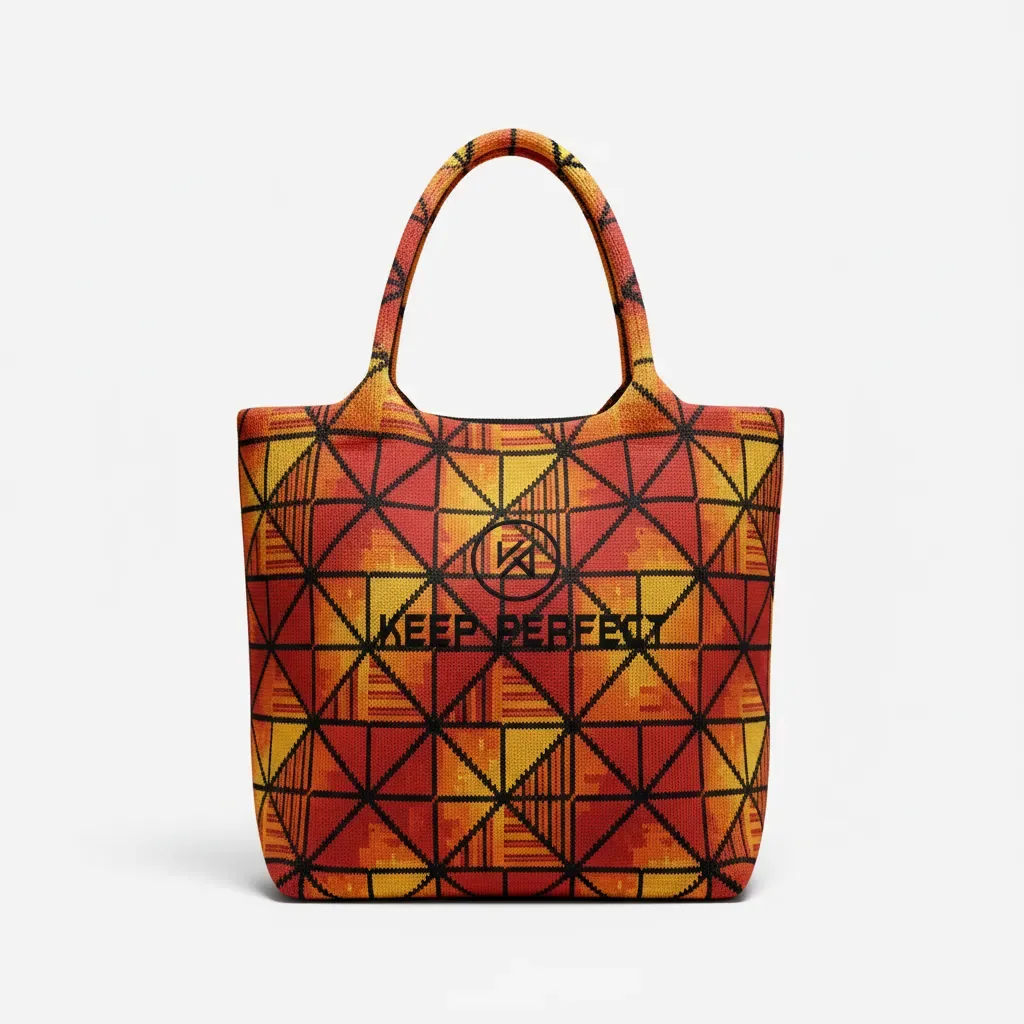
What a Colour Match Costs on a Knitted Bag Programme
A custom knitted bag colour match adds about 7% to the unit cost of a standard shade and about 10 working days to the schedule, and both figures are set by the dye lot rather than by the knitting.
The cost is easy to misread because it rarely appears as a single line item. A stock shade programme buys yarn that already exists; a matched shade programme books a dye lot, and a dye lot has a minimum. On a knitted bag body the usual minimum is around 300 kg, which is more yarn than a 100-piece first run consumes, and the surplus is held against the repeat. That holding is the real cost of matching, and it is why the premium is quoted as a percentage of the unit rather than as a set-up fee.
The schedule cost behaves the same way. Sampling on a knit programme runs 7 working days from an approved artwork and technical pack, and a custom shade does not shorten that — it lengthens it, because the dip has to be knitted, not just dyed. A dip presented on yarn alone is not a dip; it is a cone, and a cone does not carry loop geometry. The only honest approval surface is a knitted swatch from the production bed, at the production gauge, in the production yarn.
The Four Numbers Behind a Shade Approval Decision
Four numbers decide whether a knitted bag shade is approved — Delta E against the brand reference, the dye-lot minimum, the number of dip rounds, and the colourway count — and the first is the only one most briefs state.
Delta E is the acceptance figure and it belongs in the technical pack next to the GSM, not in an email thread. The dye-lot minimum decides whether a matched shade is viable at the ordered volume at all, and on small programmes it is the number that turns a custom shade into a stock-shade conversation. Dip rounds decide the calendar, because each round is a physical iteration on the bed rather than a digital revision. Colourway count decides the set-up arithmetic, since MOQ is stated per style and per colourway. A programme that fixes all four before sampling starts rarely needs a third round.
- Delta E target
- 1.0 or better under D65, measured on the finished knit against the brand reference
- Dye-lot minimum
- About 300 kg for a custom dope-dyed or piece-dyed shade
- Dip rounds
- Two on average, about 30% of programmes need a third
- Colourway count
- MOQ 100 pcs applies per style and per colourway, not per order
- Metamerism index
- Below 0.5 across D65, TL84 and illuminant A
- Sampling window
- 7 working days from approved artwork, technical pack and yarn booking
Lab Dip Rounds: How Many It Takes and What Each One Costs
A custom knitted bag shade reaches approval in two dip rounds on average, about 30% of programmes need a third, and every extra round costs roughly three calendar days plus one yarn set-up on the sampling bed.
The second round exists for a reason that has nothing to do with competence. The first dip is mixed against a spectrophotometer reading of the reference; the second is corrected against a knitted swatch of the first. Those two readings differ, because the reference is usually a flat chip and the swatch is a loop structure, and the instrument sees the difference as a shade error rather than as a construction difference. Once the loop geometry is in the measurement, the correction is usually small and the third round becomes unnecessary.
- Round one: shade mixed to the instrument reading of the brand reference, knitted at production gauge, about three days.
- Round two: corrected against the knitted swatch from round one, typically the approval round.
- Round three: needed on about 30% of programmes, usually where the reference is a printed rather than a dyed standard.
- Each round beyond the second adds a yarn set-up, and on a sampling bed a set-up is the dominant cost.
- Requesting two dip options per round costs little extra and removes one full iteration in most cases.
Reading Delta E: Tolerance Bands That Survive a Retail Audit
Delta E 1.0 is the acceptance figure for a knitted bag body measured against a brand reference under D65; between 1.0 and 1.5 the difference is visible to a trained eye on adjacent panels, and above 2.5 it is visible to a shopper across a shelf.
The formula matters as much as the figure. Delta E calculated under CIELAB overstates the difference in saturated blues and reds, which is exactly where brand palettes cluster, so the figure quoted in a specification should be CIEDE2000 unless the brief says otherwise. A supplier quoting 1.2 under CIELAB may be inside 1.0 under CIEDE2000, and a specification that does not name the formula produces an argument that neither side can settle. Naming it costs one line in the technical pack.
| Delta E (CIEDE2000) | What a trained eye sees | Where it is acceptable | Programme consequence |
|---|---|---|---|
| 0.0 to 0.5 | No perceptible difference | Luxury and flagship retail | Usually requires a controlled dye lot and a single colourway |
| 0.5 to 1.0 | Imperceptible on a single panel | Standard brand programme | The reference band behind a 7-day sampling window |
| 1.0 to 1.5 | Visible only on adjacent panels | Body against trim, where materials differ anyway | Acceptable if agreed in writing before bulk |
| 1.5 to 2.5 | Visible on the same panel in daylight | Promotional use, single-season item | Usually a re-dip rather than a concession |
| Above 2.5 | Visible across a shelf | Not acceptable on a brand programme | Re-dip and re-book the dye lot |
Why Yarn Type Moves a Shade More Than the Dye Recipe
The same dye recipe can read up to 1.8 Delta E differently on a 300D polyester body than on a 600D recycled rPET body at identical gauge, because filament cross-section and staple length change how the surface scatters light.
This is the most under-specified line in a knitted bag technical pack. A brand team approves a shade on a 300D body, the value engineering conversation moves the construction to a recycled 600D to meet a sustainability target, and the approved shade is now out of tolerance without a single change to the dye recipe. The fix is to re-approve on the final yarn, not to argue about whether the difference is real. Where a programme intends to run both, the shade should be matched on each and the two standards held separately, with the Delta E figure stated per yarn.
Metamerism and Light Source: The Approval Conditions Buyers Forget
A shade matched under one light source can shift measurably under another, and the metamerism index should be held below 0.5 across D65, TL84 and illuminant A before a knitted bag colourway is released.
Metamerism is the failure that reaches the customer rather than the lab. Two surfaces match under the light box in the sampling room and separate under the lighting on a retail floor, because the two reflectance curves are different even though the two readings agree. A knitted body and an applied trim are the classic pairing: the body is dyed in one process, the trim tape in another, and they agree under D65 and disagree under the warm lighting of a store. Requiring the index to be reported across three illuminants costs nothing and removes an entire class of complaint.
Approval conditions that make a knitted bag shade defensible
- Name the illuminant: D65 as the primary source, with TL84 and illuminant A reported alongside it.
- Name the formula: CIEDE2000, not CIELAB, whenever the palette carries saturated blues or reds.
- Measure the finished knit, not the cone, and at the production gauge rather than a swatch gauge.
- Report the metamerism index across three sources and hold it below 0.5.
- Approve the body and the trim as a pair, since a body and a tape are dyed in different processes.
- Keep a signed reference swatch from the approval round; it is the arbiter if bulk is disputed.
Colourway Count and the Set-Up Cost Behind Each Shade
Four colourways on a 2,000-piece knitted bag programme add about 11% to the unit cost, because each colourway is a separate yarn set-up on the bed and MOQ applies per style and per colourway rather than per order.
The arithmetic is worth stating plainly, because it is where most colour programmes lose their cost target. A 2,000-piece order is not one programme in four colours; it is four programmes of 500, each of which has to clear MOQ 100 pcs and each of which carries its own dye lot. The saving available is not in the knitting — it is in sharing the structure. One knitting programme across four shades means only the yarn changes, not the stitch file, and that keeps the premium to the yarn rather than compounding it with a second programming charge.
Single shade, stock yarn
No dye lot, no set-up premium, shortest booking. The reference case for a USD 4.80 FOB quotation on a standard E12 tote.
Single custom shade
About 7% on the unit and roughly 10 working days for the dye lot. Surplus yarn from the 300 kg minimum is held for the repeat run.
Two to three colourways
About 6% to 9% on the unit when one knitting programme is shared. Each shade still needs its own dye lot and set-up.
Four or more colourways
About 11% on the unit, and every colourway must clear 100 pcs. Raising total volume absorbs the premium better than cutting per-shade quantity.
What Colour Fastness a Matched Shade Has to Hold
A matched knitted bag shade has to hold grade 4 or better to AATCC 8 for rubbing, grade 4 after an AATCC 61 2A wash, and grade 4-5 to ISO 105-B02 for light, because a shade that drifts after one wash has not been matched at all.
Fastness and matching are the same problem viewed at different distances in time. A dye formulation pushed hard to hit a tight Delta E on a difficult shade can meet the tolerance on day one and fail it by week six, particularly on deep navies and bright reds where unfixed dye sits near the surface. That is the argument for testing the approval swatch rather than a laboratory standard: the swatch carries the actual formulation, the actual yarn and the actual finishing route, and a fastness result taken from it predicts the bulk. Where a programme is running a deep shade, washing the approval swatch once before reading Delta E removes the drift from the measurement.
Match a shade on your next knit programme
Send the brand reference, the yarn count you intend to run, the colourway split and the volume per shade. Our knit team will return a dip schedule, a Delta E acceptance figure, a dye-lot plan against MOQ 100 pcs per style and colourway, and a quotation on 7 working days of sampling and 30 days of bulk. Start on the contact page.
Frequently Asked Questions
What Delta E should I specify for a custom knitted bag colour?
Specify 1.0 or better under CIEDE2000, measured on the finished knit rather than on the cone. Between 1.0 and 1.5 the difference shows only on adjacent panels; above 2.5 a shopper sees it across a shelf. Naming the formula matters as much as the number.
Why does a knitted surface read darker than the brand chip it was matched to?
Because loop geometry changes surface shadow. The same dyestuff on a loop structure reflects less light than on a flat printed chip, so the first dip almost always needs correcting. That correction is structural, not a mixing error, and the second round absorbs it.
How many lab dip rounds should a knit programme plan for?
Two on average, with roughly 30% of programmes needing a third. Each round beyond the second adds about three calendar days and one yarn set-up on the sampling bed. Requesting two dip options per round removes a full iteration in most cases.
What is the minimum dye lot for a custom knitted bag shade?
About 300 kg on a knitted bag body. That is more yarn than a 100-piece first run consumes, and the surplus is held against the repeat, which is why the premium is quoted as a percentage of the unit rather than as a set-up fee.
Does a custom shade change the sampling window?
It lengthens it. Sampling runs 7 working days from an approved artwork and technical pack, and a custom shade adds the dip to that window because the dip has to be knitted at production gauge, not merely dyed on a cone.
Can I use the same approved shade on a different yarn count?
Not without re-approval. The same recipe can read up to 1.8 Delta E differently on 300D polyester than on 600D recycled rPET at identical gauge. If a programme runs both, match on each and state the tolerance per yarn.
What is metamerism and why does it matter on a knitted bag?
It is a match under one light source and a mismatch under another, caused by different reflectance curves. It matters most between a knitted body and an applied trim tape, which are dyed in separate processes. Hold the index below 0.5.
Which light sources should a knitted bag shade be approved under?
D65 as the primary source, with TL84 and illuminant A reported alongside it. D65 approximates daylight, TL84 the fluorescent lighting of a retail floor, and illuminant A the warm lighting of a store interior.
How much does a four-colourway range add to the unit cost?
About 11% against the same volume in a single shade, because each colourway is a separate yarn set-up on the bed. Sharing one knitting programme across the shades keeps the premium to the yarn rather than compounding it with programming.
Does MOQ apply per colourway or per order?
Per style and per colourway. MOQ is 100 pcs, so a four-colourway programme commits 400 pieces at minimum. Where four shades are genuinely required, raising total volume absorbs the premium better than cutting the per-shade quantity.
What colour fastness should a matched shade be tested against?
Grade 4 or better to AATCC 8 for rubbing, grade 4 after an AATCC 61 2A wash, and grade 4-5 to ISO 105-B02 for light. Deep navies and bright reds pushed hard to hit a tight tolerance are the shades most likely to drift.
Should the fastness test be run on the approval swatch?
Yes. The approval swatch carries the actual formulation, yarn and finishing route, so a result taken from it predicts the bulk. A laboratory standard does not, and on a pushed formulation the two can diverge by a full grade.
How is the surplus yarn from a dye lot handled?
It is held against the repeat run. Because the minimum is around 300 kg and a first run of 100 pieces consumes less, the balance is booked to the programme and drawn down on reorder, which is one reason repeats price more favourably.
What should a colour specification say besides the Delta E figure?
The formula, the illuminant, the measurement surface and the yarn count. A pack that states only a number produces an argument neither side can settle; a pack that states all four produces a decision in one round.
People Also Ask
How do I get an exact brand colour on a knitted bag?
Specify the tolerance rather than the recipe: Delta E 1.0 or better under CIEDE2000 and D65, measured on a swatch knitted at production gauge. Approve against a physical reference swatch and keep it signed for the bulk dispute.
Why did my approved knitted bag shade look different in store?
Metamerism. The body and the trim were dyed in different processes and match under D65 but separate under retail lighting. Reporting the index across three illuminants and holding it below 0.5 prevents it.
Does matching a custom shade delay a knitted bag order?
Yes, by about 10 working days for the dye lot, on top of 7 working days of sampling. Booking the shade before day one of sampling is the only compression available, and it requires the reference to be fixed first.
Is a custom shade worth the premium on a small run?
Only if the volume clears the dye-lot minimum economically. At around 300 kg, a 100-piece run carries a lot of surplus yarn, so a stock shade is usually the better value below about 500 pieces per shade.
Can one knitting programme carry several colours?
Yes, and it should. Sharing the stitch file across colourways means only the yarn changes, holding the premium to the yarn alone. Two to three colourways then add about 6% to 9% instead of compounding per shade.
Sources and further reading
Every figure on this page is either our own programme data or attributed below. Open the originals before you write them into a specification.
- ISO 2859-1 — Sampling procedures for inspection by attributes, Part 1: AQL-indexed sampling schemesISO Defines the AQL 2.5 release that governs bulk shade acceptance after the approval swatch is signed.
- AATCC colour fastness test methodsAATCC Home of AATCC 8 crocking and AATCC 61 accelerated washing, the two fastness floors quoted for a matched shade.
- ISO 12947-2 — Textiles, determination of abrasion resistance, Part 2: specimen breakdownISO Referenced for the abrasion threshold a knitted body has to hold after a shade change alters the finishing route.
- OEKO-TEX STANDARD 100OEKO-TEX Finished-textile testing for harmful substances, relevant whenever a custom dye lot is booked.
- Recycled Claim Standard and Global Recycled StandardTextile Exchange The transaction-certificate route behind recycled rPET, the yarn that shifts a matched shade most.
- Substances restricted under REACH (Annex XVII)ECHA The restriction list that applies to dyestuffs and auxiliaries used in a custom shade.
Specify the Tolerance, Not the Recipe
A colour argument on a knitted bag programme is almost never about competence. It is about a specification that named a colour and not a tolerance, a light source and not a formula, a cone and not a swatch. Four lines in the technical pack — Delta E, illuminant, measurement surface and yarn count — turn shade approval from an exchange of opinions into a measurement both sides already agreed to accept.
For the branding methods that sit on a matched surface, see knitted bag logo application methods. For the structure of the volume commitment behind a shade booking, see custom knit bags, and for how a shade behaves across a yarn range, see knitted bag colour fastness by yarn.