Knitted Bag Sampling Workflow: What Happens on Each of the Seven Working Days and Who Decides at Each
The knitted bag sampling workflow is six steps across seven working days, and the question that matters is not how long it takes but who decides at each step. Day one programmes, day two knits and sets, day three is the fit assessment where the buyer says yes or no, days five and six place trim, and day seven writes the sample record that bulk will be built against. Three pieces are produced and twelve points are measured. This article walks the seven days as a sequence of questions.
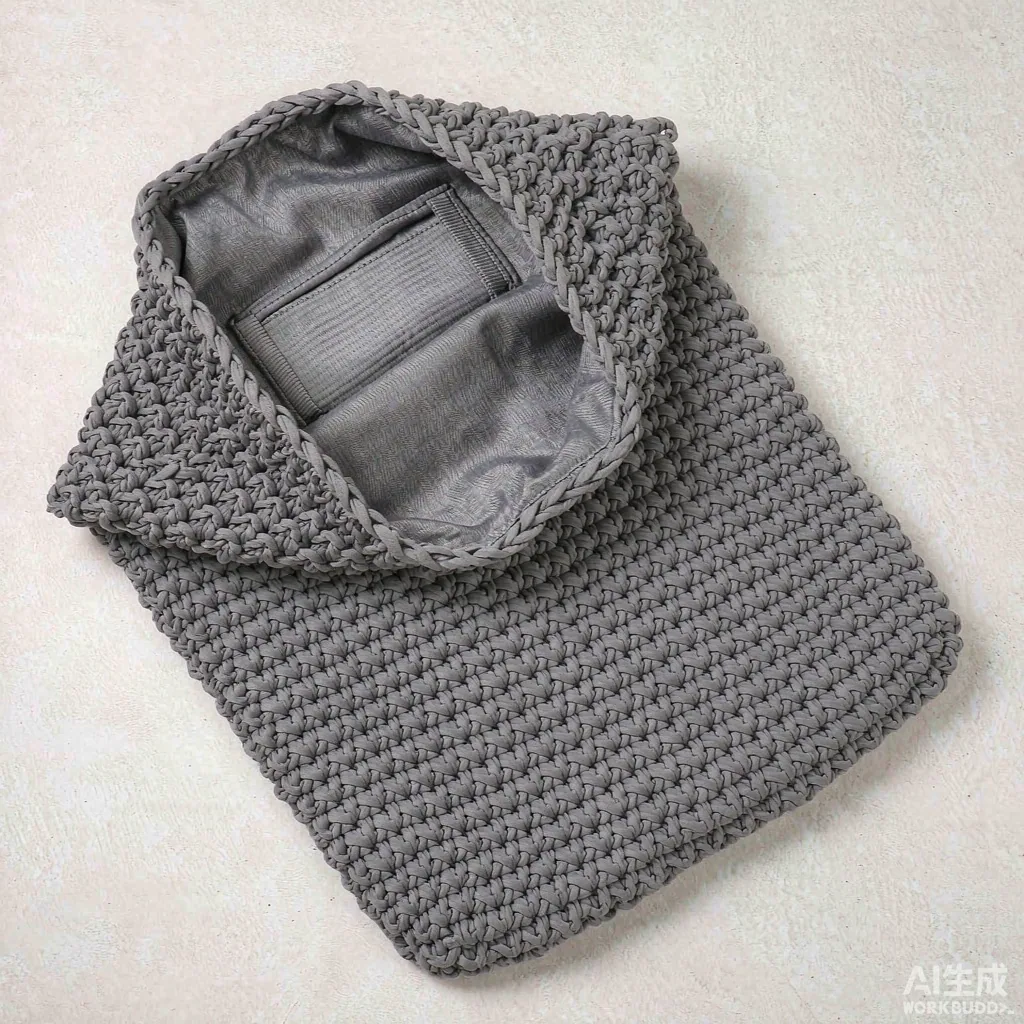
What Is the Sampling Workflow Actually For?
Sampling exists to convert a drawing into a production specification, not to produce a nice object — which is why the deliverable of a sampling workflow is a sample record with numbers on it rather than a bag.
The distinction sounds pedantic and it is the thing most programmes get wrong. A buyer who treats sampling as a beauty contest approves a piece that looks right and then discovers at the pre-shipment inspection that the bulk run does not measure the same. A buyer who treats sampling as specification work approves a piece and a record: gauge, yarn lot reference, finished GSM, setting parameters and a signed-off trim list. The second buyer's approval survives contact with production; the first buyer's does not.
There is a second purpose that is less often stated. Sampling is the only point in a knit programme at which a change is inexpensive. After yarn is booked, a change costs money and calendar time; before it, a change costs programming time only. A workflow that front-loads the decisions into the seven days is therefore doing commercial work, and the 30 days of bulk that follow are largely the execution of decisions taken in the first week.
Who Does What at Each Step of the Seven Days?
Six steps run across seven working days, and only three of them need the buyer: the fit assessment on day three, the trim approval on day six, and the record sign-off on day seven.
Naming the owner of each step is what makes a workflow predictable. Programming belongs to the engineering team, the first knit and setting to the floor, the fit assessment to the buyer, the structural correction to engineering again, trim placement to the finishing team with a buyer approval, and the record to the quality function with a buyer sign-off. A programme in which these owners are not named will still run, but it will run slower, because every handover becomes a negotiation about who was waiting for whom.
- Day one, programming: engineering. Input is the tech pack; output is the knitting file.
- Day two, first knit and setting: the floor. Output is three physical pieces.
- Day three, fit assessment: the buyer. Output is a yes, a no, or a named correction.
- Day four, structural correction: engineering, on the buyer's named correction.
- Days five and six, trim and lining: the finishing team, with a buyer approval at day six.
- Day seven, measurement and record: the quality function, with a buyer sign-off.
- Conditioning: 24 hours at 20 °C and 65% relative humidity, before any measurement is taken.
What Happens on Day One?
Day one is programming: the tech pack is turned into a knitting file, and the deliverable is not a bag but a programme that will produce one — which is why a pack without a gauge, a GSM and a stitch structure cannot start on day one.
Programming is sequential and skilled, and it is the single step most likely to need two passes rather than one. The first pass produces a body that is recognisably the intended shape and subtly wrong in one or two places: the base transition creases, the aperture sits 6 mm low, the shoulder curve does not fall where the drawing showed it. The second pass corrects those and is usually the last. A buyer who plans for one pass experiences the second as a delay; a buyer who plans for two experiences it as the process working. Nothing physical changes on day one, which is exactly why it is the least expensive place to discover that a shape does not work.
What Happens on Days Two and Three?
Day two runs the first knit at roughly a 9-minute cycle per piece and then heat-sets the bodies; day three is the fit assessment, and the two cannot be compressed into one because a knitted body must be conditioned for 24 hours before any measurement means anything.
The overnight hold is not a scheduling artefact; it is physics. A knitted body leaves the bed in a state that is not its final state, and it keeps relaxing. A piece measured on the day reads differently from the same piece measured after 24 hours at 20 °C and 65% relative humidity, which is the conditioning specified in ISO 139. A programme that skips the hold to save a day produces an approval that does not survive the bulk run, and the discrepancy is discovered at the pre-shipment inspection rather than at the sample table, which is the worst possible place to discover it.
- Knitting cycle
- About 9 minutes per piece on an E12 body
- Pieces produced
- Three, one of which is kept as the approved reference
- Conditioning
- 24 hours at 20 °C and 65% relative humidity
- Measurement points
- Twelve, plus finished GSM
- GSM tolerance
- Plus or minus 5% on the finished body
- Colour tolerance
- Delta E 1.0 against the physical standard
- Correction rounds
- Two, inside the seven-day window

What Happens at the Fit Assessment?
The fit assessment is the buyer's decision point, and the discipline that makes it useful is one distinction: is this a structural correction, where the programme missed the brief, or a specification correction, where the brief has changed?
A structural correction is a programme error: the body came out 6 mm narrow, the handle drop is wrong, the base transition creases, the reinforcement band sits too low. Those are corrected inside the quoted sampling window. A specification correction is a change of mind after seeing the piece: a different GSM, a different handle drop, a different yarn. Both are legitimate and only the first is within scope. Naming which one applies at the moment the request is made is the most useful habit a buying team can adopt, because it turns a negotiation into a classification and it keeps the calendar honest.
The assessment should close on a measurement sheet rather than on an opinion. Twelve points plus GSM, each with a tolerance, measured after conditioning, recorded against the tech pack. An opinion — it feels a bit small — cannot be corrected precisely and generates a second round; a measurement — 6 mm narrow at the base — can be corrected in one.
What Happens on Days Five and Six?
Days five and six place the trim and the lining, and they are the largest single block in the seven days because every trim is a discrete operation requiring a jig, a placement and a check.
The surprise for most buyers is that knitting is not the slow part. Three bodies take about half a day; placing a zip, a lining, hardware and a label takes two. Each of those four is a separate operation with its own setup, and each has to be checked before the next begins. A programme that samples a body without trim first can compress to about five days, and many buyers do exactly that on a first round: approve the body, then approve a trimmed sample. The cost is a second cycle; the benefit is that the structural decision is made on a body rather than on a body carrying hardware that distracts from it.
What Happens on Day Seven?
Day seven produces the sample record: twelve measured points, finished GSM, gauge, yarn lot reference, setting parameters and the signed-off trim list — and this document, not the bag, is what bulk production is built against.
The record is the deliverable and it deserves more attention than it usually gets. It is the reference against which the pre-shipment inspection is judged, the basis on which a re-order matches a first season, and the only defence a buyer has when a bulk run is disputed. A programme that ships the bag and files the record will have no difficulty; a programme that ships the bag and loses the record will be re-litigating the same questions a season later. Where a buyer wants an additional safeguard, a second record can be kept with the physical reference piece, tagged and stored under the same conditions.
| Day | Activity | Owner | Deliverable |
|---|---|---|---|
| Day 1 | Programming, usually two passes | Engineering | The knitting file |
| Day 2 | First knit at about 9 minutes per piece, then heat setting | The floor | Three physical pieces |
| Overnight | Conditioning at 20 °C and 65% relative humidity | Automatic | A body in its stable state |
| Day 3 | Fit assessment, twelve points plus GSM | The buyer | A yes, a no, or a named correction |
| Day 4 | Structural correction, round one of two | Engineering | A corrected body |
| Days 5 to 6 | Trim and lining placement | Finishing, with buyer approval | A finished sample |
| Day 7 | Measurement, photography and packing | Quality, with buyer sign-off | The sample record |
What Goes Into the Sample Record?
A sample record carries seven items — gauge, yarn lot reference, finished GSM, setting parameters, twelve measured dimensions, the signed-off trim list and the shade reference — and a record missing any one of them is a record that cannot settle a dispute.
The yarn lot reference is the one most often omitted and the one that matters most on a re-order. A different lot of the same nominal yarn differs in shade and in hand, and without the reference there is no way to ask for the same material twice. Setting parameters matter for the same reason: temperature and time determine how much the body relaxes, and a bulk run set differently from the approved sample will measure differently even from identical knitting. Both are inexpensive to record and impossible to reconstruct later.
What the buyer has to decide, and by when
- Day one: confirm gauge, yarn count and GSM, or the programme cannot start.
- Day three: approve or name a correction, and say which kind it is.
- Day six: approve the trim set, since a later change means a trim rebooking.
- Day seven: sign the sample record, which is what bulk will be built against.
- Throughout: answer within one day, since four gates each waiting three days costs nearly two weeks.
- At handover: confirm the yarn lot, because a different lot changes shade and hand.
How Many Pieces, and What Happens to Each?
Three pieces are produced, and the allocation matters: one is kept as the approved reference, one is tested and washed, and one is photographed or sent on — because a single sample cannot be approved, tested and shipped at the same time.
The three-piece convention exists for a practical reason. Approval requires a piece in hand; testing destroys or at least ages a piece; and photography or a sales sample requires a piece that has not been handled. One piece cannot do all three, and a programme that produces one piece will find the buyer approving it and then having nothing to test against. Where a physical reference bag was supplied rather than a tech pack, a fourth piece is knitted to match the reference, so the buyer can compare like for like.
What Turns an Approved Sample Into Bulk?
An approved sample becomes bulk on the handover of five written items — gauge, yarn lot reference, finished GSM, setting parameters and the signed-off trim list — and bulk then runs 30 days from that handover.
The 30 days break down predictably: yarn booking across the first 10 days, knitting across days 8 to 20, finishing and trim across days 18 to 26, and inspection, packing and the pre-shipment release across days 24 to 30. Release is against AQL 2.5 under an ISO 2859-1 sampling plan. MOQ is 100 pcs per style and per colourway, FOB Xiamen is the standard term with CIF and DDP available, and the reference unit cost for a standard E12 tote at 320 g/m² in 300D is USD 4.80. Behind the programme sit 7 production lines running about 200,000 pcs per month.
Reference workflow, 7 days
Two programming passes, two correction rounds, three pieces, full trim. The standard shape of a knit sampling cycle.
Body-only workflow, 5 days
No trim on the first round, so the structural decision is made on the body alone. Costs a second cycle for the trimmed piece.
Concurrent workflow, 5 days
Yarn and trim booked in parallel with programming. Fastest on paper, and slowest if the yarn changes at the fit assessment.
Reference-match workflow, 8 days
Starts from a physical bag rather than a pack: conditioned, measured at twelve points, digitised, then knitted. Produces four pieces.
Where the Workflow Breaks and How to Keep It Running
Three failure modes account for most sampling overruns, and all three are decision failures rather than production failures: an unanswered question at a decision point, a yarn change after the fit assessment, and an approval given before the body has been conditioned.
An unanswered question is the most common and the least visible, because it costs calendar time without appearing on any cost sheet. Four gates each waiting three days is nearly two weeks, and the time is usually attributed to production. A yarn change after the fit assessment is the most expensive, because the yarn has usually been committed by then and a change on a custom or dope-dyed shade can add 10 days or more. An approval given before conditioning is the most insidious, because it is not discovered until the bulk run is measured and the discrepancy is then treated as a production fault.
Run a sampling cycle on your brief
Send a tech pack with gauge, GSM, yarn count and trim list, or a physical reference if you have no pack. Our knit team will run the seven-day workflow, name the three decision points, and hand you a sample record you can build bulk against. Start on the contact page.
Frequently Asked Questions
What is the knitted bag sampling workflow?
Six steps across seven working days: programming, first knit and setting, conditioning, fit assessment, structural correction, then trim and the sample record. Three of the six need the buyer, at the fit assessment, the trim approval and the record sign-off.
What is the deliverable of a sampling workflow?
A sample record with numbers on it, not a bag. It carries gauge, yarn lot reference, finished GSM, setting parameters, twelve measured dimensions, the signed-off trim list and the shade reference.
Who owns each step of the seven days?
Engineering owns programming and correction, the floor owns knitting and setting, the buyer owns the fit assessment, finishing owns trim with a buyer approval, and the quality function owns the record with a buyer sign-off.
Why does day one produce no physical piece?
Because day one is programming, and writing the knitting file changes nothing physical. That is exactly why it is the least expensive place to discover that a shape does not work, since no yarn has yet been committed.
Why do most programmes need two programming passes?
Because the first pass produces a body that is recognisably the intended shape and subtly wrong in one or two places. Planning for two passes turns what feels like a delay into what is simply the process working.
Why cannot the first knit and the fit assessment happen on the same day?
Because a knitted body keeps relaxing after it leaves the bed. It has to be conditioned for 24 hours at 20 °C and 65% relative humidity before any measurement is meaningful, as specified in ISO 139.
What is the difference between a structural and a specification correction?
A structural correction is where the programme missed the brief and is corrected inside the quoted window. A specification correction is where the brief changed after the piece was seen, and it consumes a correction round and possibly a yarn booking.
Why does trim take two days of the seven?
Because each trim is a discrete operation needing a jig, a placement and a check. Three bodies take about half a day to knit; placing a zip, a lining, hardware and a label takes two days.
Can sampling be compressed by skipping trim?
Yes, to about five days. Many buyers approve the body first and the trimmed sample second. The cost is a second cycle; the benefit is that the structural decision is made on a body rather than on one carrying hardware.
How many sample pieces are produced?
Three: one kept as the approved reference, one tested and washed, one photographed or sent on. Where a physical reference bag was supplied rather than a tech pack, a fourth is knitted to match the reference.
What are the twelve measurement points?
The dimension set from the tech pack: body width and height, base width and depth, aperture width, handle drop, strap length and width, reinforcement band position, trim placement, and finished GSM. All measured after conditioning.
Why does the sample record need the yarn lot reference?
Because a different lot of the same nominal yarn differs in shade and in hand. Without the reference there is no way to ask for the same material twice, and a re-order will not match the first season.
What happens after the sample is approved?
Bulk runs 30 days from handover: yarn booking across the first 10 days, knitting days 8 to 20, finishing days 18 to 26, and inspection, packing and release days 24 to 30, against AQL 2.5 under ISO 2859-1.
What are the three main causes of a sampling overrun?
An unanswered question at a decision point, a yarn change after the fit assessment, and an approval given before the body has been conditioned. All three are decision failures rather than production failures.
People Also Ask
How long does knitted bag sampling take?
Seven working days for the reference workflow, five for a body-only or a concurrent route, and eight where the programme starts from a physical reference bag rather than a tech pack.
Why is my sample a different size from the bulk run?
Usually because it was approved before conditioning. A knitted body keeps relaxing after it leaves the bed, so a piece measured on the day reads differently from the same piece after 24 hours at 20 °C and 65% relative humidity.
How many samples should I ask for?
Three: one to keep as the approved reference, one to test and wash, one to photograph or send on. One piece cannot be approved, tested and shipped at the same time.
What should I check at the fit assessment?
Twelve measured points plus finished GSM, all after conditioning, recorded against the tech pack. A measurement such as 6 mm narrow at the base can be corrected in one round; an opinion cannot.
Can I change the yarn after the fit assessment?
You can, but it is the most expensive change available. Yarn is usually committed by day three, and a change on a custom or dope-dyed shade can add 10 days or more to the programme.
Sources and further reading
Every figure on this page is either our own programme data or attributed below. Open the originals before you write them into a specification.
- ISO 139:2005 — Textiles, standard atmospheres for conditioning and testingISO Defines the 20 °C and 65% relative humidity conditioning that occupies the overnight hold on day two.
- ISO 2859-1:2026 — Sampling procedures for inspection by attributes, Part 1: AQL-indexed sampling schemesISO Defines the AQL 2.5 release that closes bulk after the day seven handover.
- ISO 3801:1977 — Textiles, determination of mass per unit length and mass per unit areaISO The method behind the finished GSM recorded in the sample record.
- AATCC test methodsAATCC Source of AATCC 61, the wash fastness method applied to the second sample piece during testing.
- ISO 13934-1:2013 — Textiles, tensile properties of fabrics, Part 1: maximum force using the strip methodISO Referenced when the approval is tied to a strength figure as well as to a measurement sheet.
- WHOLEGARMENT knitting machinesShima Seiki The machine class behind the programming step that occupies day one of the workflow.
The Record Is the Point of the Week
Seven working days produce a bag and a document. The bag is what gets approved; the document is what gets built. A programme that treats the week as specification work rather than as a beauty contest will find that the 30 days of bulk that follow are uneventful, which is the highest praise a production run can earn.
For the revision decisions that sit inside the window, see knitted bag prototype revision cycles. For the shade decisions taken at day six, see custom knitted bag colour matching, and for the programme windows around sampling, see custom knit bags.