Knitted-In Logo vs Woven Label: A Selection Checklist for Knitted Bag Brand Programmes
Most knitted bag branding arguments are really two questions wearing one coat. Can the artwork hold a 3 mm stroke at gauge E12, and does the programme clear the label loom minimum. If the answer to the first is yes, the identity belongs in the stitch file; if the answer to the second is no, the legal line still has to go on a label. This article gives both decisions as checklists, with the numbers that settle each line and the cost shape at three volumes.
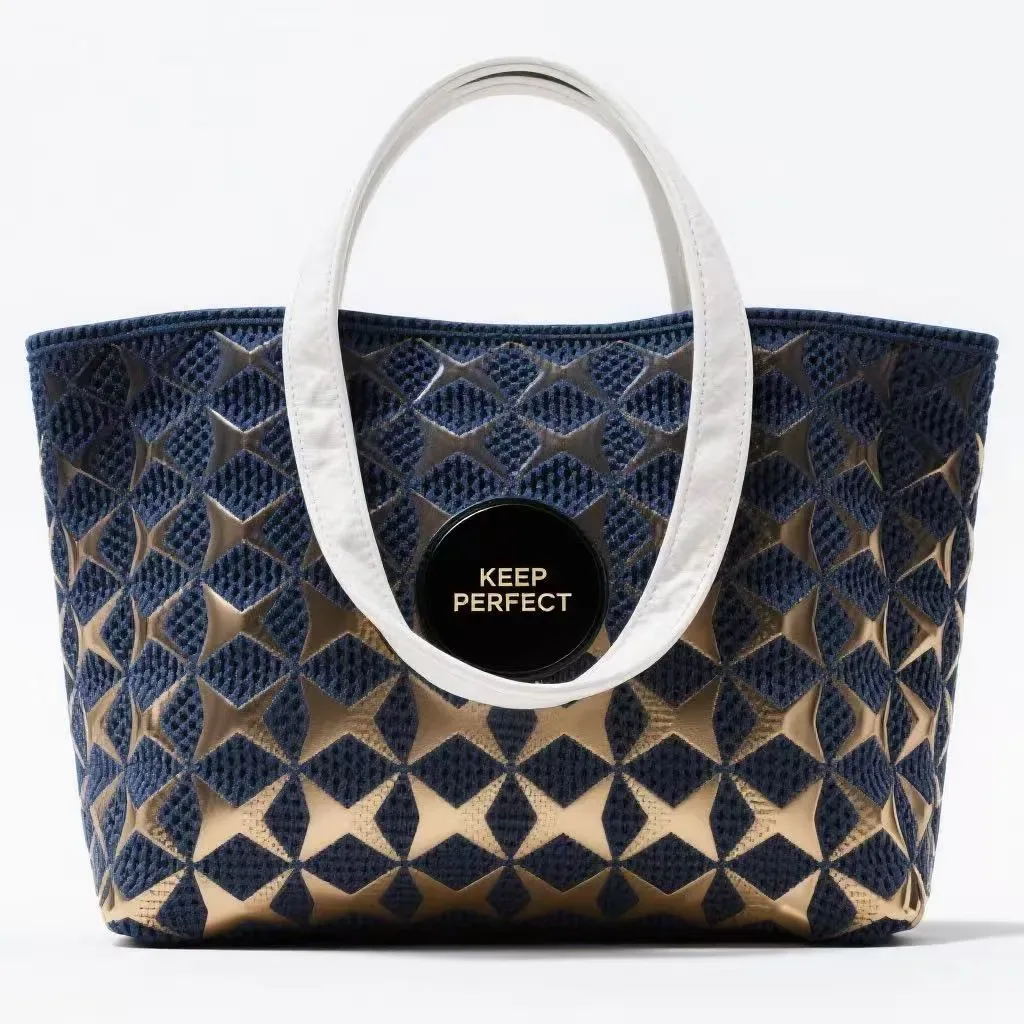
The Decision in One Paragraph
A knitted-in logo is the right choice when the artwork holds a 3 mm stroke and the run clears about 300 pieces; a woven label is the right choice whenever the programme carries legal, care or origin text, and the two are usually combined rather than chosen between.
Framing the question as either-or is what costs programmes time. The identity and the compliance text are different objects with different reproduction limits, and no single route serves both well. A knitted surface resolves shape and colour beautifully down to a floor set by the gauge, and it resolves text badly below roughly 8 pt. A woven damask label resolves text down to about 4 pt in a 25 mm width and resolves photographic colour badly. Each element should go to the route that reproduces it, and the checklists below are the way to make that assignment without a second sample round.
Checklist: Is Your Artwork Knittable at All
Six checks decide whether a knitted-in mark is feasible, and the first three are artwork checks rather than production checks — which is why they should be run before the technical pack is written.
The artwork checks are about geometry. Stroke width, enclosed counters, and the number of distinct colours are the three limits a loop structure imposes, and none of them can be negotiated by changing the yarn. The production checks come afterwards: panel location, whether the mark crosses a seam or a shaping line, and whether the body yarn is the same one the mark will be knitted in. A mark that crosses a shaping line will distort, because the loop count changes across that line, and that is a design constraint rather than a defect.
Artwork feasibility checks before a knitted-in mark is specified
- Minimum stroke width: about 3 mm at gauge E12, about 5 mm at E7, wider on coarser gauges.
- Enclosed counters: any fully enclosed negative space needs at least 4 mm across or it fills in.
- Colour count: two or three yarn colours resolve cleanly; four or more blur at E12.
- Panel location: the mark must sit on a flat field, clear of any shaping or seam line.
- Body yarn: the mark knits in the body yarn unless a second feeder is programmed, which adds cost.
- Brand approval: a knit-specific lockup needs sign-off, and that approval is often the critical path.
Checklist: Stroke Width, Area and Colour Count
A knitted-in mark needs about 40 cm² of legible area, a 3 mm stroke minimum at E12 and no more than three yarn colours; below any one of those three, the mark should move to an applied route.
The three limits interact, and that is what makes the check worth doing formally rather than by eye. A mark with a 3 mm stroke inside a 25 cm² area is at the edge of legibility, because the negative space between strokes scales with the strokes themselves and shrinks with the area. A three-colour mark inside the same area is past the edge, because each colour boundary costs roughly one stitch of definition, and at E12 one stitch is about 2.1 mm of yarn. Enlarging the mark is usually the only fix, and on a small bag there may not be room for it.
Contrast is the fourth limit and the one most often omitted from a brief. Two yarn colours can be nominally different and read as one on a knitted surface, because the loop structure mixes them optically at normal viewing distance. A practical rule is a lightness difference of at least 20 units between adjacent stitch colours, checked on a knitted swatch rather than on the two cones side by side. Where the brand palette does not allow that difference, the mark needs an outline stitch in a third colour to separate the two fields, which is a programming change rather than a yarn change and is inexpensive if it is decided before the file is written.
- Area: roughly 40 cm² minimum for a wordmark; below that, go applied.
- Stroke: about 3 mm at E12; hairlines around 1.4 mm close up during heat setting.
- Colours: two is clean, three is workable, four blurs on most panels.
- Contrast: adjacent stitch colours need a lightness difference of at least 20 units or the mark reads flat.
- Placement: keep the mark at least 15 mm from any seam, edge or handle junction.
Checklist: What the Legal and Care Lines Require
Fibre content, country of origin, care instructions and any tracking identifier belong on a woven label, because a knitted surface cannot resolve type below roughly 8 pt while a 25 mm woven damask label resolves about 4 pt.
The requirement is regulatory rather than aesthetic, and it varies by destination market, so the label content should be confirmed by the importer before the loom is booked. Getting it wrong is expensive in a specific way: a label is a finished component with its own minimum order, so a content error discovered after weaving usually means reweaving the whole lot rather than reprinting a line. The practical sequence is to fix the legal content first, book the label second, and treat the label booking as a long-lead item alongside the yarn rather than as trim that can be ordered late.

Checklist: Volume, MOQ and the Label Loom Minimum
A woven label carries its own minimum, typically around 1,000 pieces from the label loom, which sits above the 100 pcs knit MOQ and is the single most common surprise on a small branded programme.
This mismatch catches programmes that have planned correctly against the knit minimum and not against the trim minimum. MOQ on the bag is 100 pcs per style and per colourway; the label is woven by a separate specialist whose economics are set by loom set-up, not by bag volume. Below the label minimum the surplus is held, exactly as surplus dye lot is held, and the holding cost lands on a run that is too small to amortise it. The two ways through are to accept a stock label with generic content where the regulation permits it, or to size the first run so that the label minimum and the bag minimum are cleared together.
- Knit MOQ
- 100 pcs per style and per colourway
- Label loom minimum
- Typically about 1,000 pcs for a custom woven design
- Label booking lead time
- About 7 to 10 working days once the artwork is approved
- Standard label size
- 25 mm wide, with 20 mm used on smaller panels
- Label construction
- Polyester damask at roughly 48 picks per centimetre, ultrasonic cut or folded ends
- Stitch specification
- Polyester sewing thread around 30 tex, 8 to 10 stitches per inch
Checklist: Cost Shape at 100, 1,000 and 5,000 Pieces
A knitted-in mark is a fixed cost that amortises, so its per-piece contribution falls from about 14% at 100 pieces to near zero at 5,000, while a woven label is a near-constant per-piece cost of about 2% at every volume.
The crossing point is the whole decision for a cost-led programme. On a run of 100 pieces the programming charge spread across a small quantity is significant and the label is the better value for everything it can carry. On a run of 5,000 the programming is invisible and the label is the only variable cost left. Programmes that expect to reorder should read the 5,000 column even when ordering 100, because the programming charge is paid once and the repeat run inherits it at no additional cost — which is one of the few places where a knit programme genuinely rewards planning ahead.
| Element | 100 pcs | 1,000 pcs | 5,000 pcs |
|---|---|---|---|
| Knitted-in jacquard programming | About 14% of the unit, one-off | About 1.4% of the unit | Below 0.3% of the unit |
| Knitted-in mark, per piece | No per-piece add-on | No per-piece add-on | No per-piece add-on |
| Woven label, 25 mm | About 2%, plus loom surplus | About 2% | About 2% |
| Label sewing operation | Included in the trim allowance | Included in the trim allowance | Included in the trim allowance |
| Combined identity plus compliance | Label first, jacquard on reorder | Both routes together | Both routes together |
Checklist: Durability and Wash Evidence
A knitted-in mark has no failure mode beyond the body itself, while a woven label fails at its stitch line — so the label should be released on a seam-strength check and the mark on the same abrasion threshold as the panel.
The two routes should not be tested with the same method, and doing so is a common specification error. A knitted-in mark is the fabric; it can only fail if the fabric fails, so the relevant evidence is the abrasion result for the panel, around 20,000 Martindale rubs to ISO 12947-2. A woven label is an attached component, so its relevant evidence is the seam holding it, and a stitch count of 8 to 10 per inch in a 30 tex polyester thread is what determines whether it survives the life of the bag. Where the label sits in a side seam, the seam allowance protects it and the risk is low; where it is surface-applied to a front panel, edge lift becomes the failure mode and the wash check applies.
Knitted-in jacquard
No applied layer, no adhesive, no second material. Tested with the panel at 20,000 rubs to ISO 12947-2.
Woven label in a side seam
Protected by the seam allowance. Released on stitch density of 8 to 10 per inch in 30 tex thread.
Woven label on a front panel
Exposed to abrasion and to edge lift. Requires five AATCC 61 2A cycles before release.
Printed satin label
Lower cost and finer type, but print rubs off faster than a woven structure on a carried bag.
Checklist: Lead Time and the Booking Sequence
Sampling runs 7 working days and bulk 30 days, but a custom woven label adds about 7 to 10 working days of its own and must be booked at the same time as the yarn, not after the sample is approved.
Booking the label late is the most avoidable delay on a branded knit programme, and it is caused by a reasonable-sounding assumption: that a label is trim and trim is ordered last. On a cut-and-sew programme that is often true; on a knit programme the label is a woven component with a loom queue, and the queue does not compress because the bag sample is ready. The sequence that works is artwork approval, then yarn and label booked in parallel, then sampling, then bulk at 30 days, then inspection and release against AQL 2.5 under an ISO 2859-1 plan, then FOB Xiamen shipment.
One further item belongs in the sequence and is almost always left out: the approval of the label artwork itself. A woven label is a drawing, not a print file, and the loom needs a weave chart rather than a vector file. Converting artwork to a weave chart takes a day, and the brand team then has to approve a rendering of it. That approval sits alongside the knit lockup approval, and both should be requested at the same time, because they are the two items that hold up a branded programme while the knitting itself waits.
Choose the right route for your branding
Send the artwork, the destination market for the compliance text, and the volume per colourway. Our knit team will return a route checklist, the stroke and area limits at your gauge, a label booking plan against the loom minimum, and a quotation on MOQ 100 pcs, 7 working days of sampling and 30 days of bulk. Start on the contact page.
Frequently Asked Questions
Should I choose a knitted-in logo or a woven label for a knitted bag?
Usually both. Knit the identity in if the artwork holds a 3 mm stroke at gauge E12 and the run clears about 300 pieces, and put fibre content, origin and care on a 25 mm woven label. The two routes solve different problems.
What is the minimum stroke width for a knitted-in logo?
About 3 mm at gauge E12 and about 5 mm at gauge E7. Hairlines around 1.4 mm knit on the bed and close up during heat setting, which is why print artwork usually needs a knit-specific lockup.
How small can text be on a woven label?
About 4 pt on a 25 mm polyester damask label at roughly 48 picks per centimetre. The same text on a knitted surface needs about 8 pt, because a stitch cannot resolve a finer letterform.
Why does a woven label have its own minimum order?
Because it is woven by a specialist whose economics are set by loom set-up rather than by bag volume. The minimum is typically around 1,000 pieces, above the 100 pcs knit MOQ, and surplus is held against the reorder.
How much does a knitted-in mark cost at low volume?
The programming charge spreads across the quantity, so it is about 14% of the unit at 100 pieces, about 1.4% at 1,000 and below 0.3% at 5,000. There is no per-piece add-on at any volume.
Does a woven label cost the same at every volume?
Roughly yes, about 2% of the unit, because it is a purchased component rather than a fixed charge. At 5,000 pieces it becomes the larger of the two branding costs for that reason.
How long does a woven label take to book?
About 7 to 10 working days after the artwork is approved, and it should be booked in parallel with the yarn rather than after sample approval. The loom queue does not compress because the sample is ready.
Can a knitted-in mark carry the care instructions?
It should not. Care symbols and fibre content need a resolution a knitted surface does not have, and an error discovered after weaving means reweaving the whole label lot rather than reprinting a line.
How many colours can a knitted-in logo use?
Two resolve cleanly, three are workable, and four or more begin to blur at gauge E12. Each colour boundary costs about one stitch of definition, and one stitch at E12 is roughly 2.1 mm of yarn.
What stitch density should attach a woven label?
About 8 to 10 stitches per inch in a polyester thread around 30 tex. The stitch line is the failure point for an attached label, not the label itself, so density is the specification that matters.
Where should a woven label be placed on a knitted bag?
In a side seam where possible, because the seam allowance protects it. A front-panel label is exposed to abrasion and needs five AATCC 61 2A wash cycles before release.
How is a knitted-in mark tested for durability?
Together with the panel, at around 20,000 Martindale rubs to ISO 12947-2. It has no applied layer and no adhesive, so it cannot fail independently of the fabric it is knitted into.
What happens to surplus labels from the loom minimum?
They are held against the reorder, in the same way surplus dye lot is held. The holding cost is what makes a custom label poor value on a very small run, and a stock label is often the better answer there.
Is a printed satin label a valid alternative?
Yes for short-life items. It costs less and resolves finer type, but print rubs off faster than a woven structure on a bag that is carried rather than displayed.
People Also Ask
Is a knitted-in logo better than a woven label?
For the identity, yes above about 300 pieces, because there is no applied layer to fail and no per-piece cost. For compliance text, no: a 25 mm woven label resolves about 4 pt where a knit needs 8 pt.
Can both routes be used on the same knitted bag?
Yes, and that is the normal specification. The identity is knitted in at a 3 mm stroke and the fibre content, origin and care lines go on a woven label in the side seam.
What is the minimum order for a custom woven label?
Typically around 1,000 pieces from the label loom, well above the 100 pcs knit MOQ. Below that, a stock label with permitted generic content is usually better value.
How much space does a knitted-in logo need?
About 40 cm² of legible area, with strokes of at least 3 mm at gauge E12 and a gap of about 15 mm from any seam, edge or handle junction.
When should the woven label be ordered?
In parallel with the yarn, before sampling finishes. A custom label needs about 7 to 10 working days of loom time, and the queue does not compress because the bag sample is ready.
Sources and further reading
Every figure on this page is either our own programme data or attributed below. Open the originals before you write them into a specification.
- ISO 2859-1 — Sampling procedures for inspection by attributes, Part 1: AQL-indexed sampling schemesISO Defines the AQL 2.5 release under which logo legibility and placement defects are inspected.
- ISO 12947-2 — Textiles, determination of abrasion resistance, Part 2: specimen breakdownISO The 20,000-rub threshold applied to a panel carrying a knitted-in mark.
- AATCC colour fastness test methodsAATCC Source of AATCC 61 2A, the five-cycle wash check used for surface-applied labels.
- OEKO-TEX STANDARD 100OEKO-TEX Finished-textile testing that applies to a woven label as a component of the bag.
- Consumer Product Safety Improvement ActU.S. Consumer Product Safety Commission Tracking-label requirements behind the compliance text carried on a woven label.
- ISO 13934-1 — Textiles, tensile properties of fabrics, Part 1: maximum force using the strip methodISO Referenced for the seam and panel strength figures used when a label is attached in a seam.
Assign Each Element to Its Own Route
The programmes that ship on schedule are the ones that stopped asking which route is better and started asking which element belongs where. Identity in the stitch file, compliance on the label, and both booked in parallel with the yarn. That assignment turns a design argument into two measurements — stroke width and loom minimum — and both are settled before sampling starts.
For the full set of routes and their cost add-ons, see knitted bag logo application methods. For the hardware and trim that sit beside a label, see custom knitted bag hardware options, and for the volume structure behind the quotation, see custom knit bags.