Knitted Travel Bag Carry-On Compliance: Size, Weight and Structure for Cabin Use
A knitted travel bag passes cabin rules by being compressible rather than by being small. The common airline limit is 55 by 40 by 20 cm with a linear total near 115 cm and a 7 kg weight allowance, and a knit body gains about 30 mm of tolerance in a bag sizer that a rigid shell does not. Minimum 100 pcs per style and colourway, sampling 7 working days, bulk 30 days, FOB Xiamen.
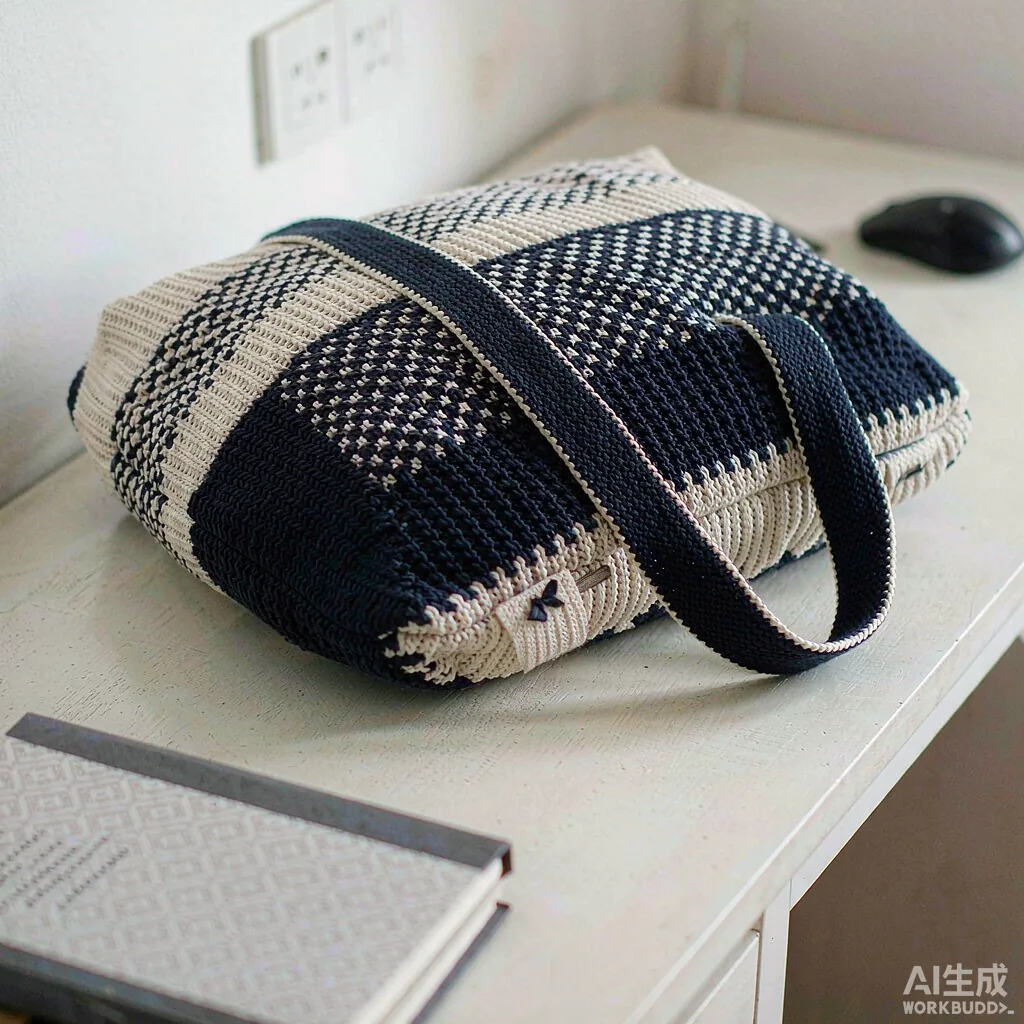
Does a Knitted Travel Bag Count as Carry-On?
Yes, provided it meets the airline's size and weight limits at the gate, and a knitted travel bag has one structural advantage over a rigid one: it compresses. Where a moulded shell either fits a sizer or does not, a knit body gives about 30 mm of tolerance when it is underfilled, which is the margin that decides a boarding dispute.
The caveat is that compression is only available when the bag has no internal frame. A travel bag with a moulded base board or a hard shell panel behaves like a rigid bag in a sizer and loses the advantage entirely, which is a specification decision rather than a material one.
What Size Is Actually Allowed in the Cabin?
The figure most carriers in Europe work to is 55 by 40 by 20 cm, a linear total of 115 cm. IATA publishes a recommended cabin baggage size of 56 by 45 by 25 cm and individual airlines set their own limits within that, so a travel programme should design to the strictest carrier it expects its customers to fly rather than to an average.
| Bag type | Dimensions | Linear total | Capacity | Fits cabin | Compression gain |
|---|---|---|---|---|---|
| Personal item | 40 x 30 x 15 cm | 85 cm | 18 L | Always | 20 mm |
| Cabin duffel | 50 x 30 x 25 cm | 105 cm | 32 L | Most carriers | 28 mm |
| Carry-on travel bag | 55 x 40 x 20 cm | 115 cm | 40 L | Most carriers | 30 mm |
| Large carry-on | 56 x 45 x 25 cm | 126 cm | 52 L | Some carriers | 32 mm |
| Checked travel bag | 70 x 45 x 30 cm | 145 cm | 78 L | Hold only | 35 mm |
The linear total is the figure gate staff actually use, and it is the sum of the three dimensions rather than the capacity. A 40 litre bag at 55 by 40 by 20 cm totals 115 cm and passes; the same 40 litres arranged as 60 by 35 by 20 cm totals 115 cm as well and also passes, but as 45 by 45 by 22 cm it totals 112 cm and reads as a box.
How Much Does Weight Matter Versus Size?
Weight is enforced less often than size but it is enforced, and the common cabin allowance is 7 kg with some carriers allowing 10 kg. A 40 litre knitted travel bag weighs about 780 g empty against roughly 2.6 kg for a wheeled hard-shell case of the same capacity, which leaves about 1.8 kg more of the allowance for what the traveller packs.
That difference is the strongest commercial argument for a knit travel bag and it should appear on the hangtag. Stating an empty weight of 780 g is more persuasive to a traveller than any capacity claim, because the weight limit is the constraint that actually bites at a check-in desk.
Empty weight is also the figure programmes can move most easily. Going from 600D to 900D yarn, or adding a fixed board and a padded strap set, takes a 40 litre bag from 780 g to about 1.35 kg and gives back roughly 570 g of the allowance. Every structural addition to a travel bag should be weighed against what it costs the traveller in packing room.
Why Does Knit Have an Advantage in a Bag Sizer?
Because a sizer is a rigid box and a knit bag is not. A bag knitted at E7 in 600D polyester with no frame will compress by roughly 30 mm in each of its smaller dimensions when pushed into a sizer, so a bag that measures 58 cm flat will enter a 55 cm frame. A moulded shell of the same nominal size will not.
- Cabin size to design to
- 55 x 40 x 20 cm, linear total 115 cm
- IATA reference size
- 56 x 45 x 25 cm, the recommended maximum
- Personal item size
- 40 x 30 x 15 cm, 18 litres
- Cabin capacity
- 40 litres at carry-on size, 52 litres at the IATA maximum
- Empty weight
- About 780 g for a 40 L knitted travel bag
- Cabin weight allowance
- 7 kg common, 10 kg on some carriers
- Compression gain
- About 30 mm in a sizer on a frameless knit body
- Liquids rule
- One transparent bag of 1,000 ml holding containers of 100 ml
- Yarn
- 600D recycled polyester at 420 g/m², GRS-documented
- Base
- Frameless for cabin use; a board only on hold bags
- Minimum order
- 100 pcs per style and colourway
- Shipment
- FOB Xiamen, CIF and DDP available
The compression is reversible and it does not damage the bag, which is worth stating because buyers ask. A knit structure returns to its dimensions after being compressed, provided it is not compressed repeatedly at the same fold line, which is why a travel bag should be specified without a permanent folded crease.
What Happens When a Bag Is Overpacked?
It stops compressing and the advantage disappears. A 40 litre bag packed to 46 litres becomes effectively rigid, because the contents rather than the fabric determine the shape, and it will not enter a sizer that a half-full version of the same bag enters easily. That is the honest limitation and it belongs in the product copy.
The design response is to keep the stated capacity conservative. Naming a bag 40 litres when it holds 46 at a push is more useful than naming it 46, because the number on the tag sets what the traveller puts in it and therefore whether the bag still compresses at the gate.
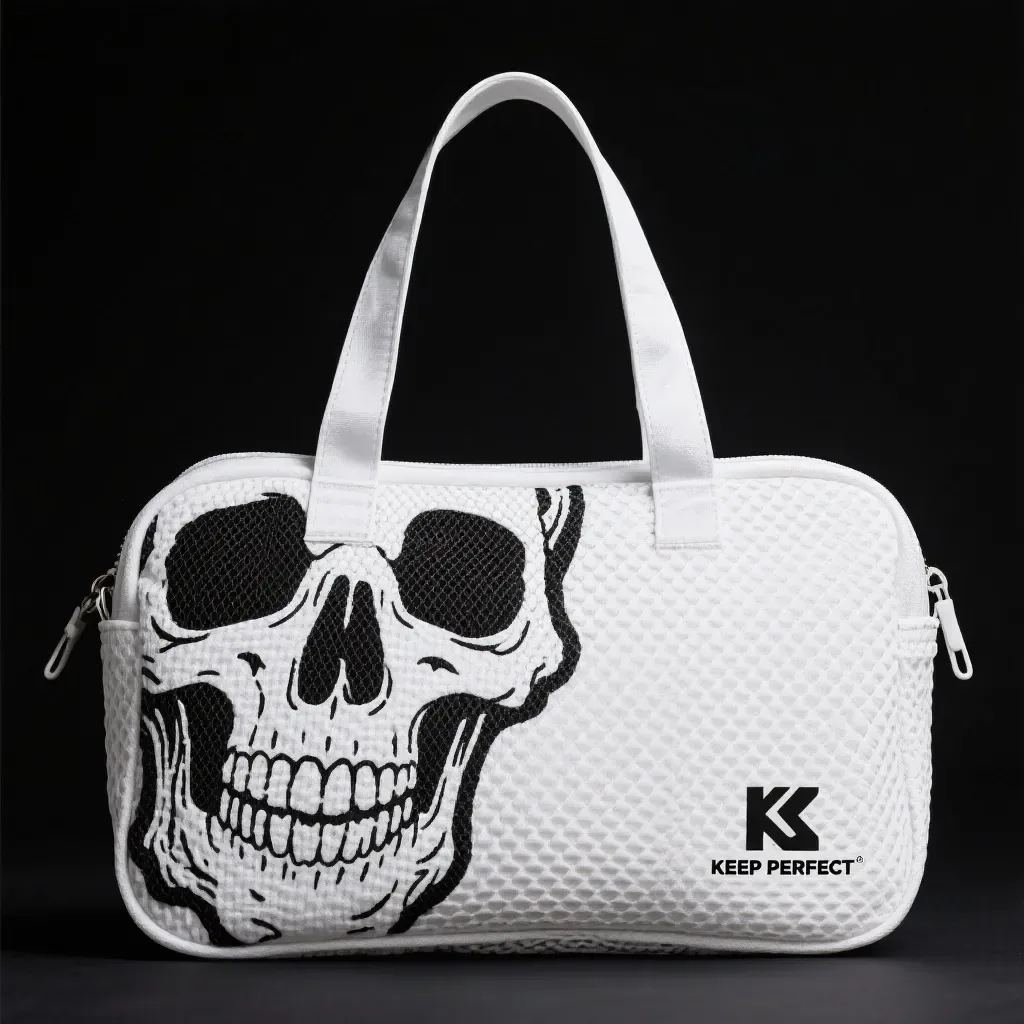
How Should a Carry-On Knitted Travel Bag Be Structured?
Frameless, with a gusseted base and no board, a wide mouth that opens flat, and one external pocket for documents. That configuration keeps the compression advantage, keeps the empty weight near 780 g, and gives the traveller the access a security checkpoint requires without unpacking the whole bag.
Where a programme wants the bag to hold its shape on a hotel floor, the compromise is a removable board rather than a fixed one. A removable board gives structure when wanted and restores full compressibility at the gate, at the cost of about 1.4 minutes and a component the traveller can lose.
Which Closure and Opening Does Security Require?
No closure is mandated, but a bag that opens flat and wide is materially faster to clear. A mouth that opens to 90 percent of the bag width lets a laptop and a liquids bag be lifted out separately, which is what checkpoint trays require, while a narrow gathered mouth forces the traveller to unpack from the top.
A zip panel is the practical choice for a travel bag for that reason, despite its 6.2 minutes of fitting time. It keeps the mouth wide, it gives the security of a closed bag in a crowded terminal, and it loses only about 30 mm of circumference against an open mouth.
What About Liquids, Devices and Personal Items?
The liquids rule is one transparent bag of 1,000 ml holding containers of up to 100 ml each, and it is worth designing a pocket sized to it: about 200 by 200 mm, placed where it can be reached without opening the main compartment. Devices larger than a phone are usually screened separately, so a laptop sleeve with a suspended base also serves the checkpoint.
Personal item, 18 L
40 x 30 x 15 cm, always accepted, and the size to specify for an under-seat bag on a short-haul programme.
Cabin duffel, 32 L
50 x 30 x 25 cm, 105 cm linear. Clears most carriers with margin and suits a weekend programme.
Carry-on, 40 L
55 x 40 x 20 cm, 115 cm linear, about 780 g empty. The reference size for a knit travel programme.
Hold bag, 78 L
70 x 45 x 30 cm, 145 cm linear. The only size where a fixed base board is worth specifying.
Personal item allowances vary more than cabin allowances and they are where a programme can add value at low cost. A foldable knitted bag that packs flat inside a suitcase and becomes the personal item on the return leg is a genuinely useful product, and it is covered in the foldable knitted shopping bag guide.
How Is a Travel Bag Tested for the Trip?
On the three things a trip does to a bag: load, abrasion and handling. Straps and the base are cycled and drop-tested as set out in the knitted bag base construction guide, abrasion runs to ISO 12947-2 on the base and corners, and tensile work on the straps and seams runs to ISO 13934-1 and ASTM D5034.
The travel-specific addition is a compression cycle. A bag that will be pushed into a sizer and into an overhead bin is compressed 200 times at rated load and then measured for dimensional recovery, with acceptance at under 3 percent permanent set. That test exists for knit travel bags specifically and catches a body that stays squashed.
How Does a Knit Travel Bag Behave in an Overhead Bin?
Better than a rigid case and worse than a soft duffel, and the difference is worth designing for. A frameless knit bag conforms to the bin rather than competing with it, so it takes the space its contents need and no more, while a shell case takes its own volume whether it is full or not.
The design consequence is that a travel bag should not be specified with stiffened side panels. Panels that hold the bag square help it stand on a hotel floor and stop it conforming in a bin, which is the trade-off to state explicitly at specification. Frameless for the bin, removable board for the floor.
Handle placement matters more in a bin than anywhere else, because the bag is lifted out overhead with one hand. A grab handle at the end of the bag, sized at about 120 mm and rated to the full 12 kg, is the fitting that makes a frameless travel bag usable in practice rather than only compliant on paper.
How to Specify a Carry-On Knitted Travel Bag
State the three dimensions and the linear total, the stated capacity, the empty weight, whether the bag is frameless, and the compression cycle requirement. Five fields, and the linear total is the one buyers forget because it is not a dimension of the product but a sum of three.
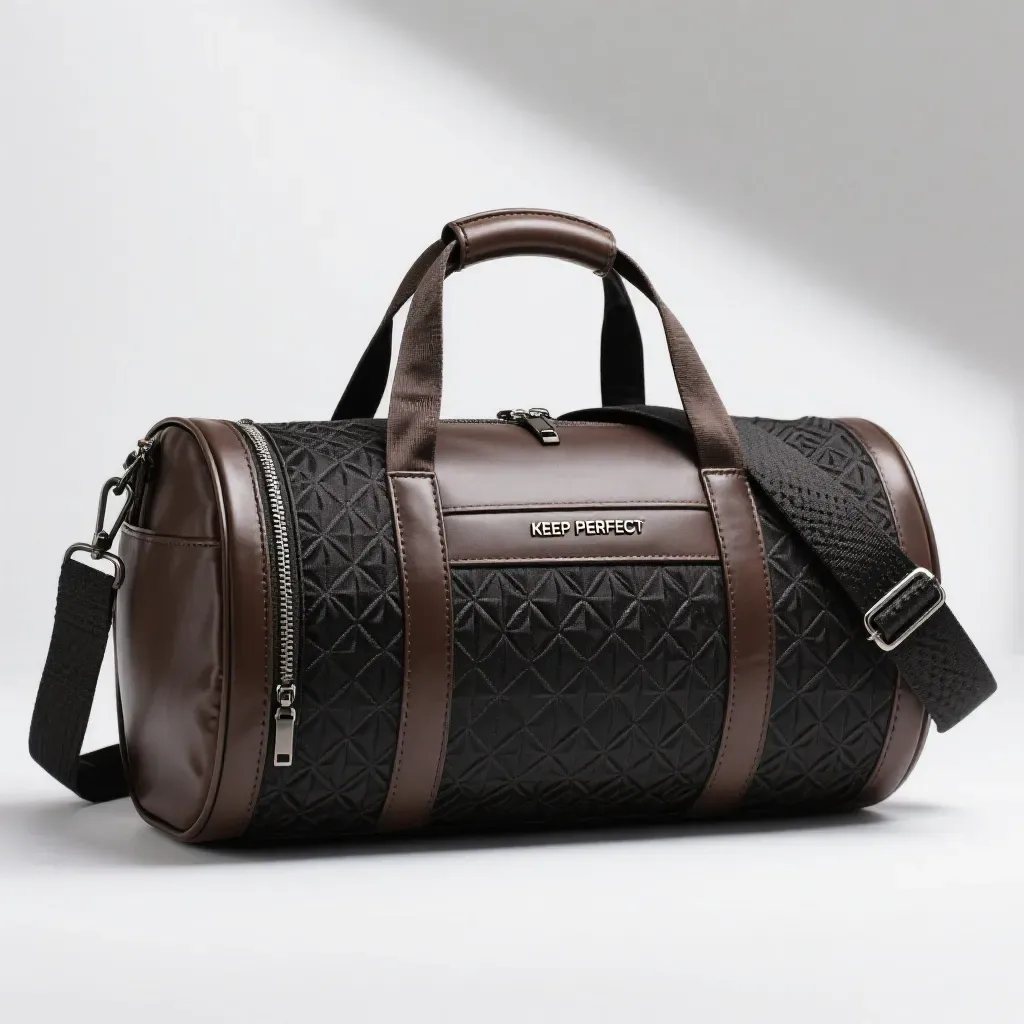
Then state the carrier the bag is designed to, because that sets the size. Designing to 55 by 40 by 20 cm covers most European carriers, and a programme selling into markets with a 56 by 45 by 25 cm allowance can use the extra volume at no compliance cost. Shipment runs FOB Xiamen under the Incoterms rules published by the ICC, with CIF and DDP available. Full travel groupings sit on the knitted bag collection pillar.
Specify a travel bag that clears the sizer
Send the target dimensions, the carrier and the empty weight goal. The team returns a frameless spec, a compression test plan and an FOB Xiamen quote on 100 pcs. Start a travel bag review.
Frequently Asked Questions
Does a knitted travel bag qualify as carry-on baggage?
Yes, provided it meets the carrier's size and weight limits at the gate. A knit body has an advantage because it compresses, gaining about 30 mm in a sizer, but only if it is specified frameless without a fixed base board. A knit body gains about 30 mm in a sizer, but only when specified frameless.
What size should a knitted carry-on bag be?
Fifty-five by 40 by 20 cm, a linear total of 115 cm, which covers most European carriers. IATA publishes a recommended maximum of 56 by 45 by 25 cm, so design to the strictest carrier your customers are likely to fly. Design to the strictest carrier your customers are likely to fly.
What is a linear total and why does it matter?
It is the sum of the three dimensions and it is the figure gate staff actually use. Two bags of the same capacity can have different linear totals, so arranging capacity as flatter and wider can bring a bag inside the limit. Two bags of the same capacity can have different linear totals on the frame.
How much does an empty knitted travel bag weigh?
About 780 g for a 40 litre bag, against roughly 2.6 kg for a wheeled hard-shell case of the same capacity. That leaves about 1.8 kg more of a 7 kg allowance for what the traveller packs. That leaves about 1.8 kg more of the allowance for what the traveller packs.
What is the cabin weight allowance?
Seven kilograms on most European carriers, with some allowing 10 kg. Weight is enforced less often than size but it is enforced, and the empty weight figure is the strongest argument for a knit travel bag. Weight is enforced less often than size but it is enforced at the desk.
How much does a knit bag compress in a sizer?
About 30 mm in each of its smaller dimensions, provided it has no internal frame. A bag knitted at E7 in 600D polyester that measures 58 cm flat will enter a 55 cm frame; a moulded shell of the same size will not. A moulded shell of the same nominal size will not compress at all.
Does compressing a knit bag damage it?
No, provided it is not compressed repeatedly along the same fold line. A knit structure returns to its dimensions after compression, which is why a travel bag should be specified without a permanent folded crease. A travel bag should be specified without a permanent folded crease for that reason.
What happens when a travel bag is overpacked?
It stops compressing and the advantage disappears, because the contents rather than the fabric determine the shape. That is why stating capacity conservatively works better than naming the maximum a bag will hold. Stating capacity conservatively works better than naming the maximum a bag holds.
Should a travel bag have a base board?
For cabin use, no, because a board removes the compression advantage. Where structure on a hotel floor matters, specify a removable board, at about 1.4 minutes and with the risk that a traveller loses the component. A removable board costs about 1.4 minutes and can be lost by the traveller.
Which closure is best on a carry-on knitted bag?
A zip panel. It keeps the mouth wide for checkpoint access, secures the bag in a crowded terminal and loses only about 30 mm of circumference against an open mouth. That is worth the 6.2 minutes of fitting time. It loses only about 30 mm of circumference, which is worth the 6.2 minutes.
What size should a liquids pocket be?
About 200 by 200 mm, sized to a one litre transparent bag, and placed where it can be reached without opening the main compartment. That is what makes a checkpoint straightforward rather than a full unpack. That is what makes a checkpoint straightforward rather than a full unpack.
How is a travel bag tested differently from a day bag?
It gets a compression cycle in addition to the standard tests: 200 compressions at rated load with acceptance at under 3 percent permanent set. That test exists for knit travel bags and catches a body that stays squashed. Acceptance is under 3 percent permanent set after 200 compressions at rated load.
Does a travel bag change the minimum order quantity?
No. The minimum stays at 100 pcs per style and colourway. A travel bag is the largest body in a knit range, so it uses more line time per piece and is worth booking early in a season. A travel bag uses the most line time per piece and is worth booking early.
Can a knitted bag be used as a personal item?
Yes, at 40 x 30 x 15 cm and about 18 litres it is always accepted as a personal item. Personal item allowances vary more than cabin allowances, which makes them useful territory for a programme. Personal item allowances vary more than cabin allowances, which makes them useful territory.
How long does a travel bag take to sample?
Seven working days from an approved tech pack, with bulk at 30 days. Three bodies are built: one compression cycled, one load and abrasion tested, one sealed as the inspection reference. Three bodies are built: one compression cycled, one load tested, one sealed as reference.
People Also Ask
Why not just make the bag smaller than the limit?
Because capacity is the product. Designing to 55 x 40 x 20 cm rather than to 50 cm keeps 40 litres inside a compliant linear total, which is the whole point of designing to the linear sum rather than to a single dimension.
Is a wheeled travel bag better for cabin use?
Not on weight. A wheeled hard-shell case of the same capacity weighs roughly 2.6 kg against 780 g for a knit bag, and wheels and handles count toward the linear total on most carriers.
Should capacity be stated as the maximum the bag holds?
No. Naming a 40 litre bag 46 litres encourages overpacking, and an overpacked knit bag stops compressing and fails the sizer it would otherwise pass. A fixed internal frame removes the tolerance that makes knit worth specifying.
What is the most common carry-on compliance failure?
A fixed internal frame. A board or shell panel turns a compressible knit body into a rigid one and removes the 30 mm of tolerance that is the main reason to specify knit for travel.
Does a laptop sleeve help at a checkpoint?
Yes. Devices larger than a phone are generally screened separately, so a suspended sleeve that lets a laptop be lifted out in one movement is faster than unpacking the main compartment.
Sources and further reading
Every figure on this page is either our own programme data or attributed below. Open the originals before you write them into a specification.
- ISO 12947-2 Martindale abrasion resistanceISO Applied to the base and corners of a travel bag, which take the heaviest abrasion of any bag type.
- ISO 13934-1 Tensile properties of fabricsISO Tensile reference for travel bag straps and seams under a full cabin load.
- ASTM D5034 Breaking Strength and Elongation of Textile Fabrics (Grab Test)ASTM International Used with ISO 13934-1 on strap roots and the gusseted base of a travel body.
- ICC Incoterms rulesInternational Chamber of Commerce The rule set under which FOB Xiamen, CIF and DDP shipments are contracted.