Knitted Bags for Subscription Boxes: Flat-Pack Knits That Ship Every Month Without Re-Negotiating Anything
Subscription operators ask whether a reusable knit pouch can survive twelve monthly fulfilment cycles, keep its colour identical between January and December, and still fit an automated packing line. The answer depends on three numbers rather than on the sample's first impression: a flat-pack profile near 8 mm, a monthly colour consistency target of Delta E 1.5 or better, and MOQ set at 100 pcs per style/colourway so twelve drops can be scheduled in one plan. Get those three right and the pouch stops being a cost line and starts working as retention.
Consider a beauty subscription shipping roughly 40,000 boxes a month. For two years it used a printed cotton pouch, and every problem traced back to construction rather than print quality: the pouches arrived creased, the seams opened under the weight of glass bottles, and colour drifted slightly between quarterly runs so subscribers noticed the difference in unboxing videos. The operator did not need a prettier pouch. It needed one that packed flat, survived the courier network intact, and looked identical in month one and month twelve. That is a knitting problem, which is why the fix came from construction rather than from artwork.
A Subscription Operator's Monthly Problem, in Numbers
Monthly fulfilment fails on three measurable things: dimensional drift, colour drift, and failure under load. Dimensional drift matters most, because a pouch that grows even 4 mm can jam an automated packing line or refuse to sit inside a fixed-size outer carton. Colour drift is the subscriber-visible failure, since the same brand colour appears twelve times a year on camera. Failure under load is what generates replacements and negative reviews, and it is the one most often blamed on the courier rather than on the pouch specification.
Put numbers on all three before costing anything. A width tolerance of ±4 mm across the run, a Delta E target of 1.5 or better against the brand reference under D65 light, and a handle and body strength figure appropriate to the actual contents — typically 400 N handle pull is sufficient for beauty or snack loads, while heavier beverage boxes need the 600 N figure used on equipment bags. These are boring constraints, but they are what turn a monthly cadence into something repeatable.
Why Whole-Panel Knit Beats a Cut-and-Sew Pouch
A whole-panel knit replaces a six-panel cut-and-sew construction with one knitted shell, and every removed seam is one removed failure point. For a subscription pouch the gain is not only durability — it is dimensional consistency, because there is no seam allowance to vary between operators and no stretch to fight at the joining edge. The pouch holds the same width in month January and month November because the loop structure, not a sewing operator, sets the dimension.
The second gain is how the pouch behaves empty. Knit compresses flat and recovers when filled, so it ships flat and presents well the moment a subscriber opens it. A cut-and-sew pouch made from coated cotton tends to hold whatever crease it was packed with, which is why subscription operators often end up paying for an internal card or a steaming step at the fulfilment house just to make a plain pouch look presentable.
The caution is honest: knit has more surface texture than a smooth woven pouch. If the brand identity depends on a photographic print that needs a glass-flat substrate, knit is the wrong answer, or at least the wrong answer for the outer face. Operators usually resolve this by knitting the identity in and using a printed card for photography-heavy artwork, which keeps the tactile benefit without forcing print detail onto a loop surface.
Specifying for Automated Packing Lines: Tolerance, Hand and Profile
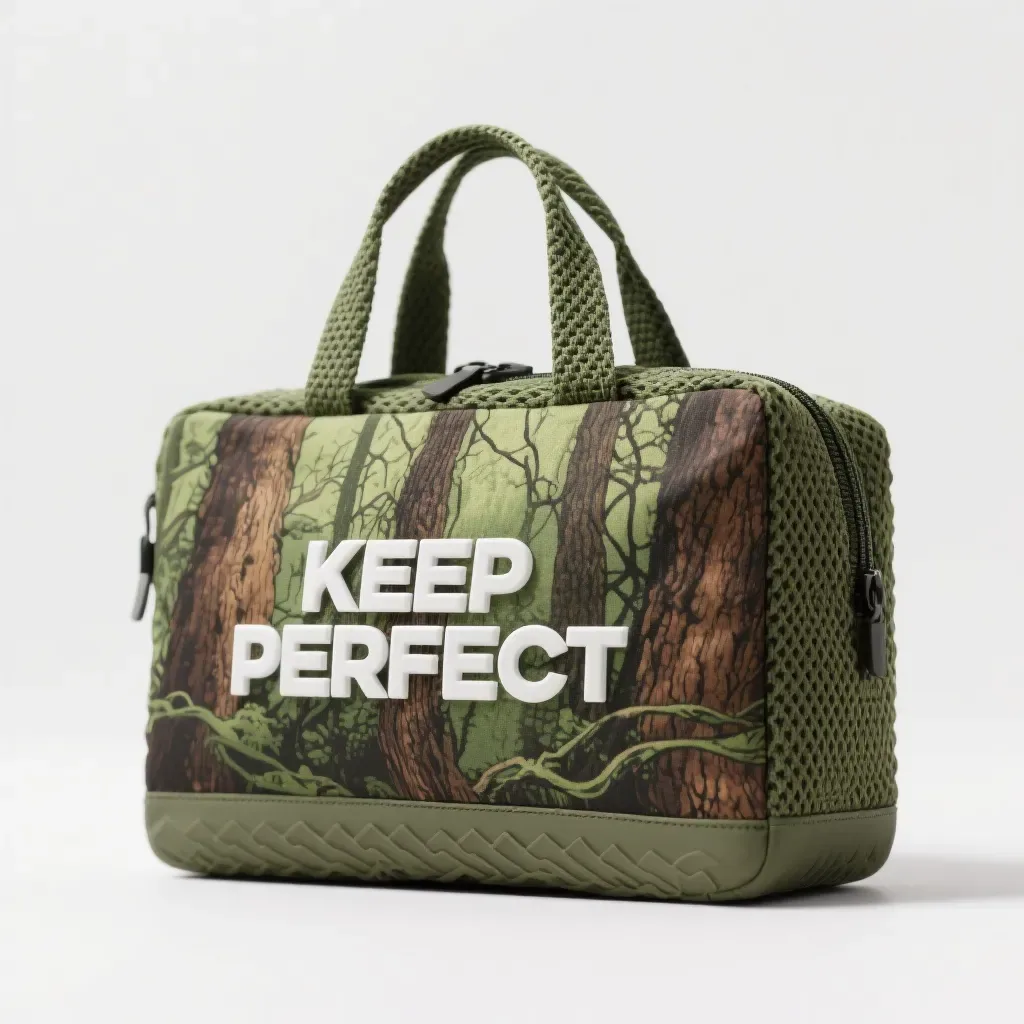
Ask for three things if the pouch will meet an automated line: a stated dimensional tolerance, a stated flat-pack profile, and a stated fabric mass. A ±4 mm width tolerance across the run keeps the pouch feeding reliably; a flat-pack profile near 8 mm lets the fulfilment planner size cartons correctly; and a fabric mass near 280 g/m² gives enough body to open cleanly without fighting an inserting machine.
- Construction
- Whole-panel knit, one joining seam at the base
- Gauge
- E12 for a fine hand suited to beauty, snack and lifestyle boxes
- Yarn
- 300D recycled polyester, GRS-scope certified
- Fabric mass
- 280 g/m² target, ±5% tolerance
- Flat-pack profile
- About 8 mm empty
- Dimensional tolerance
- ±4 mm on width across the run
- Handle pull
- 400 N typical for beauty and snack loads, ISO 13934-1
- Abrasion
- 20,000 Martindale rubs, ISO 12947-2
- Colour target
- Delta E 1.5 or better under D65 per shipment
- Sampling
- 7 working days from approved artwork and yarn
- Bulk
- 30 days from sample approval, FOB Xiamen
- Inspection
- AQL 2.5, ISO 2859-1, per drop
Hand feel deserves a deliberate decision rather than an accident. E12 with 300D gives a softer, more fluid surface that suits beauty and lifestyle boxes; dropping to E7 with 600D produces a heavierLoop that suits a snack or beverage box carrying weight. Sampling both is inexpensive and takes 7 working days, and it is far better than discovering after month three that subscribers describe the pouch as stiff in feedback surveys.
MOQ 100 Pcs per Colourway Across Twelve Monthly Drops
MOQ is 100 pcs per style and colourway, which is what makes a monthly cadence viable for a mid-size operator. Instead of committing to one enormous annual purchase, an operator can schedule twelve drops that share one base construction and one knit file, changing only yarn colour where the brand refreshes seasonally. The 100-piece scale also lets an operator test a second or third colourway inside the same year without carrying a year of inventory risk on an unproven shade.
The operational trick is to order ahead of the calendar rather than inside it. Because bulk runs 30 days from sample approval, the pouch that ships in month two has to be approved while month one is still shipping. Operators who plan one unconditional cycle of buffer stock — usually a full month of pouches held at the fulfilment house — absorb freight delays and sudden growth in subscriber count without ever changing the print or the knit file.
Beauty boxes
E12 300D with knit-in monogram; glass-bottle loads need a reinforced base panel.
Snack and coffee
Heavier 600D option; grease-resistant liner specified where contents require it.
Lifestyle and apparel
Soft hand prioritised; often the largest testing ground for new colourways.
Replenishment models
One shell reused every month, identity knitted in rather than printed.
Sampling in 7 Working Days: Testing the Unboxing Before You Commit
Sampling takes 7 working days from approved artwork and a confirmed yarn choice, and the sample should be tested exactly the way a subscriber will meet it. Fill it with the heaviest realistic contents, drop it once from waist height onto a hard floor, then open it. Stretch the handle with a loaded water bottle inside and check whether the join creeps. A pouch that survives a desk review but opens badly is a pouch that generates returns.
- Fill the sample with the heaviest realistic contents, not an average box.
- Drop-test once from waist height, because that is the courier failure that actually happens.
- Check handle creep under sustained load overnight.
- Approve colour under D65 lighting against the brand reference before releasing bulk.
- Lock the dimensional tolerance in writing so future drops are comparable.
Colour Consistency Across Twelve Shipments Without Re-Negotiating Dye Lots
Colour consistency is the difference between a subscription pouch that reads as premium and one that reads as mismatched. Set a Delta E target of 1.5 or better against the brand reference under D65 light, and require the reference swatch to be signed off before bulk. Where an operator changes colour seasonally, keep the previous season's reference on file so the following year's refresh can be measured against the original rather than against memory.
Dye lots are the practical constraint. A custom dope-dyed or piece-dyed shade usually requires around 300 kg per dye lot, so very small operators are better served by stock-supported shades from the existing yarn library, while larger monthly volumes justify a dedicated lot held for the year. Colour strategy work belongs here as well: a brand that defines five core shades instead of fifteen can hold every one of them in yarn library and never pay a dye-lot minimum again.
Durability Targets for a Pouch That Comes Back Empty
A subscription pouch has an unusual life: it ships full once and then stays in the subscriber's home for months or years, used as a wash bag, a cable pouch or a travel organiser. Specify durability for that second life, not just for the first trip. 20,000 Martindale rubs under ISO 12947-2 is a sensible floor for a beauty box; heavier contents justify moving toward the 30,000 figure normally reserved for equipment duty.
The pouch that survives its first courier trip but loses its shape in month three has quietly failed. Test both: the outbound journey determines returns, but the months of reuse determine whether the brand stays visible in the subscriber's home.
Care labelling should not be an afterthought. Knit dries faster than a lined cotton pouch and can be machine washed on a cool cycle, which matters because subscribers will wash these. Provide a care statement that survives contact with water, usually as a knit-in or bar-tacked label rather than a heat transfer that lifts after a handful of cycles.
Cost Per Shipment and Cost Per Subscriber: Reading the Real Return
Judge a subscription pouch on cost per retained subscriber rather than cost per unit. A pouch priced slightly higher that stays in a subscriber's home for a year is delivering monthly brand exposure for the price of one insert, and unboxing content shot for social channels compounds that exposure further. The correct comparison is therefore against the annual spend on disposable inserts and printed mailers, not against the lowest pouch quote in isolation.
Freight and duty then decide whether the arithmetic holds. Shipments are booked FOB Xiamen by default, with CIF or DDP available for operators who prefer one logistics owner; both choices should be modelled against the fulfilment calendar, since air freight to recover a missed month costs more than the entire pouch programme for that drop. Capacity across 7 production lines running about 200,000 pcs per month means even a large multi-month order can be scheduled inside one plan rather than split across vendors.
Plan your twelve-month pouch calendar
Send your monthly volume, heaviest realistic contents and brand colour references. You will receive a construction recommendation, a 7-working-day sampling slot and a twelve-drop production calendar with one inspection standard across all of them.
Frequently Asked Questions
What is the MOQ for knitted subscription pouches?
MOQ is 100 pcs per style and colourway. That scale allows a mid-size operator to schedule twelve monthly drops that share one base construction, rather than committing to a single large annual purchase and carrying the inventory risk of an unproven shade for a full year.
How long does sampling take for a subscription pouch?
Sampling takes 7 working days from approved artwork and a confirmed yarn choice. The important part is how the sample is tested: fill it with the heaviest realistic contents, drop it once from waist height, and hang it loaded overnight to check whether the handle join creeps.
How long is bulk production for a monthly pouch order?
Bulk production is 30 days from sample approval. Because that window sits beside a 7-working-day sampling phase, the pouch shipping in month two has to be approved while month one is still in the courier network, which is why operators keep about one month of buffer stock.
Can the same pouch be used for every month of the year?
Yes, and that is usually the better plan. One base construction and one knit file can run all twelve drops, with yarn colour changed only where the brand refreshes seasonally. Reusing the file removes a second engineering charge and makes each shipment directly comparable to the last.
What dimensional tolerance should an automated packing line expect?
Ask for a width tolerance of ±4 mm across the production run. A pouch that drifts wider jams automated insertion equipment or refuses to sit inside a fixed-size outer carton, which is why the tolerance belongs in the tech pack rather than in an email thread about the approval sample.
How much colour drift is acceptable between monthly shipments?
Set a target of Delta E 1.5 or better against the signed-off brand reference under D65 light. Colour drift is the subscriber-visible failure, because the same brand colour appears twelve times a year in unboxing content where side-by-side comparison happens instantly.
Does a custom colourway require a minimum dye lot?
A custom dope-dyed or piece-dyed shade typically requires around 300 kg per dye lot. Smaller monthly volumes are better served by stock-supported shades from the existing yarn library, while larger plans justify a dedicated lot held for the full year.
Which gauge suits a beauty or lifestyle subscription box?
E12 with 300D recycled polyester suits beauty and lifestyle boxes, giving a soft hand at about 280 g/m². Heavier contents such as beverage or snack boxes justify moving to E7 with 600D, which produces a coarser loop that carries weight without stretching.
How much abrasion resistance should a subscription pouch have?
A sensible floor is 20,000 Martindale rubs under ISO 12947-2 for a beauty box. Specify durability for the pouch's second life as a wash bag or travel organiser rather than only for the outbound courier trip, because that second life is what keeps the brand visible.
Can the brand identity be knitted into the pouch?
Yes. A knit-in monogram becomes part of the loop structure, survives washing, and adds no secondary operation. Where the brand depends on a photographic print needing a flat substrate, knit the identity into one face and carry the heavy artwork on a printed insert card instead.
What handle strength should I specify for subscription loads?
About 400 N handle pull is normally sufficient for beauty or snack loads under ISO 13934-1. Beverage boxes carrying glass bottles justify the 600 N figure used for equipment duty, and the correct number depends on the heaviest realistic contents rather than the average box.
Where are subscription pouch shipments booked?
Shipments are booked FOB Xiamen by default, which suits operators with an existing freight forwarder. CIF or DDP can be arranged for operators preferring a single logistics owner. Either choice should be modelled against the fulfilment calendar before committing.
People Also Ask
Why do subscription boxes need a flat-pack knit rather than a lined pouch?
Flat-pack knit ships at roughly 8 mm and recovers when filled, so it presents well without the creasing or internal card that a lined cut-and-sew pouch needs. Dimensional consistency comes from the loop structure rather than from a seam allowance.
How far ahead should a monthly operator order pouches?
Order about one full cycle ahead. With 30 days for bulk and freight on top, a drop shipping in month two must be approved while month one is still in transit, and one month of buffer stock absorbs freight delay or sudden subscriber growth.
Is a knit pouch machine washable?
Yes. Knit dries faster than a lined cotton pouch and handles a cool machine cycle, which matters because subscribers will wash these during months of reuse. Use a knit-in or bar-tacked care label rather than a transfer that lifts after a few cycles.
Can one programme run several colourways in a single year?
Yes — at 100 pcs per colourway, several colourways fit inside one plan, though each custom shade usually needs around 300 kg of dye lot. Operators testing unproven shades usually begin with stock-supported yarn library colours.
What should I compare a subscription pouch cost against?
Compare against the annual spend on disposable inserts and printed mailers, plus retained-subscriber value, rather than against the lowest pouch quote. A pouch that survives a year of reuse delivers monthly brand exposure for the price of one insert.
Sources and further reading
Every figure on this page is either our own programme data or attributed below. Open the originals before you write them into a specification.
- ISO 12947-2 — Determination of the abrasion resistance of fabrics by the Martindale methodISO Referenced for the 20,000-rub abrasion floor recommended for subscription pouches.
- ISO 13934-1 — Textiles, tensile properties of fabrics, Part 1: maximum force using the strip methodISO Source of the 400 N and 600 N handle pull figures for different box weights.
- Recycled Claim Standard and Global Recycled StandardTextile Exchange Traceability framework for the 300D and 600D recycled polyester yarns offered for subscription programmes.
- ISO 2859-1 — Sampling procedures for inspection by attributesISO The AQL-indexed scheme applied per drop so twelve monthly shipments share one inspection standard.
- ISO 139:2005 — Textiles, standard atmospheres for conditioning and testingISO Referenced for conditioning before dimensional measurement, supporting the ±4 mm width tolerance.
Turning One Sample into a Twelve-Month Cadence
The pattern worth copying from operators who have done this well is unglamorous: they specify once, carefully, and then never re-open the specification for twelve months. Dimensional tolerance, colour target, abrasion figure and handle pull are agreed before the first drop and then applied unchanged to every subsequent shipment. That single decision removes more cost and more argument than any negotiation on unit price.
What does deserve review is the brand side: whether a second colourway has earned a slot, whether the monogram still reads at the size it was knitted in, and whether the pouch is being reused in the way the marketing team assumed. Sampling for those questions takes 7 working days and does not disturb the running plan, so the learning can happen in parallel with fulfilment rather than instead of it.
Treat the pouch as infrastructure rather than as a gift with purchase, and the costing changes shape. A construction that survives the courier network and twelve months of reuse reduces replacement shipments, reduces negative unboxing content, and keeps one visible brand object in the subscriber's home all year. That return is measurable, and unlike the unit price it does not compress when the calendar gets tight.