Knitted vs Cut and Sew Bag Cost: Where the Money Actually Moves
Does a knitted bag really cost more than a cut and sew one? On a 40 x 35 x 12 cm shopper at 20,000 pcs, yes on unit price — USD 5.10 against USD 4.65 FOB Xiamen — and no on programme cost once the range refreshes, because the cut and sew route pays about USD 380 and 12 working days for every new shade while the knit route swaps a yarn cone for nothing. This article follows one four-shade seasonal programme through twelve months and shows exactly where the two quotations diverge: input waste, shade refresh, sampling time and defect rate.
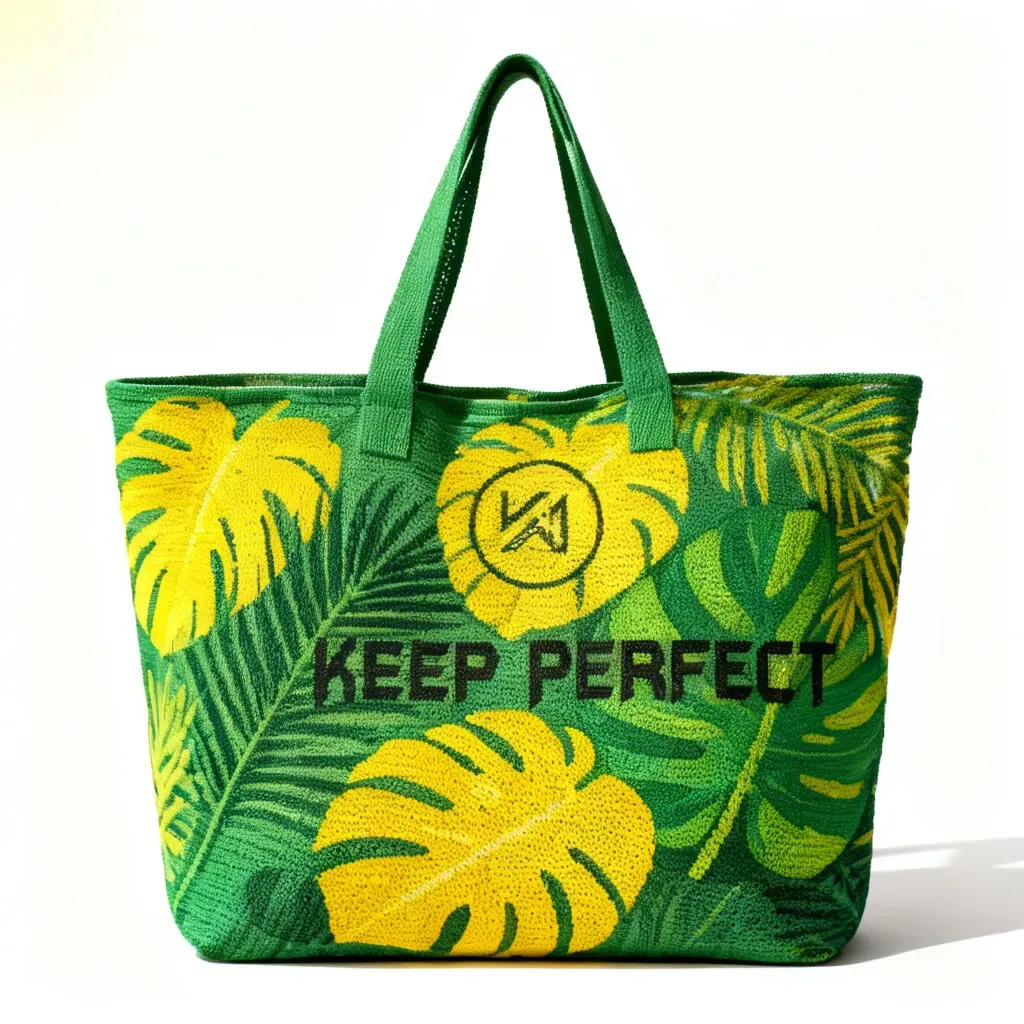
The Programme: Four Shades, 20,000 Pieces, One Season
A mid-size grocery retailer wanted a reusable shopper at 40 x 35 x 12 cm, built to carry 8 kg, in four seasonal shades. Annual volume was 20,000 pieces. The buying team had two live quotations: one knitted in one piece on a whole-garment machine, one cut from 12 oz canvas and assembled in nine operations. Both quotes were FOB Xiamen, both included the same webbing handle and the same AQL 2.5 inspection, so the comparison was honest from the start.
On paper the cut and sew quote won by USD 0.45 per piece, which is USD 9,000 across the year. What the spreadsheet did not show was how the two routes behave when the range changes. The retailer refreshed three of the four shades mid-season, and that single event rearranged the ranking completely. The rest of this article is the arithmetic the buyer wishes had been done before the first purchase order.
Where the Cutting Room Spends Its Money
A cut and sew quote is dominated by four costs: fabric per metre, marker efficiency, cutting and sewing labour, and the consumables around each seam. At 12 oz canvas quoted at about USD 1.85 per metre, a 40 x 35 x 12 cm shopper consumes roughly 1.05 m of fabric including the handle, so material lands near USD 1.94. Thread, interlining and a woven label add about USD 0.34. That is USD 2.28 before anyone touches a machine.
Labour is the rest. Cutting the panel set takes about 4 minutes, sewing nine operations takes about 11 minutes, and pressing and trimming take a further 3 minutes — around 18 minutes of direct labour at a loaded rate near USD 0.09 per minute, or about USD 1.62. Add overhead, hardware at USD 0.41 and packing at USD 0.34 and the bag lands at about USD 4.65. Every one of those numbers moves with volume, which is why the route looks strong at 20,000 pieces.
What the Knitting Machine Spends Instead
A knitted quote has a different shape. There is no marker, no cutting table and no sewing line for the body, so labour collapses into one machine attendance cycle. The body knits in about 18 minutes, but one operator tends several machines, so the labour attributed to a single bag is roughly USD 0.52. Yarn is the dominant input instead: about 0.55 kg of recycled polyester at roughly USD 2.45 per kilogram, or about USD 1.35.
The remaining cost is machine time, which is the scarce resource. At 18 minutes per body across 7 production lines running about 200,000 pcs per month, machine time carries an opportunity cost of roughly USD 1.60 per body. Hardware, a knitted-in label and packing bring the total to about USD 5.10. The important structural difference is that almost none of this cost is fixed per style — there is no die to amortise and no marker to reissue.
The structural difference in one line
- Cut and sew spends money once per style and then saves on every unit.
- Knitting spends money on every unit and saves on every change.
- Which one wins depends on how many units sit behind each change.
Waste: 15% Off the Roll Against 3.5% Off the Cone
Waste is where the two routes separate most cleanly. A marker for a 40 x 35 x 12 cm shopper on 150 cm fabric typically runs about 82% efficient, which means roughly 15% of purchased fabric leaves as off-cut. Some of it is recycled, some is landfilled, and all of it was paid for at full fabric price. On this programme that is about 0.16 m of fabric per bag, or roughly USD 0.29 already buried inside the quote.
Knitting wastes about 3.5% of yarn mass, almost all of it in the start-up course, the cone tail and the bind-off. There is no off-cut because there is no cutting. The difference matters twice: once in material cost and once in any extended producer responsibility fee the retailer pays on placed-on-market mass. A monomaterial recycled polyester knit body also lands in a simpler end-of-life category than a canvas body with a polyester label and cotton thread.
The Shade Refresh That Changed the Answer
Three shades were refreshed mid-season. On the cut and sew route each refresh meant a new marker, a new screen for the print and a fresh cutting trial: about USD 380 in direct cost and about 12 working days of calendar time, during which the line could not run the old shade at full rate either. On the knit route a shade is a yarn cone. The change carries no tooling cost, and the only constraint is a cone minimum of roughly 60 kg per shade.
That difference is small once and enormous four times. Three refreshes cost the cut and sew route about USD 1,140 and roughly 36 working days of elapsed programme time. For a retailer dropping four collections a year, the refresh line grows to about USD 5,700 and starts to rival the unit-price advantage entirely. This is the single most under-priced line in bag sourcing, because it never appears on the first quotation.
Sampling: 7 Working Days Against a Reissued Pattern
Time has a cost that buyers rarely book. A knitted sample runs 7 working days because the change is a program file and a yarn carrier; the machine knits the revised body in the next cycle. A cut and sew revision needs the pattern reissued, a new marker nested, a fresh cutting trial and a sewing operator briefed, which normally takes 12 to 15 working days for the same change.
Across a season with three refreshes, that gap is roughly 24 working days of extra elapsed time. For a retailer with a fixed shelf date, the delay usually converts into air freight on the first drop, and air freight at about USD 4.20 per kilogram on a 480 g bag is about USD 2.02 per piece — enough to erase the unit-price advantage of the cut and sew route on its own.
Defect Rate, Returns and the Cost of a Failure
The two routes fail differently. A cut and sew bag fails at the seam: handle-root pull-out, skipped stitches and mis-aligned panels. On this programme the measured defect rate at incoming inspection under AQL 2.5 was about 3.4%. A knitted body fails at the loop: dropped stitches, tension bars and yarn breaks, at about 2.1%. Both were inspected to ISO 2859-1, so the comparison is on the same basis.
The difference of 1.3 points is 260 bags a year. At a handling cost of about USD 12 per returned unit — return postage, inspection, repack and write-off — that is about USD 3,120 a year, or USD 0.16 per piece. It does not decide the comparison on its own, but it is twice the size of most buyers' estimates and it lands entirely on the route with nine seams.
Where Cut and Sew Wins and Keeps Winning
Cut and sew wins on three things and should not be argued out of them. First, unit price at stable high volume: at 20,000 pieces of one shade with no mid-season change, the cut and sew route finished about USD 4,464 lower across the year, a 4.1% advantage. Second, printed artwork: rotary and digital printing on a flat woven panel resolves detail down to about 0.2 mm, where a knitted-in logo has a minimum practical stroke near 1.5 mm.
Third, structure. A bag that must stand up empty, hold a rigid base or carry a photographic image needs interlining, a base board and a flat print surface, and a cut and sew line installs all three more economically than a knitting machine does. Knitting also loses outright where the buyer needs a waterproof body without a liner — an uncoated knit panel shows a hydrostatic head under 100 mm against roughly 5,000 mm for a coated woven.
Putting Both Routes on One Page
The honest comparison is a full-year programme table, not a unit-price table. Below are the same 20,000 pieces under two drop patterns: one single drop of four shades, and four quarterly drops of four shades each. Freight is charged at about USD 165 per cubic metre and returns at about USD 12 per unit.
| Cost line | Single drop, knit | Single drop, cut and sew | Four drops, knit | Four drops, cut and sew |
|---|---|---|---|---|
| Units at 20,000 pcs | USD 102,000 | USD 93,000 | USD 108,000 | USD 104,000 |
| Programme setup and tooling | USD 1,400 | USD 620 | USD 1,400 | USD 620 |
| Shade refresh, 3 and 15 changes | USD 0 | USD 1,140 | USD 0 | USD 5,700 |
| Freight at USD 165 per m³ | USD 2,772 | USD 3,828 | USD 2,772 | USD 3,828 |
| Returns at USD 12 per unit | USD 5,040 | USD 8,160 | USD 5,040 | USD 8,160 |
| Programme total | USD 111,212 | USD 106,748 | USD 117,212 | USD 122,308 |
Read the last row carefully. With one drop, cut and sew wins by about USD 4,464. With four drops, knitting wins by about USD 5,096. The crossover sits at roughly three refresh events a year for this volume and this silhouette. Below that, choose cut and sew. Above it, choose knit. Any comparison that leaves the refresh line out will give the wrong answer for a seasonal range.
What the Buyer Did, and What You Should Copy
The retailer split the range. The two evergreen shades that never changed went to cut and sew at USD 4.65, because 10,000 stable pieces reward the lower unit price. The two seasonal shades that changed every quarter went to knitting at USD 5.10, because the refresh line was worth more than the USD 0.45 gap. The blended programme came in about USD 2,900 under either single-route option.
The transferable lesson is to quote both routes against the same written specification and the same drop calendar, and to insist that the shade-refresh cost is stated as a separate line rather than absorbed. If a quotation will not break out tooling, refresh and inspection, it is not comparable. Both routes here were quoted FOB Xiamen with CIF and DDP options available, and both ran to AQL 2.5 under ISO 2859-1.
Cost your programme both ways
Send the silhouette, annual volume and drop calendar. The team will quote the same bag knitted and cut and sewn, break out tooling and shade refresh as separate lines, and return FOB Xiamen pricing at 100 pcs per style and colourway with 7 working day sampling. Start on the contact page.
Frequently Asked Questions
Is a knitted bag more expensive than a cut and sew bag?
Per unit, usually slightly more: USD 5.10 against USD 4.65 on the comparison shopper at 20,000 pcs. Per programme, often less, because tooling and shade refresh nearly disappear on the knitted route. The answer depends on how many times the range changes in a year, which is why a unit-price comparison alone gives the wrong result.
Why is the knitted unit price higher?
Almost all of it is machine time. A knitted body occupies a whole-garment machine for about 18 minutes, and that time carries an opportunity cost of roughly USD 1.60. Yarn adds about USD 1.35 and labour about USD 0.52. The cut and sew route spends less on the unit and more on setup, so it catches up as volume rises.
How much does a new shade cost on each route?
On the cut and sew route, about USD 380 in direct cost plus 12 working days, because the marker, the print screen and the cutting trial all have to be redone. On the knitted route the change is a yarn carrier swap with no tooling cost, limited only by a cone minimum near 60 kg per shade.
What waste figure should I expect from each route?
Around 15% of purchased fabric leaves a cutting room as off-cut, based on a marker efficiency near 82% for this shape. Knitting wastes about 3.5% of yarn mass in the start-up course, cone tail and bind-off. The gap matters twice: once in material cost and once in any fee charged on placed-on-market mass.
Does the knitted route really sample faster?
Yes. A knitted revision is a program file and a yarn carrier change, so it runs 7 working days. A cut and sew revision needs the pattern reissued, a marker nested and a cutting trial, normally 12 to 15 working days. Over three refreshes that gap is about 24 working days of elapsed programme time.
Which route has the lower defect rate?
On this programme, knitting measured about 2.1% against about 3.4% for cut and sew, both inspected to AQL 2.5 under ISO 2859-1. Knitted failures are loop defects such as dropped stitches and tension bars; sewn failures concentrate at the seam, especially handle-root pull-out and skipped stitches.
When should I definitely choose cut and sew?
Choose cut and sew when the shade range is stable for a full year, when volume exceeds roughly 20,000 pieces per style, when artwork needs photographic detail, and when the bag must stand up empty. It also wins outright where a waterproof body is needed without a liner, because an uncoated knit will not reach that performance.
When should I definitely choose knitting?
Choose knitting when the range refreshes more than about three times a year, when each shade runs below roughly 2,000 pieces, when lead time is tight, and when the brief calls for zoned construction or a monomaterial body. The minimum is 100 pcs per style and colourway, which suits seasonal and promotional drops.
Can one range use both routes?
Yes, and it is usually the best answer. Keep evergreen shades on the cut and sew line, where stable volume rewards the lower unit price, and put seasonal shades on the knitting machines, where the refresh cost disappears. On this programme the split came in about USD 2,900 under either single-route option.
How do freight costs compare between the two?
Knitted bodies nest flatter because there are no bulky sewn seams, at about 0.42 m³ per 500 pieces against about 0.58 m³ for the assembled canvas version. At roughly USD 165 per cubic metre that is USD 2,772 against USD 3,828 on 20,000 pieces — about USD 0.05 per bag in favour of knitting.
What inspection standard applies to both routes?
Both were inspected to AQL 2.5 under ISO 2859-1 using general inspection level II, with the same defect classification for critical, major and minor faults. Performance testing covered abrasion to ISO 12947-2, tensile to ISO 13934-1, and colour fastness to rubbing under AATCC 8 and to laundering under AATCC 61.
What should I insist on seeing in a quotation?
Insist on tooling, shade refresh, inspection and packing as separate lines rather than absorbed into the unit price. Ask for the quotation to state the rated load, the abrasion target and the dimensional tolerance it is built against. A quotation that will not break out those lines cannot be compared honestly with another route.
People Also Ask
Which bag construction costs less per unit?
Cut and sew, usually by 8 to 12% at stable volume. On the comparison shopper it was USD 4.65 against USD 5.10 at 20,000 pcs. Knitting recovers that gap through lower tooling, near-zero shade refresh cost, lower freight volume and a lower defect rate.
How much fabric waste does cut and sew produce?
Roughly 15% of purchased fabric for a boxy shopper shape, based on marker efficiency near 82%. Knitting loses about 3.5% of yarn mass. On a 0.55 kg knitted body against about 1.05 m of canvas, the difference is several hundred kilograms of input per 20,000 pieces.
Is 20,000 pieces a large order for a bag?
It is a mid-size programme. It comfortably exceeds a 100 pcs per style and colourway minimum and fits inside about 200,000 pcs per month of capacity, but it is small enough that per-unit setup costs on the cut and sew route still matter.
Does a knitted bag last as long as a sewn canvas bag?
In abrasion terms, often longer: about 30,000 rubs to ISO 12947-2 for a 600D knit against roughly 15,000 for 12 oz canvas. In puncture and seam-peel terms the sewn version can be stronger, especially where a rigid base and interlining carry the load.
How long does bag production take?
Sampling runs 7 working days for a knitted revision and 30 days for bulk after approval. A cut and sew revision normally needs 12 to 15 working days for sampling with a similar bulk window. The difference compounds across a season with several refreshes.
Sources and further reading
Every figure on this page is either our own programme data or attributed below. Open the originals before you write them into a specification.
- ISO 2859-1 — Sampling procedures for inspection by attributesISO The sampling standard behind the AQL 2.5 inspection level used for both routes in the comparison.
- ISO 12947-2 — Abrasion resistance of fabrics by the Martindale methodISO Referenced for the 30,000 rub knit figure and the roughly 15,000 rub canvas figure.
- ISO 13934-1 — Tensile properties of fabrics, maximum force by the strip methodISO Used for the tensile targets both quotations had to meet.
- Incoterms rulesInternational Chamber of Commerce (ICC) Defines where cost and risk transfer under the FOB Xiamen terms used in both quotations.
- OEKO-TEX STANDARD 100OEKO-TEX Referenced for the restricted-substance limits both bodies had to meet for the retail market.
How to Run This Comparison on Your Own Range
Start by writing one specification that both routes must meet: dimensions, rated load in kilograms, abrasion target to ISO 12947-2, tensile target to ISO 13934-1, colour fastness to AATCC 8 and to AATCC 61, and an inspection level. Then ask for two quotations against it. If either route cannot meet a stated target, that is a finding, not an inconvenience, and it belongs on the table.
Next, list every change event the range will see in twelve months — new shades, new sizes, new artwork, new hardware — and price each one under both routes. Add freight at the real volumetric rate and returns at the real handling cost. The route that wins this table is the route to buy, regardless of which one looked lower on the first quotation. More on the wider selection logic sits in the knit versus traditional comparison.