How to Choose a Knitted Bag Gauge: Four Gates Covering Load, Surface, Yarn Count and Cycle Time
Finer is not better. An E7 body knits in 5 to 7 minutes with a 3.63 mm needle pitch and 600D to 900D yarn at about 380 g/m², while an E16 body takes 18 to 24 minutes at 1.59 mm with 100D to 150D yarn at about 200 g/m². Choose coarse for load, stiffness and speed, and fine for surface smoothness and fine knitted-in detail.
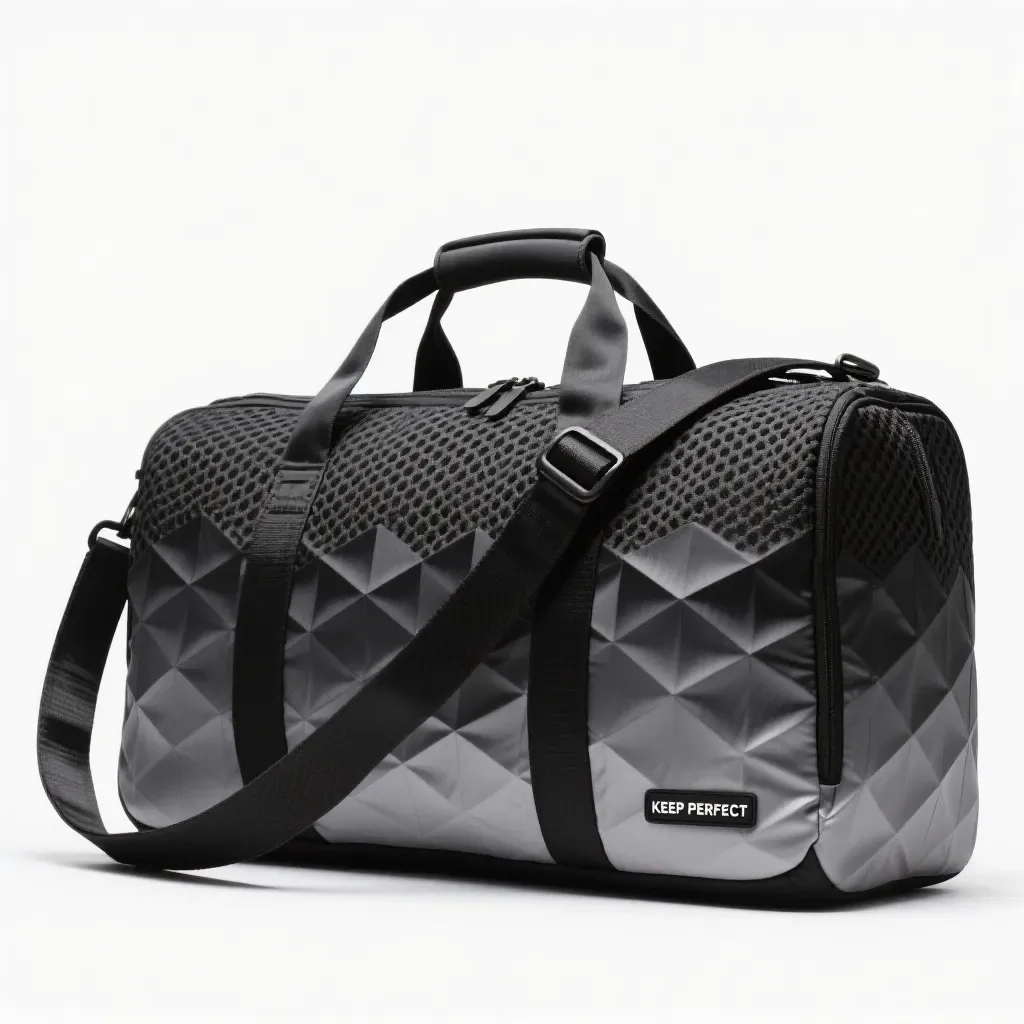
The Decision Sequence: Four Gates Before You Pick a Number
Choose a gauge by passing the brief through four gates in order: what load the bag carries, what the surface has to do, what yarn the programme wants to use, and what cycle time the cost target allows, and the first gate that constrains decides the answer.
Gauge is the number of needles per inch, and it sets almost everything else at once: the smallest shaping step, the yarn count the needle hook can take, the fabric weight, the cycle time and the surface quality. Because it sets all five together, treating it as an independent choice is the most common specification error in a knitted bag programme. A buyer who picks E14 because the fabric feels nice and then specifies 600D yarn has made two decisions that cannot both hold, because an E14 needle hook will not take 600D. Working through the four gates in order prevents that, and usually lands on the right gauge in one pass.
- Gate one, load: above 6 kg or needing self-supporting stiffness, start at E7 or E8.
- Gate two, surface: fine knitted-in detail or a print-quality face, start at E14 or E16.
- Gate three, yarn: the needle hook limits the count, so name the yarn and the gauge together.
- Gate four, cycle time: every step finer roughly doubles the traverse, so time and cost follow.
- Default when nothing constrains: E12, which balances all five and suits most programmes.
Gate One: What Load Does the Bag Carry?
Load sets a floor on yarn count and therefore on gauge: a bag carrying 6 kg needs roughly 600D yarn, and 600D only fits an E7 or E8 needle hook, so a heavy-duty brief decides the gauge before any other consideration.
The chain runs from load to yarn to gauge and it is worth following explicitly. A strap carrying 6 kg needs cross-sectional material in the load path, which means a heavy yarn, and a heavy yarn needs a needle with a large enough hook and a pitch wide enough for the loop to form without jamming. That puts the programme at E7 with 600D to 900D yarn at about 380 g/m². Trying to achieve the same load rating at E16 with 150D yarn means either a much wider strap or a doubled yarn, and neither is a better answer than simply choosing the coarse gauge. There is a secondary benefit too: a coarse body is stiffer, because the loops are larger and the yarn is heavier, so it resists bending more and needs less interlining.
Gate Two: What Does the Surface Have to Do?
Surface quality sets a ceiling on gauge: fine knitted-in detail needs at least three needles of stroke width, which is 6.4 mm at E12, 5.4 mm at E14 and 4.8 mm at E16, so a logo with strokes under about 5 mm only works at E14 or finer.
Print quality follows the same rule for a different reason. A coarse surface has pronounced loop relief, so an applied print sits on peaks and valleys and the edge breaks up; a fine surface is flatter and holds a printed edge. The honest threshold is that a coarse E7 body should carry a woven label or a knitted-in motif rather than a print, while an E14 or E16 body can take a transfer or a screen print acceptably. Buyers often discover this at the sampling stage and try to solve it with a heavier print deposit, which makes the hand stiff without fixing the edge. The answer is a gauge decision, not a print decision.
- Needle pitch, E7
- 3.63 mm
- Needle pitch, E10
- 2.54 mm
- Needle pitch, E12
- 2.12 mm
- Needle pitch, E14
- 1.81 mm
- Needle pitch, E16
- 1.59 mm
- Yarn count, E7
- 600D to 900D
- Yarn count, E12
- 300D to 450D
- Yarn count, E16
- 100D to 150D
- Fabric weight, E7
- about 380 g/m²
- Fabric weight, E16
- about 200 g/m²
- Minimum knitted stroke, three needles
- 10.9 mm at E7, 6.4 mm at E12, 4.8 mm at E16
- Needles across a 130 cm bed
- about 358 at E7, about 818 at E16
Gate Three: What Yarn Do You Want to Use?
Yarn and gauge have to be chosen together, because the needle hook limits yarn volume: E7 takes 600D to 900D, E12 takes 300D to 450D and E16 takes 100D to 150D, and a recycled-content commitment can constrain the choice further because fine recycled yarns are harder to source.
The recycled-content interaction is worth flagging because it is specific and it surprises buyers. Fine recycled polyester filament below about 150D is less widely available than the equivalent virgin yarn, and it carries a larger colour-consistency penalty because there is less material to average across. A buyer who wants both a fine gauge and a certified recycled yarn should expect a narrower shade range and a longer yarn booking lead time, and should consider taking the recycled content in a 300D yarn at E12 instead. The general rule is to name the yarn count and the gauge in the same line of the specification, and to check availability before the sampling window opens rather than during it.
Gate Four: What Cycle Time Can the Programme Afford?
Cycle time rises steeply with fineness because there are more needles to traverse: an E7 tote runs 5 to 7 minutes, an E12 tote 9 to 12 minutes, an E14 tote 14 to 18 minutes and an E16 tote 18 to 24 minutes, so the finest gauge costs roughly three to four times the machine time of the coarsest.
Machine time is a real cost line and it should be read alongside the yarn saving rather than instead of it. Moving from E12 to E16 saves about 120 g/m² of fabric and costs roughly 9 to 12 minutes of extra bed time per body, and on a 3,000-piece order that is 450 to 600 extra hours of machine time. Whether that is worth it depends entirely on whether the surface quality the finer gauge buys is actually being sold. On a bag where the customer never touches the surface closely and the brand mark is a woven label, the extra time buys nothing. On a bag sold partly on a fine knitted-in motif, it buys the product.
Reading the Gauge Table
Four gauges cover the practical range for bags, E7 through E16, and each has a clear home: E7 for heavy and stiff, E10 for mid-weight structured, E12 as the default, and E14 to E16 for fine surface work.
| Gauge | Pitch and yarn | Weight and cycle | Abrasion and surface | Best for |
|---|---|---|---|---|
| E7 | 3.63 mm, 600D to 900D | about 380 g/m², 5 to 7 min | 25,000 to 35,000 rubs, open | Heavy duty, stiff bodies |
| E10 | 2.54 mm, 450D to 600D | about 350 g/m², 7 to 9 min | 22,000 to 32,000 rubs, textured | Structured totes, duffels |
| E12 | 2.12 mm, 300D to 450D | about 320 g/m², 9 to 12 min | 20,000 to 30,000 rubs, balanced | The default for most programmes |
| E14 | 1.81 mm, 200D to 300D | about 260 g/m², 14 to 18 min | 15,000 to 25,000 rubs, smooth | Print-quality faces, lighter bags |
| E16 | 1.59 mm, 100D to 150D | about 200 g/m², 18 to 24 min | 12,000 to 20,000 rubs, fine | Fine knitted-in detail, soft hand |
The abrasion column is the one buyers misread. Finer is not stronger; it is weaker on abrasion, because there is less material per loop and the loops are smaller. An E16 body at 12,000 to 20,000 rubs is a poor choice for a bag that will be dragged, and a buyer who moves finer for surface reasons should compensate with a heavier yarn within the gauge, or with a coated panel at the wear point.
Choose E7 to E10
Loads above 6 kg, self-supporting stiffness, heavy yarns, recycled content in a coarse count, fastest cycle time.
Choose E12
The default. Balanced weight, cycle time, abrasion and surface, with the widest yarn availability including recycled counts.
Choose E14 to E16
Fine knitted-in motifs with strokes under about 5 mm, print-quality faces, soft hand, lightest practical weight.
Reconsider the brief
Needing both 8 kg load and a 4 mm knitted stroke: no single gauge does both, so split the body and the detail panel.
Where a Coarse Gauge Beats a Fine One
A coarse gauge wins on four things that matter more than they sound: abrasion life, self-supporting stiffness, cycle time, and tolerance, because a larger loop is more forgiving of small tension variation than a small one.
The tolerance point is the least obvious and the most useful. A loop is formed by a needle drawing a length of yarn, and the dimensional consequence of a small tension error is proportionally smaller when the loop is large. In practice that means an E7 body holds its specified dimensions more easily than an E16 body, and it is one reason coarse gauges are used where a bag has to accept an insert or match a nested size. Abrasion is the second point and it is straightforward: more material per unit area survives more rubbing, which is why E7 reaches 25,000 to 35,000 rubs against 12,000 to 20,000 at E16. Where a buyer has moved fine for surface reasons and then sees wear complaints, the coarse gauge was the right answer all along.
Where a Fine Gauge Is the Only Answer
A fine gauge is the only answer in three cases: a knitted-in motif with strokes below about 5 mm, a bag sold on surface smoothness or a printed face, and a brief with a hard weight limit that the coarse gauges cannot reach.
The weight case is the one that justifies E16 despite its cost and its abrasion penalty, and it is worth being precise about the size of the prize. Moving from E12 at about 320 g/m² to E16 at about 200 g/m² removes roughly 120 g/m², which on a tote is 80 to 110 g of finished weight. On a bag that is carried empty in a handbag, or shipped by air in quantity, that is a real gain. On a bag that is carried full for twenty minutes, it is not, and the buyer has paid 9 to 12 minutes of extra machine time and given up a third of the abrasion life for a number nobody will notice.
Putting Gauge on the Tech Pack
Gauge should be written alongside yarn count, fabric weight and tolerance in a single line of the tech pack, because changing any one of the four without the others produces a specification the needle bed cannot deliver.
A workable line reads as a set: gauge, yarn count and type, target fabric weight in grams per square metre, and the dimensional tolerance after conditioning. Written that way, a sample can be measured against it rather than assessed by hand, which is what makes the 7 working day sampling window usable. Where a programme needs two gauges in one body, which is common on a bag with a fine detail panel, the specification should say where the transition is and how it is knitted, because a gauge change within one course is a programme decision rather than a fabric one. Both fit inside the standard windows: MOQ 100 pcs per style and per colourway, 30 days of bulk, and release against AQL 2.5 under an ISO 2859-1 plan, with FOB Xiamen as the standard term.
Get the gauge decision checked
Send the load, the artwork and the target weight. Our knit team will confirm the gauge, the yarn count and the cycle time before sampling, against MOQ 100 pcs and 30 days of bulk. Start on the contact page.
Frequently Asked Questions
What gauge should a knitted bag use?
E12 by default, because it balances weight at about 320 g/m², cycle time at 9 to 12 minutes, abrasion at 20,000 to 30,000 rubs and yarn availability. Move to E7 for loads above 6 kg and to E14 or E16 for fine surface detail.
What does gauge mean in knitting?
Needles per inch. It sets the needle pitch, which is 3.63 mm at E7, 2.12 mm at E12 and 1.59 mm at E16, and that single number drives yarn count, fabric weight, cycle time, abrasion life and surface quality at the same time.
Why can I not use 600D yarn at E16?
The needle hook can only take a limited yarn volume. E16 is designed for 100D to 150D, and 600D will not form a loop at that pitch. Yarn count and gauge have to be specified together, not separately.
Does a finer gauge make a stronger bag?
No, the opposite. An E7 body reaches 25,000 to 35,000 Martindale rubs against 12,000 to 20,000 at E16, because there is more material per unit area. Finer gauge buys surface quality, not strength.
How much slower is a fine gauge?
Roughly three to four times. An E7 tote runs 5 to 7 minutes and an E16 tote 18 to 24 minutes, because there are about twice as many needles to traverse at each step finer. On 3,000 pieces that is 450 to 600 extra machine hours.
How fine can a knitted-in logo be?
About three needles of stroke width, which is 10.9 mm at E7, 6.4 mm at E12 and 4.8 mm at E16. A logo with strokes under about 5 mm needs E14 or finer, or should move to a woven label.
Can one bag use two gauges?
Yes. A coarse body with a fine detail band is common, and the specification should state where the transition sits and how it is knitted, because a gauge change within one course is a programme decision rather than a fabric one.
Which gauge is best for a heavy duty bag?
E7, with 600D to 900D yarn at about 380 g/m². It carries the load, reaches 25,000 to 35,000 rubs of abrasion, is self-supporting without an interlining, and knits fastest at 5 to 7 minutes.
Does gauge affect dimensional tolerance?
Yes. A larger loop is more forgiving of small tension variation, so E7 holds specified dimensions more easily than E16. Where a bag has to accept an insert or match a nested size, the coarser gauge is easier to hold.
Is recycled yarn harder at a fine gauge?
Yes. Fine recycled polyester below about 150D is less widely available and carries a larger colour-consistency penalty, because there is less material to average across. Taking recycled content in a 300D yarn at E12 is usually easier.
How is a knitted order inspected before shipment?
Against AQL 2.5 under an ISO 2859-1 plan with critical, major and minor classes agreed before production. At 100 pieces the General Inspection Level II sample is 32 with an accept number of 2, and critical defects carry zero acceptance.
What are the terms for a knitted bag programme?
MOQ 100 pcs per style and per colourway, 7 working days of sampling, 30 days of bulk, 7 production lines at about 200,000 pcs per month, FOB Xiamen with CIF and DDP available, and a reference unit cost of USD 4.80 for an E12 tote.
People Also Ask
Is a higher gauge number finer?
Yes. The number is needles per inch, so E16 is finer than E7. The pitch runs from 3.63 mm at E7 down to 1.59 mm at E16, and everything else follows from that one number.
Which gauge gives the smoothest surface?
E16, at about 200 g/m² with 100D to 150D yarn. It takes a printed face and fine knitted-in detail down to about 4.8 mm of stroke width, at the cost of 18 to 24 minutes of cycle time.
Why is coarse knitting faster?
Fewer needles to traverse. An E7 bed has about 358 needles across 130 cm against about 818 at E16, so the carriage covers less than half the distance for the same width of fabric.
Can I change gauge after sampling?
Yes, but it is a new programme rather than a tweak. Gauge sets yarn count, weight, cycle and tolerance together, so changing it means re-specifying all four and re-approving the sample.
What is the lightest practical knitted gauge?
E16 at about 200 g/m². Below that the loop structure stops holding its shape and the fabric looks sparse, so if the brief needs lighter still, a thin woven shell is the honest answer.
Sources and further reading
Every figure on this page is either our own programme data or attributed below. Open the originals before you write them into a specification.
- WHOLEGARMENT knitting machinesShima Seiki The machine class on which a shaped bag body is knitted to gauge in a single programme.
- ISO 12947-2:2016 — Textiles, determination of abrasion resistance by the Martindale methodISO The abrasion method behind the range from 25,000 to 35,000 rubs at E7 down to 12,000 to 20,000 at E16.
- ISO 13934-1:2013 — Textiles, tensile properties of fabrics, Part 1: maximum force using the strip methodISO The strip method used to confirm a load rating once the gauge and yarn count are fixed.
- ISO 2859-1:2026 — Sampling procedures for inspection by attributes, Part 1: AQL-indexed sampling schemesISO The sampling plan behind the AQL 2.5 release and the sample size quoted for a 100-piece order.
- Global Recycled StandardTextile Exchange The chain-of-custody standard relevant when a recycled yarn count is specified alongside a gauge.
Let the Brief Pick the Gauge, Not the Swatch
Finer is not better and coarser is not stronger in every sense. E7 wins abrasion, stiffness, tolerance and speed. E16 wins surface resolution, print quality and the lowest practical weight, at three to four times the cycle time and roughly half the abrasion life. E12 sits between them and is the correct default when nothing in the brief constrains the choice.
For the yarn side of the same decision, see how to choose knitted bag yarn weight. For the cost comparison across construction routes, see knitted bag versus cut and sew cost.