Lightweight Bag Materials Compared With Knit: Eight Options by Weight, Tear, Abrasion and What Each One Actually Survives
If the brief is the lowest number on the scale, knitting is the wrong answer. A 20D ripstop nylon shell sits at about 40 g/m² against 320 g/m² for a knitted E12 body and 200 g/m² for the finest practical knit, and a packable ripstop tote weighs 45 to 60 g against 240 g. Knitting wins instead on what the bag survives: 25 to 45 N of tear against 8 to 12 N, and 20,000 to 30,000 rubs against 5,000 to 10,000.
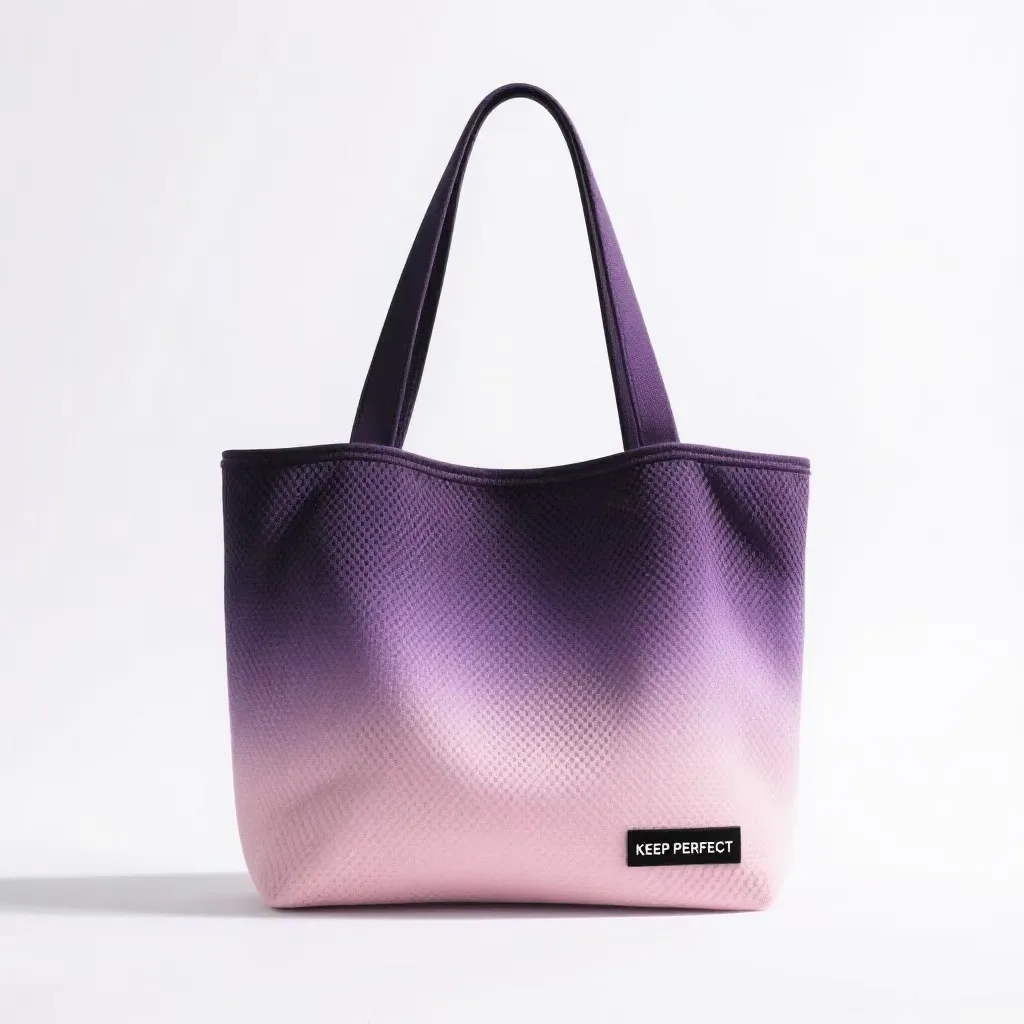
The Honest Starting Point: Knitting Is Not the Lightest
A knitted body is not a lightweight material and should not be specified as one: the lightest practical knitted bag fabric is about 200 g/m² at E16 in 150D yarn, while a 20D ripstop nylon shell is about 40 g/m², so on a packable tote the woven shell wins on weight by a factor of four to six.
This needs saying at the top because the rest of the comparison is meaningless without it. Buyers arrive at knitted construction from a sustainability or a construction-efficiency brief, assume it is also the light option, and then discover at the weighing stage that it is not. A knitted body is a loop structure with air in it, which sounds light, but the yarn has to be thick enough to hold a loop that will not collapse, and that sets a floor at roughly 200 g/m². A woven shell has no such floor: a 20D ripstop at 40 g/m² is a legitimate bag fabric as long as nothing sharp goes near it.
What knitting wins instead is the ratio that matters once the bag has to do something. A knitted body tears at 25 to 45 N against 8 to 12 N for 20D ripstop, survives 20,000 to 30,000 Martindale rubs against 5,000 to 10,000, and needs no coating to achieve either. If the brief is a bag that weighs almost nothing and is used gently, ripstop wins and should be specified. If it is a bag that gets used, the weight difference stops being the deciding number.
The Matrix: Eight Materials by Weight and by What They Survive
Eight materials cover the field: 20D and 40D ripstop nylon, 190T woven polyester, a fine E16 knitted body, a standard E12 knitted body, non-woven polypropylene, a coated polyethylene sheet and a mesh, and they span 40 to 600 g/m².
- 20D ripstop nylon, woven
- about 40 g/m², tear 8 to 12 N
- 40D ripstop nylon, woven
- about 60 g/m², tear 15 to 22 N
- 190T woven polyester
- about 65 g/m², tear 12 to 20 N
- Non-woven polypropylene, spunbond
- about 80 g/m², tear 8 to 15 N
- Coated polyethylene sheet
- about 70 g/m², tear 10 to 18 N
- Polyester mesh
- about 85 g/m², very low abrasion life
- Fine knitted body, E16 in 150D
- about 200 g/m², tear 18 to 30 N
- Standard knitted body, E12 in 300D
- about 320 g/m², tear 25 to 45 N
Reading the list by weight alone would send every buyer to the top of it, which is why the second number in each row matters more. Tear strength separates the field into two groups: everything under 100 g/m² tears below about 22 N, and everything knitted tears above 18 N and up to 45 N. The practical consequence is that the light materials are suitable for a bag that carries a light, soft, non-abrasive load, and the knitted materials are suitable for a bag that carries anything at all.
Strength per Gram: The Metric That Decides Ultralight Briefs
On strength per gram the woven shell beats the knitted body too: 20D ripstop delivers roughly 5 N of tear per g/m² against about 0.1 N for a knitted E12 body, so a buyer optimising for weight should not expect knitting to win on any weight-normalised measure.
Being straight about this saves a buyer a wasted sampling round. A ripstop shell is an extremely efficient structure: the yarns are continuous, straight and loaded axially, so almost all of the material is doing work. A loop structure is bent yarn, and bent yarn carries load less efficiently per unit mass. That is a permanent property of the two constructions, not something a gauge or a yarn change alters. What a knitted body offers instead is absolute performance, comfort and construction efficiency, and those are the three reasons a buyer would accept four to six times the fabric weight. A brief that genuinely needs the lowest possible weight has one answer and it is not knitting.
| Material | Weight | Tear, ISO 13937-2 | Abrasion, rubs | Best for |
|---|---|---|---|---|
| 20D ripstop nylon | about 40 g/m² | 8 to 12 N | 5,000 to 10,000 | Packable totes, stuff sacks |
| 40D ripstop nylon | about 60 g/m² | 15 to 22 N | 10,000 to 18,000 | Light day packs, liners |
| 190T woven polyester | about 65 g/m² | 12 to 20 N | 8,000 to 15,000 | Promotional foldable bags |
| Non-woven polypropylene | about 80 g/m² | 8 to 15 N | 2,000 to 5,000 | Single-use conference bags |
| Coated polyethylene sheet | about 70 g/m² | 10 to 18 N | 6,000 to 12,000 | Wet-use and wipe-clean bags |
| Polyester mesh | about 85 g/m² | 10 to 16 N | 3,000 to 6,000 | Beach and produce bags |
| Fine knit, E16 in 150D | about 200 g/m² | 18 to 30 N | 15,000 to 25,000 | Light daily carry, printing |
| Standard knit, E12 in 300D | about 320 g/m² | 25 to 45 N | 20,000 to 30,000 | Daily carry, grocery, work |
The right-hand column is the one to read first. Each material has a brief it is genuinely best at, and choosing on weight alone produces a bag that is light and wrong. A single-use conference bag in non-woven polypropylene is a correct specification; the same material in a bag intended for weekly grocery shopping is not, and it will fail at the handle in a month.
Abrasion and Tear: Where Thin Shells Stop Working
Below about 100 g/m² every material in the field tears under 22 N and abrades under 18,000 rubs, so a thin shell is a correct choice only where the load is light, soft and non-abrasive, and the failure is almost always at the handle or at a seam.
The failure location is worth predicting in advance because it is consistent. A 20D ripstop tote carrying 3 kg of groceries does not fail in the middle of the panel; it fails where the handle joins the body, because that is where load concentrates into a few square centimetres of a fabric that tears at 10 N. The standard fixes are a bartack, a reinforcement patch and a wider handle tape, and all three add weight back to a product whose whole purpose was to be light. A knitted body spreads the same load over a 40 to 50 mm integral strap and a continuous loop structure, so it needs no reinforcement. That is the honest trade: the thin shell is light until it is reinforced, and then it is less light.
Packed Size and the Packable Tote Brief
A packable tote in 20D ripstop folds to roughly an eighth of its open volume and weighs 45 to 60 g, while the same capacity knitted tote folds to about a third and weighs 240 g, so for a bag that lives in a pocket until it is needed the woven shell wins on both counts.
Packed size is a separate property from weight and it is the one buyers forget to specify. A knitted body is bulkier when folded because the loop structure resists compression; it springs back rather than staying flat. A ripstop shell has no loft at all and folds to almost nothing. For a shopping bag kept in a handbag, a travel bag kept in a suitcase, or a giveaway that has to ship flat in a small mailer, packed volume is often the harder constraint and the woven shell wins it clearly. Where a knitted body still wins these briefs is when the bag is used daily rather than occasionally, because then the packed volume stops mattering and the abrasion life starts to.
Choose a thin woven shell
Packable totes, stuff sacks, travel laundry bags, emergency shopping bags, anything that folds away and is used gently.
Choose a knitted body
Daily carry, grocery, work and gym bags, loads above about 3 kg, wet-use programmes, monomaterial recyclability.
Choose non-woven or mesh
Single-use conference bags, produce bags, beach bags where the load is soft and the life is short.
Neither is enough
A light bag carrying 8 kg: no material in this table does that without a webbing load path, which is a construction answer.
Waste, Assembly and the Hidden Weight of Components
Material weight is only part of finished weight: a knitted body is knitted to shape with near-zero waste and integral straps, while a thin woven shell needs cutting, seam binding, reinforcement patches and a separate handle, and those components can add 30 to 50% to the theoretical fabric weight.
This is the point at which the weight comparison narrows and it deserves a worked example. A 20D ripstop tote starts at perhaps 18 g of shell fabric, then gains a handle tape, two reinforcement patches, seam binding and a stuff pouch, and finishes at 45 to 60 g. A knitted tote is 240 g of fabric with the strap already in it and nothing added. The gap is still a factor of four, but it is no longer the factor of thirteen that the raw fabric weights suggest. The same arithmetic applies to waste: a knitted body wastes nothing, while a cut shell loses 12 to 18% of the fabric to the marker, and that waste is paid for and then discarded.
Recyclability: Monomaterial Against Coated and Laminated
A knitted polyester body is a single polymer with no coating, while a thin woven shell usually carries a polyurethane or silicone coating for water resistance and often a ripstop grid in a different polymer, which makes the knitted route the easier one to recycle even though it uses more material.
This is the one criterion where the heavier material wins on environmental grounds and it is worth stating plainly, because it surprises buyers. Recyclability is governed by material composition, not by mass. A monomaterial knitted body goes into a polyester stream without separation. A coated nylon shell does not: the coating has to be dealt with, and a nylon and polyester mix in one article is worse still. Where a buyer has both a weight target and a recyclability target, the honest answer is that they conflict, and the resolution is usually to take the knitted body and accept the weight, or to specify an uncoated monomaterial woven shell and accept that it will not be water-resistant.
Choosing by Brief: Six Cases
Six recurring briefs resolve cleanly: emergency shopping totes and stuff sacks take a thin woven shell, daily grocery and work bags take a knitted body, conference giveaways take a non-woven, wet-use bags take a coated sheet, and a brand with a recyclability commitment takes an uncoated monomaterial of either construction.
The sixth case is the one worth dwelling on, because it is where the comparison pays for itself. A buyer with a brief that reads lightweight and durable together is describing two requirements that pull in opposite directions, and no material in the table satisfies both. The honest resolutions are to relax the weight target and take a knitted body, or to relax the durability target and take a thin shell with a stated intended life and a stated load limit. Either is defensible if it is stated. What is not defensible is specifying a thin shell and marketing it as durable, because the returns will arrive in the first season.
Programme Windows for a Knitted Lightweight Body
A knitted programme runs on MOQ 100 pcs per style and per colourway, 7 working days of sampling, 30 days of bulk, 7 production lines at about 200,000 pcs per month, and release against AQL 2.5 under an ISO 2859-1 plan, with FOB Xiamen as the standard term.
Where weight is the objective, the two levers inside a knitted programme are gauge and yarn count, and both have a floor. Moving from E12 in 300D to E16 in 150D takes the body from about 320 g/m² to about 200 g/m², which is a genuine 35 to 40% saving on the fabric, and it costs cycle time, since an E16 body runs 14 to 18 minutes against 9 to 12 at E12. Below that, the loop structure stops holding its shape and the fabric starts to look sparse. The other lever is to knit the body smaller and let it stretch, which works for a produce bag or a string bag and not for a structured tote.
Compare the materials on your own brief
Send the capacity, the load and the target empty weight. Our knit team will say whether a knitted body or a thin woven shell is the honest answer, against MOQ 100 pcs and 30 days of bulk. Start on the contact page.
Frequently Asked Questions
Is a knitted bag the lightest option?
No. A 20D ripstop nylon shell is about 40 g/m² against 320 g/m² for a knitted E12 body and about 200 g/m² for the finest practical knit. A packable ripstop tote weighs 45 to 60 g against about 240 g, so on weight alone the woven shell wins by four to six times.
What is the lightest practical knitted bag fabric?
About 200 g/m², at E16 in 150D yarn. Below that the loop structure stops holding its shape and the fabric looks sparse. The saving from the standard E12 body at 320 g/m² is 35 to 40%, at the cost of cycle time rising to 14 to 18 minutes.
Why is a knitted bag heavier than a ripstop one?
A loop needs yarn thick enough to hold its shape without collapsing, which sets a floor around 200 g/m². A woven shell has no such floor because the yarns are straight and continuous, so a 20D shell at 40 g/m² is viable.
Is a thin ripstop shell strong enough for a shopping bag?
For soft, light loads, yes. It tears at 8 to 12 N against 25 to 45 N for a knitted body, so it fails at the handle join if the load is heavy. Reinforcement patches and bartacks add weight back to a product chosen for being light.
Which packs smaller, a knitted bag or a ripstop bag?
Ripstop, clearly. It folds to roughly an eighth of its open volume against about a third for a knitted body, because a loop structure has loft and springs back rather than staying flat.
Does a knitted bag use less material overall?
It wastes less. A knitted body is knitted to shape with near-zero waste, while a cut woven shell loses 12 to 18% to the marker. The knitted body also needs no separate handle, binding or reinforcement patch to be added.
Which is easier to recycle?
A knitted body, because it is one polymer with no coating. A thin woven shell usually carries a polyurethane or silicone coating and sometimes a ripstop grid in a different polymer, which makes separation necessary and recyclability harder.
Can a lightweight brief and a durability brief both be met?
Not with one material. Weight and durability pull in opposite directions across the whole field. The honest resolutions are to relax the weight target and take a knitted body, or to relax the durability target and state an intended life and load limit.
What is non-woven polypropylene good for?
Single-use and short-life bags: conference giveaways, produce bags, protective covers. At about 80 g/m² it tears at 8 to 15 N and abrades at 2,000 to 5,000 rubs, so it is not a reusable shopping bag material.
How much does a coating add to a woven shell?
Typically 10 to 20 g/m² of applied solids for a polyurethane coating, and it is what gives the shell a hydrostatic head. It is also what makes the shell harder to recycle, because the coating has to be separated from the polymer.
What are the two levers for weight inside a knitted programme?
Gauge and yarn count. Moving from E12 in 300D to E16 in 150D takes the body from about 320 g/m² to about 200 g/m², and knitting a smaller body that stretches works for produce and string bags but not for a structured tote.
What are the terms for a knitted bag programme?
MOQ 100 pcs per style and per colourway, 7 working days of sampling, 30 days of bulk, 7 production lines at about 200,000 pcs per month, FOB Xiamen with CIF and DDP available, and a reference unit cost of USD 4.80 for an E12 tote.
People Also Ask
What is the lightest material for a tote bag?
A 20D ripstop nylon shell at about 40 g/m², giving a finished packable tote of 45 to 60 g. It suits gentle use; it tears at 8 to 12 N and abrades at 5,000 to 10,000 rubs.
Are knitted bags heavy?
Heavier than thin woven shells, yes. A knitted E12 tote is about 240 g against 45 to 60 g for a packable ripstop one. The extra mass buys 25 to 45 N of tear strength and 20,000 to 30,000 rubs of abrasion life.
What is a packable tote made from?
Usually 20D or 40D ripstop nylon, sometimes siliconised for water resistance. It folds to about an eighth of its open volume and weighs 45 to 60 g, which is the whole point of the product.
Is non-woven polypropylene reusable?
Marginally. At about 80 g/m² with 8 to 15 N of tear and 2,000 to 5,000 rubs of abrasion life, it suits conference and produce bags rather than a weekly shopping bag.
Which bag material is most recyclable?
An uncoated monomaterial of any construction. A knitted polyester body with no coating and no laminate goes into an existing stream; a coated or laminated shell does not, regardless of how little it weighs.
Sources and further reading
Every figure on this page is either our own programme data or attributed below. Open the originals before you write them into a specification.
- ISO 12947-2:2016 — Textiles, determination of abrasion resistance by the Martindale methodISO The abrasion method behind the 5,000 to 10,000 rub figure for a thin shell and 20,000 to 30,000 for a knitted body.
- ISO 13934-1:2013 — Textiles, tensile properties of fabrics, Part 1: maximum force using the strip methodISO The strip method used alongside tear figures when a load rating is agreed for a lightweight body.
- ASTM D1424 — Standard test method for tearing strength of fabrics by falling-pendulum type (Elmendorf) apparatusASTM International An alternative tear method often specified for lightweight woven shells alongside ISO 13937.
- Textile Exchange standardsTextile Exchange The chain-of-custody standards behind recycled-content and monomaterial claims on either construction.
- ISO 2859-1:2026 — Sampling procedures for inspection by attributes, Part 1: AQL-indexed sampling schemesISO The sampling plan behind the AQL 2.5 release on a knitted programme.
Weight Is One Column, Not the Whole Table
Across eight materials the lightest option and the most durable option are never the same one. A 20D ripstop shell at about 40 g/m² wins weight and packed size by a factor of four to six. A knitted body wins tear, abrasion, production waste, comfort and recyclability. A brief that asks for both is asking for two things no single material delivers.
For the gauge and yarn levers inside a knitted programme, see how to choose knitted bag gauge. For the production-route comparison, see machine knit versus hand knit bags.