Knitted Bag Tensile Strength Testing: Which Force Figure to Specify, Strip or Grab, and What a Knit Loop Structure Does to the Result
What force figure should a knitted bag specification carry? Name the method before the number, because ISO 13934-1 strip and ASTM D5034 grab results on the same fabric differ by a wide margin and are not convertible. A 50 mm strip at a 200 mm gauge length and a constant rate of extension is the ISO route; a 100 mm specimen grabbed at 25 mm jaws is the ASTM route. On a knitted panel the gap between the two is wider than on a woven one, because the loop structure lets fabric outside the jaws contribute to a grab result.
The Numbers First: What a Tensile Figure Actually Contains
A tensile result on a bag fabric is not one number; it is four. There is the maximum force in newtons, the elongation at that force as a percentage, the direction tested, and the specimen condition. A report that gives only the first is a report that cannot be compared with another one, and most disputes about tensile figures turn out to be disputes about one of the other three.
Maximum force is the figure that gets written into specifications because it governs acceptance. Elongation at maximum force is the figure that should get more attention on a knit, because it distinguishes a stable construction from one that distorts under load, and two panels with identical force and very different elongation behave completely differently on a bag.
Direction matters more on a knit than on anything else in the bag. A knitted panel is strongly anisotropic: the course direction and the wale direction can differ by a factor of two or more in both force and elongation, and the weaker of the two is the one that governs how the bag performs in service.
- ISO strip method
- ISO 13934-1, 50 mm specimen width frayed to an exact yarn count
- ISO strip gauge length
- 200 mm, reduced to 100 mm where elongation at maximum force exceeds 75 percent
- ISO strip extension rate
- 20 mm/min where elongation is below 8 percent, 100 mm/min from 8 to 75 percent
- ISO grab method
- ISO 13934-2, partial-width gripping on a wider specimen
- ASTM grab method
- ASTM D5034, 100 mm by 150 mm specimen, 25 mm jaws, 75 mm gauge, 300 mm/min
- ASTM strip method
- ASTM D5035, narrower strip on the same constant-rate principle
- Machine type
- Constant rate of extension, abbreviated CRE, in both the ISO and ASTM systems
- Specimen condition
- Conditioned in the standard atmosphere under ISO 139, with wet-state testing available
- Typical reporting
- Maximum force in newtons and elongation at maximum force, reported per direction
Strip Method Versus Grab Method: The Numbers Do Not Match
The strip method clamps the full width of a prepared specimen, so every yarn across that width is loaded. The grab method clamps only the centre portion of a wider specimen, and fabric outside the jaws still contributes to the measured force. The two therefore answer different questions and produce different numbers on the same fabric.
On a woven fabric the gap is meaningful but understood. On a knitted one it is larger, because a loop structure transmits load sideways far more readily than a plain weave does, so more of the ungripped width participates in a grab test. A grab figure on a knit can run materially above the strip figure on the same panel.
That has a direct consequence for specifications. Writing a minimum of 600 N without naming the method invites a supplier to report whichever method produces the higher number, and both reports will be entirely truthful. Name the method, the specimen width, the gauge length and the extension rate, and the ambiguity disappears.
Gauge Length and Extension Rate Move the Result
Two machine settings that look like administrative detail actually change the number. Gauge length sets how much material is under test, and a longer gauge includes more of the weak points that a shorter one might miss, so results fall as gauge length rises. Extension rate sets how quickly the load is applied, and a faster rate generally reads higher.
ISO 13934-1 handles this by tying the rate to the expected elongation: 20 mm/min where elongation at maximum force is below 8 percent, and 100 mm/min between 8 and 75 percent, on a 200 mm gauge. The rate has to be chosen before the run, which means the band has to be estimated in advance rather than read off afterwards.
This is why two competent laboratories can disagree without either being wrong. If one ran 20 mm/min and the other 100 mm/min on the same knit, the faster run will report a higher force. Requiring both settings on the report converts a suspected error into an explainable difference.
What a Knit Loop Does to a Force Curve
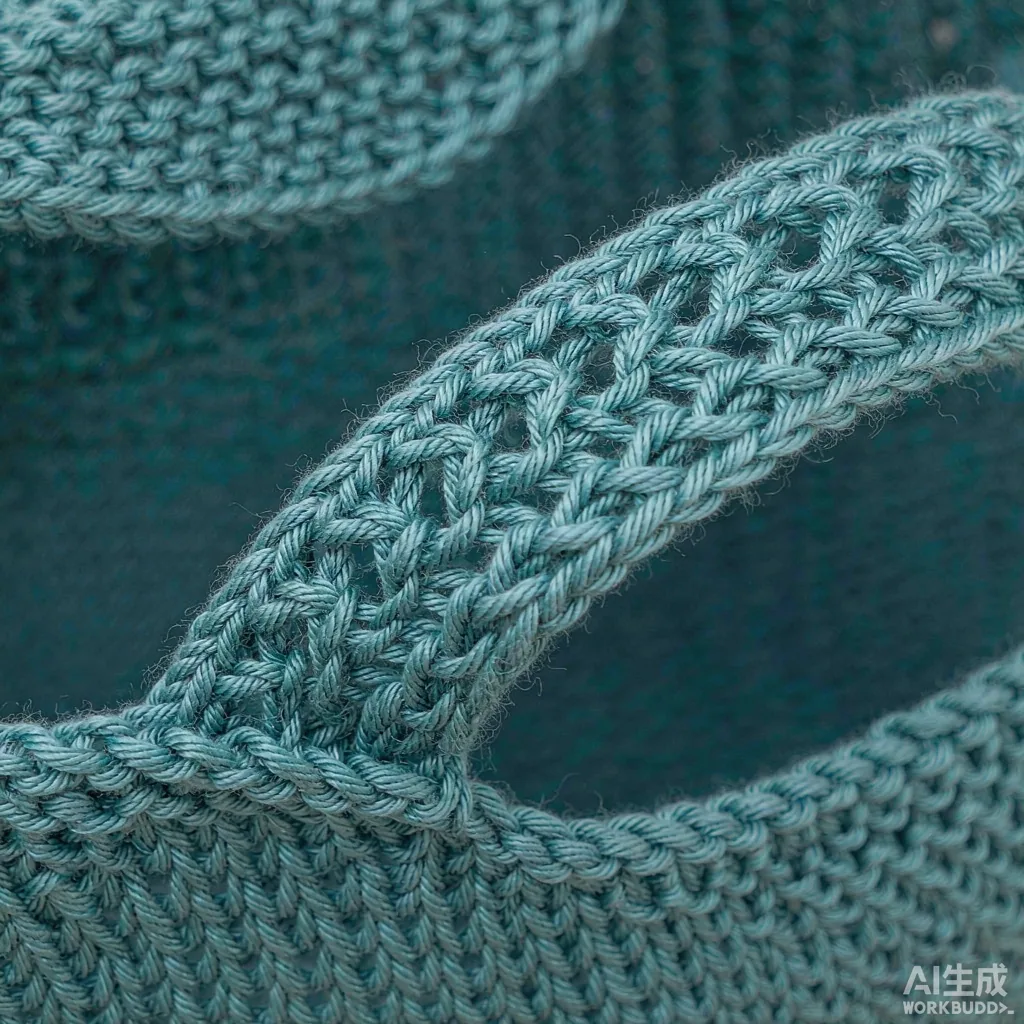
A woven fabric under tension shows a fairly straight load-extension region followed by a break. A knitted panel does not, because the loop has geometry to give up before the yarn itself is loaded. The first part of the curve is loop deformation, the second is yarn rotation and jamming, and only the third is the yarn carrying load.
The practical outcome is high elongation. A knitted bag panel routinely reaches elongation at maximum force well above what a woven of comparable mass would, and figures of 30 to 60 percent in the course direction are normal rather than alarming. A buyer who reads that number against a woven frame of reference will conclude the fabric is weak when it is simply knit.
The second outcome is recovery. A knit that has been loaded to near its maximum force may not return fully to its original dimensions, which is why tensile testing on a bag should sit alongside dimensional stability testing to ISO 5077. Strength without recovery produces a bag that survives the load and then looks wrong.
Direction, Conditioning and Wet State
Test both directions and require both on the report. On a knitted panel the course direction generally extends more and the wale direction generally carries more force, though the exact relationship depends on the stitch structure. Specifying only one direction is common and leaves the governing one unstated.
Condition in the standard atmosphere before testing. ISO 139 sets the temperature and humidity for textile conditioning, and moisture content changes both force and elongation measurably. A report that omits conditioning may be competent, but two reports prepared differently cannot be compared.
Wet-state testing is available under ISO 13934-1 and is worth specifying for a bag that will be used outdoors, carried in the rain, or laundered. A panel that loses a significant share of its dry force when wet is a real risk for a beach or market bag, and the dry figure alone will not reveal it.
| Variable | ISO 13934-1 strip | ASTM D5034 grab | Effect on the reported figure |
|---|---|---|---|
| Specimen | 50 mm wide, frayed to an exact yarn count | 100 mm by 150 mm, centre gripped | Grab results run higher on knits because ungripped loops contribute |
| Gauge length | 200 mm, or 100 mm above 75 percent elongation | 75 mm | Longer gauges include more weak points and read lower |
| Extension rate | 20 or 100 mm/min, set by expected elongation | 300 mm/min | Faster rates generally read higher |
| Machine | Constant rate of extension | Constant rate of extension | Comparable principle, different specimen and settings |
| Reported | Maximum force and elongation at maximum force | Breaking force and elongation | Elongation is often the more informative figure on a knit |
| Direction | Warp and weft, or course and wale, separately | Both directions reported separately | The weaker direction governs in service |
Setting the Force Target: Where the Number Comes From
There is no correct universal newton figure for a bag panel, and any table that suggests otherwise is hiding the end use. The defensible route is to derive the target from load: estimate the worst realistic load the bag will carry, apply a safety factor, and require the panel to hold that with margin in the weaker direction.
As an order-of-magnitude orientation, a knitted body panel from a 300D polyester typically reports in the several hundred newtons range by the strip method, while a base panel in a 600D yarn sits materially higher. Those bands move with gauge, stitch structure and finishing, which is precisely why they are orientation rather than a specification.
The better calibration is a bag already in the range. Test a bag the buyer sells and is satisfied with, under the same method, then set the new target at or above that result. One afternoon of testing produces a number that is defensible against a retailer's question, which a borrowed figure never is.
Tensile Versus Tear: Why ISO 13937 Often Fails on Knits
Buyers often ask for tear strength alongside tensile strength, and the reflex is ISO 13937, the Elmendorf pendulum method. It is a good standard and it is written primarily for woven fabrics. On a knitted structure the tear path follows the loop rather than running straight, and specimens frequently fail by yarn slippage instead of tearing.
The method itself anticipates this. Where a defined number of specimens show slippage rather than tearing, the result is invalid and the method is considered unsuitable for that material. On a knit this outcome is common enough that commissioning ISO 13937 as a matter of routine is often money spent on an unusable report.
Where tear propagation genuinely matters for a knitted bag, tongue or wing tear methods, or a combination of tensile to ISO 13934-1 and seam strength to ISO 13935-2, produce the more defensible picture. Both measure what actually happens at a loaded join, which is where bags fail.
Reading a Tensile Report: Seven Fields
A usable tensile report carries the method and edition, the specimen width and gauge length, the extension rate, the direction per result, the conditioning statement, the number of specimens, and the individual results rather than only a mean. Seven fields, and each one hides something when it is missing.
Individual results matter most. Five specimens at 620, 640, 650, 660 and 680 N describe a consistent fabric. Five at 380, 470, 650, 810 and 950 N describe the same mean and a very different one, and only the full list tells a buyer which fabric is being quoted.
Discard rules matter too. A specimen that breaks within a short distance of the jaw is a grip failure rather than a fabric failure and should be excluded under the method. Asking whether any specimens were discarded, and why, is a reasonable question and one that competent laboratories answer without hesitation.
Name the method
ISO 13934-1 strip or ASTM D5034 grab. Without it a supplier can report truthfully under whichever reads higher.
Fix the settings
Specimen width, gauge length and extension rate all move the number. State them on the request and require them on the report.
Test both directions
A knit is anisotropic. Course and wale results can differ widely, and the weaker direction governs in service.
Read elongation too
On a knit, elongation at maximum force often tells a buyer more than the force does, because it distinguishes stable from distorting.
Condition first
ISO 139 sets the conditioning atmosphere. Reports prepared under different conditions cannot be compared whatever the numbers say.
Consider wet state
For an outdoor or laundered bag, wet testing under ISO 13934-1 reveals a loss of force that dry figures hide.

Writing the Tensile Clause
The clause needs the method and edition, the specimen geometry, the extension rate, the direction, the conditioning, the minimum force, and the minimum elongation. Eight fields sounds like a lot and compresses into four lines, and every one of them prevents a conversation that would otherwise happen after the goods have shipped.
Add the construction line and the clause is complete. Requiring the tested construction to carry the same gauge and yarn count as the approved sample closes the last route by which a strong result on a different fabric can satisfy a written requirement.
The tensile clause in one line
- Tensile to ISO 13934-1, 50 mm strip, 200 mm gauge, 100 mm/min, five specimens per direction, conditioned under ISO 139, minimum 600 N and minimum 25 percent elongation at maximum force in the weaker direction, on the production construction at the stated gauge and yarn count.
Set a tensile target for a knit bag programme
Send the bag type, the yarn and the load it has to carry. We will return the method, the specimen geometry and a defensible force and elongation target, and quote FOB Xiamen at 100 pcs per style and colourway with 7 working days sampling and 30 days bulk. Start on the contact page.
Frequently Asked Questions
What tensile method should a knitted bag specification use?
ISO 13934-1 by the strip method is the common ISO route, with ASTM D5034 grab as the North American alternative. The two produce different numbers on the same fabric and are not convertible, so the method must be named alongside the minimum force, together with the specimen width and gauge length.
Why do strip and grab results differ on a knit?
A strip test loads every yarn across the specimen width. A grab test grips only the centre, and on a knit the ungripped loops transmit load sideways readily, so more of the width contributes and the grab figure runs higher. The two answer different mechanical questions rather than one question twice.
What gauge length does ISO 13934-1 use?
200 mm, reduced to 100 mm where elongation at maximum force is expected to exceed 75 percent. A longer gauge includes more weak points, so results fall as gauge length rises. State the gauge on the request, because a result without it cannot be reproduced by another laboratory.
What extension rate should be used?
ISO 13934-1 sets 20 mm/min where elongation at maximum force is below 8 percent and 100 mm/min from 8 to 75 percent, and the band has to be estimated before the run rather than read off afterwards. A faster rate generally reads higher, so two laboratories can disagree without either being wrong.
Why does a knitted panel show such high elongation?
Because the loop has geometry to give up before the yarn carries load. Loop deformation comes first, then yarn rotation and jamming, then yarn loading. Elongation at maximum force of 30 to 60 percent in the course direction is normal rather than alarming, and it should be reported alongside the force.
Should both directions be tested?
Yes. A knitted panel is strongly anisotropic and course and wale can differ widely in both force and elongation. Specifying one direction leaves the governing one unstated, and that is the one that fails. Require both on the report and set the limit against the weaker of the two.
Does conditioning affect tensile results?
It does. Moisture content changes both force and elongation measurably, so textiles are conditioned in the standard atmosphere under ISO 139 before testing. Reports prepared under different conditions cannot be compared, and a conditioning statement is one of the fields worth insisting on every time.
Should a bag fabric be tested wet?
For an outdoor, rain-exposed or laundered bag, yes. ISO 13934-1 provides for wet-state testing, and a panel that loses a significant share of its dry force when wet is a real service risk that the dry figure alone will not reveal. Beach and market bags are the usual cases.
Is ISO 13937 suitable for knitted fabrics?
Often not. The Elmendorf method is written primarily for wovens, and on a knit the tear path follows the loop and specimens frequently show slippage instead of tearing, which invalidates the result under the method itself. Tensile plus seam strength gives the more defensible picture for a bag.
What force figure should a bag panel reach?
There is no universal number. Derive it from the worst realistic load, apply a safety factor, and require margin in the weaker direction. Better still, test a bag already in the range under the same method and set the target at or above that measured result, which is defensible against a retailer.
What is a typical force range for a knitted bag panel?
As orientation only, a 300D polyester body panel typically reports in the several hundred newtons range by the strip method, and a 600D base panel materially higher. Both move with gauge, stitch structure and finishing, so they are orientation rather than specification limits to be written into an order.
What should a tensile report contain?
Method and edition, specimen width and gauge length, extension rate, direction per result, conditioning statement, specimen count, and individual results rather than only a mean. Seven fields, and a report missing any one of them cannot be checked against the specification it was written to satisfy.
Why do individual specimen results matter?
The spread is diagnostic. Five results clustered tightly describe a consistent fabric; five results spread widely describe the same mean and a very different fabric. Only the full list reveals which was tested, and a single averaged figure hides exactly the inconsistency a buyer needs to see.
What is a jaw break and why is it discarded?
A break close to the jaw is a grip failure rather than a fabric failure and should be excluded under the method. Asking how many specimens were discarded and why is a reasonable question for any competent laboratory, and the answer belongs on the report rather than in a verbal assurance.
How does tensile testing relate to dimensional stability?
They are complementary. A knit loaded near maximum force may not recover its original dimensions, so tensile strength should sit alongside dimensional change testing to ISO 5077. Otherwise a bag survives the load and then looks wrong on the shelf, which is the same commercial outcome as failing.
People Also Ask
What is tensile strength testing for bags?
A laboratory measurement of the maximum force a fabric specimen withstands before rupture, plus the elongation at that force. It is run on a constant rate of extension machine, usually to ISO 13934-1 or ASTM D5034.
What is the difference between strip and grab tensile tests?
A strip test grips the full specimen width so every yarn is loaded. A grab test grips only the centre of a wider specimen, and on a knit the surrounding loops contribute, so grab figures run higher.
What force should a knitted bag fabric reach?
There is no universal figure. Derive it from the realistic service load with a safety factor, or test a bag already in the range and set the target at or above that result.
Why is elongation high on knitted bag fabric?
The loop gives up geometry before the yarn carries load, so extension is large. Elongation of 30 to 60 percent in the course direction is normal for a knit rather than a sign of weakness.
Can ISO 13937 tear testing be used on knits?
Rarely. The Elmendorf method is written for wovens and on a knit the tear follows the loop or the specimen slips, which invalidates the result. Use tensile plus seam strength instead.
Sources and further reading
Every figure on this page is either our own programme data or attributed below. Open the originals before you write them into a specification.
- ISO 13934-1:2013 — Textiles, tensile properties of fabrics, Part 1: maximum force using the strip methodISO The strip method, including the 50 mm specimen, the 200 mm gauge length and the extension rate tied to expected elongation.
- ASTM D5034 Breaking Strength and Elongation of Textile Fabrics (Grab Test)ASTM International The grab method compared here, and the reason its results do not convert to ISO 13934-1 strip figures.
- ASTM D5035 Breaking Force and Elongation of Textile Fabrics (Strip Method)ASTM International The ASTM strip route, named alongside the grab method and the ISO strip method.
- ISO 13937-1:2000 — Textiles, tear properties of fabrics, Part 1: tear force by ballistic pendulum (Elmendorf)ISO The tear method flagged as frequently unsuitable for knitted structures because the tear path follows the loop.
- ISO 139:2005 — Textiles, standard atmospheres for conditioning and testingISO The conditioning atmosphere required before tensile testing, because moisture content changes force and elongation.
- ISO 5077:2007 — Textiles, determination of dimensional change in washing and dryingISO The dimensional stability test that complements tensile strength where a knit does not recover after loading.