Knitted Bag Storytelling: Turning Seamless Knit Construction Into a Claim a Buyer Can Verify
A brand team spent two seasons writing a heritage story for a seamless knit range and could not explain why it was not converting, until a buyer pointed out that the story contained nothing a buyer could check. Knit is unusual in that its differentiating property is physically verifiable: the body has no seam, the loop structure can be handled, and the construction can be traced to a machine class. The workable approach is to build the narrative from three proof types — construction, material and programme — with one hero claim per product stated in twelve words or fewer, and every claim backed by a named method. This article sets out the proof types, the story beats, the claim boundaries and the shelf execution.
Why Knit Construction Is a Story a Buyer Can Check
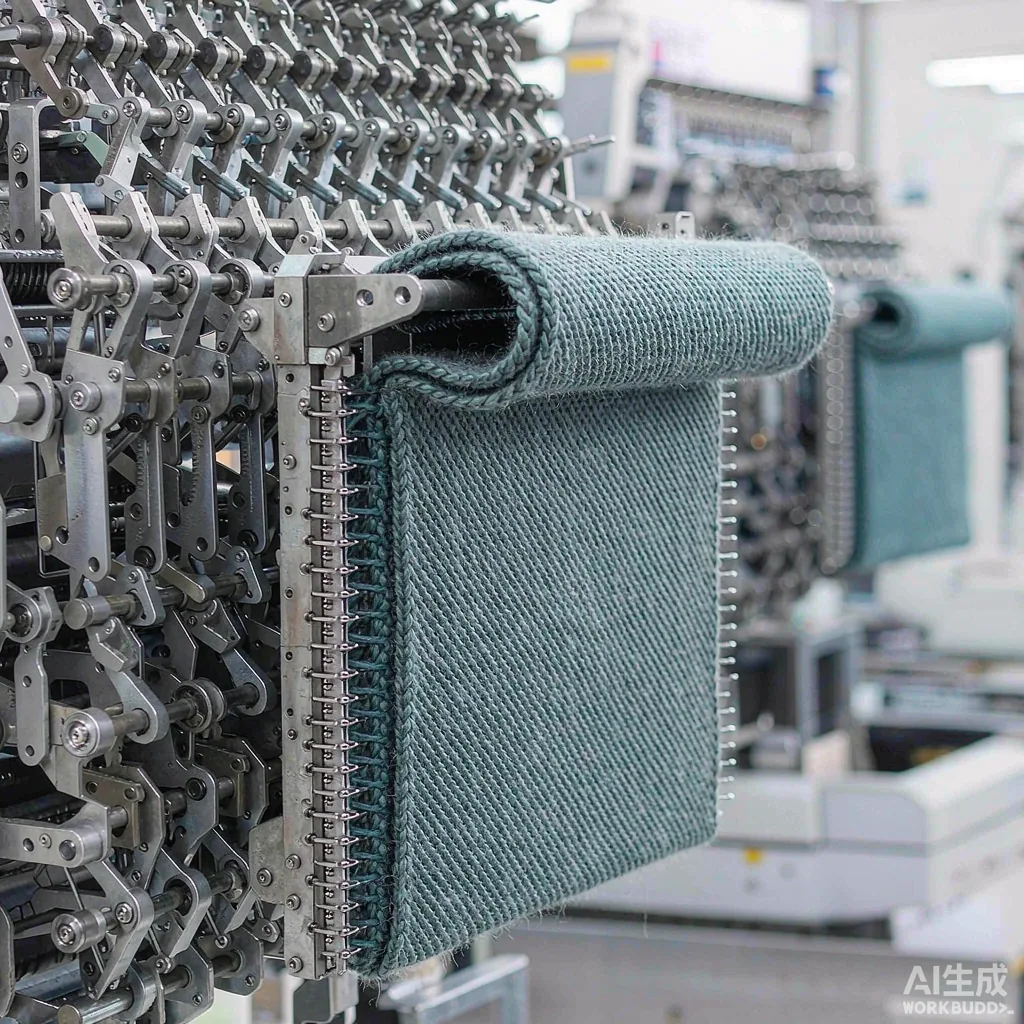
Knit construction is unusual among material stories because it is verifiable by the reader: a seamless body has no seam to find, a loop structure can be handled, and both can be confirmed in about ten seconds without trusting a word of the copy.
That property changes what a narrative has to do. Most material stories are assertions the reader must accept — a heritage date, a craft tradition, a founder's intention — and the reader's only option is belief. A knit story offers evidence instead: the edge of the body is not cut, the shoulder is continuous with the panel, and the whole thing was made on a machine that knits a complete form rather than a flat panel. Once a brand recognises this, the temptation to write a heritage narrative at all begins to look like a waste of the one asset the product actually has. The case that opened this article is typical: two seasons of origin prose sitting above a product whose construction was more interesting than anything the prose said.
The Three Proof Types: Construction, Material, Programme
Three proof types carry a knitted bag narrative — construction, material and programme — and each answers a different buyer question: how it is made, what it is made of, and who can deliver it at volume.
Separating them matters because they have different evidentiary standards and different shelf lives. Construction proof is a fact about the object and never expires: the body is knitted in one piece, at gauge E12, on a whole-garment bed. Material proof is a fact about the input and expires with the certificate: recycled content certified to the Global Recycled Standard, harmful-substance testing to OEKO-TEX STANDARD 100. Programme proof is a fact about the capability behind the range and is what a retail buyer actually asks for: knit bag programmes coordinated since 2014, seven production lines, about 200,000 pcs per month, and an AQL 2.5 release under ISO 2859-1. A narrative built on all three is robust; one built on any single type can be undermined by a single question.
- Construction proof
- Seamless body knitted in one piece at gauge E12, verifiable on the object itself
- Material proof
- Recycled content certified to the Global Recycled Standard; OEKO-TEX STANDARD 100 testing
- Programme proof
- Programmes coordinated since 2014, seven production lines, about 200,000 pcs per month
- Release proof
- AQL 2.5 inspection under ISO 2859-1 on every bulk lot
- Durability proof
- Abrasion resistance to ISO 12947-2, quoted with the cycle figure achieved
- Hero claim length
- Twelve words or fewer, one per product, never five competing claims
One Hero Claim per Product, Not Five
A knitted bag product should carry one hero claim stated in twelve words or fewer, because a reader retains a single proposition and a page offering five leaves the reader with none of them.
The twelve-word limit is not stylistic pedantry. A claim that survives in memory is a claim that can be repeated by a sales assistant without notes, and twelve words is roughly the length of a sentence a person can reproduce after one reading. A hero claim for a seamless tote might be: knitted in one piece, so there is no seam to fail. That is eleven words, it names the construction, it states the consequence, and a shop assistant can repeat it. The claims that usually surround it — durable, lightweight, sustainable, versatile, considered — are adjectives rather than propositions, and stacking five of them dilutes the one that is actually differentiating. The test is simple: ask someone who read the page yesterday what the product does, and whatever they say is the hero claim whether or not it was intended as one.
Writing the Origin Beat Without Inventing Anything
An origin beat should state when the knit programme began, what machine class it runs and what volume it supports, and nothing else, because every addition beyond those three facts is an invitation to be checked.
This is where knit narratives most often go wrong, and the failure is always the same shape: a founding date is invented, a craft lineage is implied, or a place is named that has nothing to do with where the work happens. The remedy is to write the origin beat from the three facts that are both true and interesting. A knit bag programme coordinated since 2014 is a genuine statement and a decade is a meaningful figure. Seven production lines running about 200,000 pcs per month is a capability statement a retail buyer can act on. A whole-garment bed from a named machine class is a technical provenance that connects the product to a documented lineage of seamless knitting. None of these requires invention, and all three are more persuasive than a story about a workshop.
| Story beat | What it states | Evidence behind it |
|---|---|---|
| Construction | Knitted in one piece, no cut-and-sew assembly | The object itself; a detail photograph of the shoulder |
| Material | Recycled content, tested for harmful substances | Global Recycled Standard certificate; OEKO-TEX STANDARD 100 |
| Origin | Programmes coordinated since 2014 on seven production lines | The capability statement a retail buyer asks for |
| Durability | Abrasion resistance and colour fastness figures | ISO 12947-2 and ISO 105-X12 reports with the grades achieved |
| Programme | Sampling 7 working days, bulk 30 days, MOQ 100 pcs | The commercial terms quoted on the order, not on the page |
Story Beats Across a Product Page
A knitted bag page should run its story in four beats in a fixed order — what it is, how it is made, what it is made of, and what stands behind it — because that is the order in which a sceptical reader tests a claim.
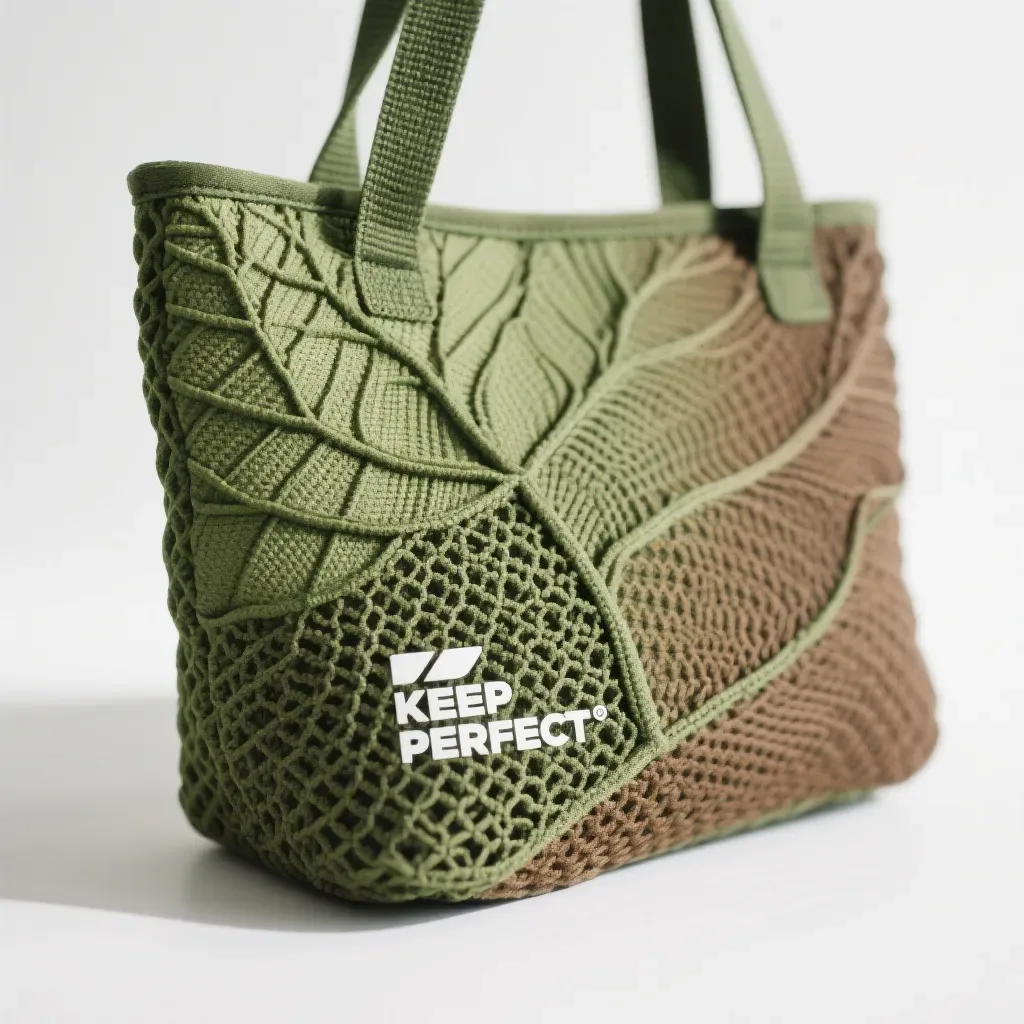
Reading order and doubt order are the same, and a page that answers out of sequence reads as evasive. A reader who has just been told a bag is seamless asks how; a page that answers with a material claim instead looks like it is changing the subject. The second consequence of the fixed order is that it forces economy: four beats at roughly 60 words each is 240 words, which fits inside a 350-word body allowance and leaves room for the specification block. The story does not need more space than that, because the evidence is elsewhere — in the object, in the detail photograph and in the test report — and the page only has to point at it.
What Storytelling Must Not Say: Claim Boundaries
Four claims must never appear on a knitted bag page: an unmeasured durability absolute, an unscoped environmental claim, an invented provenance, and a comparison against an unnamed product.
Claim boundaries for a knit narrative
- No unmeasured absolutes: indestructible and tear-proof cannot be tested and must not be written.
- No unscoped environmental claims: state the percentage recycled and the scheme behind it.
- No invented provenance: a decade since 2014 is a fact; a heritage invented for the page is not.
- No comparison against an unnamed product: name the comparator or drop the comparison.
- No claim without a method: every figure on the page carries the test standard it was measured against.
- No implied claim in a photograph that the copy would not state in words.
The environmental boundary deserves particular attention because it is the one most often crossed by accident. Recycled content, sustainable materials and circular design are all regulated descriptions in several markets, and the EU rules on empowering consumers for the green transition require an environmental claim to be substantiated and scoped. On a knit range the compliant form is short: 62% recycled polyester, certified to the Global Recycled Standard. That sentence is defensible, specific and shorter than the vague claim it replaces. The comparison boundary works similarly: a claim that a knit body outlasts a woven one is only publishable if the comparator, the test method and the figure are all named.
Packaging, Hangtag and the Story at Shelf
A knitted bag hangtag should carry three items — the twelve-word hero claim, the construction statement and one evidence line — because the tag is read at the moment of the purchase decision and has room for no more than three.
Shelf execution is where most narratives are lost, not because the story is weak but because the tag is cluttered. A typical hangtag carries a brand mark, a price, a barcode, a care block, a material statement, a sustainability paragraph and a country-of-origin line, and the hero claim is buried somewhere in the middle of that. The fix is a hierarchy rather than a reduction: the front of the tag carries the hero claim and the construction statement, and everything required by regulation moves to the back. The evidence line is the one addition worth making — a single sentence naming the abrasion figure and the standard, because it converts the hero claim from an assertion into a measurement at exactly the moment the shopper is deciding. The three items should be set in one type size order on the tag, with the claim largest, and the tag should be attached where the shopper's hand naturally goes, which on a tote is the handle rather than the body.
Keeping the Story Consistent Across Channels
One narrative should be written once and distributed as a claim table rather than rewritten per channel, because a story retold by four teams produces four versions and the differences are what a buyer notices.
Hero claim
Twelve words, identical in every channel, from the hangtag to the marketplace listing. The one string that must never be rewritten.
Evidence table
One table of claims with the test method and figure behind each. Distributed as a file, never retyped per channel.
Beat order
Four beats in a fixed sequence, so a reader moving from a marketplace page to a brand page meets the same argument in the same order.
Local evidence
The schemes a market recognises may differ; swap the scheme, never the claim. Recycled content stays 62% everywhere.
The mechanism that keeps this together is unglamorous: a single claim table held by the brand team, with one row per claim and three columns — the wording, the evidence and the markets where it is approved. Every channel pulls from that table rather than from a previous channel's copy, which prevents the most common failure, where a marketplace listing written first becomes the source for a brand page written second and an error in the first is propagated. The table also keeps the review cycle short: when a certificate expires or a figure is re-tested, one row changes rather than a search across every channel.
Build the proof behind a knit narrative
Send the claims you want to make and the markets you sell into. Our knit team will return a claim table with the test method behind each line, a twelve-word hero claim per style, and a programme plan at MOQ 100 pcs per style and colourway, 7 working days of sampling and 30 days of bulk. Start on the contact page.
Frequently Asked Questions
Why is knit easier to tell a story about than other materials?
Because the differentiating property is verifiable by the reader. A seamless body has no seam to find and a loop structure can be handled, so the claim can be checked in about ten seconds without trusting the copy at all.
What are the three proof types in a knit narrative?
Construction, material and programme. Construction is a fact about the object; material is a fact about the input and expires with the certificate; programme is the capability statement a retail buyer asks for.
How many claims should one knitted bag product carry?
One hero claim, stated in twelve words or fewer. A reader retains a single proposition, and twelve words is roughly the length a sales assistant can repeat after one reading without notes.
What should the origin beat say?
When the knit programme began, what machine class it runs and what volume it supports. Programmes coordinated since 2014, seven production lines and about 200,000 pcs per month are all true, interesting and checkable.
Can a brand write a heritage story for a knit range?
Only if it is true. An invented founding date or workshop is the most common failure in knit storytelling, and it is unnecessary: a decade since 2014 and a named machine class are more persuasive than invented provenance.
What claims must never appear on a knitted bag page?
Four: an unmeasured durability absolute, an unscoped environmental claim, an invented provenance, and a comparison against an unnamed product. Each is either untestable or unsubstantiated.
How should recycled content be stated?
As a percentage with the scheme behind it, for example 62% recycled polyester certified to the Global Recycled Standard. That form is compliant in markets that regulate environmental claims and is shorter than a vague claim.
What goes on the front of a knitted bag hangtag?
The twelve-word hero claim and the construction statement. Everything required by regulation moves to the reverse, because a tag with a hierarchy is read and a cluttered tag is not.
Should the story be rewritten for each market?
No. Swap the certification scheme a market recognises, never the claim. Recycled content stays at the same percentage everywhere, because a figure that moves between markets looks like a figure that was chosen.
What is a claim table and who holds it?
One table with a row per claim and three columns: the wording, the evidence and the approved markets. The brand team holds it and every channel pulls from it, so an error is never propagated from one listing to another.
Do photographs count as claims?
Yes. A detail crop showing a continuous shoulder implies a seamless construction, and an implied claim is held to the same standard as a written one. Never publish an image the copy would not state in words.
How long should the story section of a page be?
About 240 words across four beats of roughly 60 words each. That fits inside a 350-word body allowance and leaves room for the specification block, which is where the purchase decision is actually made.
Can a knit range claim to outlast a woven one?
Only with the comparator, the test method and the figure named. Abrasion resistance to ISO 12947-2 at a stated cycle count is publishable; a general assertion about durability is not.
How often should a claim table be reviewed?
Once per season and immediately when a certificate expires or a figure is re-tested. Holding the claims in one table means one row changes rather than a search across every channel.
People Also Ask
How do you write a brand story for a product?
Build it from proof rather than heritage: state the construction in twelve words, then back it with a named test method. On a knit product the object itself is the evidence.
What makes a product claim credible?
A named method and a figure. Abrasion to ISO 12947-2 at a stated cycle count is credible; a general assertion about durability is not, because it cannot be checked.
How many claims should a product page make?
One hero claim in twelve words or fewer. A reader retains a single proposition, and stacking five adjectives dilutes the one claim that actually differentiates the product.
Should packaging repeat the marketing story?
Only the hero claim and the construction statement, on the front of the tag. Required statements go on the reverse, because a cluttered tag is not read at all.
Can the same story run in every country?
Yes, with the certification scheme swapped per market. Never change the claim or the percentage between markets; a figure that moves looks chosen rather than measured.
Sources and further reading
Every figure on this page is either our own programme data or attributed below. Open the originals before you write them into a specification.
- Directive (EU) 2024/825 on empowering consumers for the green transitionEuropean Union The rules requiring environmental claims on a knitted bag page to be substantiated and scoped.
- ISO 12947-2:2016 — Textiles, determination of abrasion resistance by the Martindale methodISO The method behind the durability figure quoted in a hero claim's evidence line.
- Global Recycled Standard (GRS)Textile Exchange The scheme behind a recycled-content percentage stated on a hangtag or page.
- OEKO-TEX STANDARD 100OEKO-TEX The harmful-substance testing scheme named in the material proof type.
- WHOLEGARMENT knitting machinesShima Seiki The machine class that provides the technical provenance in the origin beat.
- ISO 2859-1 — Sampling procedures for inspection by attributes, Part 1: AQL-indexed sampling schemesISO Defines the AQL 2.5 release named in the programme proof type.
The Object Is the Argument
A knit range has an advantage no heritage story can match: the claim can be verified by the reader, in the hand, in ten seconds. The narrative's job is not to add belief to that but to point at it — one twelve-word claim, four beats in a fixed order, and a table of evidence behind every figure. Everything else is decoration that competes with the product's own argument.
For the customer-facing explanation that follows the story, see knitted bag customer education. For the policy that stands behind the durability claim, see knitted bag care and warranty, and for the range the story has to cover, see knitted bag assortment planning. The cluster overview sits under knit bag brand guide.