How a Knitted Bag Sample Is Made: Six Questions Through the 7-Day Window, Answered Hour by Hour
What actually happens between a signed tech pack and a sample in the post? Six questions cover it: four hours of programming, a bed that runs for about 27 minutes to produce three pieces, a setting cycle that has to precede any judgement, a buyer decision at the fit, two days on trim and lining, and a day of measurement and packing. Total 7 working days. This article answers each in order with the hours attached, so a buyer can see where their own decision points sit and what happens while they are deciding.
Question One: What Happens in the First Four Hours?
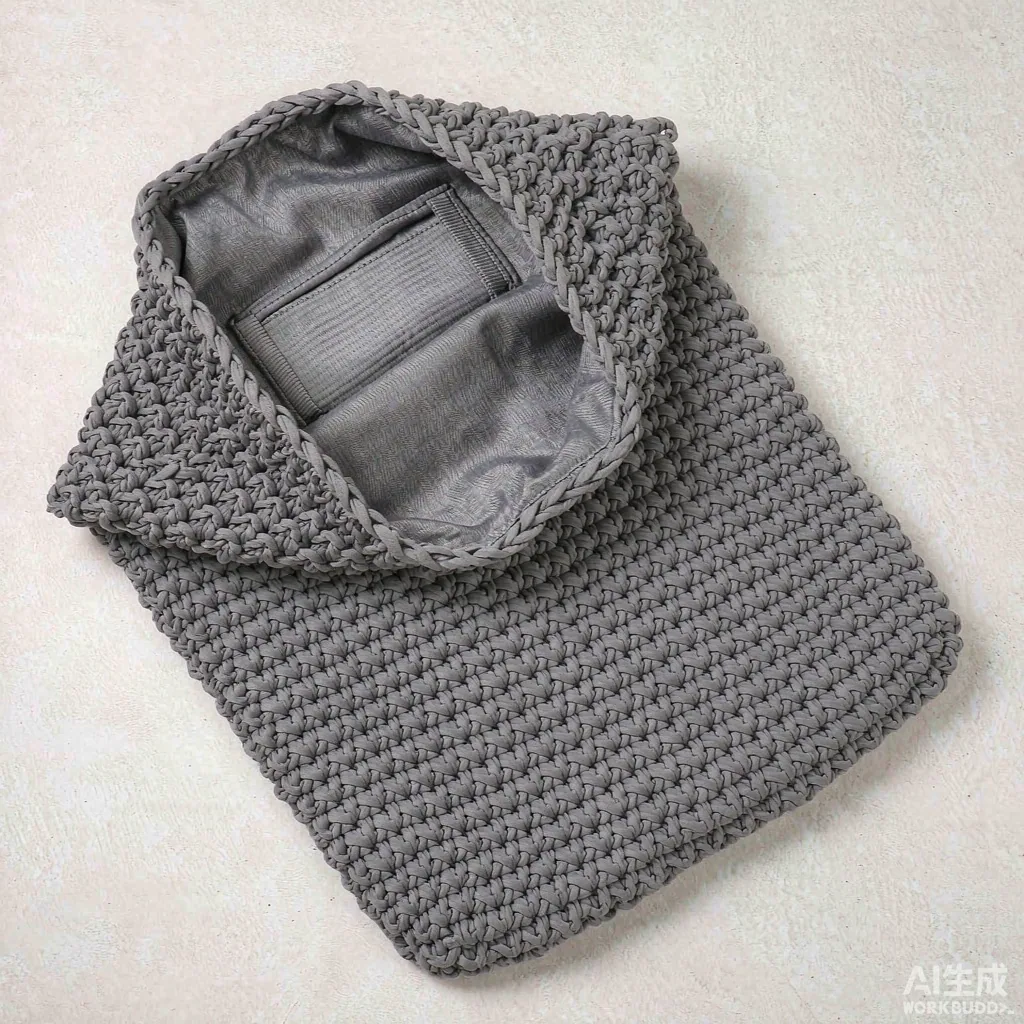
The first four hours are programming and bed set-up, and no yarn is consumed: the silhouette is written as a knitting file, simulated, and the bed is set up for the gauge and the yarn that will actually be used.
Programming converts the brief into a per-loop instruction set. At E12 a 380 mm body is roughly 180 to 240 wales by 240 to 300 courses, and the programmer decides the stitch structure, the shaping sequence, the reinforcement band and the take-down profile for each section. The simulation pass then runs the programme virtually, flagging illegal transfers, carrier conflicts and cam conflicts before any yarn is loaded. Bed set-up follows and takes about 1.5 hours: cones loaded, tension set to the band for the count in use, needles checked, and the feeder set for that specific count rather than carried from the previous run.
None of this produces a bag, which is why it is the stage buyers are most tempted to compress. It is also the stage where a change costs nothing at all: no yarn has been bought for the run, no bed has been booked and no piece exists. A revision written at hour three costs minutes. The same revision raised at hour forty costs a day, and raised after yarn booking it can cost ten days or more.
Question Two: How Long Does the Bed Actually Run?
About 27 minutes of machine time to produce three sample pieces at a 9-minute cycle, which is a small fraction of the 7-day window and the reason buyers who focus on knitting speed are optimising the wrong thing.
Three pieces are standard on a sampling run: one to keep as the approved reference, one to test and wash, and one to photograph or send on. At E12 in 300D each takes about 9 minutes, so the bed is occupied for roughly half an hour in a window that runs to seven days. The disproportion is the point. Sampling is not slow because knitting is slow; it is slow because of the conditioning, the decision loop and the trim work that surround the knitting. A buyer who asks how to make sampling faster should be asking about those three, and the answer usually involves supplying the trim list earlier rather than asking for a faster bed.
- Three pieces at about 9 minutes each: roughly 27 minutes of bed time.
- Piece one is held as the approved reference and tagged with the file revision that produced it.
- Piece two goes to testing: strip tensile, abrasion, dimensional change after washing.
- Piece three is photographed or sent to the buyer.
- The bed is idle for the rest of the window while conditioning, decisions and trim work happen.
Question Three: Why Is the Sample Set Before It Is Judged?
Because a knitted body leaves the bed under tension and keeps relaxing afterwards, so a fit judgement made on an unset piece is a judgement about a shape that no longer exists — which is why heat setting and 24 hours of conditioning come before the buyer sees it.
The setting cycle takes about 25 minutes per piece at 160 to 180 °C, followed by cooling to below 40 °C before handling. Conditioning then runs for 24 hours at 20 °C and 65% relative humidity under ISO 139. Those two steps consume more of the sampling calendar than the knitting does, and they are the reason a sample cannot be produced on demand. The commercial consequence for a buyer is worth stating plainly: the fastest way to shorten a sampling window is not a faster bed but an earlier decision, because the clock is mostly waiting for the buyer rather than for the machine.
Question Four: What Does the Buyer Decide at the Fit?
The fit assessment is the first true decision point, and it should answer four things separately — silhouette, hand and drape, dimensions against tolerance, and the load path — because a comment that mixes them sends the correction to the wrong place.
Silhouette and hand are the two most often confused. A comment that a bag feels too soft is a gauge or yarn question; a comment that it looks wrong is a shaping question. They have different fixes, and the fix for the second is in the file while the fix for the first may be in the yarn booking. Dimensions are measured at twelve points: length and width at two heights, base depth at each end, handle drop on both handles, aperture width and height, and GSM on a conditioned sample. The load path question is the one buyers forget to ask: pick the bag up loaded to its stated weight and look at the handle root, because that is where the design either works or does not.
- Programming and simulation
- about 4 hours
- Bed set-up
- about 1.5 hours
- First knit, three pieces at 9 minutes
- about 27 minutes
- Heat setting and cooling
- about 25 minutes per piece
- Conditioning before judgement
- 24 hours at 20 °C and 65% relative humidity, ISO 139
- Fit assessment
- 1 working day, buyer decision point
- Structural correction
- 1 working day, round one of two
- Trim and lining
- 2 working days
- Measurement, photography and packing
- 1 working day
Question Five: What Takes Two Days in a Seven-Day Window?
Trim and lining take two of the seven days, more than the knitting and the setting combined, because a zip, a lining, hardware and a label are each a discrete placement needing a jig and a check rather than one continuous operation.
This is the block most worth attacking and the one buyers most often overlook. A zip at 480 mm closed length, a 190T taffeta lining with a pocket, two D-rings and a woven label set 60 mm from the side edge are four separate operations, and none of them is made faster by a better knitting programme. The options are to sample the body untrimmed first and approve a trimmed sample second, which costs a second cycle but makes the structural decision cleanly, or to reduce the component count, which is a design decision rather than a scheduling one. Buyers who supply the trim list at the same time as the tech pack get the shorter window, because the trim can be staged while the programme is being written.
Question Six: What Leaves the Building on Day Seven?
A sample pack containing three pieces, a measurement sheet with twelve points, a sample record stating gauge, yarn lot and GSM, and a file revision number — and the record is the part that matters, because it is what bulk will be compared against.
The measurement sheet should carry body length and width at two heights, base depth at each end, handle drop on both handles, aperture width and height, and GSM on a conditioned sample. The sample record should carry gauge, yarn count and lot reference, target and measured GSM, setting temperature and dwell, and the file revision. Without those, bulk is compared against a photograph and a memory, and that is how an approved sample becomes a disputed shipment. Photographs come last, and they are worth taking in the same lighting conditions as the retail photography, because a knitted surface reads very differently under different light.
What should be in the sample pack
- Three pieces: reference, test piece and photography piece
- Measurement sheet with twelve points, taken after conditioning
- Sample record: gauge, yarn lot, target and measured GSM, setting parameters
- File revision number, matching the tag on the reference piece
- Trim list as fitted, with any substitution noted
- Photographs under the lighting the retail team will use
The Hour-by-Hour Timeline
Across 7 working days the hours break down as roughly 5.5 hours of machine and set-up work, 25 hours of conditioning, one full day of buyer decision, one day of correction, two days of trim and one day of measurement — and five of the seven days are waiting rather than working.
| Day | Stage | Elapsed time | Who acts |
|---|---|---|---|
| Day 1 | Programming, simulation and bed set-up | about 5.5 hours | Programmer and set-up team |
| Day 2 | First knit, heat setting, into conditioning | about 1 hour of work, 24 hours of conditioning | Bed, then no one |
| Day 3 | Fit assessment after conditioning | 1 working day | Buyer decision |
| Day 4 | Structural correction, round one of two | 1 working day | Programmer and bed |
| Days 5 and 6 | Trim, lining, hardware and label | 2 working days | Finishing team |
| Day 7 | Measurement at twelve points, photography, packing | 1 working day | Quality and packing |
| Total | Six stages across 7 working days | about 11 hours of work, 24 hours of conditioning | One buyer decision point |
What a Sample Costs and What It Is Worth
A sample costs three pieces of bed time, two days of finishing labour and a place in the sampling queue, and it is worth the difference between a bulk run that matches and one that does not — which is the entire argument for taking the full 7 days rather than compressing it.
The temptation to compress usually comes from the retail calendar rather than from the production side, and the compression available is real but limited. Sampling the body untrimmed gets to about five days. Booking yarn before the first fit, on the concurrent route, gets to five as well. What cannot be compressed is the 24-hour conditioning, because it is a physical requirement rather than a process step. A buyer who skips it gets an approval that does not predict bulk, and the saving of a day is repaid with interest at the pre-shipment inspection.
Programme windows follow: MOQ 100 pcs per style and per colourway, bulk 30 days, 7 production lines at about 200,000 pcs per month, AQL 2.5 release under ISO 2859-1 and FOB Xiamen as the standard term. The reference unit cost for a standard E12 tote at specification is USD 4.80. For the routing choices that shape this window, see knitted bag design to sample in six steps.
What the Sample Tells You About the Bulk Run
A sample is a prediction, and the only way to read it correctly is to treat every figure on the sample record as a specification rather than a description — gauge, yarn lot, measured GSM, setting parameters and file revision are the five that bulk will be held against.
Read that way, the sample answers questions the buyer has not yet asked. A measured GSM 4% above target tells you the stitch density is high and the cycle time will be longer than quoted, which is a cost conversation worth having before bulk rather than after. A handle drop 5 mm over tolerance tells you the setting former is not holding the aperture, which will scale across the whole run rather than average out. A file revision one increment behind the approved tag tells you the bulk body may look identical and behave differently. None of these are visible in a photograph, and all of them are visible on the record sheet.
The practical discipline is to compare the sample record against the tech pack line by line before releasing bulk, and to resolve any difference while the programme is still in the file stage. A discrepancy found there costs minutes. The same discrepancy found at the pre-shipment AQL 2.5 inspection costs a lot or a re-knit, and by then the yarn for the whole order has already been booked against the wrong assumption.
Book a sampling slot for your brief
Send the silhouette, the gauge preference, the yarn count and the target GSM. Our knit team will return a day-by-day sampling plan with the decision points marked, and a costed quote against MOQ 100 pcs per style, 7 working days of sampling and 30 days of bulk production. Start on the contact page.
Frequently Asked Questions
How long does it take to make a knitted bag sample?
Seven working days from a signed tech pack. The breakdown is about 5.5 hours of programming and set-up, roughly 27 minutes of bed time for three pieces, 24 hours of conditioning, one day of buyer decision, one day of correction, two days of trim and one day of measurement.
How many sample pieces are made?
Three. One is kept as the approved reference and tagged with the file revision that produced it, one goes to testing for strip tensile, abrasion and dimensional change, and one is photographed or sent to the buyer.
How long does the machine actually run during sampling?
About 27 minutes for three pieces at a 9-minute cycle. That is a small fraction of the seven-day window, which is why knitting speed is not the lever for a shorter sampling calendar. Conditioning, decisions and trim work are.
Why does the sample have to be conditioned for 24 hours?
A knitted body leaves the bed under tension and keeps relaxing afterwards. Conditioning for 24 hours at 20 °C and 65% relative humidity under ISO 139 stabilises it, so the fit judgement and the measurements predict how the bulk run will behave.
What is heat setting and how long does it take on a sample?
Relaxing the loop structure and locking the silhouette, at 160 to 180 °C for about 25 minutes per piece, followed by cooling to below 40 °C before handling. Without it, the sample measures differently from day to day and the approval does not predict bulk.
What does the buyer have to decide at the fit assessment?
Four things, kept separate: silhouette, hand and drape, dimensions against tolerance, and the load path. Mixing them sends the correction to the wrong place, because a shaping problem is fixed in the file while a hand problem may be a yarn question.
Why does trim take two days?
Because a zip, a lining, hardware and a label are each a discrete placement needing a jig and a check, rather than one continuous operation. Supplying the trim list with the tech pack lets trim be staged while the programme is written.
Can the sampling window be shortened?
To about five days, either by sampling the body untrimmed first or by booking yarn before the first fit. The 24-hour conditioning cannot be compressed, because it is a physical requirement rather than a process step.
What should be in the sample pack?
Three pieces, a measurement sheet with twelve points taken after conditioning, a sample record stating gauge, yarn lot, target and measured GSM and setting parameters, the file revision number, the trim list as fitted and photographs.
Why is the file revision number on the sample tag important?
Because bulk must run the revision that produced the approved piece. Small revisions change behaviour without changing appearance much, so a bulk run knitted from an earlier revision can measure correctly and still fail in use.
How many points are measured on a sample?
Twelve: body length and width at two heights, base depth at each end, handle drop on both handles, aperture width and height, and GSM taken on a conditioned sample. Measuring at two heights catches a body that is correct at the base and wrong at the mouth.
What tolerance is the sample measured against?
Plus or minus 3 mm on a 380 mm body dimension, plus or minus 3 mm on handle drop, and plus or minus 2% on finished GSM. Dimensional change after the agreed wash cycle should stay within 3% in both length and width.
What happens if the sample fails the fit?
A structural correction, which is a programme error and is inside the quoted sampling scope at one working day. A change of brief is a specification correction, which consumes a correction round and may consume a yarn booking.
How many correction rounds are included?
Two, inside the 7-working-day window. Naming which kind of correction a request is at the moment it is made is the most useful habit a buying team can adopt, because the two have very different effects on the calendar.
Does the sample use the production yarn?
It should. A sample knitted in a substitute yarn because the specified lot has not arrived will differ in hand and GSM, and the approval will not survive bulk. Where a substitute is unavoidable, approve shape only and re-approve hand and GSM later.
What happens after the sample is approved?
Bulk runs to 30 days: yarn booking across the first 10 days, knitting across days 8 to 20, finishing and trim across days 18 to 26, and inspection, packing and the AQL 2.5 release across days 24 to 30, against MOQ 100 pcs per style and per colourway.
People Also Ask
Can I get a knitted bag sample in three days?
Not with conditioning included. The 24-hour conditioning is a physical requirement, so five days is the practical floor, reached by sampling the body untrimmed or by booking yarn before the first fit.
Why is sampling slower than I expected?
Because five of the seven days are waiting rather than working: 24 hours of conditioning, a day of buyer decision and two days of trim. Only about 11 hours of the window is active work.
Should I approve the sample before or after washing tests?
Approve shape and dimensions first, then confirm hand, GSM and dimensional change on the test piece. A washed piece changes, and approving everything at once risks rejecting a body that is correct.
Do I need to attend the fit assessment?
You need to answer at it, which is not the same thing. Supplying a written decision checklist in advance lets the assessment proceed without a call, and it is the buyer answers rather than the work that hold the window open.
What is the most common sampling mistake?
Approving from a photograph. Photographs do not carry gauge, yarn lot, GSM or file revision, and those four figures are what bulk is compared against. Ask for the sample record with the photographs.
Sources and further reading
Every figure on this page is either our own programme data or attributed below. Open the originals before you write them into a specification.
- ISO 139:2005 — Textiles, standard atmospheres for conditioning and testingISO Defines the 20 °C and 65% relative humidity conditioning that occupies the longest stage of the sampling window.
- ISO 13934-1:2013 — Textiles, tensile properties of fabrics, Part 1: maximum force using the strip methodISO The test run on the second sample piece to confirm the load path before approval.
- ISO 2859-1:2026 — Sampling procedures for inspection by attributes, Part 1: AQL-indexed sampling schemesISO Defines the sampling plan behind the AQL 2.5 release that follows bulk production after approval.
- AATCC — American Association of Textile Chemists and ColoristsAATCC Source of the dimensional change method run on the test piece taken from the sample pack.
- OEKO-TEX STANDARD 100OEKO-TEX Finished-textile testing for harmful substances, requested alongside REACH and Prop 65 on knit bag programmes.
The Window Is Mostly Waiting, and the Waiting Is Mostly the Buyer's
Only about 11 hours of a 7-working-day sampling window is active work. The rest is conditioning, decision and trim. That means the fastest way to a shorter calendar is not a faster bed or a shorter conditioning period, but a buyer who answers at the decision point with a written checklist and supplies the trim list with the tech pack.
For the routing choices that shape the window, see knitted bag design to sample in six steps. For the programme windows that follow approval, see custom knit bags.