Knitted Bag Assembly Workflow: Seven Stations, the Minutes Each One Takes, and Where the Bottleneck Sits
What does a knitted bag assembly workflow actually look like, station by station? From cone to packed carton, a 300D rPET tote at E12 passes through seven stations and about 21 minutes of touch time: 9 minutes on the needle bed, 1 minute of yarn preparation, 1.5 of set-up, 2.5 of heat setting, 4 of joining and trim, 1.5 of measurement and 1.5 of inspection and packing. Capacity behind it is 7 production lines at about 200,000 pcs per month, MOQ 100 pcs per style or colourway, 7 working days of sampling and 30 days of bulk, released against AQL 2.5 under ISO 2859-1.
Where the Minutes Actually Go in a Knitted Bag Assembly Workflow
A knitted bag spends far less of its life on the needle bed than most buyers assume: knitting is about 43% of the touch time, and the remaining 57% is set-up, heat setting, joining, measuring and packing, which is why a workflow argument that only chases cycle time rarely shortens the calendar.
On a 34 x 38 cm tote at E12 in 300D rPET the measured split is 9.0 minutes on the bed, 1.0 minute of yarn preparation, 1.5 minutes of programming and needle set-up, 2.5 minutes of heat setting, 4.0 minutes of joining and trim, 1.5 minutes of measurement and conditioning, and 1.5 minutes of inspection and packing. Those seven figures add to 21.0 minutes of touch time, and they are the only honest basis for comparing one routing against another. A buyer who optimises solely for the 9-minute knitting step is optimising less than half of the work.
Touch time is not lead time, and the gap between them is where programmes slip. A piece that takes 21 minutes of touch time can still sit for two days inside a 30-day bulk window, because the queue between stations is longer than the station itself. The practical consequence for a buyer is that the two levers worth negotiating are the ones that compress the queue rather than the operation: booking yarn before the clock starts, and holding the trim set to stock items. Both are decided before sampling, and neither can be recovered afterwards.
Station Times: The Seven-Step Sequence in Minutes
The seven stations of a knitted bag assembly workflow run yarn preparation, set-up, knitting, heat setting, joining and trim, measurement, then inspection and packing — and the two that buyers never see, yarn preparation and set-up, are the two that decide whether the window is met.
Yarn preparation covers cone winding, waxing and tension setting. Wax pick-up is held near 3% by mass, because below that the yarn scuffs at the feeder and above that it deposits on the needles. Programming and set-up covers loading the knitting file, setting the needle bed-up for the gauge and knitting and checking a first piece. Knitting is the 9.0-minute core. Heat setting stabilises the loop structure before any dimension is recorded. Joining and trim is the largest post-knitting block at 4.0 minutes. Measurement happens after conditioning, never at the machine. Inspection and packing closes the loop against the agreed sampling plan.
| Station | Operation | Minutes per piece | What controls it | Typical failure mode |
|---|---|---|---|---|
| 1. Yarn preparation | Cone winding, waxing, tension set | 1.0 | Yarn count 300D, wax pick-up near 3% | Tension drift that shows up later as barre |
| 2. Set-up | File load, bed set-up, first-piece check | 1.5 | Programme revision, gauge E12, cone count | Wrong file revision loaded on the bed |
| 3. Knitting | Body formed on the needle bed | 9.0 | Gauge, course count, yarn feed | Dropped stitches and needle lines |
| 4. Heat setting | Steam and board at 160 to 180 °C | 2.5 | Temperature, dwell time, cooling | Shrinkage beyond the 3% limit |
| 5. Joining and trim | Seam, zip, hardware, label | 4.0 | 8 to 10 stitches per inch, needle size | Seam grinning at the handle root |
| 6. Measurement | Twelve points and a GSM check | 1.5 | Conditioning time, reference standard | Reading taken before the body relaxes |
| 7. Inspection and packing | Inline check plus AQL 2.5 release | 1.5 | Sample size under ISO 2859-1 | Defect graded against the wrong class |
Panel Knitting Versus Whole-Garment Output Downstream
The routing choice made at the bed decides most of the work downstream: a whole-garment body arrives at station 4 with no side seam to close, while a two-panel body adds a joining operation, a seam allowance and an extra inspection point before it reaches the same place.
Whole-garment body
Body, base transition and handle aperture come off the bed finished. Station 5 drops to trim and lining only, saving roughly 2.5 minutes of joining per piece.
Two-panel body
Two shaped panels plus a base gusset. Adds one closing seam, one seam allowance of 10 mm and one more inspection point, and allows bodies wider than the bed.
Cut-and-sew knit
Flat knit cloth is cut to a pattern and assembled like a woven bag. Highest flexibility on size, highest cutting waste, longest station 5.
Hybrid with lining
Seamless outer body with a cut-and-sewn 190T taffeta lining for pockets. Adds one operation but keeps the load path off the seam.
The trade is not simply that seamless is faster. A two-panel body knits about a minute quicker than a whole-garment one, because each panel is a simpler programme, but it gives that minute back and more at station 5. The break-even depends on how much of the silhouette the bed can form: where the whole shape fits, whole-garment wins on total touch time; where it does not, forcing whole-garment produces a distorted body and a longer correction loop in sampling.
Joining Methods: Stitch Type, Needle and Seam Allowance
A knitted body that needs any joining at all is best closed with a 401 chainstitch or a 516 safety stitch at 8 to 10 stitches per inch on a 10 mm seam allowance, using a DBx1 #14 needle — and the seam should return at least 80% of the fabric strength when tested to ISO 13935-2.
Stitch selection follows the load. A 301 lockstitch gives a flat, secure seam and is correct for a lining or a pocket bag, but it has limited extensibility and will pop on a knit that is asked to stretch. A 401 chainstitch stretches with the loop structure and is the default for closing a knit panel. A 516 safety stitch combines a chainstitch with an overedge and is used where the raw edge also needs covering. Needle size matters more than buyers expect: a DBx1 #14, metric Nm 90, is the working default for 300D, and a blunt needle produces skipped stitches that look like a knitting fault but are a sewing fault.
- Hold 8 to 10 stitches per inch: below 8 the seam grins under load, above 10 it perforates the loop structure and weakens the join.
- Keep a 10 mm seam allowance on a knitted edge; anything narrower lets the loops unrope from the cut line.
- Change the needle every 8 working hours rather than when it breaks, because damage is invisible until it shows as a fault.
- Match sewing thread to the base polymer: polyester thread on a polyester body, so the seam and the fabric age at the same rate.
- Specify seam efficiency as a number in the tech pack, not as a visual standard, so the result can be tested rather than argued.
Trim, Hardware and Lining: The Steps Buyers Underestimate
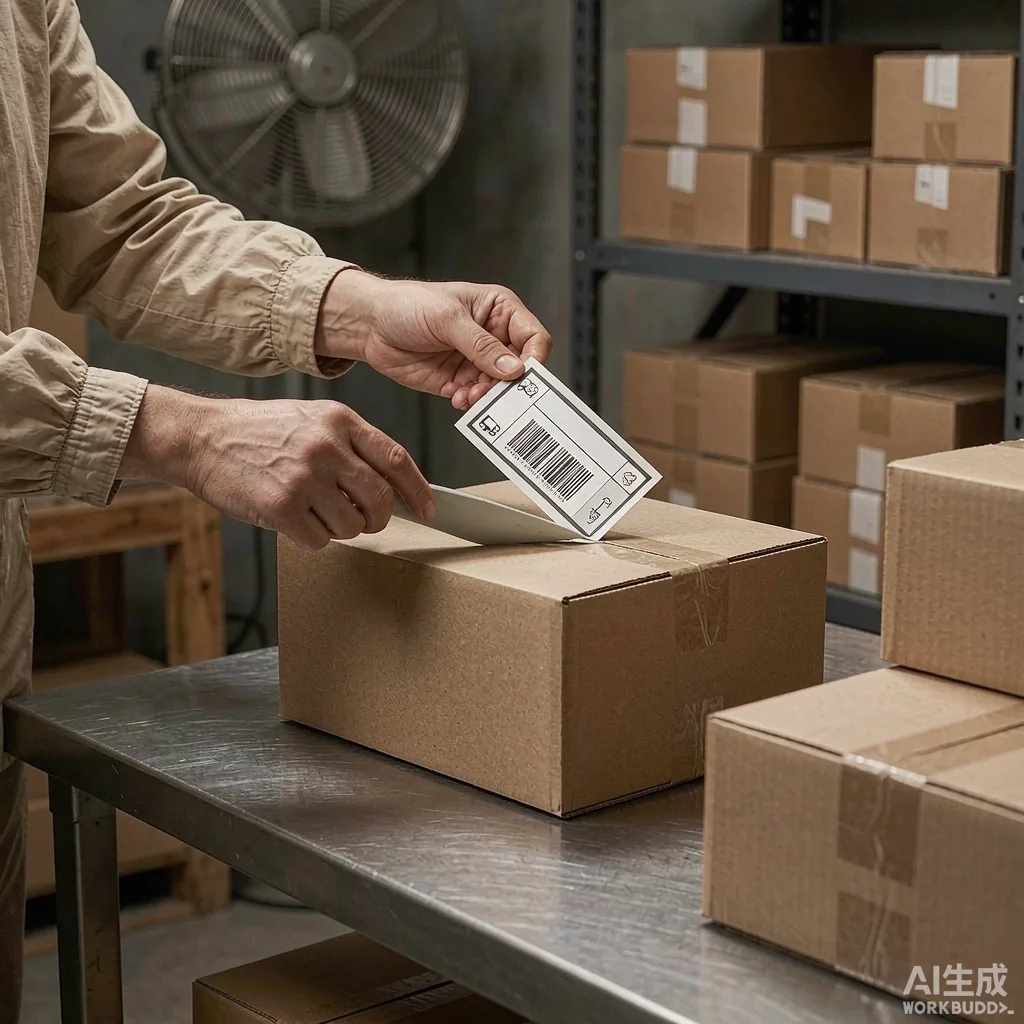
Joining and trim is the largest post-knitting block in the workflow at 4.0 minutes per piece, and almost all of that time is spent on components rather than on the knit — a No. 5 coil zip, a hardware set, a woven label and a lining each add an operation that no gauge decision can remove.
The reason is simple. Knitting is one continuous operation that the machine performs without human intervention, while trim is a series of discrete placements that each need a jig, a measurement and a check. A tote with a zip, two D-rings, a shoulder strap and a lining carries four more work elements than the same tote with none of them. Buyers who want the fastest route through the workflow should reduce the component count before they ask for a shorter knitting cycle, because the second request produces far less than the first.
- Closing zip
- No. 5 coil, 480 mm closed length on a 380 mm body
- Seam allowance
- 10 mm minimum on a knitted edge to stop unroping
- Stitch density on the join
- 8 to 10 stitches per inch, 401 chainstitch
- Needle
- DBx1 #14 (Nm 90), replaced every 8 working hours
- Lining
- 190T polyester taffeta, cut and sewn, pocket optional
- Woven label position
- 60 mm from the side edge, set during station 5
Heat Setting and Measurement Inside the Workflow
Heat setting sits at station 4 for 2.5 minutes and exists for one reason: a knitted body comes off the bed under tension and relaxes afterwards, so no dimension is meaningful until the loop structure has been stabilised and the piece has been conditioned.
Steam is applied at 160 to 180 °C with a controlled dwell, then the piece is cooled before it is handled. The measurable outcome is dimensional change, which should stay within 3% in both length and width after the agreed wash cycle under AATCC 135. Measurement then runs at station 6 across twelve points: body length and width, base depth, handle drop, aperture width, and GSM taken on a conditioned sample. Finished GSM is held to plus or minus 2%, and body dimensions to plus or minus 3 mm on a 380 mm dimension. Buyers who specify 1 mm on a knit are specifying a tolerance the process cannot repeat, and the workflow cannot be tuned to reach it.
Inspection Gates: Inline Checks and the AQL 2.5 Release Point
Two inspection gates sit inside the workflow: an inline check at station 3 that catches knitting faults while the bed is still running, and a pre-shipment release at station 7 against an AQL 2.5 sampling plan under ISO 2859-1 — and the first is worth far more than the second, because a fault found at the bed is a re-knit, while the same fault found at the carton is a rejected shipment.
Checks that belong inside the workflow
- First-piece check at set-up — dimensions, GSM and programme revision before the run starts
- Inline knit check every 50 pieces — dropped stitches, needle lines, barre
- Post-heat-setting check — dimensional change within 3%, GSM within plus or minus 2%
- Seam check at station 5 — 8 to 10 stitches per inch, no grinning, no skipped stitch
- Trim check — zip run, hardware alignment, label position at 60 mm
- Pre-shipment release — AQL 2.5 under an ISO 2859-1 sampling plan
- Carton check — count, labelling and packing documentation against the order
The distinction that matters commercially is between a defect class and a defect count. AQL 2.5 sets how many minor deviations are acceptable in a sample of a given size; it does not make a critical failure acceptable at any count. A bag with a failed handle root is critical regardless of how many pieces in the sample were clean, and a good inspection plan says so explicitly rather than leaving it to be argued at the carton.
Buffer, WIP and Changeover: Why the Line Number Matters
Changeover between styles takes about 45 minutes on a knitting line and about 20 minutes downstream, so a programme split across many colourways pays a fixed penalty per colourway that has nothing to do with the 21 minutes of touch time — which is exactly why MOQ is stated per style and per colourway rather than per order.
Each colourway is a separate yarn set-up on the bed. A three-colourway programme therefore books three set-ups, three first-piece checks and three changeovers, and the cost of those is spread over 100 pcs per colourway rather than over 300. First-pass yield on a stable programme sits near 94%, and the 6% that needs rework is overwhelmingly generated in the first hour after a changeover rather than in steady running. Buffer stock between stations is held at about two hours of flow, which is enough to keep a downstream station running through an upstream stoppage and small enough not to hide a systematic fault for long.
- Knitting line changeover: about 45 minutes, including file load, cone change and first-piece check.
- Downstream changeover: about 20 minutes, mostly jigs for trim placement.
- Work in progress buffer: about two hours of flow between stations.
- First-pass yield on a stable programme: about 94%, with most rework inside the first hour after changeover.
- Available capacity: 7 production lines running about 200,000 pcs per month.
Programme Windows: MOQ, Sampling and Bulk Against the Workflow
The three commercial windows line up with the workflow rather than sitting beside it: 7 working days of sampling covers stations 1 to 6 once, and 30 days of bulk runs stations 1 to 7 across the full quantity, with yarn booking sitting in front of both.
Sampling compresses the sequence into one pass: programming and first knit on days one and two, fitting and structural correction on days three and four, trim and lining on days five and six, and measurement, photography and packing on day seven. Bulk stretches the same sequence over a calendar: yarn booking across the first 10 days, knitting across days 8 to 20, finishing and trim across days 18 to 26, and inspection, packing and the pre-shipment AQL 2.5 release across days 24 to 30. MOQ is 100 pcs per style and per colourway, FOB Xiamen is the standard term with CIF and DDP available, and the reference unit cost for a standard E12 tote at specification is USD 4.80.
Map your programme against the seven stations
Send the silhouette, the component list and the quantity per colourway. Our knit team will return a station-by-station time estimate, the changeover cost per colourway and a costed quote against MOQ 100 pcs per style, 7 working days of sampling and 30 days of bulk production. Start on the contact page.
Frequently Asked Questions
How many stations are there in a knitted bag assembly workflow?
Seven: yarn preparation, set-up, knitting, heat setting, joining and trim, measurement, and inspection and packing. On a 34 x 38 cm tote at E12 in 300D the touch times are 1.0, 1.5, 9.0, 2.5, 4.0, 1.5 and 1.5 minutes, totalling about 21 minutes per piece before any queue time is counted.
Why is knitting only part of the total touch time?
Because the bed produces a body, not a finished bag. Set-up, heat setting, joining, trim placement, measurement and packing all follow, and together they account for roughly 57% of the touch time. A programme that optimises only the knitting cycle is optimising under half of the work, which is why cycle-time arguments rarely shorten the delivery calendar.
What stitch density should a knitted bag seam use?
Eight to ten stitches per inch on a 10 mm seam allowance, using a 401 chainstitch where the seam must stretch with the loop structure and a 301 lockstitch only for non-extensible elements such as a lining or a pocket bag. Below eight the seam grins under load, and above ten it perforates the structure.
Which needle is used to join a knitted bag panel?
A DBx1 #14, metric Nm 90, is the working default for a 300D body, and it should be replaced every eight working hours rather than when it fails. A blunt needle produces skipped stitches that are routinely mistaken for a knitting fault, sending the correction to the wrong station and wasting a cycle.
How long does heat setting take and why is it needed?
About 2.5 minutes per piece at 160 to 180 °C, followed by cooling. A knitted body leaves the bed under tension and relaxes afterwards, so no dimension is meaningful until the loop structure has been stabilised. Measurement taken before heat setting will disagree with measurement taken after it, sometimes by more than the whole tolerance band.
What dimensional tolerance does the workflow hold?
Plus or minus 3 mm on a 380 mm body dimension, plus or minus 3 mm on handle drop, and plus or minus 2% on finished GSM, all measured after heat setting and conditioning. Dimensional change after the agreed wash cycle should stay within 3% in both length and width when tested to AATCC 135.
Where do most defects get created in the workflow?
In the first hour after a changeover, and at the joining station rather than at the bed. First-pass yield on a stable programme sits near 94%, and the rework is concentrated in set-up and trim placement. That is why an inline check every 50 pieces is worth more than a stricter final inspection: it finds the cause while the run can still be corrected.
How much time does a colourway changeover cost?
About 45 minutes on a knitting line, including file load, cone change and first-piece check, plus about 20 minutes downstream for trim jigs. Each colourway is a separate yarn set-up, so a three-colourway programme pays three changeovers spread over 100 pcs each rather than one changeover spread over 300.
Does a seamless body remove any stations?
It removes the side-seam closing operation, which cuts joining from about 4.0 minutes to roughly 1.5 minutes on a tote. It does not remove heat setting, measurement, trim placement or inspection. Where the silhouette exceeds the needle-bed width, a two-panel or cut-and-sew routing is the honest recommendation instead.
What trim adds the most time per piece?
A lining, followed by a zip. A 190T taffeta lining with a pocket is cut and sewn separately and adds a full operation, while a No. 5 coil zip on a 480 mm closed length adds placement, a jig and a run check. Reducing the component count is the fastest way to shorten station 5.
How does the sampling window map onto the workflow?
Seven working days covers one pass through stations 1 to 6: programming and first knit on days one and two, fitting and structural correction on days three and four, trim and lining on days five and six, and measurement, photography and packing on day seven. Custom yarn or a new trim tool adds lead time before the clock starts.
How does the bulk window map onto the workflow?
Thirty days stretches the same stations over a calendar: yarn booking across the first 10 days, knitting across days 8 to 20, finishing and trim across days 18 to 26, and inspection, packing and the pre-shipment release across days 24 to 30. The overlap is deliberate, because stations run concurrently once the first pieces clear the bed.
What inspection gates should a buyer ask for?
A first-piece check at set-up, an inline knit check every 50 pieces, a post-heat-setting dimensional check, a seam check at the joining station and a pre-shipment release against AQL 2.5 under an ISO 2859-1 sampling plan. Ask for the defect classification in writing, so a critical failure cannot be argued as a minor one.
What is the MOQ when the workflow is split by colourway?
MOQ is 100 pcs per style and per colourway rather than per order, because each colourway is a separate yarn set-up and a separate changeover. Capacity behind it is 7 production lines running about 200,000 pcs per month, and FOB Xiamen is the standard term with CIF and DDP available.
Can the workflow be shortened below 30 days for bulk?
Compressing station time rarely achieves it, because the queue dominates the calendar. The reliable levers are booking yarn in the specified count and shade before the clock starts, holding the trim set to stock items, and limiting the number of colourways. All three are decided during specification, not during production.
People Also Ask
What is touch time in bag production?
The total minutes of human and machine work applied to one piece, excluding queue time. On a knitted tote it is about 21 minutes across seven stations, while the calendar lead time is far longer because pieces wait between stations.
Why does a seamless knit body still need joining?
The body is seamless, but trim is not. A zip, a lining, hardware and labels are still placed by hand or by jig, and those operations are what station 5 of the workflow is mostly made of.
Is a chainstitch stronger than a lockstitch on knit?
Not necessarily stronger, but more extensible. A 401 chainstitch stretches with the loop structure instead of popping under load, which is why it is the default for closing a knitted panel despite the lower absolute seam strength.
How often should sewing needles be changed on knit?
Every eight working hours. Damage to a needle point is invisible, and the resulting skipped stitches are usually misdiagnosed as a knitting fault, which sends the correction to the wrong station and costs a full cycle.
What is a realistic first-pass yield on a knit bag run?
About 94% on a stable programme. The rework is concentrated in the first hour after a changeover rather than in steady running, which is why an inline check every 50 pieces outperforms a stricter final inspection.
Sources and further reading
Every figure on this page is either our own programme data or attributed below. Open the originals before you write them into a specification.
- ISO 2859-1:2026 — Sampling procedures for inspection by attributes, Part 1: AQL-indexed sampling schemesISO Defines the sample size and accept or reject thresholds behind the AQL 2.5 release at station 7.
- ISO 13934-1:2013 — Textiles, tensile properties of fabrics, Part 1: maximum force using the strip methodISO The reference method for the fabric strength that seam efficiency is expressed as a percentage of.
- AATCC — American Association of Textile Chemists and ColoristsAATCC Source of AATCC 135, the dimensional change method cited for the 3% post-wash limit at station 4.
- OEKO-TEX STANDARD 100OEKO-TEX Finished-textile testing for harmful substances, requested alongside REACH and Prop 65 on knit bag programmes.
- Sedex and SMETA ethical trade auditSedex The social-compliance audit framework referenced for the production floor behind the workflow.
Reading a Workflow Quote Correctly
A workflow is only comparable once it states the touch time per station, the changeover time per colourway and the queue assumption behind the calendar. Three numbers tell a buyer what the programme actually is; the total alone tells them nothing. A quote that omits them is not wrong, it is incomplete, and filling the gap is the fastest route to a fair comparison between two routings.
For the gauge and yarn decisions that set station 3, see knit bag materials and yarn counts. For the inspection standards and defect classification used at station 7, see knit bag QC and testing.