Textured Yarn in Knit Bag Fabric: How Crimp, Bulk and Cover Change Hand on a Knitted Bag
Textured yarn is the lever you reach for when a knitted bag fabric looks thin and feels hard, and the fix is crimp rather than weight. A 150D/48f draw-textured polyester carries roughly 12-18 percent crimp contraction, which lifts bulk enough to close the see-through gap at E12 without adding grams. The case below walks through a tote programme that failed on hand, the three texture routes considered, and the numbers that settled it.
The Brief That Arrived as a Complaint
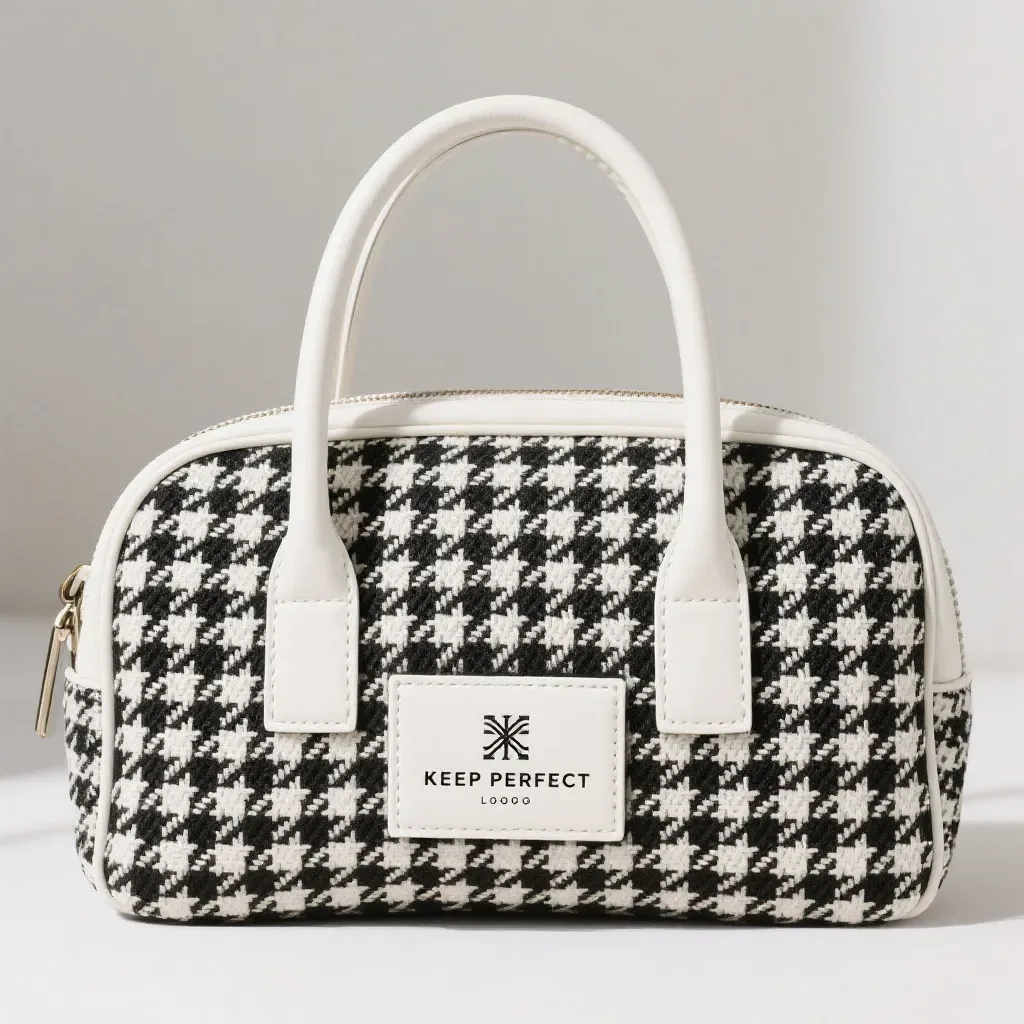
A European accessories buyer sent a sample back with one line of feedback: the bag looked unfinished. The fabric was a flat 150D/34f polyester knitted at E12 to 310 g/m², and it was technically compliant. Tensile cleared ISO 13934-1, abrasion cleared 20,000 Martindale cycles, and the colour matched the reference. What it did not do was look like a retail product.
Two measurable problems sat behind the complaint. The fabric was translucent: held against a light box, roughly 22 percent of incident light passed through the single-layer panel. And it felt hard, with a bending length of 41 mm on a cantilever test, which is board-like for a bag body.
The buyer wanted both fixed without adding weight, because the bag was priced to a target cost of about USD 4.80 in yarn at a 100 pcs run and shipped flat. That combination, better hand and better cover at unchanged grams, is precisely what texturing buys.
What the case turned on
- Hand and cover are bulk problems, not weight problems.
- Texturing puts air into the yarn bundle, so the same grams occupy more volume, the loops close over each other, and the fabric stops reading as translucent board.
What Texturing Does to a Filament Bundle
Texturing takes a straight filament bundle and permanently deforms each filament into a crimped or looped shape. The polymer mass does not change and the decitex does not change. What changes is the volume that mass occupies, which is why texture is measured as bulk in cubic centimetres per gram rather than as count.
A flat 150D/34f polyester occupies about 1.1 cm³/g in yarn form. The same count after draw texturing occupies roughly 2.2-2.6 cm³/g, because the crimped filaments hold air between them and cannot pack tightly. That doubling of specific volume is the entire mechanism behind the improvement in hand and cover.
In a knitted structure the consequence is geometric. A crimped filament fills more of the loop, the loop closes over its neighbour, and the interstices that let light through shrink. The fabric gets thicker at the same mass per unit area, which is exactly the trade the buyer needed.
Three Texture Routes: DTY, ATY and BCF
Three commercial routes produce a textured yarn, and they are not interchangeable. Draw texturing, air texturing and the bulked continuous filament route each give a different hand, a different bulk and a different abrasion profile.
Draw-textured yarn, or DTY, is the default for bags. Filaments are twisted, heat-set and untwisted so each one takes a permanent helical crimp. It gives high bulk, a soft dry hand and good cover, and it runs on ordinary knitting machines with no special feeding.
Air-textured yarn, or ATY, is made by blowing filaments through a jet so they form surface loops. It gives a cotton-like, matte hand and excellent cover, but the loops are a snagging risk on a bag that will meet a zip or a key. BCF is the carpet route: very high bulk, coarse counts, and rarely right below 600D.
| Route | Bulk, cm³/g | Hand | Best use in bags | Watch out for |
|---|---|---|---|---|
| DTY, draw textured | 2.2 to 2.6 | Soft, springy, dry | Bodies, gussets, liners at E10-E14 | Slight shine; crimp loss above 190 °C |
| ATY, air textured | 1.8 to 2.2 | Matte, cotton-like | Outer faces where a natural look sells | Surface loops snag on zips and hardware |
| BCF, bulked continuous | 3.0 to 4.0 | Lofty, carpet-like | Base panels and protective cases above 600D | Too coarse for fine gauges; bulky seams |
| Flat, FDY untextured | 1.0 to 1.2 | Firm, hard, flat | Structure zones and monofilament support | Translucent cover, board-like bending length |
Hand: How Crimp Contraction Translates to Feel
Hand is the composite of bending stiffness, surface friction and compressional softness, and crimp contraction moves all three in the right direction for a bag body. Crimp contraction is the percentage by which a textured yarn shrinks when it is relaxed in free steam.
The practical band for bag fabrics is 12-18 percent contraction on DTY polyester. Below 10 percent the yarn behaves close to flat and the hand stays hard. Above about 22 percent bulk continues to rise, but the yarn becomes difficult to knit evenly because the crimp makes tension control unstable.
In the case at hand, moving from flat 150D/34f to a 150D/48f DTY with 15 percent crimp contraction dropped the cantilever bending length from 41 mm to 27 mm. That is the difference between a panel that stands up on its own and one that falls into a soft fold, and it is the number the buyer actually felt.
Cover: Closing the See-Through Gap at E12
Cover is absence of light transmission and it is what makes a single-layer knit look finished. Textured yarn improves cover by filling the loop interstices, and the improvement is large enough to let a single layer replace a lined double layer at the same opacity.
Measured on a light box, the flat panel passed 22 percent of incident light. The DTY panel of identical count and gauge passed 6 percent. That took the fabric past the threshold where a lining became necessary, and dropping the lining saved more weight and cost than the textured yarn added.
Cover is also a function of gauge and filament count. At E12 with 48 filaments the improvement is reliable; at E7 the loops are already large and coarse, so texturing adds less. The rule used on the floor is that texturing pays most between E10 and E14, where the loop size and the filament crimp are of comparable scale.
- Yarn, before
- 150D/34f flat polyester, 1.1 cm³/g bulk
- Yarn, after
- 150D/48f DTY polyester, 15 percent crimp contraction
- Gauge, both
- E12, single-layer jersey structure
- Fabric weight, both
- 310 g/m²
- Light transmission
- 22 percent before, 6 percent after
- Bending length
- 41 mm before, 27 mm after
Bulk and Weight: Fewer Grams, More Fabric
Bulk lets a programme buy thickness with air instead of polymer, which is the only way to improve hand while holding a landed cost. A textured panel of 310 g/m² finishes about 0.85 mm thick against 0.58 mm for the flat equivalent, a 46 percent gain in thickness at identical mass.
The cost arithmetic follows from that. Textured yarn costs more per kilogram than flat, typically 8-14 percent, because texturing is an extra process step. But the panel needs fewer grams to reach a given opacity and thickness, so the cost per finished bag is roughly flat, and it falls whenever the textured fabric lets a lining be dropped.
There is a ceiling. Bulk is compressional, and under a sustained load a crimped bundle flattens. On a bag that carries 5 kg for eight hours a day, expect the textured panel to lose roughly 8-12 percent of its thickness over the first month and then stabilise. Design the finished dimension on the relaxed state, not on the as-knitted state.
Reading a Textured Yarn Spec: Dtex, Filaments and Crimp
A textured yarn spec needs three numbers beyond a flat yarn spec: crimp contraction, crimp stability and bulk. Without them a spinner can supply a yarn that carries the right ticket but behaves like flat yarn on the machine.
Filament count matters more than most buyers expect. At the same 150D, a 48-filament construction textures to a finer, softer crimp than a 34-filament one, because each filament is thinner and takes a smaller helix. Going from 150D/34f to 150D/48f is often a larger change to hand than going from 150D to 200D.
- Write the count as dtex or denier plus filament count, for example 167 dtex/48f or 150D/48f.
- Name crimp contraction as a percentage with a test method, typically 12-18 percent free-steam relaxation.
- Name crimp stability, the retained contraction after a loaded heat treatment, at 80 percent or better.
- State the bulk target in cm³/g if the panel has to hit a thickness at a stated g/m².
- Add intermingling, expressed as knots per metre, because a textured yarn without intermingling snags on the needle.
Where Textured Yarn Loses: Abrasion and Pilling
Textured yarn is not a free win, and the two places it loses are abrasion and snagging. Both are consequences of the same crimp that delivers the hand.
Abrasion resistance falls because the crimp exposes more surface per gram. A flat 150D panel might clear 30,000 Martindale cycles at 12 kPa where the DTY equivalent starts to show surface disturbance at 22,000-25,000. That is still ample for a bag body, but it is the reason base panels often stay on a flat or monofilament yarn.
Pilling is the second risk. Crimped filaments migrate, and any filament that works loose forms a pill under rubbing. Specifying a higher intermingling level, around 80-100 knots per metre, holds the bundle together and typically moves a pilling grade from 3 to 4 on the ISO 12945-2 scale after 7,000 revolutions.
Bodies and gussets
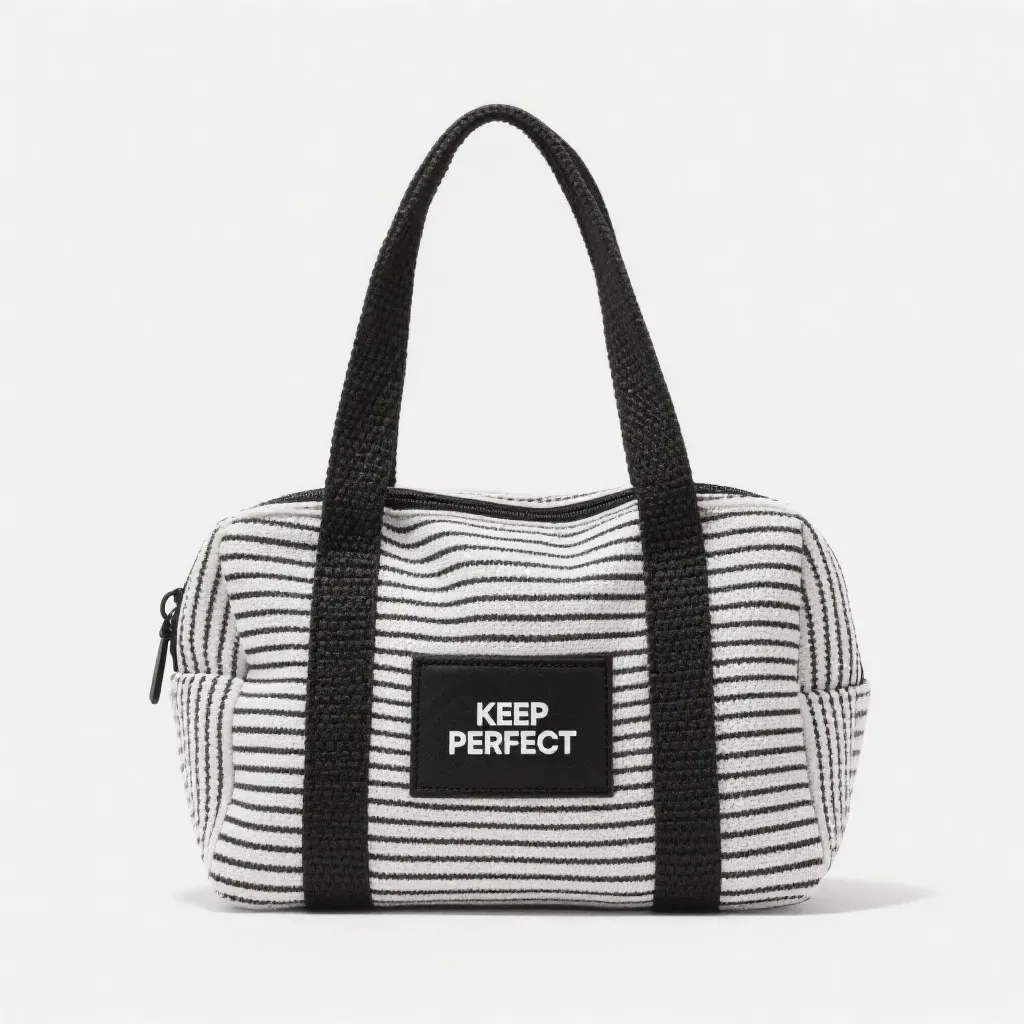
DTY 150D/48f at E12. Best cover and hand per gram, 22,000-25,000 Martindale cycles.
Base panels
Flat or monofilament. Textured bulk compresses 8-12 percent under sustained load.
Outer face, natural look
ATY for a matte cotton-like hand, with hardware specified to avoid snagging.
Liners
DTY 100D/36f at E14, where softness against contents matters more than abrasion.
Finishing Textured Knits: Heat, Steam and Relaxation
Textured yarn is set in the finishing stage, and getting that stage wrong is the most common reason a good yarn produces a bad fabric. Crimp development needs free relaxation, which means steam without restraint.
The working window for DTY polyester is 120-150 °C in saturated steam with the panel relaxed, held for 20-40 seconds. Below 110 °C the crimp does not fully develop and the fabric stays tighter than intended. Above 190 °C the crimp is damaged and bulk is lost permanently.
Dimensional control comes afterwards. A textured panel typically relaxes 4-7 percent in both directions on the first wet or steam treatment, so the knitted blank is cut larger to compensate. The tolerance written into a bag spec is usually plus or minus 3 mm on a 300 mm dimension after relaxation, measured under ISO 139 conditioning at 20 °C and 65 percent relative humidity.
What Textured Yarn Does to Cost, Lead Time and Programme Terms
Three commercial effects follow from choosing a textured yarn: a small yarn premium, a possible saving on lining, and no change to the programme minimum. The programme minimum stays at 100 pcs per style and colourway.
The yarn premium is 8-14 percent per kilogram over flat yarn. In the case programme that was offset twice over: the lining was dropped, and the finished bag fell from 268 g to 241 g, which reduced the freight cost per unit on a full container. Freight per unit is rarely in the yarn decision, but on a light bulky product it is not negligible.
Lead time is unaffected. Sampling runs 7 working days from a confirmed spec and bulk runs 30 days, because DTY counts in the common deniers are stock items at the mill. A bespoke filament count or a non-stock intermingling level adds yarn lead time before knitting starts.
| Cost line | Flat 150D/34f | DTY 150D/48f | Movement |
|---|---|---|---|
| Yarn per kilogram | Baseline | +8 to +14 percent | Higher |
| Fabric weight per bag | 310 g/m² | 310 g/m² | Unchanged |
| Lining required | Yes | No | Removed |
| Finished bag weight | 268 g | 241 g | -27 g |
| Freight per unit | Baseline | Lower | Improved |
| Programme MOQ | 100 pcs | 100 pcs | Unchanged |
The Rules That Came Out of the Case
Six rules came out of that programme and they generalise to most bag work. They are ordered by how much damage ignoring them does.
- Fix hand and cover with crimp before adding grams; weight is the expensive way to buy opacity.
- Specify filament count explicitly, because 150D/48f and 150D/34f behave like different yarns.
- Hold crimp contraction between 12 and 18 percent; outside that band the yarn either stays hard or knits unevenly.
- Keep a flat or monofilament yarn in the base, where textured bulk compresses under load.
- Set the crimp in free steam at 120-150 °C and never above 190 °C.
- Write relaxation shrinkage into the pattern: a textured panel moves 4-7 percent before it stabilises.
Applied together, those six rules took the case programme from a rejected sample to a repeat order at the same yarn cost. The buyer's note on the second submission was one word shorter: approved.
Checklist Before You Specify a Textured Bag Yarn
A textured yarn is specified correctly when the sheet answers five questions and the sample has been tested against the answers. Use this list before a 30-day bulk run is committed.
- Is the hand problem a bulk problem? If the fabric is hard, crimp fixes it; if the fabric is weak, count fixes it.
- Has the filament count been named, and is it high enough for the crimp you want?
- Is crimp contraction stated with a test method and a tolerance band?
- Is intermingling specified at 80-100 knots per metre so the bundle does not snag or pill?
- Has the relaxation shrinkage been measured and written into the cutting pattern?
When those five are answered, the texture choice becomes a controlled variable rather than a hope. That is the difference between a fabric that gets approved and one that gets sent back with one line of feedback.
Send the hand and cover target you need to hit
Share the gauge, target g/m², opacity requirement and the hand reference you are matching. Sampling is 7 working days from a confirmed yarn spec at 100 pcs per colourway, with crimp contraction and bulk reported on the trial panel.
Frequently Asked Questions
What is textured yarn in a knitted bag fabric?
It is a filament yarn whose individual filaments have been permanently crimped or looped, most often by draw texturing. The count and the mass do not change, but the bulk roughly doubles from about 1.1 to 2.4 cubic centimetres per gram. That extra bulk is what softens the hand and closes the fabric.
How does textured yarn improve the hand of a knit bag?
Crimp reduces bending stiffness by letting filaments move against each other instead of acting as one rod. On a cantilever test a flat polyester panel might measure 41 mm bending length, and the same count in a 15 percent crimp DTY measures 27 mm. Lower bending length reads as softer.
What crimp contraction should a bag fabric specify?
Between 12 and 18 percent for draw-textured polyester, tested by free-steam relaxation. Below 10 percent the yarn still behaves close to flat and the hand stays hard. Above 22 percent bulk keeps rising but tension becomes unstable on the machine, so the fabric knits unevenly.
Does textured yarn add weight to a knitted bag?
No. Textured yarn has the same count and the same mass per metre as the flat yarn it replaces, and the fabric is usually knitted to the same grams per square metre. What changes is thickness, which rises by roughly 45 percent at unchanged mass because the bulk is air.
Can textured yarn remove the need for a lining?
Often yes, because the main reason for a lining is opacity. A flat single-layer panel at E12 passed 22 percent of incident light in the case described here, and the textured equivalent passed 6 percent. That change let the lining be dropped and cut 27 g from the bag.
What is the difference between DTY and ATY yarn?
DTY is draw-textured, with each filament crimped into a helix by twisting, heat-setting and untwisting. ATY is air-textured, with filaments blown through a jet to form surface loops. DTY is springy and dry; ATY is matte and cotton-like but its surface loops snag on zips and hardware.
Does textured yarn reduce abrasion resistance?
Yes, slightly, because crimp exposes more surface per gram to the abrading face. A flat 150D panel may clear 30,000 Martindale cycles at 12 kPa where the DTY equivalent shows surface disturbance at 22,000 to 25,000. That is ample for a body and is why bases often stay flat.
How do you stop a textured knit from pilling?
Specify intermingling, measured as knots per metre, at roughly 80 to 100 for a bag body. Intermingling holds the filament bundle together so loose filaments cannot migrate to the surface and form pills. It typically moves a pilling result from grade 3 to grade 4 on ISO 12945-2 after 7,000 revolutions.
What finishing temperature suits textured polyester?
Develop the crimp in free steam at 120 to 150 °C held for 20 to 40 seconds. Below 110 °C the crimp does not fully develop and the panel stays tighter than intended. Above 190 °C the crimp is damaged permanently and the bulk you paid for is lost.
How much does a textured knit shrink in finishing?
Typically 4 to 7 percent in both directions on the first wet or steam treatment, after which the panel stabilises. The cutting pattern is enlarged to compensate, and the finished dimension is held to plus or minus 3 mm on 300 mm. Measure after conditioning by ISO 139 at 20 °C and 65 percent RH.
Is textured yarn more expensive than flat yarn?
About 8 to 14 percent more per kilogram, because texturing is an extra process step. The premium is usually recovered elsewhere: fewer grams are needed for a given opacity, a lining can often be dropped, and the lighter finished bag costs less per unit to freight.
Which gauge suits a textured bag yarn best?
Texturing pays most between E10 and E14, where loop size and filament crimp are of comparable scale. At E12 the cover gain is large, from 22 to 6 percent light transmission in one measured case. At E7 the loops are already coarse, so the same yarn adds comparatively little.
How does filament count change the hand of a textured yarn?
At the same overall count, more filaments mean finer individual filaments and therefore a smaller, softer crimp helix. Moving from 150D/34f to 150D/48f usually changes the hand more than moving from 150D to 200D. Always write the filament count in the spec.
How long does a textured yarn sample take?
Sampling runs 7 working days from a confirmed yarn spec at 100 pcs per style and colourway, because common DTY deniers are stock items at the mill. A bespoke filament count or a non-stock intermingling level adds yarn lead time first. Bulk then runs 30 days on FOB Xiamen terms.
Can textured yarn be used in a sustainable programme?
Yes, and it is increasingly the norm. Recycled PET is draw-textured on the same equipment as virgin PET, so a Global Recycled Standard claim survives the texturing step. Keep documentation from the spinner so the recycled content percentage can be evidenced at final inspection.
What tests belong in a textured bag fabric spec?
Tensile by ISO 13934-1, abrasion by ISO 12947-2, pilling by ISO 12945-2 and colour fastness by ISO 105 series. For the texture itself add crimp contraction, crimp stability and bulk on the incoming yarn. Final inspection of the sewn bag runs at AQL 2.5 under ISO 2859-1.
People Also Ask
Why does a knitted bag fabric look see-through?
Because flat filaments pack tightly and leave the loop interstices open. At E12 a single-layer flat panel can transmit 22 percent of incident light. Textured yarn fills those interstices with crimped filaments, dropping transmission to around 6 percent at unchanged weight.
Is more grams per square metre the fix for poor cover?
It works but it is the expensive fix, because it adds polymer and cost. Bulk is the lower-cost route: crimping the yarn adds thickness and opacity at the same grams per square metre. Reach for crimp first and add weight only when the structure also needs strength.
Does textured yarn snag on bag hardware?
Air-textured yarn does, because its surface loops can catch on zip teeth and metal feet. Draw-textured yarn with 80 to 100 intermingling knots per metre is far safer. Where a bag has exposed hardware, keep ATY away from the contact zones.
What is crimp stability and why does it matter?
It is the share of crimp contraction that survives a loaded heat treatment. A yarn at 80 percent or better holds its bulk through finishing and through the life of the bag. Below that the panel flattens in service and the hand reverts toward flat yarn.
Can a textured yarn be knitted on the same machine as flat yarn?
Yes, on the same beds and the same gauge. The settings differ: a textured yarn runs at lower and more stable tension, and the take-down must allow free relaxation. Most programmes change only the tension band and the finishing recipe, not the machine.
Sources and further reading
Every figure on this page is either our own programme data or attributed below. Open the originals before you write them into a specification.
- ISO 13934-1:2013 — Textiles, tensile properties of fabrics, Part 1: maximum force using the strip methodISO The tensile test named in textured bag fabric specifications alongside abrasion and pilling.
- ISO 12947-2:2016 — Textiles, determination of abrasion resistance by the Martindale methodISO Used to compare flat and textured panels; textured surfaces typically show disturbance at 22,000-25,000 cycles.
- ISO 139:2005 — Textiles, standard atmospheres for conditioning and testingISO Conditioning at 20 °C and 65 percent RH required before measuring relaxation shrinkage on textured knits.
- Recycled Claim Standard and Global Recycled StandardTextile Exchange Chain-of-custody rules that let a recycled PET claim survive draw texturing and knitting.
- OEKO-TEX STANDARD 100OEKO-TEX Restricted-substance screening applied to textured yarns and finished knitted bag panels.