Monofilament Yarn in Knitted Bag Structure: Diameter, Gauge Windows and Where Stiffness Pays
Monofilament yarn earns its place in a knitted bag when a panel has to hold shape without an insert, and it fails when the gauge is too fine for its diameter. The decision reduces to three numbers: filament diameter in millimetres, needle hook gap at the target gauge, and the bend radius the stitch forces the filament through. A 0.30 mm PA6 monofilament knits cleanly at E7 and begins to whiten at E14; a 0.20 mm filament reaches E12 but contributes far less stiffness. A 100 pcs programme can be sampled in 7 working days, so the faster test is a knit trial, not a drawing.
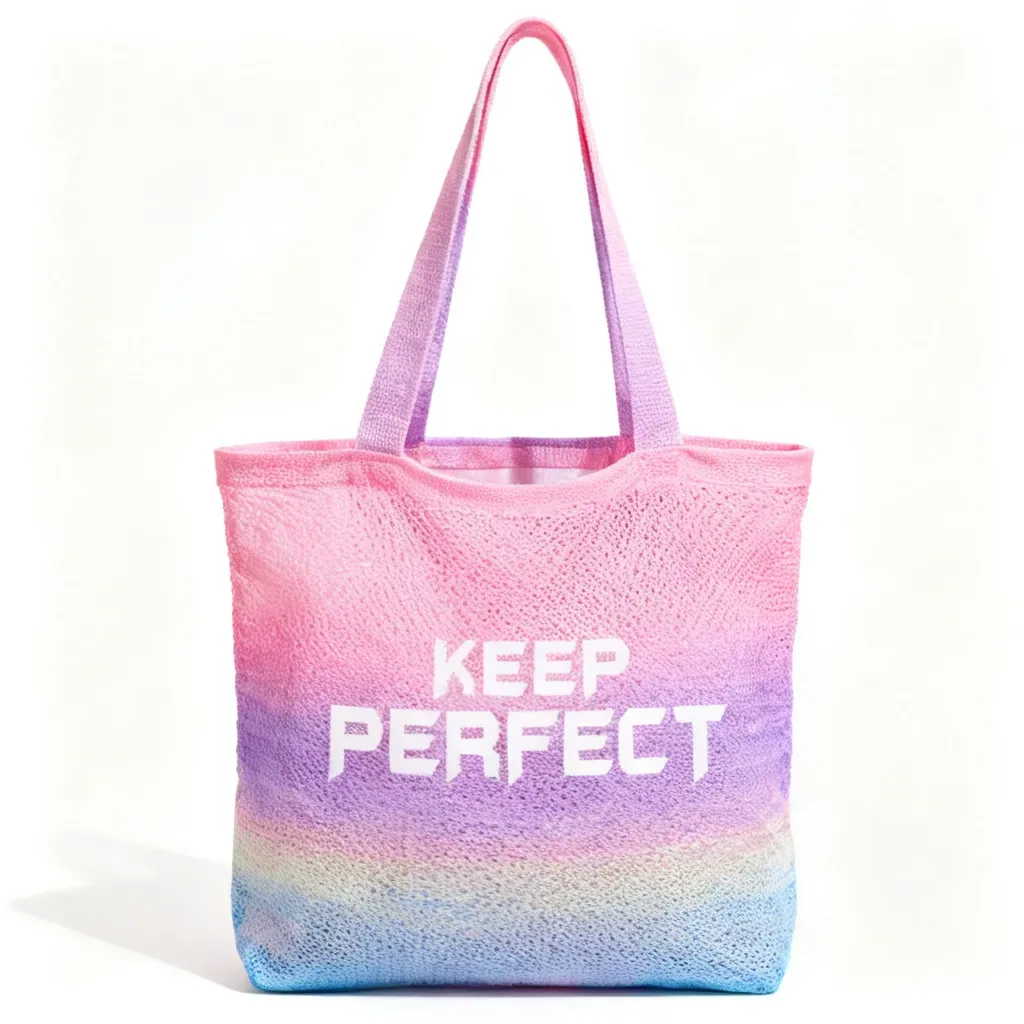
What Monofilament Actually Contributes to a Knitted Panel
Monofilament adds bending stiffness, not tensile strength, and that distinction decides whether it belongs in your spec. A single filament resists being folded, so a panel containing it springs back to its knitted shape after a compressive load instead of collapsing. Tensile strength per decitex is usually similar to a comparable multifilament, so a monofilament panel is not automatically stronger in a pull test.
The practical result is shape retention. A tote body knitted with 0.30 mm monofilament in the base panel holds a square footprint when empty, where the same structure in 300D multifilament slumps into a soft pouch. Buyers who specify monofilament are buying silhouette, shelf presence and the ability to drop a lining or a baseboard.
The cost of that stiffness is hand. Monofilament panels feel firmer and slightly springy, and the surface reads as technical rather than soft. That trade is acceptable on a structured tote, a tool roll or a display case, and it is usually wrong on a drawstring pouch or a bag meant to be folded flat in a pocket.
The one-line rule for monofilament
- Specify monofilament where the panel must hold a shape under its own weight, and specify multifilament everywhere the bag has to drape, fold or compress.
- Mixing the two in one panel is where most programmes get value: monofilament in the base and mouth band, multifilament in the body.
Diameter First: 0.20 mm, 0.30 mm and 0.50 mm on the Needle Bed
Diameter is the number that governs everything else, and it is written in millimetres rather than denier because the needle cares about thickness, not mass. Three diameters cover nearly all bag work: 0.20 mm for light structure, 0.30 mm for base panels and mouth bands, and 0.50 mm for semi-rigid frames.
A 0.30 mm PA6 monofilament is roughly 780D in denier terms, which surprises buyers who expect a filament that thin to be light. It is also the reason a monofilament panel weighs more than the multifilament panel it replaces: the same loop length carries far more polymer. Expect a finished fabric around 480-520 g/m² when 0.30 mm monofilament is used at E7.
- 0.20 mm (about 350D): usable to E12, adds crispness without obvious stiffness, good for mouth bands and gusset edges.
- 0.30 mm (about 780D): usable to E7-E10, the default for base panels and self-standing bodies, adds roughly 25 percent to panel weight.
- 0.50 mm (about 2,150D): usable at E7 only, produces a semi-rigid shell that can replace an injected frame in small bags.
- Above 0.50 mm: knitting becomes unreliable on standard bag gauges and the loop cannot close without visible marking.
Where Stiffness Pays: Base Panels, Mouth Bands and Structure Zones
Three zones in a knitted bag repay the added weight of monofilament: the base, the mouth and any vertical corner that has to stay visible on a shelf. Stiffening only those zones costs less than stiffening the whole shell, and it keeps the rest of the bag soft enough to pack.
A base panel is the clearest case. Knitted at E7 with 0.30 mm monofilament and a double-layer structure, a 260 mm by 120 mm base carries a 5 kg load with about 2.5 mm of centre deflection instead of the 9-11 mm a multifilament base shows. That difference is what stops a loaded tote from bulging into a barrel.
Mouth bands are the second case. A monofilament course at the top edge keeps the opening from rolling inward, which is the defect that makes a bag look tired after a week on a shop floor. Corner zones are the third, particularly on a rectangular lunch bag or a cosmetic case where the silhouette is the selling point.
Where Monofilament Cracks: Bend Radius and the Fine-Gauge Problem
Monofilament fails by whitening and then cracking at the loop crown, and the failure is driven by bend radius. Every stitch bends the filament through a radius set by the needle hook and the loop length; when that radius is too small for the diameter, the polymer on the outside of the bend is strained past its yield point.
The visible symptom is a white stress mark at the crown of the loop, which appears after knitting and grows during finishing. It is cosmetic at first and structural later: after roughly 3,000-5,000 flex cycles a whitened crown develops a crack that runs across the filament. A rule of thumb used on the floor is that the loop bend radius should be at least 6 times the filament diameter.
That rule is what excludes thick monofilament from fine gauges. A 0.50 mm filament needs a bend radius near 3 mm, which an E14 needle bed simply cannot give, so the filament is over-strained on every course. The same filament at E7, where the hook and loop geometry are far more generous, knits without marking.
| Filament diameter | Safe gauge window | Loop bend radius | Typical failure mode |
|---|---|---|---|
| 0.20 mm | E10 to E12 | 1.2 mm or wider | Rarely whitens; can snap if tension exceeds 8 cN |
| 0.30 mm | E7 to E10 | 1.8 mm or wider | Whitening at E12 and above, cracking after 5,000 flex cycles |
| 0.50 mm | E7 only | 3.0 mm or wider | Immediate crown marking on E10, loop refusal on E12 |
Monofilament Against Multifilament: The Cost and Weight Arithmetic
The comparison that matters to a buyer is cost and weight per finished panel, not cost per kilogram of yarn. Monofilament is priced lower per kilogram than a high-tenacity multifilamentcity multifilament, but a panel needs more of it because the loops are solid polymer rather than a bundle of fine filaments with air between them.
On a worked example, a 300D/96f PA6 body panel finishes at about 420 g/m² and a yarn cost of roughly USD 4.80 per bag at a 100 pcs run. Replacing the base zone only with 0.30 mm monofilament lifts the finished weight by about 60 g and the yarn cost by around 8 percent, while removing the need for a baseboard that would have cost more than that to buy and sew.
Full-shell monofilament is a different calculation. It roughly doubles panel weight and pushes yarn cost up by 40-55 percent, which is only justifiable when the bag replaces a moulded or injected component entirely. Most programmes land in the middle: 20-30 percent of the shell, concentrated in the load-bearing zones.
- Yarn, body
- 300D/96f PA6 multifilament, high tenacity
- Yarn, structure zone
- 0.30 mm PA6 monofilament, round section
- Gauge
- E7 for the structure zone, E12 for the body
- Finished fabric
- 420 g/m² body, 520 g/m² structure zone
- Deflection, base
- 2.5 mm under 5 kg at 260 x 120 mm
- Acceptance tests
- ISO 13934-1 tensile, ISO 12947-2 abrasion
Gauge Windows and Machine Settings That Accept a Monofilament
A monofilament runs on the same machines as a multifilament, but the settings are narrower and the tolerance for error is smaller. Three settings decide whether a run is clean: yarn tension, take-down tension and stitch cam setting.
Yarn tension is the first. A monofilament has no filament bundle to absorb a tension spike, so the operating window is roughly 4-8 cN against 8-18 cN for a 300D multifilament. Above about 10 cN the filament begins to stretch permanently, which shows up as a panel that shrinks unevenly in finishing.
Take-down and cam setting come next. A longer loop length reduces bend strain at the crown, so dropping the stitch cam by one step buys a meaningful safety margin on a fine gauge. The cost is a slightly more open fabric, which is why structure zones are usually knitted with a tighter cam and a thicker monofilament at a coarser gauge rather than the reverse.
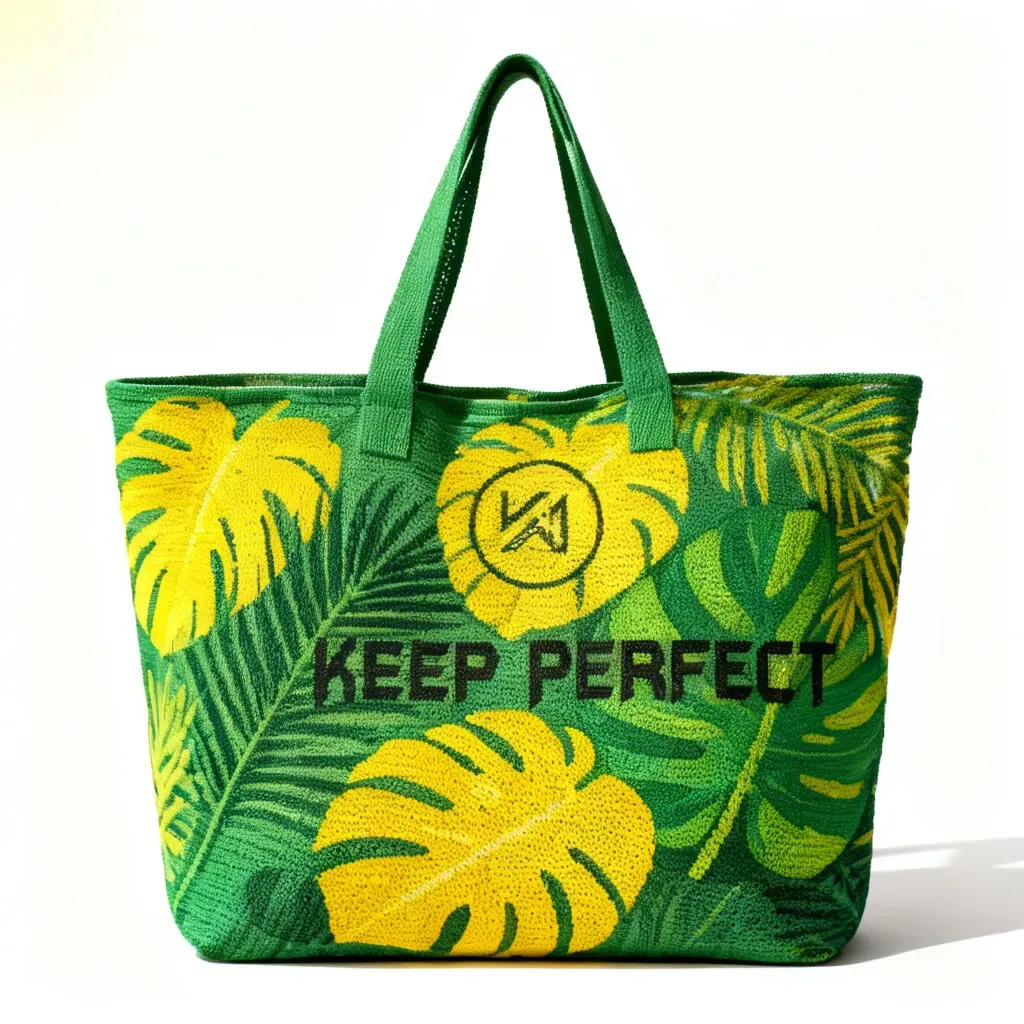
Testing Monofilament Panels: Abrasion, Flex and Whiteness
Three tests catch monofilament failures before bulk, and two of them are not part of the standard fabric test set most buyers request. Abrasion is standard; flex and whiteness are the ones specific to a single filament.
Abrasion by ISO 12947-2 using a Martindale machine is the baseline. A monofilament surface resists flat abrasion well, often clearing 30,000 cycles to a 12 kPa load where a textured multifilament of the same polymer shows pilling at 15,000. The failure it does not predict is edge abrasion, where a filament is worn at the fold of a handle attachment.
Flex testing is the useful addition. A simple 5,000-cycle fold test at a 3 mm radius, assessed for whitening under a 10x loupe, catches the crown strain problem that Martindale misses. Whiteness assessment belongs in the same inspection: a panel is rejected if more than 5 percent of loop crowns show stress marks after finishing.
A monofilament clause that names only ISO 12947-2 will pass a panel that cracks in the field. Add a 5,000-cycle flex test at a stated radius and a whiteness limit assessed at 10x, and name the rejection threshold. It costs nothing at sampling and it is the difference between a structured bag and a returned one.
Colour, Finish and the Limits of a Single Filament
Monofilament takes colour differently from a multifilament because the filament is thick enough for light to travel through it. A dyed monofilament reads deeper and glossier than the same shade in a multifilament, which is why a mixed panel often looks like two colours even when both yarns came from one dye lot.
Solution-dyed monofilament avoids most of that problem and is the route used when a structure zone has to match a body exactly. It also carries better light fastness: a solution-dyed PA6 monofilament commonly reaches grade 6-7 on the ISO 105-B02 blue wool scale where a piece-dyed filament sits at grade 4. The constraint is colour count, since solution dyeing needs a minimum lot.
Finishing has its own limits. Heat setting works well on PA6 monofilament at 170-185 °C and stabilises the panel, but it must stay below the 220 °C melting point with margin for local hot spots. Any finish that relies on penetration, such as a deep softener, is wasted on a monofilament because there are no inter-filament capillaries to carry it.
Structure zone
0.30 mm monofilament at E7, solution dyed, heat set at 180 °C. Holds square with no insert.
Body zone
300D/96f multifilament at E12 for drape and hand. Soft where the bag is handled.
Transition row
Two courses of 0.20 mm monofilament bridging the gauges so the stiffness change is not a visible step.
Base zone
Double-layer monofilament panel, 520 g/m², 2.5 mm deflection under a 5 kg load.
How Monofilament Changes Cost, MOQ and Lead Time
Monofilament changes three commercial variables: yarn cost, colour minimum and sampling risk. None of them alter the programme minimum, which stays at 100 pcs per style and colourway, but all three change the number that ends up on the quotation.
Yarn cost moves with the share of the shell that uses monofilament, as set out above. Colour minimum is the surprise: a solution-dyed monofilament colour usually needs a dye lot of 300-500 kg, so a first programme is better served by a stock shade than by a bespoke one. Sampling risk is the third variable, because a monofilament panel has a narrower process window and therefore a higher chance that the first trial needs a second pass.
Lead time is mostly unaffected. Sampling runs 7 working days from a confirmed spec and bulk runs 30 days, because the monofilament is a stock item in the common diameters and gauges. The exception is a bespoke diameter or an unusual polymer, which adds yarn lead time before knitting can start.
A Worked Monofilament Panel Spec You Can Copy
The fastest way to specify a monofilament zone is to copy a complete spec and change three numbers. Below is a working spec for a structured tote base that has run at 100 pcs and cleared inspection at AQL 2.5 under ISO 2859-1.
- Style
- Structured tote, 320 x 300 x 120 mm
- Structure yarn
- 0.30 mm PA6 monofilament, round, solution dyed
- Body yarn
- 300D/96f recycled PA6, dope dyed
- Gauge
- E7 base zone, E12 body zone
- Fabric weight
- 520 g/m² base, 420 g/m² body
- Deflection limit
- 3.0 mm maximum under 5 kg
- Abrasion
- 30,000 cycles ISO 12947-2 at 12 kPa
- Flex
- 5,000 cycles at 3 mm radius, no crown cracking
- Inspection
- AQL 2.5, ISO 2859-1
- Commercial
- 100 pcs per colourway, 7 working days sampling, 30 days bulk, FOB Xiamen
Checklist Before Releasing a Monofilament Panel to Bulk
A monofilament panel is released when the sample has cleared the mechanical tests and the whiteness inspection, not when it looks right on a desk. Five checks close the loop before a 30-day bulk run is committed.
- Confirm the diameter against the gauge: the loop bend radius must be at least 6 times the filament diameter.
- Run the 5,000-cycle flex test at the stated radius and inspect crowns at 10x for whitening or cracking.
- Measure base deflection under the real load and compare it against the limit in the spec, not against a previous sample.
- Verify colour match between the monofilament zone and the multifilament body under retail lighting, not under office lighting.
- Confirm yarn tension was logged in the 4-8 cN band during the trial and that the same setting is written into the bulk instruction.
Once those five are signed off, the panel is a known quantity. The remaining risk is lot-to-lot variation in the filament, which is controlled by keeping the yarn certificate with the bulk record and re-checking diameter on every incoming lot.
Send the panel drawing and the load it has to carry
Share target diameter, gauge, finished g/m² and the deflection limit. Sampling is 7 working days from a confirmed spec at 100 pcs per colourway, and the trial panel is tested to ISO 13934-1 and ISO 12947-2 before bulk is quoted.
Frequently Asked Questions
What does monofilament yarn do in a knitted bag?
It raises bending stiffness so a panel springs back to its knitted shape instead of collapsing. Tensile strength per decitex is close to a comparable multifilament, so the gain is silhouette and shape retention rather than pull strength. Buyers use it to drop a baseboard, a frame or a lining.
What monofilament diameter should a knitted bag use?
Three diameters cover almost all bag work. Use 0.20 mm where you want crispness without obvious stiffness, 0.30 mm for base panels and mouth bands, and 0.50 mm for a semi-rigid shell. Above 0.50 mm the loop cannot close cleanly at bag gauges.
Which machine gauge accepts a monofilament yarn?
Gauge is set by diameter, not by preference. A 0.20 mm filament runs to E12, a 0.30 mm filament runs at E7 to E10 and starts whitening at E12, and a 0.50 mm filament runs at E7 only. The governing rule is a loop bend radius of at least 6 times the filament diameter.
Why does monofilament whiten at the loop crown?
Whitening is yield strain at the outside of the bend. Every stitch folds the filament through a radius set by the needle hook, and when that radius is too small for the diameter the polymer is strained past yield and turns white. It is cosmetic first and becomes a crack after 3,000 to 5,000 flex cycles.
How much weight does a monofilament base panel add?
Stiffening the base zone only typically adds about 60 g to a tote, lifting the finished fabric from around 420 g/m² to around 520 g/m² in that zone. Full-shell monofilament is heavier still, roughly doubling panel weight, which is rarely worth the cost.
Does monofilament change yarn cost per bag?
Yes, in proportion to how much of the shell uses it. A monofilament base zone adds roughly 8 percent to yarn cost on a bag that costs about USD 4.80 in yarn at 100 pcs. A full monofilament shell adds 40 to 55 percent and is only justified when it replaces a moulded component.
What yarn tension does a monofilament need?
Roughly 4 to 8 cN, against 8 to 18 cN for a 300D multifilament. A single filament has no bundle to absorb a tension spike, so above about 10 cN it stretches permanently and the panel shrinks unevenly in finishing. Log the setting on the trial and carry it into the bulk instruction.
Which tests catch monofilament failures before bulk?
Abrasion by ISO 12947-2 is the baseline and a monofilament surface often clears 30,000 cycles at 12 kPa. The tests that matter more are a 5,000-cycle flex test at a stated radius and a whiteness check of loop crowns at 10x magnification. Neither is in the standard fabric set most buyers request.
Can monofilament and multifilament be knitted in one panel?
Yes, and it is the most common way to get value from monofilament. Knit the base and mouth in 0.30 mm monofilament at E7 and the body in 300D multifilament at E12, with two transition courses of 0.20 mm filament so the stiffness change is not a visible step.
Does monofilament dye to the same colour as the body yarn?
Not reliably in piece dyeing. A thick filament transmits light differently, so the same dye lot reads deeper and glossier in monofilament than in a multifilament panel. Solution-dyed monofilament matches far better and reaches ISO 105-B02 light fastness grade 6 to 7 rather than grade 4.
What heat-setting temperature suits PA6 monofilament?
Set at 170 to 185 °C, comfortably below the 220 °C melting point of PA6. The margin matters because local hot spots in a stenter can exceed the set point. PET monofilament sets higher, around 200 to 220 °C against a 260 °C melting point.
Is monofilament a problem for sustainability claims?
It complicates them, because a mixed panel is harder to recycle than a single-polymer one. Keeping the monofilament and the body yarn in the same polymer family, for example PA6 throughout, keeps the panel recyclable and keeps a Global Recycled Standard claim intact.
How long does a monofilament sample take?
Sampling runs 7 working days from a confirmed spec at 100 pcs per style and colourway, because the common diameters are stock items. A bespoke diameter or an unusual polymer adds yarn lead time before knitting can begin. Bulk then runs 30 days on FOB Xiamen terms.
What replaces monofilament when stiffness is not wanted?
Use a heavier multifilament at a coarser gauge, a double-layer structure, or a textured yarn with more bulk per decitex. All three add stiffness without the bend-radius constraint of a single thick filament. A 600D textured PET at E7 is the usual first alternative.
What inspection standard applies to monofilament panels?
Final inspection runs at AQL 2.5 under ISO 2859-1, the same plan used across the knit programme. Add the flex and whiteness criteria to the defect list so an inspector can reject a panel for crown marking. Conditioning before test follows ISO 139 at 20 °C and 65 percent relative humidity.
What is the minimum order for a monofilament knit programme?
100 pcs per style and colourway, unchanged from a standard multifilament programme. The real minimum that bites is on colour: a bespoke solution-dyed monofilament shade typically needs a 300 to 500 kg dye lot, so a first run is better served by a stock shade.
People Also Ask
Is monofilament yarn stronger than multifilament?
Per decitex the tensile strength is comparable, so monofilament is not automatically stronger in a pull test. What it adds is bending stiffness, which is a different property. A monofilament panel resists folding and springs back, where a multifilament panel of the same strength drapes and collapses.
Why does monofilament crack on fine gauges?
The needle hook forces the filament through a bend radius that is too small for its diameter. The outside of the bend is strained past yield, whitens, and eventually cracks. Keeping the bend radius at 6 times the diameter keeps a 0.30 mm filament at E7 to E10 and off E14.
Can monofilament replace a bag frame?
At 0.50 mm knitted at E7 it can replace an injected or moulded frame in small bags, because the panel becomes semi-rigid. The trade is weight and cost, roughly double the panel weight. For larger bags it replaces a baseboard rather than a full frame.
Does monofilament pill?
Far less than a textured multifilament, because there are no loose fibre ends to migrate to the surface. A monofilament surface commonly clears 30,000 Martindale cycles where a textured yarn pills at 15,000. Its failure mode is cracking at the loop crown, not pilling.
What finish works on a monofilament panel?
Heat setting works well and stabilises the panel. Penetrating finishes such as deep softeners are largely wasted, because a single filament has no inter-filament capillaries to carry the liquor. Surface finishes, including a fluorocarbon-free water repellent, still work.
Sources and further reading
Every figure on this page is either our own programme data or attributed below. Open the originals before you write them into a specification.
- ISO 12947-2:2016 — Textiles, determination of abrasion resistance by the Martindale methodISO The abrasion test used to qualify monofilament panels; a monofilament surface typically clears 30,000 cycles at 12 kPa.
- ISO 2859-1:1999 Sampling procedures for inspection by attributesISO The sampling plan behind the AQL 2.5 final inspection applied to structured knit bag programmes.
- ISO 139:2005 — Textiles, standard atmospheres for conditioning and testingISO Conditioning at 20 °C and 65 percent RH before tensile and abrasion testing of knitted panels.
- Shima Seiki whole-garment knitting machineryShima Seiki Machine geometry, needle hook gap and gauge options that set the bend-radius limit for monofilament.
- OEKO-TEX STANDARD 100OEKO-TEX Restricted-substance screening applied to monofilament yarns and finished knitted panels.