Knitted Bag Product Page Copy: Section Order, Word Counts and Claim Discipline for Seamless Knit Listings
Most knitted bag listings fail for a structural reason rather than a stylistic one: the specification block sits below the fold, the construction word appears only in the third paragraph, and the buyer leaves without learning that the body is knitted in one piece. The fix is a fixed section order with a word allowance for each — a 60-character headline, a 120-word opening that answers what it is, how it is made and how big it is, then a five-line specification block, then 350 words of body copy. This article gives the eight sections, the counts behind them, the three-tier rule for claims, and a pre-publication checklist that catches the errors which generate returns.
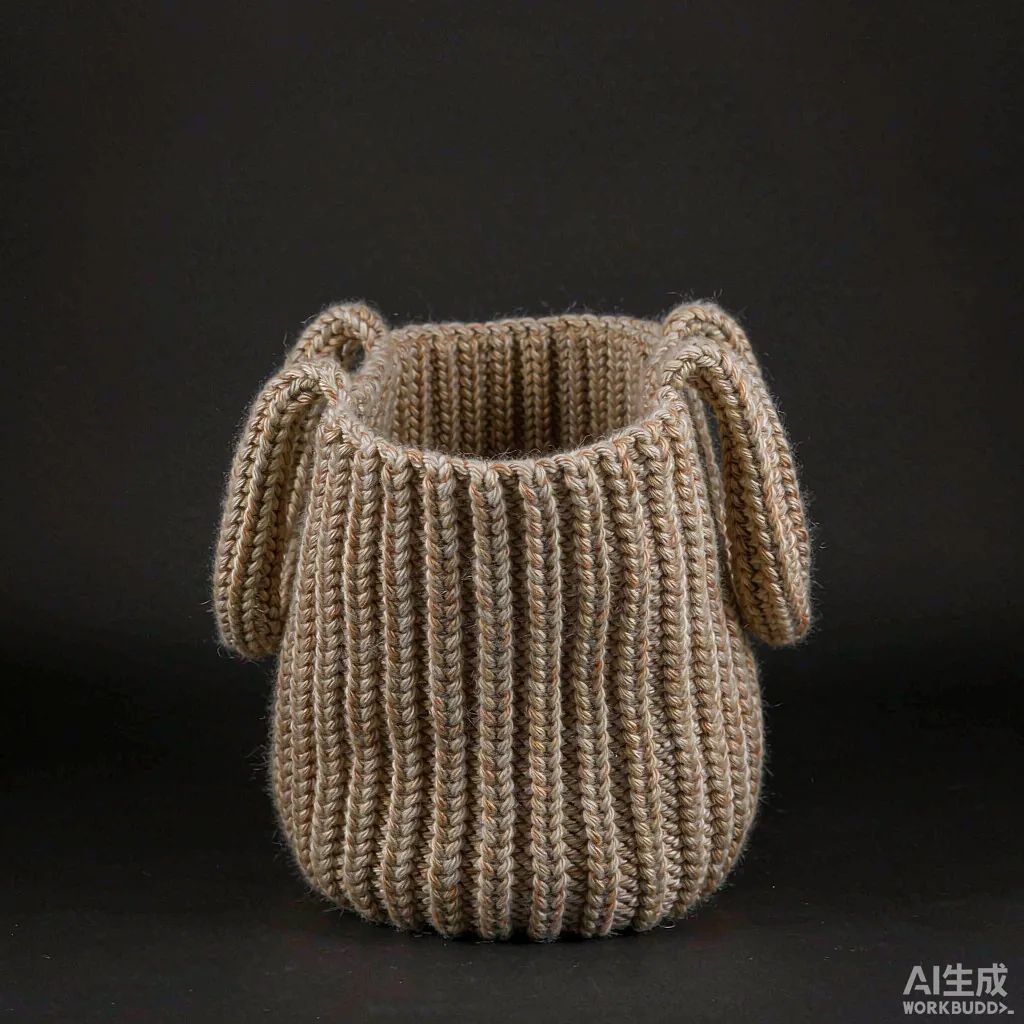
The Eight-Section Order a Product Page Should Follow
A knitted bag product page should follow a fixed eight-section order — headline, opening, specification block, construction, capacity, care, materials and claim evidence — because a shopper scans in that sequence and any section that is missing gets answered by assumption instead.
The sequence comes from the order in which a shopper asks questions, not from the order in which a brand finds it easy to write. What is it, how is it made, how big is it, will it last, how do I look after it, and why should I believe you — that is the sequence, and it is remarkably stable across categories. On a knit product there is one addition: the construction has to be stated early, because seamless is the differentiating property and a shopper who reaches the care section without meeting it will have already filed the product under ordinary soft bags. A page that reorders these sections to put brand voice first reads better and converts worse, which is a trade worth naming explicitly before the copy is commissioned.
- Headline: family word plus structure word, inside 60 characters so nothing is truncated on mobile.
- Opening: 120 words answering what it is, how it is made and how big it is, in that order.
- Specification block: five lines, each under 18 words, covering dimension, gauge, yarn, weight and capacity.
- Construction: one paragraph on the seamless body and what the absence of a seam means in use.
- Capacity: stated in litres and in a plain object comparison, never as a nominal size label.
- Care: six lines maximum, written as instructions rather than as warnings.
- Materials: fibre composition with the recycled content stated as a percentage.
- Claim evidence: the standard or test method behind any durability or safety claim.
Word Counts by Section, and Where Those Numbers Come From
A knitted bag listing works at about 350 words of body copy plus a 120-word opening and five specification lines, and those counts come from scan behaviour rather than from SEO convention: the page has to be readable end to end in under 90 seconds.
The counts are ceilings rather than targets, and treating them as targets is how a page becomes padding. If the construction point is made in 60 words, it should stay at 60. The reason for a ceiling at all is that a product page competes with the shopper's own time, and a page that cannot be finished will be abandoned at whatever point the reader decides it is not worth continuing — which on a mobile screen is usually somewhere around the second screenful. The number that matters most is not the total but the position of the specification block: if it sits within the first screenful, the page has done its job even if the reader never scrolls.
- Headline
- 60 characters, family word first, structure word second, shade last
- Opening paragraph
- 120 words, answering what it is, how it is made and how big it is
- Specification block
- Five lines, each under 18 words, above the fold on a mobile screen
- Body copy
- 350 words as a ceiling, not a target; readable end to end in 90 seconds
- Care section
- Six lines maximum, written as instructions rather than warnings
- Claim evidence
- One line per claim, naming the test method and the grade achieved
Writing the Specification Block Without Losing the Buyer
A knitted bag specification block should carry exactly five lines — dimension, gauge, yarn, weight and capacity — because these are the five numbers a shopper actually compares, and anything beyond five turns the block into a data sheet nobody reads.
The discipline is in what gets left out. Tensile strength, abrasion cycles and colour fastness grades are all interesting and none of them belong here, because a shopper cannot evaluate them and will skip the block entirely if it opens with a number measured in newtons. Those figures belong in the claim-evidence section at the bottom, where the reader who wants them will find them and the reader who does not will never be slowed down. The other common error is writing the specification in the language of the tech pack: dimension as 340 by 380 by 120 mm is unreadable to most shoppers, while 34 by 38 by 12 cm is not, and the centimetre form is also the form that survives translation.
Claim Discipline: What Can Be Stated and What Must Be Tested
Every claim on a knitted bag page belongs to one of three tiers — measured, certified or opinion — and only the first two may appear without qualification, while an opinion has to be written as one.
The three-tier rule exists because unqualified claims are the ones that generate both returns and regulatory attention. A measured claim names a test method and a figure: abrasion resistance to ISO 12947-2 at 20,000 cycles, or colour fastness to rubbing at grade 4 to ISO 105-X12. A certified claim names the scheme: recycled content certified to the Global Recycled Standard, or harmful-substance testing to OEKO-TEX STANDARD 100. An opinion is anything else — hard-wearing, beautifully made, built to last — and it is permitted as long as it is not dressed up as a measurement. The test of a well-written page is that a reader can tell which tier each sentence belongs to without being told.
| Tier | What it looks like | Rule for the page |
|---|---|---|
| Measured | Abrasion to ISO 12947-2 at 20,000 cycles | State the method and the figure; never round a figure upward |
| Certified | Recycled content certified to the Global Recycled Standard | Name the scheme and the scope of the certificate |
| Opinion | Holds its shape under a full load | Permitted, but must not be phrased as a test result |
| Implied | A photograph with no wording beside it | Treat as a claim; a detail crop implies a seamless construction |
| Prohibited | An absolute such as indestructible or tear-proof | Never publish; no test supports an absolute on a textile |
Copy for Gauge, Yarn and Structure Without Jargon
Gauge should be written as a sentence about what the number does — a gauge E12 body carries about 12 stitches per inch and reads as a fine, dense surface — rather than as the bare token E12, which means nothing to a shopper and everything to a technologist.
The rule for technical vocabulary is that a term may stay if it is explained in the same sentence and must go if it is not. Gauge stays, because it can be converted into stitches per inch in six words. Denier mostly goes, because 300D is not a unit a shopper can use; yarn weight in grams per square metre is marginally better and is what the specification block should carry. Seamless stays, because it is the differentiating word and it is self-explanatory. Whole-garment knitting should be glossed once, as knitted in one piece on the machine with no cut-and-sew assembly, and thereafter referred to as seamless. One unexplained technical term on a page is a small cost; three of them and the reader stops believing any of it.

Care Copy That Prevents Returns
Care copy should be six instruction lines written in the imperative — wash at 30 degrees, reshape while damp, dry flat, do not tumble, do not iron the trim, store empty — because a warning list reads as an admission that the product is fragile.
The wording carries more commercial weight than it appears to. A knit body reacts to washing in ways a woven body does not, and the shopper who does not know that will discover it and file a return described as a defect. Two lines carry most of the load: the temperature and the drying method. Washing at 30 degrees and drying flat keep the dimensional change inside the tolerance the product was engineered to, which on a knitted body is about 3%; a hot wash and a tumble do not, and the resulting bag is genuinely out of specification through no fault of the knitting. Saying this as an instruction rather than as a prohibition also changes how it is read: do not tumble dry invites a shopper to wonder why, while dry flat simply tells them what to do.
Six lines that prevent care-related returns
- State the wash temperature as a number: 30 degrees, not cold.
- Say reshape while damp, which is the step that actually preserves the silhouette.
- Say dry flat, and say it as an instruction rather than as a prohibition.
- Separate the trim care from the body care; a webbing handle tolerates more than a knit panel.
- Give the expected dimensional change as a percentage so a small change is not read as a fault.
- Repeat the two most important lines on the care label, not only on the page.
Localisation: One Range, Several Markets
A knitted bag page should be localised as a rewrite rather than a translation, because a headline written to 60 characters in English reaches about 34 characters of equivalent meaning in German, and the truncated headline loses the structure word first.
The practical consequence is that the character allowance has to be set in the longest market language and then held there, which means English copy often comes in under its limit. Units need the same treatment: litres and centimetres for most of Europe, inches and cubic capacity where the market expects them, and never a conversion written as a parenthetical afterthought. Claims need it most of all, because the schemes a European reader recognises differ from the ones an American reader recognises, and a page that names only one set will leave half its audience unable to evaluate the claim. The solution is not to lengthen the page but to keep a single claim table per market, which is why the claim-evidence section is built as a table in the source rather than as prose.
The Pre-Publication Checklist
Run nine checks before a knitted bag page goes live: four on the words, three on the claims and two on the way the page behaves on a phone, and treat any failure as a hold rather than a note for next time.
Words: four checks
Headline inside 60 characters; opening answers what, how and how big; five specification lines each under 18 words; body at or under 350 words.
Claims: three checks
Every claim sits in a named tier; every measured claim names its method and figure; every certified claim names the scheme and scope.
Behaviour: two checks
Specification block visible in the first screenful on a phone; headline still carries the family word when truncated by the template.
The checklist exists because the errors it catches cost little to fix here and a great deal to fix later. A headline that is 74 characters costs nothing to shorten before publication and costs a full content cycle to shorten after a marketplace has indexed it. A claim without a method behind it costs nothing to qualify before publication and costs a regulatory conversation afterwards. The single check that is most often skipped is the mobile one, and it is the one that decides whether the page works at all: if the specification block is below the fold on a phone, then for most of the audience the page has no specification.
Build the copy structure for a knit range
Send the style count, the markets the pages have to serve and the claims you intend to make. Our knit team will return a section order, word allowances, a claim table with the test method behind each line, and a schedule built on 7 working days of sampling and 30 days of bulk. Start on the contact page.
Frequently Asked Questions
How long should a knitted bag product description be?
About 350 words of body copy plus a 120-word opening and five specification lines. Those figures are ceilings set by scan behaviour rather than targets; if a point is made in 60 words, leave it at 60.
Where should the specification block sit on the page?
Within the first screenful on a mobile device. It is the most-read part of a page, and a shopper who never scrolls has effectively seen a page with no specification at all if it sits below the fold.
How many lines should a knitted bag specification block have?
Five: dimension, gauge, yarn, weight and capacity. Beyond five lines the block stops being a comparison tool and becomes a data sheet, and opening it with a figure measured in newtons will lose the reader entirely.
Should gauge be written on a consumer product page?
Yes, but explained in the same sentence. Gauge E12 means about 12 stitches per inch and reads as a fine dense surface; the bare token E12 means nothing to a shopper and should never appear alone.
What is the difference between a measured claim and a certified claim?
A measured claim names a test method and a figure, such as abrasion to ISO 12947-2 at 20,000 cycles. A certified claim names a scheme and its scope, such as recycled content certified to the Global Recycled Standard.
Can I write an opinion such as hard-wearing on a product page?
Yes, as long as it is not phrased as a test result. The failure mode is an opinion dressed up as a measurement, which is both a returns risk and a regulatory one. Keep opinion and measurement visibly separate.
How should care instructions be worded for a knitted bag?
As six imperative lines: wash at 30 degrees, reshape while damp, dry flat, keep the trim away from heat, store empty, and expect about 3% dimensional change. Instructions read better than prohibitions and are followed more often.
Why does care copy affect the return rate?
A knit body reacts to heat and agitation differently from a woven one. A shopper who washes hot and tumbles dry will produce a bag that is genuinely out of specification and will describe it as a defect rather than as care.
Should capacity be stated in litres?
Yes, in litres and alongside a plain object comparison. A nominal size label such as medium tells a shopper nothing, and size expectation is one of the largest single causes of returns in any bag category.
How do I localise a knitted bag page for several markets?
Rewrite rather than translate, and set the character allowance in the longest market language. A 60-character English headline reaches about 34 characters of equivalent meaning in German, and truncation loses the structure word first.
Should a B2B line sheet carry the same copy as a consumer page?
No. A line sheet leads with the commercial parameters: MOQ 100 pcs per style and colourway, 7 working days of sampling, 30 days of bulk, AQL 2.5 release and FOB Xiamen. The consumer page leads with what, how and how big.
What is the most common error on a knitted bag product page?
Burying the construction. If a shopper reaches the care section without learning that the body is knitted in one piece, the differentiating property has been wasted and the product has been filed with ordinary soft bags.
Do product photographs count as claims?
Yes. A detail crop with no wording beside it implies a seamless construction, and an implied claim is held to the same standard as a written one. Keep the caption consistent with what the frame actually shows.
How often should a product page be reviewed?
Once per season, and immediately after any construction or yarn change. A shade or yarn revision invalidates the specification block and any measured claim tied to the old construction, even if the wording still reads well.
People Also Ask
How do you write a product description for a bag?
Answer what it is, how it is made and how big it is in the first 120 words, then give a five-line specification block. Keep body copy to about 350 words and place the specification above the mobile fold.
What should a bag specification include?
Five numbers: dimension, gauge, yarn, weight and capacity. Anything beyond five lines turns the block into a data sheet that shoppers skip, and laboratory figures belong lower down the page.
How do you describe seamless knit construction to a shopper?
Say knitted in one piece on the machine with no cut-and-sew assembly, then call it seamless thereafter. Gloss the technical term once and never use the bare token without an explanation beside it.
Should product pages state test standards?
Yes, for any durability or safety claim. Name the method and the figure, such as abrasion to ISO 12947-2 at 20,000 cycles, or name the certification scheme and its scope.
How do you stop care-related returns on knit products?
Write care as instructions rather than warnings, give a wash temperature as a number, and state the expected dimensional change as about 3% so a normal small change is not read as a defect.
Sources and further reading
Every figure on this page is either our own programme data or attributed below. Open the originals before you write them into a specification.
- ISO 12947-2:2016 — Textiles, determination of abrasion resistance by the Martindale methodISO The method behind the abrasion figure quoted in a measured claim on a knitted bag page.
- ISO 105-X12:2016 — Textiles, tests for colour fastness, Part X12: colour fastness to rubbingISO The rubbing fastness method referenced by the grade quoted in a colour claim.
- Directive (EU) 2024/825 on empowering consumers for the green transitionEuropean Union The rules on environmental claims that govern how a material statement may be worded on a retail page.
- OEKO-TEX STANDARD 100OEKO-TEX The harmful-substance testing scheme named in a certified claim tier.
- Global Recycled Standard (GRS)Textile Exchange The scheme behind a recycled-content percentage stated in the materials section.
Structure First, Voice Second
A knitted bag page fails when the reader finishes it without learning that the body is knitted in one piece, and that failure is almost always an ordering problem rather than a writing problem. Fix the eight sections and the word allowances first, then write, then run the nine checks. Voice can be added at any point; a specification block below the fold cannot be recovered by better prose.
For the frames that sit beside this copy, see knitted bag photography. For the price bands a page has to support, see knitted bag price architecture, and for the display conditions the copy has to survive on a fixture, see knitted bag merchandising. The brand-level view sits under knit bag brand guide.