Knitted Bag Price Architecture: Tier Ladders, Margin Bands and Markdown Ladders for a Seamless Knit Range
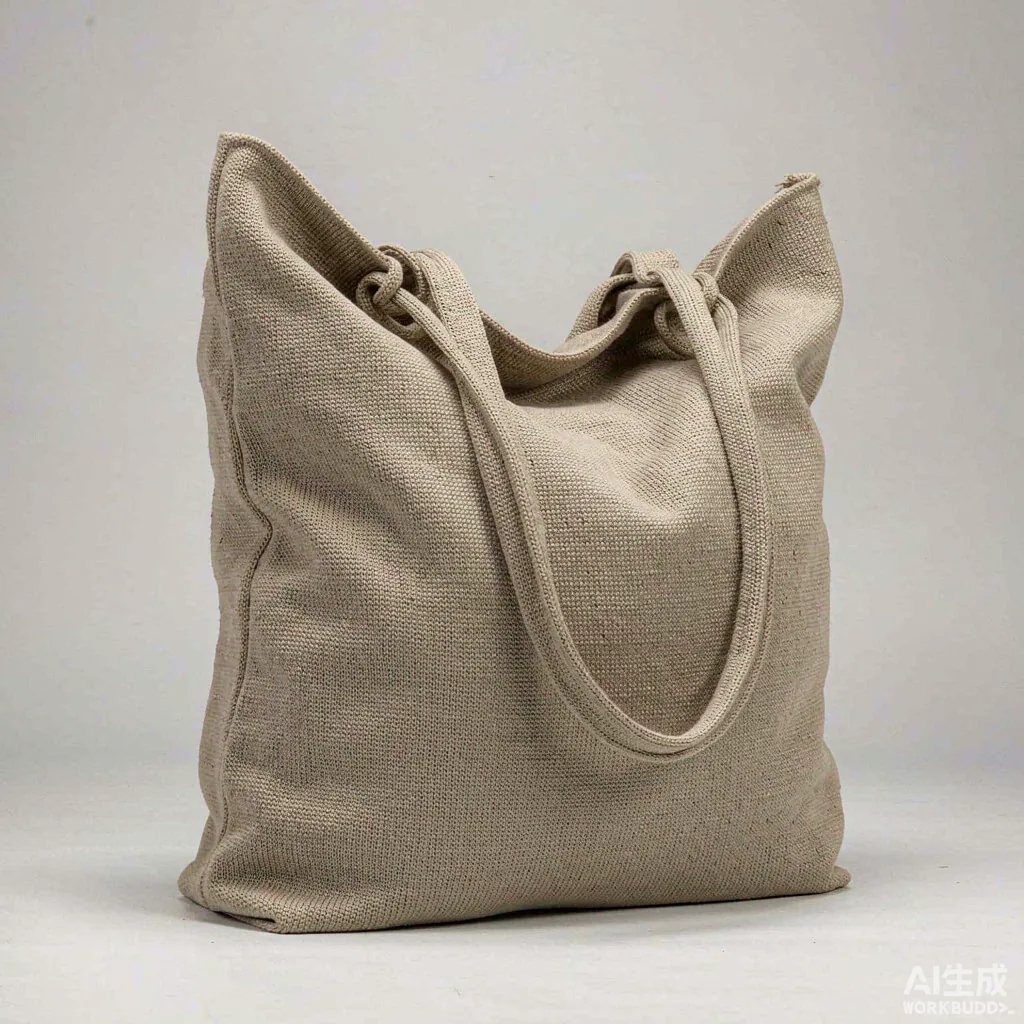
A knitted bag range usually arrives at retail pricing backwards: the tiers are set by what the category already charges, and the construction argument is then made to fit them. The better order starts at the floor. A standard gauge E12 tote body quotes at about USD 4.80 FOB Xiamen; freight, duty and handling take that to a landed figure roughly 1.6 times higher; and a 55% initial margin puts the first tier at USD 19 and the top tier at USD 45 with three steps between. This article works through the ladder in the order the questions are actually asked: the floor, the tier count, the build-up, the channel margins, the markdown ladder, the ending, and the volume effect.

What Sets the Floor of a Knit Price Ladder?
The floor of a knitted bag price ladder is set by the knitting time and the yarn booking rather than by the trim, because a seamless body carries its cost in machine minutes and a booked dye lot rather than in assembly operations that can be value-engineered later.
This matters because it makes the floor less negotiable than a cut-and-sew floor. On a sewn bag, a price can often be found by simplifying a pocket or changing a lining, because those are added operations with their own cost lines. On a knit body, the equivalent levers are gauge and yarn, and both change the product that was approved: dropping from gauge E12 to gauge E7 reduces machine time by roughly a third, but it also changes the surface, the fabric mass and the hand, and the shade has to be re-approved against the new construction. The floor is therefore best treated as a function of the approved sample rather than as a target to be negotiated against, and the pricing conversation should happen after the sample is fixed rather than before it.
How Many Tiers Does a Knit Range Actually Need?
Three tiers is the right count for a first knitted bag range, because three tiers can be separated by a step wide enough to be perceived while five tiers compress the gaps below the 8% threshold at which a shopper stops reading them as different products.
The step width is the whole argument. Price perception is relative rather than absolute, and a gap narrower than roughly 8% reads as the same product at a confusingly different price, which produces the worst possible outcome: the shopper assumes the difference is arbitrary and buys the lowest tier, or assumes the higher tier is overpriced and buys nothing. A three-tier ladder at USD 19, USD 29 and USD 45 gives steps of about 53% and 55%, which are unmistakable, and each step can be justified by something the shopper can see — capacity, a lined interior, or a hardware upgrade. Five tiers across the same span compress the steps to around 20%, which is still workable, but it requires five visible differences rather than three, and most first ranges do not have five differences to show.
- Reference FOB
- About USD 4.80 for a standard gauge E12 tote body, FOB Xiamen
- Landed multiplier
- About 1.6 times FOB once freight, duty and handling are included
- Tier one retail
- USD 19, at an initial margin of about 55%
- Tier two retail
- USD 29, roughly a 53% step above the first tier
- Tier three retail
- USD 45, roughly a 55% step above the second tier
- Minimum step
- 8%; below this a shopper does not read the tiers as distinct products
What Sits Between FOB and the Retail Price?
Between a USD 4.80 FOB figure and a USD 29 retail price sits about 1.6 times on the landed cost and roughly 4.2 times on the retail price, and the two multipliers are the ones a brand most often conflates.
The first multiplier is arithmetic and the second is strategic. Landed cost is FOB plus freight, insurance, duty and handling, and for a knit bag shipped FOB Xiamen into a European or North American warehouse it typically lands around 1.6 times the FOB figure, because a knit body packs densely and the freight line is modest against the duty line. The retail multiplier is a choice, not a calculation: it is set by the margin the channel requires and by the brand position, and it usually lands between 3.5 and 4.5 times landed on an accessories range. Conflating the two is how a brand ends up with a price that looks right and a margin that is not, because the conversation happens in retail prices while the commitment happens in FOB.
| Line | Basis | Effect on the unit |
|---|---|---|
| FOB Xiamen | Quoted on the approved sample at the agreed gauge and yarn | The base figure, about USD 4.80 on a standard tote |
| Freight and insurance | Sea freight on a densely packed knit consignment | Modest; knit packs better than a structured bag |
| Duty | Classification-dependent, applied to the customs value | The largest single component of the landed multiplier |
| Handling and receipt | Warehouse receipt, ticketing and distribution | Fixed per unit, so it falls with volume |
| Channel margin | Set by the retailer or by the marketplace fee stack | Decides the retail multiplier, typically 3.5 to 4.5 times landed |
Why Do Margin Bands Differ by Channel?
Margin bands differ by channel because the cost of the sale differs: own e-commerce carries roughly a 65% initial margin, a marketplace about 50% after the fee stack, and a department store door about 45% at the price the retailer will accept.
The practical problem this creates is that one ladder cannot serve three channels without a channel-specific price, and a shopper who finds two prices for one product concludes the higher one is inflated. The workable resolution is to hold one recommended retail price and vary the margin rather than the price, accepting a lower band in the department store channel and recovering it through volume. That works on a knit range better than on most categories, because the unit cost falls as volume rises: at 100 pcs per style and colourway the unit carries the full set-up, and at 1,000 pcs the same set-up is spread across ten times the pieces. The result is that the department store channel, which takes the volume, can also carry the better unit cost.
When Should the Markdown Ladder Be Written?
The markdown ladder should be written before the season opens, in six steps, because a markdown decided in the season is a reaction to a stock position rather than a planned descent and it usually lands on the wrong style.
A planned ladder runs roughly 15%, 25%, 40%, 50%, 60% and 70% against retail, with each step triggered by a sell-through figure rather than by a date, and each step applied to a defined subset of the range rather than to all of it. The discipline that matters most is the subset: marking down the whole range teaches a shopper to wait, while marking down three styles leaves the ladder intact and clears the same stock. The other discipline is protecting the top tier for the whole season, because the top tier is what makes the middle tier look reasonable, and cutting it in week six collapses the perceived value of everything beneath it.
Markdown rules that protect a knit ladder
- Write all six steps before the season opens and date them against sell-through triggers, not calendar dates.
- Apply each step to a defined subset of styles rather than to the whole range.
- Hold the top tier at full price for the full season; it is what makes the middle tier look reasonable.
- Never let two adjacent tiers sit at the same marked price, because the ladder then reads as one tier.
- Take the deepest step only after the planned step has run its two-week window.
- Track the realised margin against the planned ladder weekly, not at the end of the season.
Which Price Ending Suits a Knit Premium Position?
A knitted bag positioned on construction rather than on value should use round endings — USD 45 rather than USD 44.95 — because charm endings signal a promotional posture and undercut the seamless argument the range is built on.
The ending is a position statement and it is read as one. Charm pricing is well established in grocery and general merchandise, where the shopper is comparing on price and the ending signals that the price has been worked at. In a category where the purchase argument is construction, materials and durability, the same ending signals the opposite: that the price has been shaved to meet a threshold rather than set to reflect the product. There is a second, more practical argument in favour of round numbers on knit specifically: a markdown ladder expressed as percentages produces awkward figures from a charm price, while 50% of USD 45 is a clean USD 22.50 and 50% of USD 44.95 is not.
Where Does MOQ 100 pcs Change the Unit Cost Curve?
MOQ 100 pcs per style and colourway is where the unit cost curve is steepest: the first 100 pieces carry the full knitting programme and yarn set-up, and the next 900 pieces add only yarn, machine time and finishing.
The consequence for price architecture is that the ladder should be designed against the volume the range will actually reach, not against the volume of the first order. A brand that prices its tiers from a 100-piece first buy sets the whole ladder about 12% higher than the same ladder priced from a 1,000-piece run, and when the range succeeds and the volume rises, the realised margin overshoots the plan and the price looks high against the value delivered. The better method is to price the ladder at the expected steady-state volume and to accept a thinner margin on the first drop, treating the opening order as the cost of establishing the range rather than as the basis of its economics.
How Do You Reprice Mid-Season Without Damaging the Ladder?
Reprice a knitted bag range by changing the product rather than the price: a revised yarn, an added pocket or a hardware change justifies a new tier position, while a straight price cut on an unchanged product resets the shopper's reference permanently.
Add a tier above
Introduce a fourth tier at USD 65 with a visible difference. This lifts the perceived value of the USD 45 tier without cutting anything.
Revise the product
Change the yarn or add a lining, then price the revised style into the vacated step. Sampling runs 7 working days, so a revision is feasible in season.
Reduce the pack
Remove a secondary item from the offer rather than cutting the price. The value delivered falls without the reference price moving.
Cut the price
Only as the last step of a planned ladder, applied to a defined subset. A cut on an unchanged product resets the reference permanently.

The underlying principle is that a price is a promise about the product, and changing it without changing the product tells the shopper the original promise was wrong. That is recoverable once, at the bottom of a planned ladder, and it is not recoverable as a mid-season tactic. Where a range genuinely needs to move down, the cleanest route is usually to let the existing tiers run out and introduce the lower position with a new style, so the old ladder and the new one are never both on the shelf at the same price for the same product.
Build the ladder for a knit range
Send the tier count you are considering, the channels the range has to serve and the volume per style. Our knit team will return a landed cost build-up, a tier ladder with margin bands by channel, and a quotation against MOQ 100 pcs per style and colourway, 7 working days of sampling and 30 days of bulk. Start on the contact page.
Frequently Asked Questions
What sets the floor price of a knitted bag?
Knitting time and the yarn booking, not the trim. On a seamless body the cost sits in machine minutes and a booked dye lot, and the two levers that reduce it — gauge and yarn — both change the approved sample, so the floor is best treated as a property of the sample.
How many price tiers should a first knitted bag range have?
Three. Three tiers can be separated by a step wide enough to be perceived, while five compress the gaps toward the 8% threshold at which a shopper stops reading them as different products and starts assuming the difference is arbitrary.
What is the smallest price step a shopper notices?
About 8% between adjacent tiers. Narrower than that and the two tiers read as one product at a confusingly different price, which pushes the shopper to the lowest tier or out of the range entirely.
What is the landed multiplier on a knitted bag?
About 1.6 times FOB once freight, insurance, duty and handling are included. A knit body packs densely, so the freight line is modest and duty is usually the largest single component of the multiplier.
What retail multiplier should an accessories range use?
Typically 3.5 to 4.5 times landed cost. It is a strategic choice set by the channel and the brand position rather than a calculation, which is why the conversation should never be held in retail prices while the commitment is made in FOB.
Why do margin bands differ between channels?
Because the cost of the sale differs. Own e-commerce carries roughly 65% initial margin, a marketplace about 50% after the fee stack, and a department store door about 45% at the price the retailer will accept.
Should one price serve every channel?
Yes, one recommended retail price with the margin varied by channel rather than the price. A shopper who finds two prices for one product concludes the higher one is inflated, and the loss of trust costs more than the margin recovered.
When should a markdown ladder be written?
Before the season opens, in six steps triggered by sell-through rather than by date. A markdown decided in the season is a reaction to a stock position and usually lands on the wrong style at the wrong depth.
Should a markdown apply to the whole range?
No. Apply each step to a defined subset of styles, because marking down the whole range teaches a shopper to wait, while marking down three styles clears the same stock and leaves the ladder intact.
Why should the top tier hold full price?
Because it is what makes the middle tier look reasonable. Cutting the top tier in week six collapses the perceived value of everything beneath it, which is a far larger loss than the stock cleared by the cut.
Should a knit range use charm pricing?
Not if the range is positioned on construction. A charm ending signals a promotional posture and undercuts a seamless argument. Round endings also keep a percentage markdown ladder arithmetically clean.
How does MOQ 100 pcs affect the unit cost?
It is where the curve is steepest. The first 100 pieces per style and colourway carry the full knitting programme and yarn set-up, and the next 900 add only yarn, machine time and finishing, so the ladder should be priced at steady-state volume.
What happens if a ladder is priced off the first order?
The whole ladder sits about 12% higher than the same ladder priced from a 1,000-piece run. When volume rises, the realised margin overshoots plan and the price looks high against the value delivered.
Can a range be repriced mid-season safely?
Only by changing the product. A revised yarn, an added pocket or a hardware change justifies a new tier position; a straight cut on an unchanged product resets the shopper's reference permanently and is recoverable only once.
People Also Ask
How do you price a knitted bag range?
Start at the FOB figure on the approved sample, apply the landed multiplier, then set tiers with a minimum 8% step. Three tiers at USD 19, USD 29 and USD 45 is a workable first ladder.
What margin should a bag brand target?
About 65% initial margin on own e-commerce, 50% on a marketplace after fees and 45% at a department store door. Hold one retail price and vary the margin rather than the price.
How many price tiers should a product range have?
Three for a first range. Five tiers compress the gaps below the level at which a shopper reads them as distinct, and a first range rarely has five visible differences to show.
When should markdowns be planned?
Before the season opens, in six steps triggered by sell-through and applied to a defined subset of styles. Hold the top tier at full price for the whole season.
Does order volume change the unit price much?
Yes, especially in the first 100 pieces per style and colourway, where the full knitting programme and yarn set-up sit. Price the ladder at the volume the range will reach, not at the first order.
Sources and further reading
Every figure on this page is either our own programme data or attributed below. Open the originals before you write them into a specification.
- Incoterms rulesInternational Chamber of Commerce The rule set that defines FOB Xiamen and where the cost and risk pass in a knitted bag shipment.
- Access2MarketsEuropean Commission The tariff and rules-of-origin reference used to determine the duty line in a landed cost build-up.
- Harmonized Tariff Schedule of the United StatesUSITC The classification reference behind the duty applied to a knitted bag entering the United States.
- ISO 2859-1 — Sampling procedures for inspection by attributes, Part 1: AQL-indexed sampling schemesISO Defines the AQL 2.5 release that governs acceptance of the bulk the price was quoted against.
- WHOLEGARMENT knitting machinesShima Seiki The machine class whose cycle time sets the knitting-minute component of the cost floor.
Price the Ladder at the Volume You Will Reach
Most knit ladders are built from the first order and then discovered to be wrong when the range works. The unit cost curve is steepest in the first 100 pieces per style and colourway, so a ladder priced at opening volume is a ladder priced at the worst point on the curve. Set the tiers at steady state, accept a thinner margin on the opening drop, and protect the top tier for the whole season.
For the sequence that brings a priced range to the shelf, see knitted bag launch timeline. For the volume commitment behind each tier, see knitted bag assortment planning, and for the fixture the prices have to work on, see knitted bag merchandising. Commercial terms sit under custom knit bags.