Knitted Bag Capacity Verification: Nine Checks That Show Whether a Claimed 200,000 Pieces a Month Is Real
How does a buyer verify knitted bag capacity before committing a season? Not by accepting a monthly figure, but by running nine checks that convert it into arithmetic: lines, gauge mix, booked windows, cycle time and the bottleneck that is never knitting. A claimed 200,000 pieces a month is only meaningful once it is divided by working days, by lines and by the panels each bag needs. This article sets out the nine checks in order, the evidence each one should produce, and the answers that should stop a programme rather than slow it.
What a Capacity Claim Actually Measures
A capacity claim tells a buyer almost nothing until it is divided: 200,000 pieces a month over about 26 working days is roughly 7,700 pieces a day, which across 7 production lines is about 1,100 pieces per line per day.
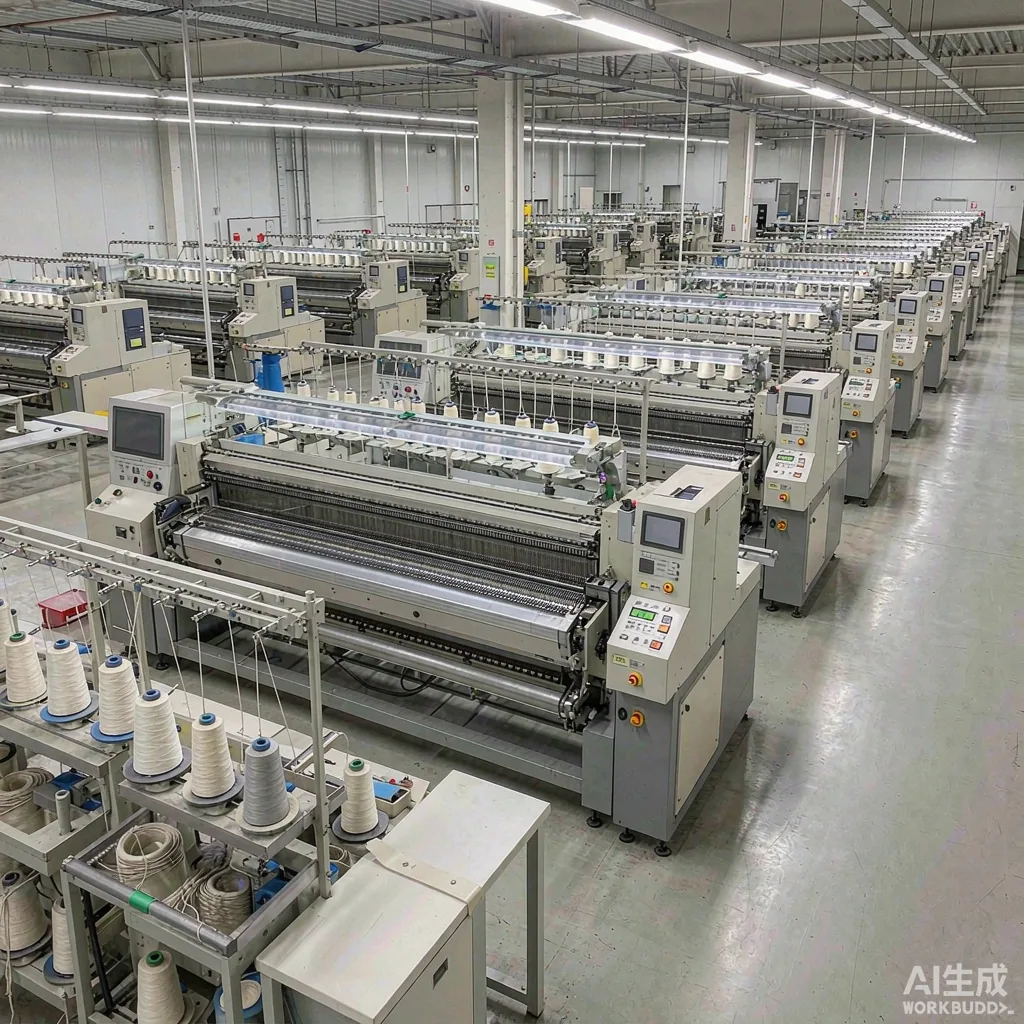
That arithmetic is the whole point of verification, and it is worth doing before asking any questions, because it turns a number into a set of things that can be checked. A line producing 1,100 knitted bags a day is producing about 2,500 to 3,500 knitted panels, at two to four panels per bag depending on whether the body is knitted in one piece or assembled from a front, a back and a gusset. At a cycle time of 6 to 9 minutes per panel on a flat knitting machine, a single machine produces roughly 60 to 90 panels in a 10-hour shift, so 3,000 panels a day needs about 35 to 50 machines running. Those are the figures a buyer should be able to reconcile.
The second reason to do the arithmetic first is that it reveals which question matters. Capacity is not one number; it is the capacity of the narrowest stage. Knitting is rarely the narrowest stage on a knit bag programme, because a knitted shell comes off the machine quickly relative to what happens next. Assembly, lining insertion, hardware attachment and final inspection are slower, more labour-dependent and far more sensitive to style complexity. A partner can have ample knitting capacity and still be unable to deliver a bag with a lining, an interior pocket and a metal closure on the date promised. Goods on this programme ship FOB Xiamen, so the freight and customs stages sit with the buyer rather than with the floor being verified.
Check One: Lines and Gauge Mix
The first check is to establish how many lines exist and which gauges they run, because a gauge the programme needs is capacity and a gauge it does not is irrelevant to it.
On a knit bag programme the gauges in common use are E5 and E7 for a chunky, structured shell and E12 to E16 for a finer, denser one. Seven production lines do not automatically cover all four: a line set up at E7 cannot run an E12 shell without a needle-bed change and a re-set, which is a setup cost rather than a scheduling one. The question to ask is which gauges each line is currently set to, and the answer should be specific. A production partner running 7 lines and about 200,000 pieces a month that can name the gauge on each of them is giving a verifiable answer; one that says all gauges is giving a figure.
Check Two: Booked Versus Free Windows
The second check separates installed capacity from available capacity, and it is the one most often skipped: a line can be fully committed for eight weeks while its monthly figure stays unchanged.
Ask for the booking position rather than the capacity figure. A useful answer states what proportion of the next 8 to 12 weeks is already committed, and it changes week by week. On a 7-line setup running at about 80 to 85% utilisation, roughly one line's worth of output is genuinely free at any point, which means a programme of 6,000 pieces does not need to fight for space but a programme of 60,000 does. Where a buyer is placing a large seasonal order, the right move is to book a named window rather than a quantity, and to confirm in writing that the window is held.
Check Three: Knitting Is Rarely the Bottleneck
The third check identifies the narrowest stage, and on a knitted bag programme that is almost never the knitting machine; it is assembly, lining and hardware.
A knitted panel is produced in minutes. Turning four panels into a finished bag with a lining, an interior pocket, a closure and a hardware set takes several times longer, and it scales with labour rather than with machine count. A programme that adds a lining roughly doubles the assembly time; one that adds a metal closure with a plated finish adds a component with a 12 to 15 working day window and a 500 to 1,000 piece minimum. This is why a capacity figure quoted in pieces is misleading between two styles: 200,000 plain foldable totes and 200,000 lined structured bags are not the same capacity at all.
- Installed capacity
- 7 production lines, about 200,000 pcs per month
- Working days per month
- About 26, giving roughly 7,700 pcs per day
- Output per line per day
- About 1,100 pcs, or roughly 2,500 to 3,500 panels
- Cycle time per panel
- About 6 to 9 minutes on a flat knitting machine
- Panels per bag
- One for a whole-garment body, two to four for an assembled shell
- Typical utilisation
- About 80 to 85%, leaving roughly one line of free output
- Practical free window
- Ask for the committed position across the next 8 to 12 weeks
Check Four: Cycle Time and Style Complexity
Cycle time converts a style into capacity, and the fourth check is to ask what the specific style costs rather than what the facility can do in general.
A whole-garment body knitted in one piece at E12 might run 6 to 7 minutes; the same bag built from four panels with a shaped gusset might run 14 to 18 minutes of machine time in total and considerably more assembly time. That difference is why two programmes of identical piece count can occupy very different amounts of capacity, and why a quotation should always be read alongside the style description. Where a buyer is comparing partners, asking each one what the style costs in machine minutes is a fair question, and the answers are usually more comparable than the prices.
There is a second-order effect here that is worth naming. A style that needs a machine setting change between colourways costs setup time, and with a 100 pcs per style and colourway minimum a programme can legitimately ask for four or five shades in one run. That is fine, but it means the run consumes more line time per thousand pieces than a single-shade run of the same volume, and a partner quoting a flat rate for any colour split is absorbing a cost that will show up somewhere else in the relationship. Asking how setup time is handled is a reasonable part of verification.
Check Five: Yarn Supply Position
The fifth check is the yarn position, because capacity on the floor is worthless without material on the shelf: a stocked shade arrives in about 7 to 10 working days and a custom-dyed one in about 15 to 20.
Ask two things. What yarn is held as safety stock, and how much of the programme's requirement is already covered by it. A production base running since 2014 and coordinating knit bag programmes at 7 lines will typically hold two to four weeks of the counts it runs most often, usually 300D and 600D polyester and rPET. Beyond that, the dyelot minimum matters: a custom shade has a minimum lot size, and on a small first run the minimum can exceed the order. Dope-dyed yarn avoids the dyelot question entirely, which is why it is worth asking about even when the palette is not yet fixed.
Check Six: Trim and Hardware Windows
The sixth check covers trim and hardware, which are the items most likely to stop a run that otherwise has capacity: a woven label takes about 7 to 10 working days, a moulded zipper about 10 to 14, and a plated metal component about 12 to 15.
Each of those carries its own minimum, typically 500 to 1,000 pieces per item, and each is supplied by a different vendor rather than by the knit facility. That is why they are a separate check rather than a footnote: a bag programme can have all the knitting capacity in the world and still be waiting on 1,000 zippers. The verification question is whether the trim is ordered against the component minimum and held against the repeat, or ordered against each order. A partner that holds trim is protecting the buyer's timeline; one that reorders each time is adding the longest window in the chain to every run.
Check Seven: Quality Records and AQL History
The seventh check is quality history, because capacity that produces goods a buyer will reject is not capacity: ask for the last three release results under AQL 2.5 and the switching-rule state.
Under ISO 2859-1, inspection moves between normal, tightened and reduced sampling based on recent results, and that state is a genuine signal. A programme running under normal inspection with a consistent record is one thing; one that has moved to tightened inspection, which happens after two of five consecutive lots are rejected, is telling the buyer something about the line. The sample sizes are also checkable: a lot of 281 to 500 pieces draws 50 with an acceptance number of 3, and a lot of 1,201 to 3,200 draws 125 with an acceptance number of 7. Asking for the actual counts, not a pass statement, is the check.
| Check | Evidence to request | Answer that should stop the programme |
|---|---|---|
| Lines and gauge mix | Which gauge each of the 7 lines is currently set to | All gauges, with no line-level detail |
| Booked versus free windows | Committed position across the next 8 to 12 weeks | No booking record at all |
| Narrowest stage | Assembly and hardware capacity for this specific style | Capacity quoted in pieces without reference to the style |
| Cycle time | Machine minutes per panel for this style | A flat rate for any style and any colour split |
| Yarn position | Counts held, weeks of cover, dyelot minimum | Yarn will be ordered after sample approval |
| Trim and hardware | Ordered to component minimum, held against the repeat | Reordered against each order |
| Quality history | Last three AQL 2.5 release results and switching state | A pass statement with no counts |
| Shift pattern and peaks | Shifts per day and the plan across the two shutdowns | Bulk scheduled across the Lunar New Year window |
| Subcontracted stages | Which stages run outside the audited floor | No answer, or everything is in-house |
Check Eight: Shift Pattern and Seasonal Peaks
The eighth check is the shift pattern and the seasonal plan, because capacity quoted on two shifts is not the same as capacity available across the Lunar New Year shutdown.
Two shutdowns sit in every China calendar: the Lunar New Year break of about two to three weeks in January or February, and the National Day holiday in early October. A production base that plans bulk to finish before the first one is doing the buyer a favour that no capacity figure mentions. Ask how many shifts run, whether overtime is available at peak, and what the order queue looks like in the August to November window when spring programmes are all being booked at once. Peak season is when a capacity claim is tested, and it is also when a buyer has the least leverage.
Check Nine: Which Stages Sit Outside the Audited Floor
The ninth check is the one buyers forget: which stages of the bag are actually run on the audited floor, and which are placed with a subcontractor.
A knit bag programme has stages that a knitting facility does not all do in-house: dyeing, printing, hardware plating, ultrasonic welding and sometimes assembly. None of that is a problem in itself, but it is a compliance and a capacity question. A stage placed outside the audited floor is outside the BSCI or Sedex SMETA scope that the buyer is relying on, and it is also outside the scheduling control the buyer has been quoted. Asking which stages are placed out, and whether those vendors are audited, is a normal part of verification and the answer should be specific.
Six answers that should stop a capacity conversation
- A monthly figure with no working-day breakdown.
- No line-level gauge detail.
- No booking record for the next 8 to 12 weeks.
- Capacity quoted in pieces without reference to the style.
- Yarn ordered only after sample approval.
- Bulk scheduled across a holiday shutdown.
How to Read the Answer You Get
The quality of a capacity answer is itself the finding: a partner that answers in arithmetic is one that can schedule, and one that answers in adjectives cannot.
There is a practical way to test this without an audit. Ask for the committed position for a named week six weeks out, and for the gauge each line is set to in that week. A partner that can answer has a schedule; one that cannot is quoting installed capacity and hoping. For a first programme the stakes are moderate, because a 100 pcs per style and colourway minimum means a trial order sits within reach. For a seasonal programme of tens of thousands of pieces, the same question is worth asking twice, and the answer is worth getting in writing alongside the booking.
Verify capacity before you book the season
Send the style, the volume per colourway, the required window and the destination. Our knit team will return the line and gauge position for that window, the committed weeks already booked, and a quotation on 7 working days of sampling and 30 days of bulk. Start on the contact page.
Frequently Asked Questions
How do I verify a knitted bag partner's capacity?
Run nine checks: lines and gauge mix, booked versus free windows, the narrowest stage, cycle time for your style, yarn position, trim windows, AQL 2.5 history, shift pattern and whether any stages sit outside the audited floor. It is worth stating in writing before production begins, because it is far harder to agree once the goods exist.
What does 200,000 pieces a month actually mean?
About 7,700 pieces a day over 26 working days, or roughly 1,100 per line across 7 production lines. That is about 2,500 to 3,500 knitted panels a day, which in turn needs somewhere between 35 and 50 machines running. Record the figure at approval so that inspection and any later run can be measured against it.
Why is knitting not the bottleneck on a bag programme?
Because a panel is knitted in minutes while assembly, lining, hardware and inspection take several times longer and scale with labour rather than with machine count. Adding a lining to a bag roughly doubles the assembly time. Both sides are better served when this is agreed early rather than discovered halfway through the programme.
What is a realistic cycle time for a knitted bag panel?
About 6 to 9 minutes per panel on a flat knitting machine. A whole-garment body is one panel, while an assembled shell with a shaped gusset is two to four, so machine time per bag ranges from about 6 to 18 minutes. That is the practical control, and it costs nothing to put in place before the deposit is paid.
Which gauges should a knit bag production base run?
E5 and E7 for a chunky structured shell, and E12 to E16 for a finer, denser one. Seven production lines do not automatically cover all four, because a gauge change needs a needle-bed re-set and time on the line. Programmes that skip this step tend to rediscover the same problem on the following season.
What is the difference between installed and available capacity?
Installed capacity is what the floor could run at full stretch. Available capacity is what is not already booked. At about 80 to 85% utilisation, roughly one line's worth of output is genuinely free at any given point in the month. Ask for it as a figure rather than a statement, since a statement cannot be checked or compared.
How far ahead should I book a production window?
Ask for the committed position across the next 8 to 12 weeks. For a seasonal programme of tens of thousands of pieces, book a named window rather than a quantity, and confirm that booking in writing before paying a deposit. Getting it right at this stage removes a whole category of argument from the rest of the programme.
How long does yarn take to arrive?
About 7 to 10 working days for a stocked shade and about 15 to 20 for a custom-dyed one, because the dye lot has to be made. Dope-dyed yarn avoids the dye lot question entirely and is worth asking about early. It belongs in the written specification rather than in a conversation that nobody can quote later.
What trim items most often delay a run?
Zippers and plated metal hardware. A moulded zipper takes about 10 to 14 working days and a plated component about 12 to 15, and each is usually ordered at a minimum of 500 to 1,000 pieces per individual item. It is worth stating in writing before production begins, because it is far harder to agree once the goods exist.
What quality record should I ask for during verification?
The last three release results under AQL 2.5 with the actual sample sizes and defect counts, plus the current switching-rule state under ISO 2859-1. Ask for counts rather than a pass statement, which on its own tells you very little. Record the figure at approval so that inspection and any later run can be measured against it.
People Also Ask
How can I tell if a bag supplier has real capacity?
Convert the claim into arithmetic and ask for a named week six weeks out. A partner who can state the gauge on each line and the committed position for that week has a schedule.
What is a good monthly capacity for knitted bags?
About 200,000 pieces across 7 production lines is a solid mid-size figure. What matters more is the free window, the gauge mix and the capacity of the assembly stage rather than the headline number.
Why does my bag order take 30 days if knitting is fast?
Because the 30 days cover knitting, relaxation, assembly with lining and hardware, packing and documentation. Knitting is roughly a third of the block; assembly accounts for most of the remainder. Confirm it before production rather than after.
What questions should I ask about knit production capacity?
How many lines, which gauge each is set to, what is already booked, what your style costs in machine minutes, what yarn is held, and what the last three AQL 2.5 results actually counted.
Does a low MOQ mean limited capacity?
No. A 100 pcs per style and colourway minimum is about setup economics rather than floor size. It lets a buyer test a shade at 100 pieces while the same floor runs a large seasonal programme.
Sources and further reading
Every figure on this page is either our own programme data or attributed below. Open the originals before you write them into a specification.
- ISO 2859-1 — Sampling procedures for inspection by attributes, Part 1: AQL-indexed sampling schemesISO Source of the sample sizes, acceptance numbers and switching rules used in check seven.
- SMETA auditSedex Defines the audit scope that a subcontracted dyeing or plating stage would fall outside.
- amfori BSCI — business social compliance initiativeamfori Referenced when confirming that the booked window sits on an audited production floor.
- WHOLEGARMENT knitting machinesShima Seiki Gauge ranges and machine classes behind the E5 to E16 figures used in check one.
- ISO 13934-1 — Textiles, tensile properties of fabrics, Part 1ISO The tensile test used to confirm a claimed GSM and structure is being held in bulk.
- Substances restricted under REACH (Annex XVII)ECHA The screen that applies to any stage placed with an outside vendor.
Capacity Is Arithmetic, Not an Adjective
A capacity figure is only a claim until it is divided by working days, lines, gauges and panels. Once it is, the questions become specific and the answers become checkable: which gauge each line is set to, what is already booked in the week the buyer needs, and what the last three release results actually counted. Those three questions take an email to ask and remove most of the uncertainty from a seasonal booking.
For the calendar those windows sit in, see knitted bag supply planning, and for turning the findings into enforceable terms, see knitted bag contract terms. The wider framework is in the knit bag sourcing guide.