Setting Tolerances on Knitted Bags: How a Gap of Three Millimetres Became a Rejected Container, and the Numbers That Prevent It
What tolerances should be set on a knitted bag? Nine numbers cover it: plus or minus 3 mm on body length, 2 mm on body width, 2 mm on handle width, 4 mm on handle placement, 5 percent on weight, 3 percent on shrinkage after washing, plus a stated seam allowance, a stated conditioning period and a stated resting period. The last two decide whether the first five mean anything, because a knit keeps moving after it leaves the machine.
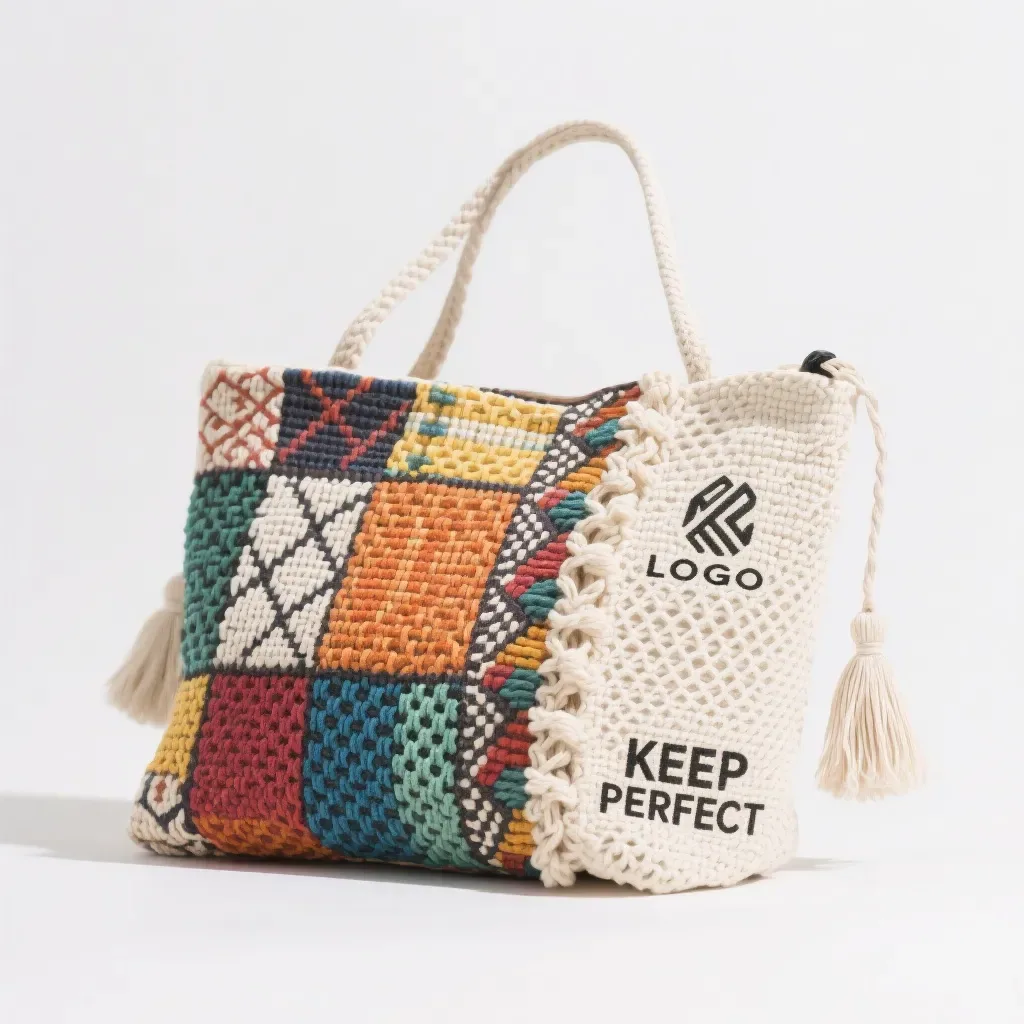
The Rejection That Started With Three Millimetres
A buyer's tech pack specified a tote at 380 mm long and did not specify a tolerance. The production run measured between 376 and 379 mm at goods-in, comfortably close to the drawing by any reasonable reading, and the shipment sailed. Four weeks later the retailer's own quality check measured the same bags at 371 mm and rejected the delivery.
Nothing had been made wrong. A knitted panel relaxes after knitting, relaxes again after packing under compression, and relaxes once more when it hangs on a fixture. Three stages of movement, none of them a defect, and a specification that named a target without naming the conditions under which the target would be checked.
The buyer's second order carried three additional lines: a tolerance of plus or minus 3 mm, a conditioning period of 4 hours under ISO 139, and a resting period of 24 hours after unpacking before measurement. The same bag, the same machine, and no rejection. The illustration is that the argument was never about three millimetres; it was about when a millimetre counts.
Why a Knit Needs a Different Tolerance Logic
A tolerance on a woven bag is mostly a cutting tolerance: the panel was cut to a size and it stays that size. A tolerance on a knitted bag is a process tolerance, because the panel was formed loop by loop under tension and it continues to change shape after the tension is released. Treating the two the same is the origin of most dimensional disputes.
Three variables drive the movement. Take-down tension on the machine sets how much the panel is stretched while it is being formed. Yarn type sets how much of that stretch is recoverable, with elasticised or textured yarns recovering more than flat ones. And finishing, particularly any washing or steaming, sets how much of the residual strain is released before the bag is packed.
The practical reading for a buyer is that a knitted bag tolerance is a range around a process, not a limit on a part. Writing plus or minus 3 mm is an acknowledgement that the process produces a distribution; writing a single target figure implies a precision that a knit does not have and invites an argument the first time a bag measures 377 mm.
The Tolerance Set: Nine Numbers
Nine numbers is a complete tolerance set for a knitted bag and most tech packs carry two. The first five are dimensional, the sixth is a performance limit, and the last three are the conditions that make the first six testable. Omitting the last three is the single most common cause of a dispute that no tolerance figure can resolve.
| Dimension or condition | Typical limit | Why it is set there |
|---|---|---|
| Body length | Plus or minus 3 mm | Wide enough to absorb relaxation, tight enough for a shelf fixture |
| Body width | Plus or minus 2 mm | Width affects packing fit more than length and is more repeatable on the machine |
| Handle width | Plus or minus 2 mm | Hand feel is judged by width; a narrow handle reads as a different product |
| Handle placement | Plus or minus 4 mm from the marked centre line | Placement asymmetry is visible to a customer but not to a tape measure on one side |
| Weight per bag | Plus or minus 5 percent against the approved reference | The fastest check that loop length and yarn count have not moved |
| Shrinkage after washing | Not above 3 percent in either direction | Sets how much relaxation is acceptable after the customer's first wash |
| Conditioning period | 4 hours at 20 degrees Celsius and 65 percent relative humidity per ISO 139 | A knit takes up and loses moisture; unconditioned readings are not comparable |
| Resting period | 24 hours after unpacking, laid flat and unrestrained | Packing compression releases over about a day and the bag grows back |
| Specimens measured | 5 pieces per colourway, drawn from 5 different cartons | One bag is a data point; five give a mean and a spread to argue from |
The resting period is the row most often omitted and the one that most often explains a rejection. A bag packed flat under compression for three weeks and measured the moment it is unpacked is at its smallest. The same bag measured a day later, having been allowed to lie unrestrained, is measurably larger, and the difference sits within the tolerance band rather than outside it.
When the Bag Is Measured Matters More Than the Number
A measurement is a number taken at a moment, and on a knitted bag the moment decides the number. Three moments are available and they give three different answers: on the machine, at goods-in, and at destination after unpacking and resting. A tolerance written without naming the moment is a tolerance that will be tested at whichever moment suits the person holding the tape measure.
The defensible convention is to measure at goods-in after conditioning and resting, because that is the first point at which both parties can reasonably be asked to agree on a number and the last point at which a remedy is still inexpensive. Measuring on the machine is meaningless to a buyer, and measuring at destination is a conversation about who is right rather than about the bag.
Writing the moment into the specification also settles the shrinkage question. A shrinkage limit of 3 percent means nothing until it says three percent after what: after one domestic wash at a stated temperature, or after the first month on a fixture. Both are legitimate and they are not the same test, so the condition belongs beside the number rather than in a footnote.
Where Tolerance Meets Function
Some dimensions on a bag are not appearance dimensions, and they need a tighter tolerance for a functional reason rather than an aesthetic one. Identifying which is which is the difference between a tolerance set that protects the product and one that merely documents it.
Handle placement
Functional. An asymmetric handle changes how the load is carried and shows up as a comfort complaint before it shows up as a visual one.
Zip length and position
Functional. A short zip leaves an opening that does not close, and no amount of dimensional tolerance on the body compensates for it.
Internal pocket opening
Functional where a device size is specified. A pocket sold as fitting a tablet needs a minimum opening, not a symmetric tolerance.
Base footprint
Functional on a structured bag. A base that is 4 mm narrow will not sit flat and the bag tips, which reads as a design fault.
Body length and width
Mostly appearance. These are the two dimensions where a wider tolerance costs nothing and a tight one costs rework.
Trim and label position
Appearance, but brand-visible. Tolerance it separately, because a misplaced brand mark is noticed faster than a misplaced seam.
The discipline is to write a one-sided limit rather than a symmetric band wherever the dimension is functional. A pocket that must accept a device has a minimum opening, not a plus or minus figure, and stating it that way removes the possibility of a compliant bag that does not do its job.
Dimensional Tolerance and AQL: Two Different Instruments
Buyers often try to express a dimensional requirement inside the AQL and it does not fit. The AQL is an attribute count: a piece either has the defect or it does not, and the accept number counts pieces. A dimensional result is a variable: every piece has a measurement, and the question is where the distribution sits relative to a limit.
The workable arrangement is to run both and keep them separate. Count attributes at AQL 2.5 with zero critical, 2.5 major and 4.0 minor, and separately measure five pieces per colourway against the dimensional tolerance, with the lot failing if any measurement exceeds the limit or if the mean drifts more than half the band from the target.
The mean drift provision is worth having and is usually left out. Five bags all inside plus or minus 3 mm but all measuring 377 mm against a 380 mm target are telling the buyer that the process has shifted, and the next lot will start producing failures. Half the band is a reasonable trigger for a process check rather than a rejection.
Writing Tolerances Into the Tech Pack
Tolerances belong on the tech pack next to the dimension they govern, not in a general notes section. A note saying all dimensions plus or minus 3 mm is worse than no note, because it applies a body tolerance to a handle placement and a pocket opening, and those three need three different figures.
- Body length
- 380 mm, plus or minus 3 mm
- Body width
- 340 mm, plus or minus 2 mm
- Handle width
- 25 mm, plus or minus 2 mm
- Handle placement
- Centre line, plus or minus 4 mm symmetric between the two handles
- Weight per bag
- Plus or minus 5 percent against the approved reference bag
- Shrinkage
- Not above 3 percent after one domestic wash at 40 degrees Celsius
- Conditioning
- 4 hours at 20 degrees Celsius and 65 percent relative humidity, ISO 139
- Resting before measurement
- 24 hours after unpacking, laid flat and unrestrained
- Specimens
- 5 per colourway from 5 different cartons, mean and spread both recorded
- Process drift trigger
- Process check when the mean moves more than half the tolerance band from target
One more line completes it and it costs nothing: the remedy. Whether a lot that measures outside tolerance is reworked, accepted with an allowance, or rejected, and who decides. Without it, a dimensional failure becomes the same open-ended conversation as any other rejection, at the point in the programme where the buyer has least time.
Reviewing Tolerances After the First Season
A tolerance set is a first guess written before any production data exists, and it should be reviewed once there is data. After a season, a buyer knows the actual spread the process produces, and the tolerance can be tightened where it was too loose or widened where it was generating rework with no benefit to the product.
The review is straightforward: collect the measurement means and spreads from every lot, plot them against the tolerance band, and look at where the distribution actually sits. A band that the process fills entirely is too tight, because it will start producing failures from normal variation. A band the process uses a third of can be tightened without cost.
The tolerance clause in one line
- Dimensions measured at goods-in after 4 hours conditioning per ISO 139 and 24 hours resting.
- 5 pieces per colourway from 5 cartons.
- body length plus or minus 3 mm.
- body width and handle width plus or minus 2 mm.
- handle placement plus or minus 4 mm.
- weight plus or minus 5 percent.
- shrinkage not above 3 percent after one 40 degree wash.
- process check at half-band drift.
Set the tolerance set for a knit bag programme
Send the bag drawing, target dimensions and intended use. We will return a tolerance set with the conditioning and resting conditions stated, measured on five pieces per colourway, and quote FOB Xiamen at 100 pcs per style and colourway with 7 working days sampling and 30 days bulk. Start on the contact page.
Frequently Asked Questions
What tolerance should be set on a knitted bag?
Plus or minus 3 mm on body length, 2 mm on body width and handle width, 4 mm on handle placement, and 5 percent on weight. Add a shrinkage limit of 3 percent and, critically, state the conditioning and resting periods before measurement.
Why do knitted bags need different tolerances from woven ones?
A woven panel is cut to size and stays there. A knitted panel is formed loop by loop under tension and keeps relaxing after knitting, after packing and on a fixture, so the tolerance describes a process distribution rather than a cut dimension.
When should a knitted bag be measured?
At goods-in, after 4 hours conditioning at 20 degrees Celsius and 65 percent relative humidity under ISO 139 and 24 hours resting laid flat. Measuring on the machine is meaningless to a buyer and measuring at destination is an argument about who is right.
Why does a bag measure smaller at goods-in and larger later?
Packing compresses the knit for several weeks and the compression releases over roughly a day once the bag is unrestrained. Measure immediately after unpacking and the bag is at its smallest; measure a day later and it is within the band.
How many pieces should be measured?
Five per colourway, drawn from five different cartons rather than from one, with both the mean and the spread recorded. One bag is a data point; five give a distribution and let a buyer argue from evidence rather than from a single tape reading.
What is the difference between a tolerance and an AQL?
An AQL is an attribute count, where a piece either has a defect or does not. A tolerance is a variable measurement, where every piece has a number. Run both and keep them separate: count attributes at AQL 2.5 and measure dimensions against the stated band.
Should dimensional results be expressed inside the AQL?
Not usefully. The AQL counts defective pieces against an accept number, while a dimensional result is a distribution against a limit. Running the measurement separately, with a failure on any exceedance, is clearer and easier to defend later.
What is a process drift trigger?
A rule that starts a process check when the mean measurement moves more than half the tolerance band from target, even though every piece is still inside the band. Five bags all at 377 mm against a 380 mm target are reporting a shift before any of them fails.
Which dimensions need a one-sided limit?
Functional ones. A pocket opening sold as fitting a device needs a minimum, a base footprint needs a minimum to sit flat, and a zip needs a minimum length. Symmetric plus or minus bands are for appearance dimensions such as body length.
Where should tolerances be written?
On the tech pack beside each dimension, not in a general notes section. A single note applying plus or minus 3 mm to everything puts a body tolerance on a handle placement and a pocket opening, and those three need three different figures.
What shrinkage limit is reasonable for a knitted bag?
Not above 3 percent in either direction, and always with the condition stated: after one domestic wash at a named temperature or after a defined period on a fixture. A percentage without the condition is not a specification.
Should the remedy be included in the tolerance clause?
Yes. State whether an out-of-tolerance lot is reworked, accepted with an allowance or rejected, and who decides. Without it, a dimensional failure opens the same unconstrained conversation as any other rejection at the worst moment in the programme.
How often should tolerances be reviewed?
After the first season of production, using the actual measurement means and spreads collected lot by lot. A band the process fills completely is too tight and will fail from normal variation; a band it uses a third of can be tightened at no cost.
Does a tighter tolerance produce a better bag?
Only where the dimension is functional. Tightening an appearance dimension produces rework and disagreement without changing what the customer sees, while tightening handle placement genuinely improves how the bag carries a load.
People Also Ask
What tolerance is normal for a knitted bag?
Plus or minus 3 mm on body length, 2 mm on body width and handle width, 4 mm on handle placement, and 5 percent on weight, measured after conditioning and resting.
Why does my knitted bag measure differently later?
A knit relaxes after knitting, after packing compression and on a fixture. Allow 24 hours resting laid flat and 4 hours conditioning before measuring to get a stable figure.
How many bags should I measure per colourway?
Five, from five different cartons, recording both mean and spread. A single reading is one data point and gives no basis for a discussion if the result is disputed.
Is a tolerance the same as an AQL?
No. An AQL counts defective pieces, while a tolerance is a variable measurement on every piece. Run the attribute count and the dimensional measurement separately on the same lot.
Should pocket openings have a symmetric tolerance?
No. A functional dimension needs a one-sided minimum, because a symmetric band allows a compliant bag that is too small to do the job it is sold for.
Sources and further reading
Every figure on this page is either our own programme data or attributed below. Open the originals before you write them into a specification.
- ISO 139 Textiles, standard atmospheres for conditioning and testingISO The 20 degrees Celsius and 65 percent relative humidity conditioning that must precede any dimensional measurement on a knit.
- ISO 2859-1 Sampling procedures for inspection by attributesISO The attribute count that runs alongside dimensional measurement and answers a different question about the same lot.
- ISO 13934-1 Textiles, tensile properties of fabrics, Part 1: maximum force using the strip methodISO The tensile method used where a dimensional tolerance is set for a functional rather than an appearance reason.
- WHOLEGARMENT knitting machinesShima Seiki The machine class whose take-down settings create the residual strain that a knit releases after production.