Knitted Bag Edge Finishing: Five Methods, What Each Costs Per Piece, and Where Each One Fails
How much does an edge cost on a knitted bag, and which method suits which edge? Five options cover almost every programme: a knitted closed selvedge at no added cost, an overlocked edge at USD 0.22 per piece, a bound edge with 12 to 20 mm tape at USD 0.38, a thermal cut and seal at 200 °C for USD 0.18, and an ultrasonic cut and seal at 20 kHz for USD 0.31. The right choice depends on which edge it is, because the mouth, the handle aperture, the base and a pocket edge each fail differently. This article prices all five and states where each one fails.
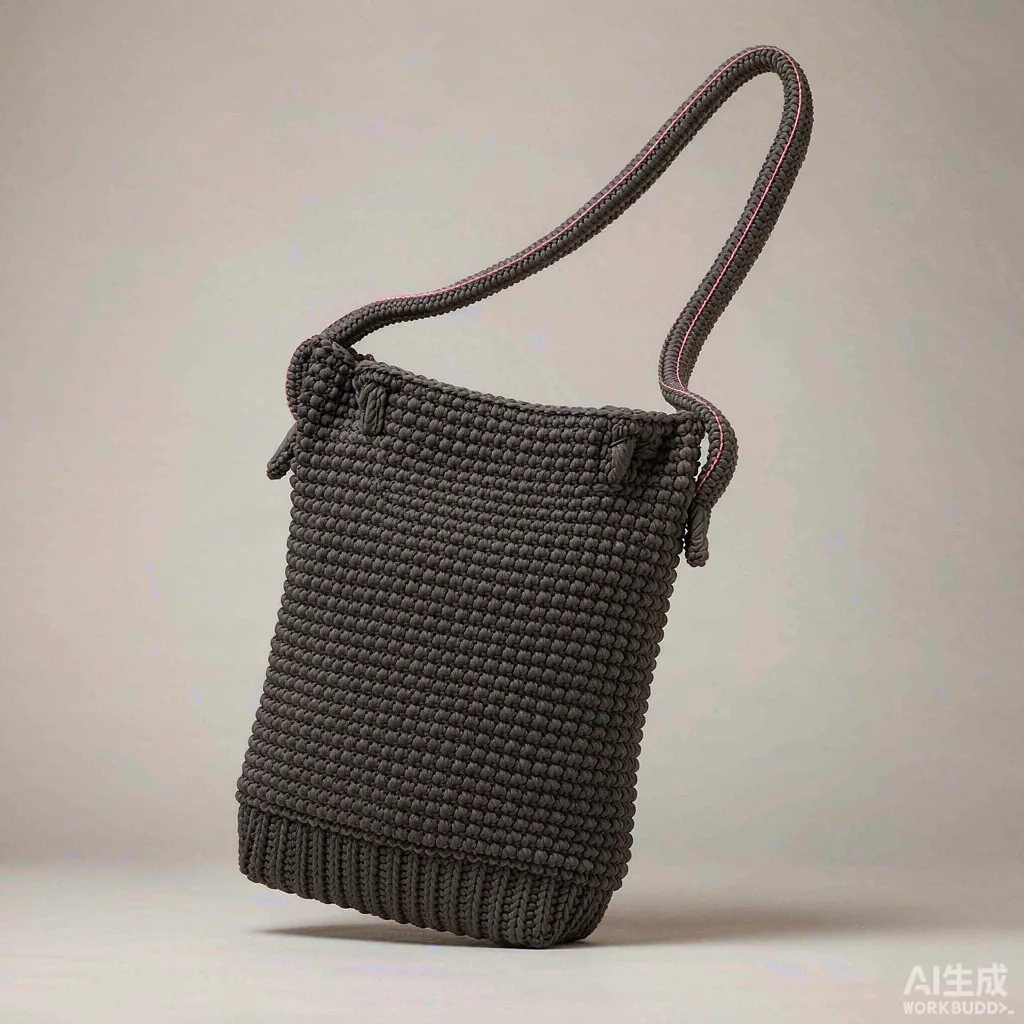
What an Edge Has to Survive on a Knitted Bag
An edge on a knitted bag has to survive three things — unroping, abrasion and handling — and the reason knit edges are a specification problem rather than a detail is that a loop structure has no cut edge to hold: release the last loop and the courses above it come apart.
That is the whole difference from a woven bag. A woven cloth cut on the bias frays a little and then stops, because the yarns are held by the weave at every crossing. A knitted structure is a series of interlocked loops, and a loop released at the edge releases the one above it, and the one above that, which is why the failure is called unroping and why it runs rather than stops. Every finishing method on this page is, in one way or another, a way of preventing that first loop from releasing. Some close it mechanically with a stitch, some wrap it in tape, and some fuse the polymer so that there is no free loop left at all.
Abrasion is the second requirement and it is not evenly distributed. The mouth edge of a tote is handled every time the bag is used, the base edge sits on the ground, and the handle aperture is rubbed by the hand. A pocket edge is barely touched. Specifying one edge treatment for the whole bag therefore over-engineers the pocket and under-engineers the mouth, which is both a cost and a durability error in the same decision.
The Cost of Each Edge, Per Piece and Per Programme
Edge finishing runs from no added cost for a knitted closed selvedge to USD 0.62 per piece for a laser-cut and sealed edge, and on a 1,000-piece programme that spread is the difference between nothing and USD 620 — which is why the edge belongs in the tech pack as a priced line, not as a finish note.
The per-piece figures below cover the operation and the material where there is one. They exclude the knitting cycle, which is unchanged by the choice, with one exception worth naming: a closed selvedge has to be programmed, and doing so adds a small amount of machine time, typically under 30 seconds per piece, because the bed performs the closing action rather than a separate station. Everything else is a downstream operation. Against the reference unit cost of USD 4.80 for a standard E12 tote at specification, a bound edge represents about 8% of the unit cost, which is a substantial fraction for something most briefs do not mention.
| Method | Added cost per piece | Edge width | Best on | Fails when |
|---|---|---|---|---|
| Knitted closed selvedge | USD 0.00, under 30 seconds of bed time | 1.5 to 2 mm | Mouth edge, low-abrasion edges | Abrasion is high or the yarn is not thermoplastic |
| Overlocked edge | about USD 0.22 | 3 to 4 mm | Pocket and lining edges | The thread is not matched to the polymer |
| Bound edge with tape | about USD 0.38 | 12 to 20 mm | Mouth edge on a daily-use tote | The tape shrinks differently from the body |
| Thermal cut and seal | about USD 0.18 | 2 to 3 mm weld | Straight edges on polyester bodies | The body is a blend or a natural fibre |
| Ultrasonic cut and seal | about USD 0.31 | 2 to 3 mm weld | Curved edges and apertures | The polymer content is below about 65% |
| Laser cut and seal | about USD 0.62 | about 3 mm | Shaped apertures at low volume | Volume is high and the cut length is long |
Method One: The Knitted Closed Selvedge, at Zero Added Cost
A closed selvedge is produced on the bed by transferring loops at the edge so the structure closes on itself, and it costs nothing in material or downstream labour — the only expense is under 30 seconds of additional machine time per piece.
It is the correct answer more often than buyers expect. Because the edge is closed during knitting rather than afterwards, there is no operation, no component and no thread to match, and the edge stretches with the body instead of restricting it. The limitations are real though: a closed selvedge is 1.5 to 2 mm wide, which is narrow, and it resists unroping but offers little against abrasion. On a bag whose mouth edge will be grabbed several times a day, a closed selvedge alone will eventually show wear. On a bag whose mouth is rarely touched, or where a lining covers the edge, it is the obvious choice and the saving is real.
- Costs no material and no downstream operation, only bed time.
- Stretches with the body, so it does not restrict the mouth or the aperture.
- Edge width is 1.5 to 2 mm, which is narrow against abrasion.
- Cannot be applied to a cut edge: it has to be programmed before knitting starts.
- Best paired with a lining, where the lining protects the edge from handling.
Method Two: Overlocked Edge at 8 to 10 Stitches Per Inch
An overlocked edge wraps the raw edge with a 504 overlock or a 516 safety stitch at 8 to 10 stitches per inch, producing a 3 to 4 mm finished edge for about USD 0.22 per piece, and it is the default for pocket and lining edges on a knitted bag.
The method is economical, fast and familiar to any sewing room, and it works on any fibre, which is its main advantage over thermal methods. The specification detail that matters is the thread: it should match the base polymer, so polyester thread on a polyester body, because otherwise the seam and the fabric age at different rates and the thread fails first. Stitch density matters for the same reason it does on a join. Below 8 stitches per inch the wrap leaves gaps where a loop can release; above 10 it perforates the structure and the edge becomes a line of weakness rather than a line of protection.

Method Three: Bound Edge With a 12 to 20 mm Tape
A bound edge wraps the raw edge in a tape 12 to 20 mm wide, folded and stitched in two passes, and at about USD 0.38 per piece it is the most expensive of the common methods and the most durable on a high-abrasion edge.
Binding is the answer for the mouth of a daily-use tote, and for any edge that will be grabbed, slung over a shoulder or dragged across a surface. It also gives the cleanest appearance and the widest scope for a contrast colour, which is why it survives on retail bags despite the cost. The failure mode is differential shrinkage: a tape whose shrinkage differs from the body will pucker after washing, and the pucker is permanent. Specify the tape in the same polymer family as the body, require a shrinkage figure, and wash-test the combination before bulk rather than afterwards. Two passes, not one, because a single-pass binding leaves the inner fold loose and it rolls after a few cycles.
Method Four: Thermal Cut and Seal at 200 °C
A heated blade cuts and fuses the edge in one pass at about 200 °C, leaving a welded bead 2 to 3 mm wide for about USD 0.18 per piece — the least expensive cut-edge method, and the one that requires a thermoplastic body to work at all.
The economics are attractive and the constraint is absolute. Polyester and nylon fuse; cotton, viscose and most blends do not, and a body with a natural-fibre content above roughly a third will char rather than weld. Where it does work, the result is an edge with no free loops at all, which is the most complete answer to unroping available. The bead is hard, and that is both the advantage and the drawback: it will not unrope, but it also will not stretch, so a sealed edge on a stretch aperture will crack. Thermal cutting also produces a bead of slightly different colour on a piece-dyed body, which is worth approving on a sample rather than discovering on a shipment.
Method Five: Ultrasonic Cut and Seal at 20 kHz
An ultrasonic head vibrates at about 20 kHz and melts the polymer locally as it cuts, sealing the edge without a hot blade, and at roughly USD 0.31 per piece it is the right choice for curved edges and apertures where a straight blade cannot follow the shape.
The advantage over thermal cutting is control. A heated blade follows a straight path well and a curved path badly, because contact time varies as the direction changes, giving an inconsistent bead. An ultrasonic head holds a consistent energy input along a curve, which is why it is the standard method for sealing a handle aperture or a shaped flap. The constraint is the same as thermal cutting: the body needs a thermoplastic content of roughly 65% or more to weld reliably. Energy input has to be set per GSM, and it is worth recording the setting on the run sheet, because a setting carried from a 240 g/m² body to a 520 g/m² one produces an incomplete weld that looks correct until it is pulled.
- Closed selvedge
- no added material, under 30 seconds of bed time, edge 1.5 to 2 mm
- Overlock
- 504 or 516 stitch, 8 to 10 per inch, edge 3 to 4 mm, about USD 0.22
- Binding
- tape 12 to 20 mm, two passes, about USD 0.38
- Thermal cut
- blade near 200 °C, weld 2 to 3 mm, about USD 0.18
- Ultrasonic seal
- about 20 kHz, weld 2 to 3 mm, about USD 0.31
- Laser cut
- about 3 mm sealed edge, about USD 0.62, suited to low volume
Choosing by Application: Mouth, Aperture, Base and Pocket
Each edge on a bag has a different job: the mouth is handled, the aperture is rubbed and stretched, the base is abraded, and a pocket is barely touched — so a well-specified bag uses two or three methods rather than one.
Mouth edge
Handled constantly. Bound edge with 12 to 20 mm tape, or a closed selvedge behind a lining where the lining takes the wear.
Handle aperture
Rubbed and stretched. Ultrasonic seal follows the curve consistently; a hard thermal bead will crack on a stretch aperture.
Base edge
Abraded on the ground. Bound edge, or an overlocked edge on a lined base where the lining carries the abrasion.
Pocket and lining edges
Barely touched. Overlock at 8 to 10 stitches per inch is sufficient and the least expensive of the sewn options.
Straight panel edges
Low abrasion, straight path. Thermal cut and seal gives a complete answer to unroping at the lowest cut-edge cost.
The point of splitting the specification is that it costs less and lasts longer. A bag with a bound mouth, an ultrasonically sealed aperture, an overlocked base and overlocked pocket edges spends its money where the wear is, and the total is well below a bag bound on every edge. That is the same argument as reinforcement zoning applied to edges: put the expense where the force and the friction are.
Testing an Edge: Unroping, Abrasion and Peel
Three tests settle whether an edge specification works: an unroping test that pulls the edge and counts courses released, abrasion on the edge under ISO 12947-2, and a peel or grab test on a bound or sealed edge reported in newtons.
The unroping test is the one that catches a bad specification before bulk, and it needs no apparatus: hold the fabric either side of the finished edge, pull apart with steady force, and see whether any courses run. A closed selvedge and a sealed edge should release nothing. An overlocked edge may release one or two before the wrap takes hold, which is acceptable. Anything more means the stitch density is too low or the thread is wrong. Abrasion on the edge is worth specifying separately from abrasion on the panel, because the two are not correlated: a body that returns 30,000 Martindale rubs on the panel can still have an edge that wears through in a month.
What to put in the tech pack about edges
- Method per edge: mouth, aperture, base, pocket — not one finish for the whole bag
- Stitch density if sewn: 8 to 10 stitches per inch, with the thread polymer matched to the body
- Tape specification if bound: width 12 to 20 mm, polymer family and a stated shrinkage figure
- Seal width if thermal or ultrasonic: 2 to 3 mm, with the energy or temperature setting recorded
- Colour of the bead or tape approved on a sample, since piece-dyed bodies show a difference
- Test: unroping check by hand, plus edge abrasion under ISO 12947-2
Where Edge Finishing Sits in the Programme Windows
Edge finishing sits inside the joining and trim station, which is the largest post-knitting block at about 4.0 minutes of touch time per piece, and it is decided during sampling before the structure is approved rather than after.
That timing matters because three of the five methods cannot be retrofitted. A closed selvedge has to be programmed; a thermal or ultrasonic seal requires a thermoplastic body of sufficient content; and a bound edge needs a tape that has been shrinkage-tested against that body. All three are decisions made at specification, and all three are expensive to change after yarn has been booked. Programme windows sit behind them: MOQ 100 pcs per style and per colourway, 7 working days of sampling, 30 days of bulk, 7 production lines at about 200,000 pcs per month, AQL 2.5 release under ISO 2859-1 and FOB Xiamen as the standard term. For the load-path decisions that sit next to the aperture, see reinforcement zones in a seamless knit body.
Specify the edges on your brief
Send the silhouette, the yarn count and the quantity per colourway. Our knit team will recommend a method per edge, price each one and return a costed quote against MOQ 100 pcs per style, 7 working days of sampling and 30 days of bulk production. Start on the contact page.
Frequently Asked Questions
Why do knitted bag edges need finishing at all?
Because a loop structure has no cut edge to hold. Release the last loop and the courses above it come apart, which is called unroping and it runs rather than stops. Every finishing method is a way of preventing that first loop from releasing, mechanically or by fusing the polymer.
What is the least expensive edge for a knitted bag?
A knitted closed selvedge, which costs no material and no downstream operation, only under 30 seconds of additional bed time. It resists unroping but offers little against abrasion, so it suits a low-touch edge or one protected by a lining.
How much does a bound edge cost?
About USD 0.38 per piece for a tape 12 to 20 mm wide folded and stitched in two passes. It is the most durable option on a high-abrasion edge such as the mouth of a daily-use tote, and it represents roughly 8% of the USD 4.80 reference unit cost.
Can a knitted bag edge be heat sealed?
Yes, if the body is thermoplastic. A heated blade near 200 °C cuts and fuses in one pass, and an ultrasonic head at about 20 kHz seals curved edges more consistently. Both need a thermoplastic content of roughly 65% or more to weld reliably.
What is unroping?
The failure in which a released loop at the edge releases the loop above it, and the one above that, so the courses run down the fabric. It is specific to knitted structures and is the reason an edge specification exists at all on a knit bag.
Which edge method suits a handle aperture?
Ultrasonic cut and seal. A heated blade follows a straight path well and a curved path badly, because contact time varies as the direction changes, while an ultrasonic head holds consistent energy input along a curve at about 20 kHz.
Should every edge on a bag use the same method?
No. The mouth is handled, the aperture is rubbed and stretched, the base is abraded and a pocket is barely touched. Specifying two or three methods puts the expense where the wear is and costs less than finishing every edge the same way.
What stitch density should an overlocked edge use?
Eight to ten stitches per inch with a 504 overlock or a 516 safety stitch. Below eight the wrap leaves gaps where a loop can release; above ten it perforates the structure and the edge becomes a line of weakness rather than protection.
Does the sewing thread matter on a knit edge?
Yes. The thread should match the base polymer, so polyester thread on a polyester body, because otherwise the seam and the fabric age at different rates and the thread fails first. This is the most common cause of an edge that looks correct and fails early.
Why does a bound edge pucker after washing?
Differential shrinkage: the tape and the body shrink by different amounts. Specify the tape in the same polymer family as the body, require a shrinkage figure, and wash-test the combination before bulk rather than discovering the pucker on a shipment.
What is an unroping test?
Holding the fabric either side of the finished edge and pulling apart with steady force to see whether any courses run. A closed selvedge and a sealed edge should release nothing; an overlocked edge may release one or two before the wrap takes hold.
Is panel abrasion a good guide to edge durability?
No, the two are not correlated. A body that returns 30,000 Martindale rubs on the panel under ISO 12947-2 can still have an edge that wears through in a month, so edge abrasion should be specified and tested separately.
Can the edge method be changed after sampling?
Not for three of the five. A closed selvedge has to be programmed, a thermal or ultrasonic seal requires a thermoplastic body of sufficient content, and a bound edge needs a shrinkage-tested tape. All three are specification decisions, not finishing choices.
How wide is a sealed edge?
Two to three millimetres for both thermal and ultrasonic sealing, and about 3 mm for a laser cut. The bead is hard and will not stretch, so a sealed edge on a stretch aperture will crack, which is why the aperture method is chosen carefully.
What colour issues does edge sealing cause?
A fused bead is slightly different in colour from the surrounding fabric, and the difference is more visible on a piece-dyed body than on a dope-dyed one. Approve the bead on a sample rather than discovering the difference on a shipment.
How do I write the edge specification into a tech pack?
State the method per edge rather than one finish for the whole bag, with stitch density if sewn, tape width and shrinkage if bound, seal width and energy setting if sealed, and the approved bead or tape colour. Add an unroping check and edge abrasion under ISO 12947-2.
People Also Ask
Do seamless knit bags have raw edges?
Fewer than a sewn bag, but yes. The body has no side seam, yet the mouth, the handle aperture and any pocket still need an edge treatment because a loop structure will unrope from a free edge.
Can you cut knitted fabric without it unravelling?
Only if the cut is sealed as it is made. Thermal, ultrasonic and laser cutting all fuse the polymer while cutting, which leaves no free loop at the edge and is the most complete answer to unroping.
What is the difference between overlock and safety stitch?
A 504 overlock wraps the edge with one thread group; a 516 safety stitch combines a chainstitch with an overedge, so it closes a seam and covers the raw edge in the same pass.
Why does my bag edge curl after washing?
Usually a single-pass binding whose inner fold was never secured, or a tape whose shrinkage differs from the body. Two passes and a shrinkage-tested tape in the same polymer family prevent both.
Is ultrasonic sealing stronger than sewing?
It is more complete against unroping, because there is no free loop left, but it is less extensible. On a stretch aperture a hard sealed bead will crack where a sewn or bound edge would give.
Sources and further reading
Every figure on this page is either our own programme data or attributed below. Open the originals before you write them into a specification.
- ISO 12947-2:2016 — Textiles, determination of abrasion resistance by the Martindale methodISO Referenced for the edge abrasion test, which is specified separately from abrasion on the panel.
- ISO 13934-1:2013 — Textiles, tensile properties of fabrics, Part 1: maximum force using the strip methodISO The method behind the grab and peel figures reported in newtons on a bound or sealed edge.
- ISO 2859-1:2026 — Sampling procedures for inspection by attributes, Part 1: AQL-indexed sampling schemesISO Defines the sampling plan behind the AQL 2.5 pre-shipment release.
- OEKO-TEX STANDARD 100OEKO-TEX Finished-textile testing for harmful substances, requested alongside REACH and Prop 65 on knit bag programmes.
- About Proposition 65California OEHHA The California listing referenced for restricted-substance compliance on finished knit bag shipments.
The Edge Is a Specification, Not a Finish Note
Most briefs describe the body in detail and the edge in a word. That is backwards in commercial terms: the edge is where knit bags fail, it is priced per piece, and three of the five methods cannot be changed after the programme starts. A tech pack that names the method per edge, with the stitch density, tape width or seal width, costs nothing extra to write and removes the most common source of a disputed shipment.
For the structural decisions around the aperture, see reinforcement zones in a seamless knit body. For the inspection standards used to grade edge faults, see knit bag QC and testing.