Woven Label Placement on Knit Bags: Six Positions, the Tolerance Each One Needs, and Why Seamless Bodies Have No Seam to Sew Into
Where does a woven label go on a knit bag? Six positions are used, and the one that fails most often is the side seam, because a seamless knit body has no seam to sew into. A buyer placed a 20 mm damask label at the side of a tubular knitted tote and 34 of 1,200 units came back twisted after one domestic wash. The fix was moving the label to the inner top edge with an 8 mm end fold caught into the binding stitch, at a tolerance of plus or minus 2 mm. This article works through the six positions and the construction detail each one needs.
A Woven Label That Twisted After One Wash
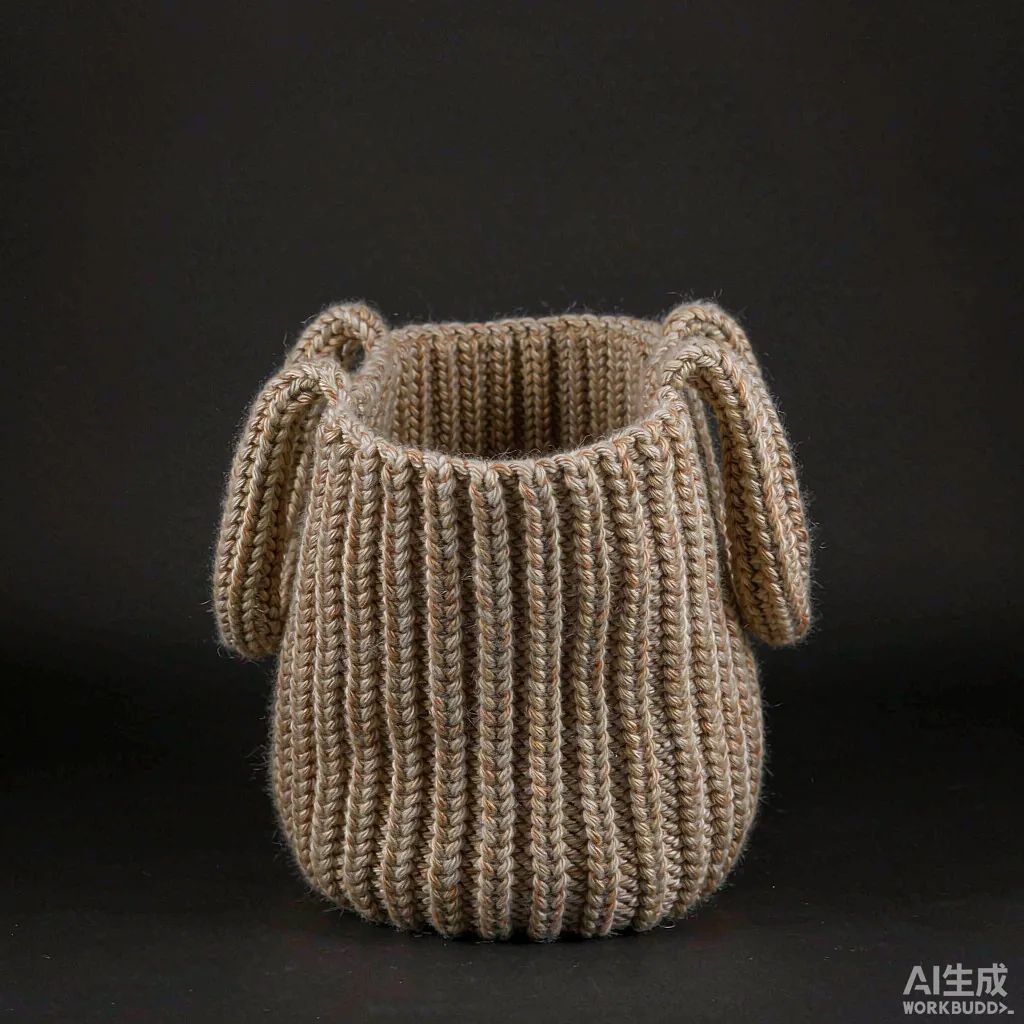
A buyer running 1,200 seamless knitted totes specified a 20 mm damask label at the side of the body, in the position a cut-and-sew bag would use, and 34 units came back from a domestic wash with the label twisted through 90 degrees and pulling the knit surface into a pucker.
Nothing was wrong with the label. The damask was correct, the end fold was correct, the stitch count was correct. What was wrong was the assumption carried over from cut-and-sew: that a bag body has a side seam with two raw edges to fold and stitch. A tubular knitted body knitted on a whole-garment machine has no side seam at all. The label was stitched to a single thickness of knit, and a single thickness of knit in a 12-gauge structure moves about 4% in width under a domestic wash. The label did not move, the body did, and the difference showed up as a twist.
The correction took one sampling round. The label moved to the inner top edge, where the binding stitch gives two thicknesses and a stable anchor, with an 8 mm end fold caught into that stitch. The re-run passed a 5-cycle wash at 40 degrees with no visible twist. The general rule that came out of it is the one this article is built on: on a knit bag, the label goes where the structure is stable, not where the position looks right on a woven bag.
Why a Seamless Knit Body Has No Seam to Sew Into
A seamless knit bag body is knitted as a tube, so the side position that carries a woven label on a cut-and-sew bag does not exist on it, and any label stitched there is anchored to a single thickness of knit that will move under wash and under load.
The structural difference is worth stating precisely, because it drives every placement decision that follows. A cut-and-sew panel bag has a side seam joining two cut edges; that seam is two thicknesses of material plus a stitch line, it is the stiffest line on the bag, and it is where a label naturally goes. A whole-garment knit body closes the tube on the machine. The closest equivalents to a seam are the top binding, the handle join, and any shaped opening the program knits in. Those are the stable lines, and those are where a label belongs.
The second consequence is about movement. A 12-gauge knit in a recycled polyester yarn relaxes about 3% to 5% in width on the first wash and stays there; a woven damask label of the same yarn family relaxes about 1%. Anchoring a 1% element across a 4% substrate, on a single thickness, produces the twist. Anchoring the same element at both ends into a stable line lets the body move around it, which is why end-fold placement with both ends caught holds and a floating centre stitch does not.
Six Positions and What Each One Costs
Six woven label positions are in regular use on knitted bags: inner top binding, outer top edge, handle join, front panel face, inner side pocket and base, and each is priced by how many thicknesses it anchors into and how much operator time it takes.
| Position | Anchor | Typical label width | Added labour | Suits |
|---|---|---|---|---|
| Inner top binding | Two thicknesses plus the binding stitch | 20 mm or 25 mm | About USD 0.03 | Seamless totes, the default choice |
| Outer top edge | One thickness plus a cover stitch | 20 mm | About USD 0.04 | Programmes where the brand must read from outside |
| Handle join | Two thicknesses where the handle meets the body | 15 mm or 20 mm | About USD 0.03 | Knit totes with a knitted or webbing handle |
| Front panel face | One thickness, top stitch only | 25 mm or 30 mm | About USD 0.05 | Flat panel programmes and structured knit bodies |
| Inner side pocket | Two thicknesses at the pocket join | 15 mm | About USD 0.04 | Bags with a knitted interior pocket |
| Base panel | One thickness on the base | 20 mm | About USD 0.06 | Promotional programmes where the bag folds flat |
The labour column is the honest one to read first. Front panel face placement looks like the obvious home for a brand mark and is the position that produces the most returns, because a single-thickness top stitch across the middle of a knit panel puts the stiffest element on the most visible, most flexible part of the bag. It is used successfully on flat panel programmes where the panel itself is a stable double-knit structure, and it fails on open single-jersey bodies.
Label Construction: Damask, Satin and End Fold
Damask is the right woven label construction for a knit bag: it runs about 48 picks per centimetre, holds a fine mark legible at 8-point type, and stays soft enough not to print through a light knit body.
Satin is the alternative and is chosen for one reason: a satin label takes a printed rather than woven mark, which allows photographic or gradient artwork and a finer colour range. It is stiffer, it shows as a ridge through a light-coloured 7-gauge knit, and it is more prone to edge fray if the cut is ultrasonic rather than hot-knife. Taffeta is lighter still and is used where the label must disappear into the bag, usually on promotional programmes at high volume.
- Default construction
- Damask, about 48 picks per centimetre
- Widths in regular use
- 15 mm, 20 mm, 25 mm and 30 mm
- End fold
- 8 mm each side, both ends caught in the stitch line
- Alternative fold
- Mitred fold for a label placed at a corner
- Cut method
- Hot-knife or ultrasonic seal, to stop edge fray
- Yarn in the label
- Recycled polyester, GRS evidence available
- Next-to-skin claim
- OEKO-TEX STANDARD 100 certification on the label itself
- Placement tolerance
- Plus or minus 2 mm in both axes
Placement Accuracy and the Tolerance That Holds
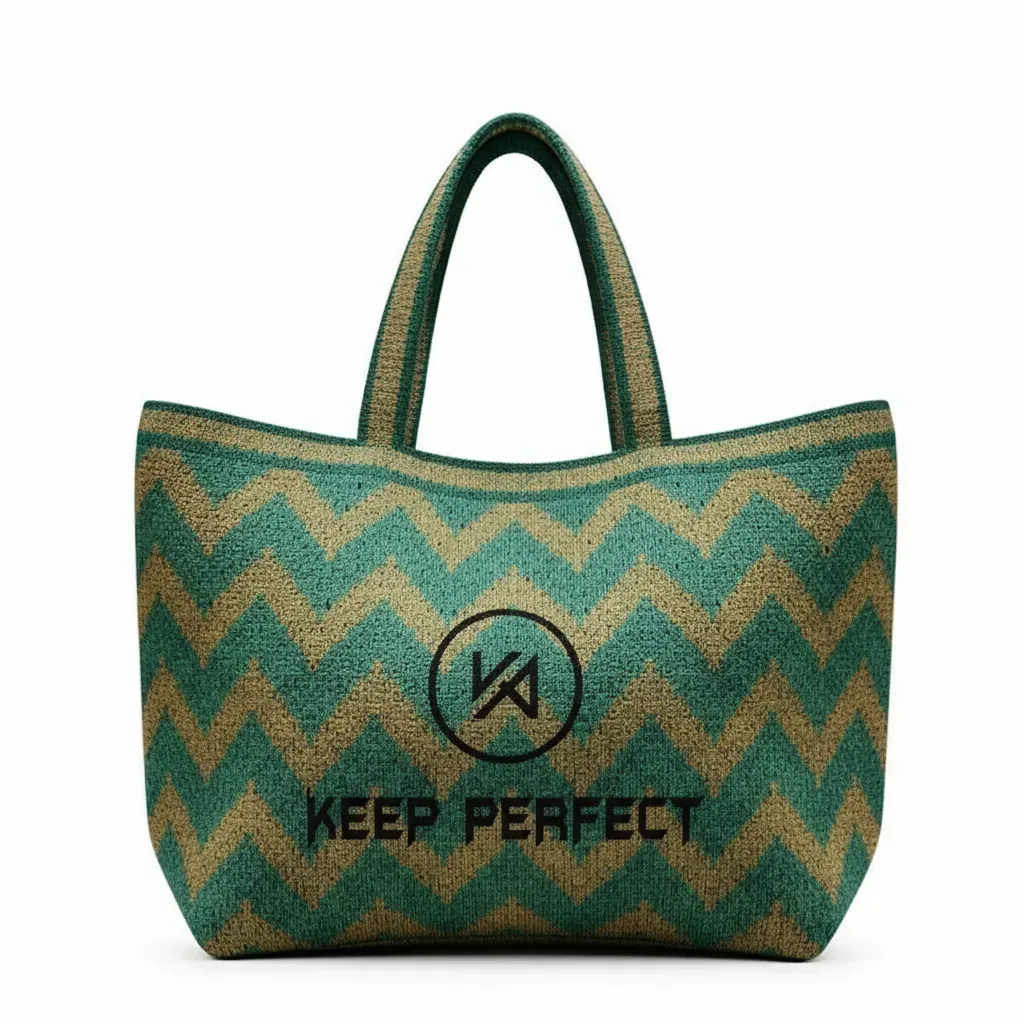
Woven label placement on a knitted bag is held to plus or minus 2 mm in both axes, and that tolerance is achievable because the label is positioned against a knitted reference point rather than measured from a cut edge.
On a cut-and-sew bag, placement is measured from a cut edge and the tolerance follows the cutting tolerance. On a knit body there is no cut edge, so the reference has to be knitted in. The two references that work are a marker loop knitted into the structure at the intended position, and a counted number of wales from the top binding. A marker loop is more accurate and costs nothing once the program is written; counting wales is accurate to about half a wale, which at 12 gauge is roughly 1 mm. Reference by marker loop is the better practice on any programme above 1,000 pcs.
What the tolerance is protecting is visual symmetry. Two labels at the same nominal position, one 3 mm high and one 3 mm low, read as a fault when the bags stand next to each other on a shelf even though each one passes individually. Under an AQL 2.5 inspection plan (ISO 2859-1) placement is checked against the approved sample, and a lot where 40% of units sit outside 2 mm is a lot that gets re-worked rather than shipped.
Wash, Rub and Shrink: What the Label Has to Survive
A woven label on a knit bag has to survive a 5-cycle domestic wash at 40 degrees, a wet and dry rub at AATCC 8 level 4 or better, and a shrinkage mismatch of about 3% against the body, and the label is tested before the programme is released rather than after.
Wash: ISO 105-C06
Five domestic wash cycles at 40 degrees. The check is not colour loss on the label but distortion: whether the label and the body have relaxed by different amounts and produced a pucker.
Rub: AATCC 8
Dry and wet crocking on the label face. A damask label at level 4 or better will not transfer onto a light knit body when the bag is packed damp or stored in a humid container.
Shrink: dimensional change
The label relaxes about 1%, a 12-gauge knit body about 3% to 5%. The mismatch is handled by anchoring both ends, not by pre-shrinking the label.
Edge: fray and curl
Hot-knife or ultrasonic cut seals the edge. A cold-cut label edge frays after three washes and the frayed edge is the complaint that reaches the brand, not the factory.
Compliance Text on a 20 mm Label
A 20 mm woven label carries the brand mark and the fibre content, and it does not carry the care instructions or the origin statement; those move to the hangtag or to a printed care card because 20 mm of label height gives roughly 8-point legible type and no more.
- Brand mark, at a height the woven construction can hold, usually 6 to 8 point.
- Fibre content by percentage, which is why 25 mm is used on blended yarn programmes.
- Country of origin where the destination market requires marking on the article.
- A size or style code, which helps the retailer and costs nothing.
- Care symbols are possible at 30 mm width but rarely read well at 20 mm.
The discipline here is the same as on the hangtag: each line has a document behind it. A fibre content of 60% recycled polyester and 40% virgin polyester printed on a label needs a GRS transaction certificate to support the recycled share, and the certificate has to name the label as well as the body, since the label yarn is a separate input with its own chain of custody.
How Placement Is Checked Before the Carton Closes
Label placement is checked twice: against the approved sample at the start of the packing run, and again inside the AQL 2.5 inspection (ISO 2859-1) that covers the finished lot before release.
The start-of-run check is the one that matters. The first 20 units off the line are laid out and the label position is measured against the approved sample with a gauge, in both axes. If the run is drifting, it drifts in the first 20 units, and catching it there costs an hour. Catching it at final inspection costs a re-work of the whole lot. The measurable faults are position outside 2 mm, an end fold not caught into the stitch, a pucker at either end of the label, and a label whose face is rotated relative to the body.
A Placement Brief That Survives the First Wash
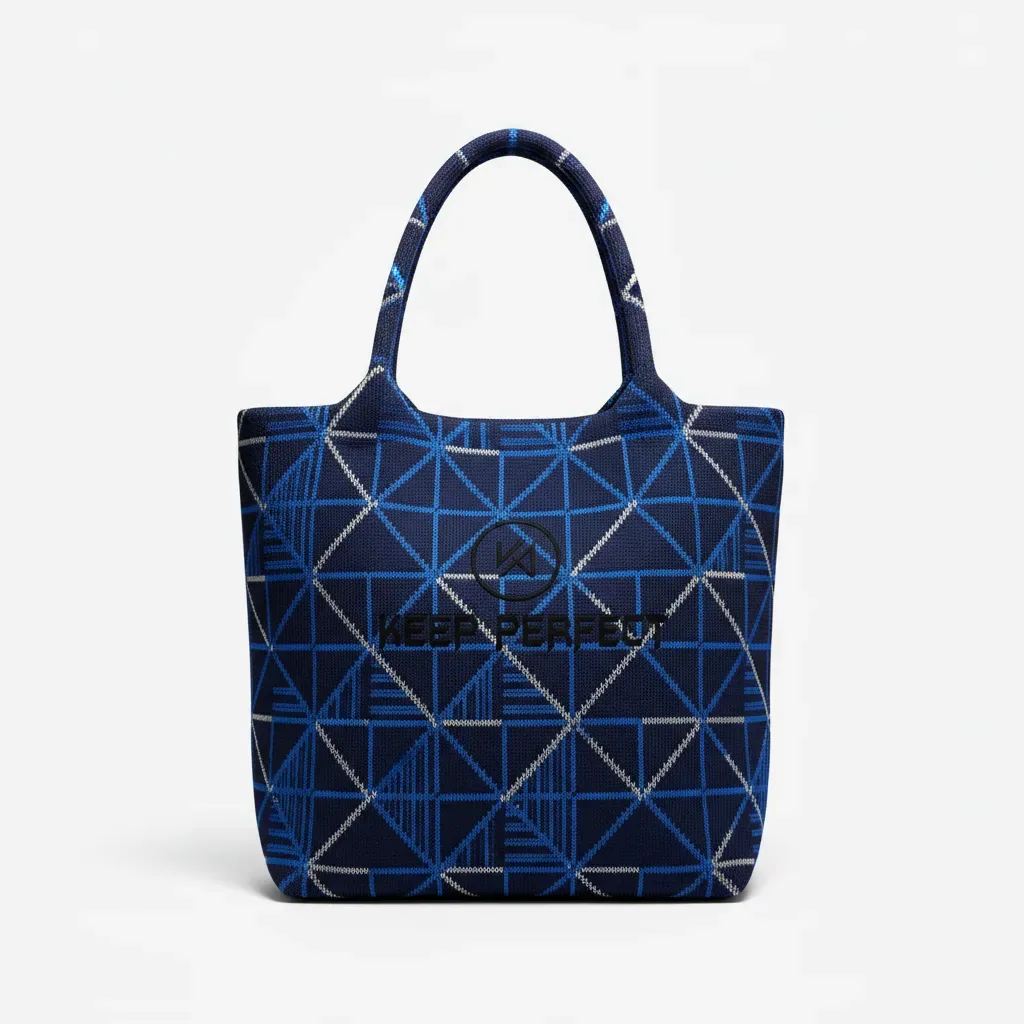
A placement brief that survives production states the position, the reference point, the label width and construction, the end fold, the tolerance and the test the finished bag has to pass, and it states them before the sample is knitted rather than after.
- Named position, with a sketch or a marked-up photo of the approved sample.
- The knitted reference the operator works from: marker loop or wale count.
- Label width in mm, construction (damask, satin or taffeta) and cut method.
- End fold dimension in mm, and whether both ends are caught.
- Placement tolerance, stated as plus or minus mm in both axes.
- The test the label has to pass: wash cycles, rub level, and who signs it off.
One more line belongs in the brief and is often left out: what the buyer considers a defect. A pucker visible at arm's length is a defect to a retail brand and not to a promotional buyer. Writing that line down is what turns a subjective complaint after despatch into a measurable acceptance criterion before it.
Where the Label Sits in the Sampling and Bulk Window
Label placement is settled on the sample inside the 7-working-day sampling window, and the label itself is ordered in parallel with bulk yarn so that it lands at the line before the 30-day bulk production window closes.
A woven label run has its own loom minimum, commonly 1,000 pcs per artwork, which at a knit programme MOQ of 100 pcs per style and colourway means the same artwork has to serve several colourways. A neutral ground with the style code rather than the colourway name is the standard way to do that, and it is decided at artwork stage rather than at order stage. Shipments leave FOB Xiamen, with CIF and DDP available.
Send a label placement brief
Send the position, the label width and construction, and the wash and rub levels the bag has to meet, and the knit team will return a placement spec with the sample inside the 7-working-day window. Send the brief
Frequently Asked Questions
Where should a woven label go on a seamless knit bag?
On the inner top binding, where the binding stitch gives two thicknesses and a stable anchor. A seamless body is knitted as a tube and has no side seam, so the position a cut-and-sew bag uses does not exist. Both label ends should be caught into the stitch line with an 8 mm end fold.
Why does a label twist after washing a knitted bag?
Because the body and the label relax by different amounts. A 12-gauge knit relaxes about 3% to 5% in width on the first wash and a damask label about 1%. Anchored on a single thickness, the difference shows as a twist and a pucker. Anchoring both ends into a stable line fixes it.
What label width is standard on a knit bag?
20 mm is the common width for a brand mark plus fibre content, and 25 mm is used on blended yarn programmes where the fibre percentages take more room. 15 mm suits handle-join placement and 30 mm is used where care symbols have to appear on the label itself.
Should the label be damask or satin?
Damask for almost every knit programme. It holds a fine woven mark at 8-point type and stays soft enough not to print through a light body. Satin takes printed artwork and a wider colour range but is stiffer and shows as a ridge through a light 7-gauge knit.
What tolerance can be held on label placement?
Plus or minus 2 mm in both axes, measured against a marker loop knitted into the structure at the intended position. Counting wales from the top binding is accurate to about half a wale, roughly 1 mm at 12 gauge, which is acceptable below about 1,000 pcs.
Can the woven label carry the care instructions?
Only at 30 mm width, and even then the symbols read poorly. On a knit programme the care instructions normally move to the hangtag or to a printed care card inside the polybag, and the label carries the brand mark and fibre content only.
How is label placement inspected before despatch?
Twice: the first 20 units off the packing line are measured against the approved sample with a gauge, and the finished lot is inspected under the AQL 2.5 plan (ISO 2859-1). Position outside 2 mm, an uncaught end fold and a pucker at either end all count as defects.
Does the label yarn need its own certification?
Yes where the bag carries a recycled claim. The label is a separate input with its own chain of custody, so a GRS transaction certificate has to name the label as well as the body. OEKO-TEX STANDARD 100 applies to the label where a next-to-skin claim is made.
What causes the label edge to fray?
A cold cut. Labels cut with a hot knife or sealed ultrasonically hold their edge through five domestic washes; a cold-cut label starts to fray after about three. Edge fray is one of the most visible complaints a brand receives because the customer sees it first.
Can one label artwork serve several colourways?
Yes, and it usually must. A woven label run has a loom minimum of about 1,000 pcs per artwork, while the knit programme MOQ is 100 pcs per style and colourway. A neutral ground carrying the style code rather than the colourway name lets one run serve several colourways.
How much does placement add to unit cost?
Between USD 0.03 and USD 0.06 depending on the position. Inner top binding and handle join sit at about USD 0.03 because the operator already works that line; a front panel face placement adds about USD 0.05 and a base panel about USD 0.06.
When is label placement decided?
On the sample, inside the 7-working-day sampling window. The reference point has to be knitted into the program, so a position decided after the sample is knitted means re-writing the program and a second sampling round rather than a simple instruction change.
What makes a label show through a light knit body?
Stiffness and colour contrast. A satin label on a light 7-gauge body reads as a ridge from the outside, and a dark label ground behind a pale yarn shows as a shadow. A damask label on a matched ground, placed on the inner face, avoids both.
Is a mitred fold ever needed?
Yes, at a corner. Where two labels or a single label must follow a right angle, a mitred fold keeps the pattern continuous through the corner instead of butting two straight ends together, which reads as a join rather than as a design element.
People Also Ask
Where do you put a label on a bag with no seams?
At the inner top binding or the handle join. A seamless knit body is knitted as a tube, so the stable lines are the binding, the handle join and any shaped opening, not the side.
How wide is a woven label on a bag usually?
20 mm for a brand mark plus fibre content, 25 mm on blended yarns where the percentages take more room, and 15 mm at a handle join.
Why is my woven label puckering the fabric?
The body relaxed more than the label did. A knit body moves about 3% to 5% on the first wash and a damask label about 1%, so a label stitched flat to one thickness pulls the surface into a pucker.
What test proves a label will stay attached?
Five domestic wash cycles at 40 degrees under ISO 105-C06, plus a wet and dry rub at AATCC 8 level 4 or better, checked on the sample before bulk release.
Do woven labels have a minimum order quantity?
Yes, commonly 1,000 pcs per artwork from the label loom. At a knit programme MOQ of 100 pcs per colourway, one neutral artwork usually has to serve several colourways.
Sources and further reading
Every figure on this page is either our own programme data or attributed below. Open the originals before you write them into a specification.
- STANDARD 100 by OEKO-TEXOEKO-TEX The certification usually requested on the woven label itself as well as on the knitted body.
- ISO 2859-1 — Sampling procedures for inspection by attributes, Part 1: AQL-indexed sampling schemesISO The AQL 2.5 plan under which label placement is inspected before a lot is released.
- Recycled Claim Standard and Global Recycled StandardTextile Exchange The transaction-certificate basis for a recycled claim on the label yarn, which is a separate input from the body yarn.
- AATCC colourfastness test methodsAATCC Source of the AATCC 8 crocking method used to check that a label will not transfer onto a light knit body.
- Incoterms rulesInternational Chamber of Commerce The rule set behind the FOB Xiamen term and the CIF and DDP alternatives offered on knit programmes.
Placement Is a Structural Decision, Not a Visual One
The position that looks right on a woven bag is usually the position that fails on a knit bag. What holds is the line where the structure is stiffest and where both ends of the label can be caught, and on a seamless body those lines are the binding and the handle join.
Decide the position on the sample, knit the reference point into the program, and the tolerance holds through bulk. For the branding element that sits alongside the label, see knitted bag hangtag design. For the retail packing that presents both, see retail ready packaging for knitted bags.