Knitted Bag Decision Tree: Five Gate Questions and Their Thresholds
Which gate decides whether a bag should be knitted? Volume, not preference: below about 5,000 pieces per style a year, knitting wins on minimum fit at 100 pcs per colourway; above about 50,000 stable pieces, a woven route wins on unit price. The other four gates are load above 20 kg, artwork needing photographic detail, and a launch window under 45 days. Knitting loses two of the five gates outright, and both losses are real.
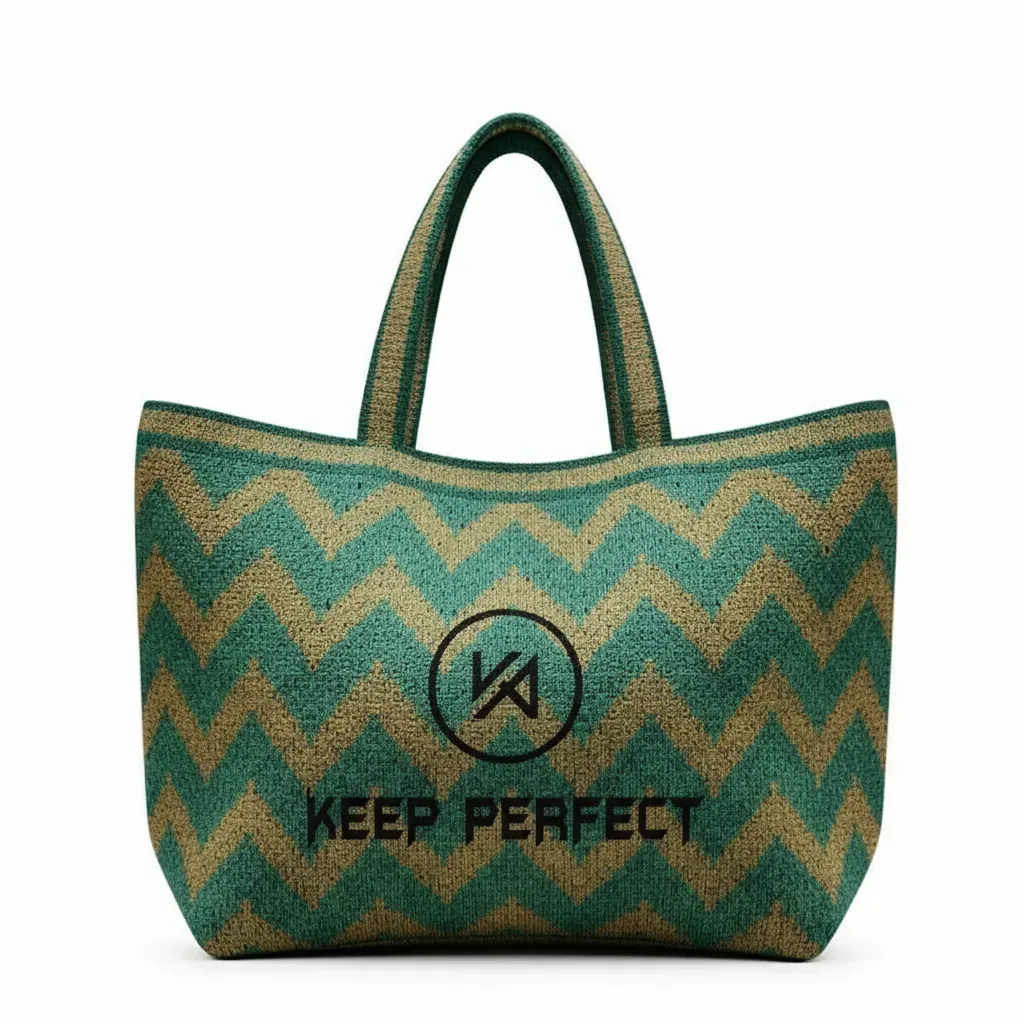
Five Gates, in This Order
A decision tree is only useful if the gates are ordered so that the fastest disqualifier comes first. For bag sourcing the order is volume, refresh rate, load, artwork and timeline. Volume eliminates routes on economics, load and artwork eliminate them on physics, and timeline decides between whatever survives. Running them in any other order wastes meetings on routes that a later gate would have removed.
Each gate has a threshold rather than a preference, because a threshold can be checked against a number in the brief. Write the number down at each gate and move on. By gate three most briefs have one surviving route, and by gate five the specification is half written.
Gate One: Annual Volume Per Style
Below about 5,000 pieces per style a year, knitting wins on minimum fit. At 100 pcs per style and colourway, a range can test six shades for the quantity a cut and sew route needs for one, and a woven route carrying a pattern, grading set and cutting die at roughly USD 640 per style has to amortise that over a larger run to make sense.
Above about 50,000 stable pieces a year of a single design that never changes, the woven route wins on unit price and there is no argument to be had: the setup cost is amortised to nothing and the per-unit material saving compounds. Between those two thresholds the gate does not decide, and the answer comes from gate two. Note that the threshold is per style, not per programme — a 60,000-piece programme across twelve styles is 5,000 per style, and knitting wins.
Gate Two: How Often the Design Changes
Count the change events in a year: new shades, new sizes, new artwork, new hardware. Below three, the woven route usually keeps its unit-price advantage. At three or more, knitting overtakes it, because each change on a woven route costs about USD 380 and about 12 working days in a new marker, a new screen and a fresh cutting trial, while a knitted change is a yarn carrier swap.
This gate is the one most buyers get wrong, because change events are invisible on a purchase order. A range that looks stable in January often refreshes four times by November as the retail calendar moves. Ask the merchandising team rather than the sourcing team how many changes to expect, and add one to whatever they say. The threshold sits at three, and it is rarely a close call once the number is honest.
Gate Three: Static Load and Load Character
Below 15 kg, a knitted body with a zoned base and a continuous strap is the right answer and reaches about 780 N on the handle root to ISO 13934-1. Between 15 and 20 kg it still works with a 900D construction and an inserted 0.8 mm base sheet. Above 20 kg, or wherever the load is sharp or irregular, the gate closes and a woven shell with a boarded base takes over.
The reason is puncture rather than tensile strength. An uncoated 900D knit fails at about 40 N on a 1 mm probe, where a 1680D woven nylon needs about 120 N. A bag carrying tools, tent pegs or camera equipment will be punctured from the inside, and no yarn count prevents it. This is the first of the two gates knitting loses outright, and it should be recorded without hedging.
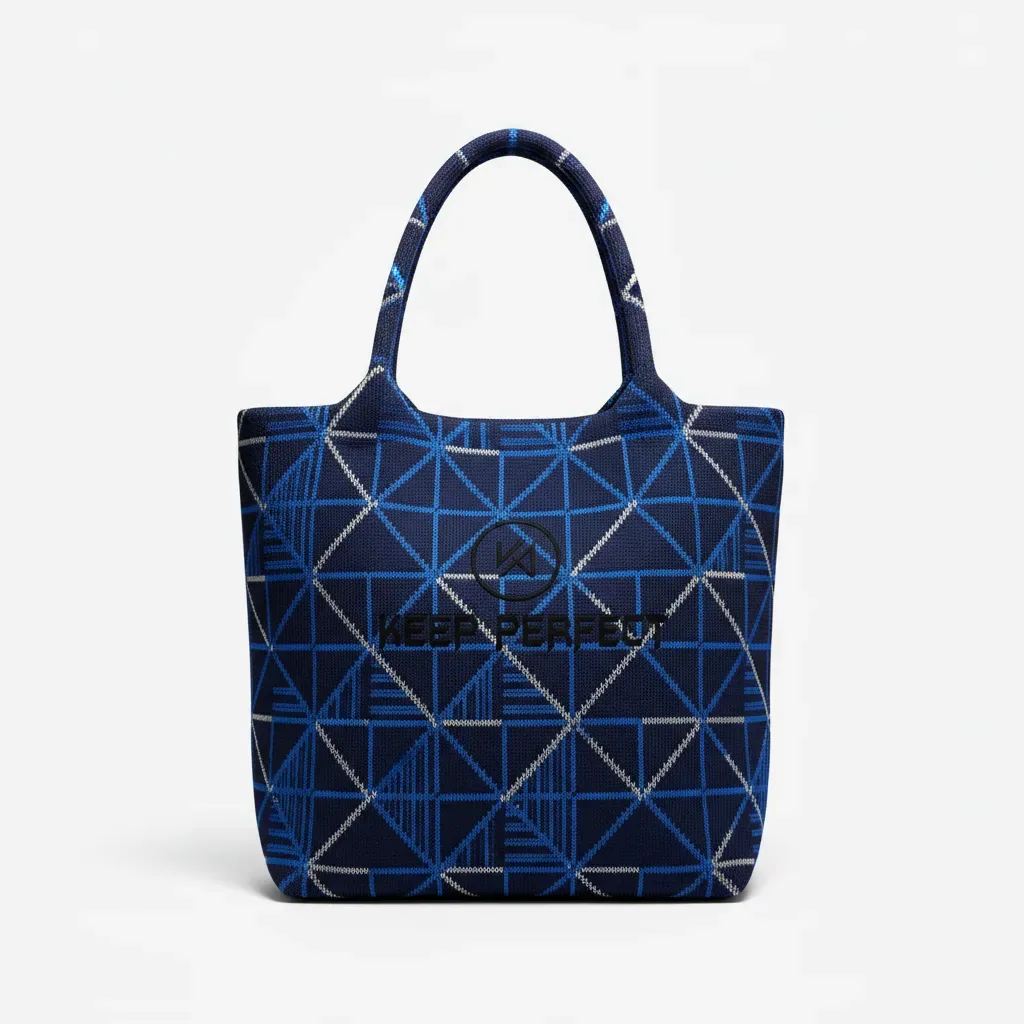
Gate Four: What the Artwork Demands
Two colours or fewer, in a bold mark, and a knitted-in logo works well with a practical minimum stroke near 1.5 mm. A heat transfer extends this to about 0.4 mm but adds a polymer layer that complicates a monomaterial claim. Photographic or four-colour process artwork closes the gate: a flat woven panel resolves detail to about 0.2 mm and a knitted surface cannot.
This is the second gate knitting loses outright, and it is the one that most often splits a range. The usual resolution is per SKU rather than per range: the shopper and the tote go to knitting, and the gift item carrying the photographic seasonal image goes to a woven panel. Forcing one route across a range with mixed artwork requirements produces a compromise that satisfies nobody.
Gate Five: The Launch Window
Add the sampling window to the bulk window and compare it with the shelf date. A knitted route runs 7 working days for sampling and 30 days for bulk, about 37 working days end to end. A woven route needs 12 to 15 working days for a revised pattern and marker and a similar bulk window, roughly 47 working days at the short end. Under a 45-working-day window, knitting is the only route that fits.
The clause that matters is the second sampling cycle. Most programmes need two, because the first sample surfaces a change. Two knitted cycles cost about 14 working days and still fit inside 45; two woven cycles cost 24 to 30 and do not. Ask for the sampling window in writing before promising a launch date, and book machine capacity at the same time, because 7 production lines at about 200,000 pcs a month are a finite resource.
| Gate | Threshold | Knitted route | Woven route | Verdict |
|---|---|---|---|---|
| 1. Volume per style | under 5,000 a year | 100 pcs per colourway | needs amortised setup | Knit wins |
| 1. Volume per style | over 50,000, stable | higher unit price | lower unit price | Woven wins |
| 2. Change events | 3 or more a year | carrier swap, no tooling | USD 380 and 12 days each | Knit wins |
| 2. Change events | fewer than 3 | no refresh cost | setup amortised | Woven wins |
| 3. Static load | over 20 kg or sharp | punctures near 40 N | punctures near 120 N | Woven wins |
| 4. Artwork | photographic, 4-colour | minimum stroke 1.5 mm | resolves to 0.2 mm | Woven wins |
| 5. Launch window | under 45 working days | about 37 working days | about 47 working days | Knit wins |
| 5. Sampling cycles | two cycles needed | about 14 working days | 24 to 30 working days | Knit wins |
Recommended Scenarios by Gate Combination
Four combinations cover most briefs. Low volume and frequent change is the clearest knit case: a seasonal range of six shades at 800 pieces each, refreshing four times a year. Tight window and low volume is the second: a campaign bag needed in six weeks. Both are decided by gate one or gate two and rarely need gates three to five at all.
High volume and no change is the clearest woven case: 60,000 pieces of one shopper in one shade, sold for three years. Heavy or sharp load is the second: a trade kit above 20 kg. Both are decided at gate one or gate three. The interesting briefs sit in the middle, and for those the honest answer is usually a split range rather than a single route.
Knit without hesitation
Low volume per style, three or more changes a year, load under 15 kg, bold two-colour artwork, window under 45 working days.
Woven without hesitation
Over 50,000 stable pieces, load over 20 kg or sharp contents, photographic artwork, and a shelf date more than three months out.
Split the range
Mixed artwork or mixed load across SKUs. Assign per SKU and give each one its own calendar and specification.
Go hybrid
A knitted body with a coated or woven base panel when the brief needs texture plus water or abrasion resistance.
When Two Gates Disagree
Disagreements are normal and informative. A brief at 3,000 pieces a year with photographic artwork fails gate one in favour of knitting and gate four in favour of woven. The resolution is not to split the difference; it is to ask which gate carries the cost. Here gate four does, because a knitted surface cannot deliver the image, so the range goes to woven and absorbs the higher minimum.
The other common conflict is high volume with frequent change. Above about 50,000 pieces a year the woven unit-price advantage is large, but at four changes a year the refresh cost partly erodes it. Run the numbers rather than the gates in this case: the crossover typically sits near three changes a year, and the total cost sheet rather than the tree should decide.
Recording the Decision So It Survives Handover
Write the gate outcomes into the specification pack: the volume per style, the expected change count, the rated load, the artwork type and the launch window, together with the route each gate pointed to and the final decision. Twelve months later, when a colleague asks why the range went to knitting, the answer should be in the file rather than in someone's memory.
Then convert the decision into numbers: yarn count and gauge, finished mass with a ±5% tolerance, abrasion target to ISO 12947-2, tensile target on the handle root to ISO 13934-1, and inspection to AQL 2.5 under ISO 2859-1. Sampling runs 7 working days and bulk 30 days, FOB Xiamen with CIF and DDP options. A decision tree chooses the route; the specification is what makes it repeatable.
Run your brief through the five gates
Send the volume per style, the expected change count, the rated load and the launch window. The team will return a gate-by-gate recommendation with FOB Xiamen pricing at 100 pcs per style and colourway, 7 working day sampling and 30-day bulk. Start on the contact page.
Frequently Asked Questions
What is the first question to ask when choosing a bag route?
Annual volume per style, not total programme volume. Below about 5,000 pieces per style a year, knitting wins on minimum fit at 100 pcs per colourway. Above about 50,000 stable pieces, a woven route wins on unit price. A 60,000-piece programme across twelve styles is 5,000 per style, which favours knitting.
How often should a range change before knitting wins?
Three or more change events a year. Each change on a woven route costs about USD 380 in a new marker, a new screen and a fresh cutting trial, plus about 12 working days. A knitted change is a yarn carrier swap with no tooling cost, limited by a cone minimum near 60 kg per shade.
At what load should I stop using a knitted bag?
Above about 20 kg, or wherever the contents are sharp or irregular. Up to 15 kg a zoned 600D or 900D body works well and reaches about 780 N on the handle root. The limiting factor above that is puncture: an uncoated 900D knit fails at about 40 N on a 1 mm probe against about 120 N for a 1680D woven.
Can a knitted bag carry photographic artwork?
No. A knitted-in logo has a practical minimum stroke near 1.5 mm, and a heat transfer reaches about 0.4 mm but adds a polymer layer that complicates a monomaterial claim. A flat woven panel resolves detail to about 0.2 mm and takes four-colour process print, so photographic briefs go to woven.
How tight can a launch window be?
About 37 working days for a knitted route: 7 working days of sampling and 30 days of bulk. A woven route runs roughly 47 working days at the short end because a revised pattern and marker need 12 to 15 working days. Two sampling cycles cost about 14 working days on knit against 24 to 30 on woven.
What if two gates point to different routes?
Ask which gate carries the cost and let that one decide. A 3,000-piece brief with photographic artwork favours knitting on volume and woven on artwork, and artwork wins because a knitted surface cannot deliver the image. Do not split the difference; resolve the conflict explicitly.
Should I split a range between routes?
Often yes, when artwork or load requirements differ by SKU. The shopper and tote go to knitting while the gift item carrying a photographic image goes to woven. Assign per SKU and give each one its own calendar and specification rather than forcing one route across the range.
What is the hybrid option?
A knitted body with a coated or woven base panel, used when the brief needs the texture and low minimum of knit plus the water or abrasion resistance of a coated panel. The join between the two materials becomes the weak point and should be peel tested at about 45 N per 50 mm.
How do I record the decision?
Write the gate outcomes into the specification pack: volume per style, expected change count, rated load, artwork type and launch window, with the route each gate pointed to and the final decision. Twelve months later the reasoning should be in the file rather than in someones memory.
What turns the decision into an order?
A written specification: yarn count and gauge, finished mass with a ±5% tolerance, abrasion target to ISO 12947-2, tensile target on the handle root to ISO 13934-1, and inspection to AQL 2.5 under ISO 2859-1. Add capacity booking, because 7 production lines at about 200,000 pcs a month are finite.
Can I still choose woven if the gates favour knitting?
Yes, if it is a brand decision rather than a sourcing one. A brand built on canvas texture may choose woven regardless. Write it down as a brand decision so nobody later tries to justify it with sourcing numbers that do not support it, and review it each season.
Does the tree replace sampling?
No. Every threshold here is a prediction, and one sampling round at 7 working days confirms or corrects it for far less than a wrong bulk run. Where the development allowance permits, sample the winning route and the runner-up, because that comparison is worth more than the saving.
People Also Ask
What is a bag decision tree?
An ordered set of threshold questions that eliminates routes quickly: volume per style, change count, load, artwork and timeline. Each gate has a number rather than a preference, so each can be checked against the brief and recorded in the specification pack.
When is knitting the wrong choice for a bag?
Above about 20 kg or with sharp contents, because an uncoated 900D knit punctures at about 40 N against about 120 N for a 1680D woven. Also with photographic artwork, and for a single stable design above 50,000 pieces a year.
How low can a knitted bag minimum go?
100 pcs per style and colourway. That is what makes a six-shade test viable, because each shade is a yarn carrier change rather than a new marker. A cone minimum near 60 kg per shade may apply if the colour is not a stock yarn.
How long does a knitted bag programme take?
About 37 working days end to end: 7 working days for sampling and 30 days for bulk after approval. A second sampling cycle adds about another week. A woven route with a revised pattern runs roughly 47 working days at the short end.
Should one bag range use more than one route?
Usually yes when artwork or load varies by SKU. Assign per SKU, give each one its own calendar and specification, and keep the yarn count consistent across the knitted items so they can share a cone lot and reuse the same test evidence.
Sources and further reading
Every figure on this page is either our own programme data or attributed below. Open the originals before you write them into a specification.
- ISO 12947-2 — Abrasion resistance of fabrics by the Martindale methodISO Referenced for the abrasion target stated in the specification pack after the route decision.
- ISO 13934-1 — Tensile properties of fabrics, maximum force by the strip methodISO The test behind the 780 N knitted handle-root figure quoted at gate three.
- ISO 2859-1 — Sampling procedures for inspection by attributesISO Defines the AQL 2.5 inspection level applied to the bulk run after the route is chosen.
- ASTM D1424 — Standard test method for tearing strength of fabrics by falling-pendulum methodASTM International Referenced for tear behaviour when comparing knitted and woven panels at the load gate.
- Incoterms rulesInternational Chamber of Commerce (ICC) Defines where cost and risk transfer under the FOB Xiamen, CIF and DDP terms offered.
Two Things the Tree Cannot Decide
The tree does not decide taste. A brand that has built its identity on canvas texture may choose woven regardless of what the gates say, and that is a legitimate decision as long as it is made explicitly rather than dressed up as a sourcing conclusion. Write it down as a brand decision so nobody later tries to justify it with the wrong numbers.
The tree also does not replace a physical sample, and it does not tell you how the market will receive the product. Two routes can both pass every gate and still differ in how the bag looks on a shelf, which is a merchandising question rather than a sourcing one. Every gate threshold here is a prediction, and one sampling round at 7 working days confirms or corrects it for less than the cost of a wrong bulk run. Sample the winning route and the runner-up where the development allowance permits, because the comparison is worth far more than the saving. For the wider picture, see the knit versus traditional bag guide.